
Every day, we charge our phones before leaving home, plug in our laptops at work, and top up our wireless earbuds at night. Have you noticed that all these different devices often use the same type of port: USB?
Decades ago, USB was just a “data port” on computers, used mainly for plugging in flash drives and transferring files. Today, it has become the most common charging interface in our daily lives. How did USB evolve from a data transfer tool into our primary charging solution? What exactly is USB power delivery, and how does it relate to the “fast charging” we hear so much about?
This article breaks down the basics, history, and practical tips of USB power delivery in plain language. Even if you have no technical background, you’ll walk away with a clear understanding.
1. What Exactly Is USB Power Delivery?
Put simply, USB power delivery is a universal power supply and charging standard built around the USB interface.
Its greatest value is combining two functions—charging/power supply and data transfer—into a single port. You no longer need separate charging and data cables; one cord does it all.
For everyday users, it has two key practical features:
- Bi-directional power flow: A USB port can both receive power to charge the device itself and send power out to charge other gadgets. For example, a power bank charging your phone is incoming power, while your phone charging your wireless earbuds is outgoing power.
- Smart negotiation: When a charger and device connect, they automatically “communicate” to find a compatible, safe power level. No manual settings are required.
2. How USB Charging Got Faster Over Time
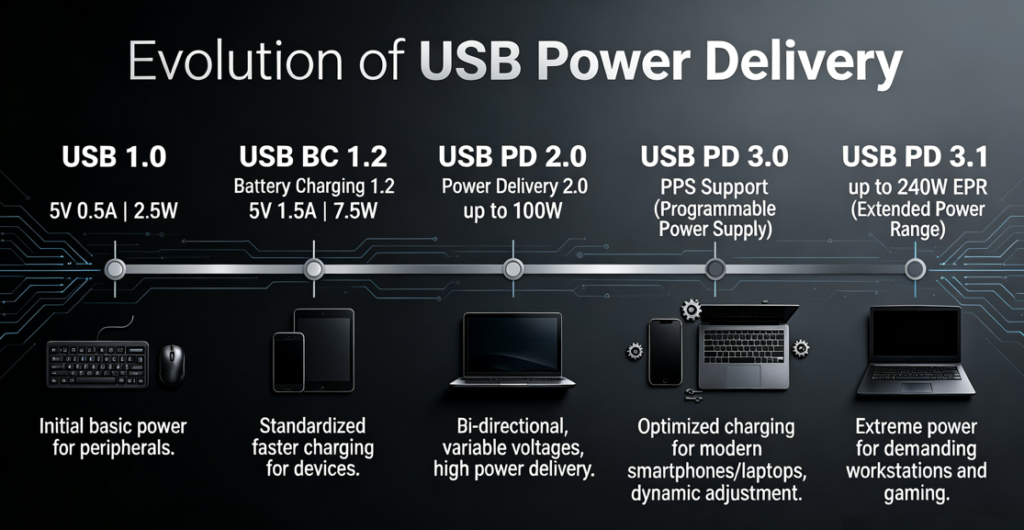
USB didn’t always have strong power capabilities. Its development falls into three main phases.
Early Days: Low-Power Auxiliary Power
In the earliest USB standards, power was just a secondary feature with very limited output.
- USB 1.0 and 2.0 delivered only 5V at 0.5A (2.5W), enough only for small accessories like mice, keyboards, and flash drives. Charging a smartphone with this was extremely slow.
- Later, the USB BC 1.2 charging specification became the first standard dedicated to charging, boosting output to 5V at 1.5A (7.5W)—enough for basic slow charging on early smartphones.
- With USB 3.0 and 3.1, data speeds improved dramatically, and power saw a small bump to 5V at 0.9A (4.5W), still firmly in the low-power range.
Breakthrough: USB PD Brings High-Power Fast Charging
What turned USB into a mainstream charging solution was the launch of the USB Power Delivery (USB PD) fast charging standard.
- Released in 2014, USB PD 2.0 supported five fixed voltage levels: 5V, 9V, 12V, 15V, and 20V, with a maximum power of 100W. This was enough to power thin and light laptops, completely breaking the idea that USB could only charge small devices.
- USB PD 3.0 arrived in 2017 with major stability improvements and added Programmable Power Supply (PPS), which allows fine-tuned voltage adjustment. This feature perfectly matches the needs of smartphone fast charging, and most universal phone fast charging today relies on this standard.
Next Level: PD 3.1 Raises the Power Ceiling
In 2021, the USB-IF released USB PD 3.1, including Extended Power Range (EPR) modes that pushed power capacity even higher.
- New 28V, 36V, and 48V voltage levels brought maximum power up to 240W. This is enough to power gaming laptops, high-performance monitors, and even small home appliances.
- At the same time, the Type-C connector became standard across phones, laptops, and tablets. This physical unification made USB power delivery a truly universal industry standard.
3. How USB Power Delivery Works, in Simple Terms
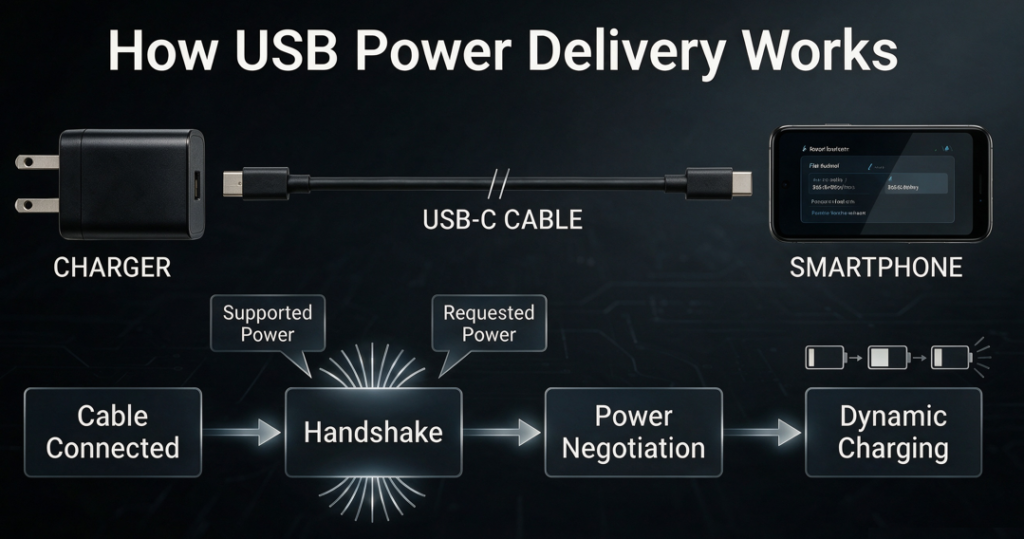
Fast charging sounds complicated, but its basic logic is easy to follow. It happens in two main steps.
Step 1: Handshake Negotiation – Talk First, Charge Later
The moment you plug in a charging cable, the charger and device don’t immediately start pumping high current. First, they perform a “handshake”.
The charger tells the device which power levels it can provide, and the device responds with how much power it needs. They settle on the highest mutually supported, safe level before charging begins. This is why legitimate chargers won’t damage your devices.
Step 2: Dynamic Power Delivery – Adjust as Needed
Once negotiation is complete, charging doesn’t stay at a fixed level. The device adjusts its current draw in real time based on its battery level.
All of this relies on the CC pin inside the Type-C connector. This tiny pin is what makes reversible plugging possible, and it also handles power negotiation and bi-directional power flow. The “reverse charging” feature works by using the CC pin to detect connection direction and switch power modes.
4. 3 Key Terms Every User Should Know
You’ll often hear three terms mentioned with USB power delivery. Understanding them will help you avoid mistakes when buying chargers and cables.
1. Programmable Power Supply (PPS): The Perfect Match for Phone Fast Charging
PPS is a feature added in PD 3.0 that allows very precise voltage adjustment.
Think of old fixed voltage levels like a faucet with only a few preset positions. PPS is like a faucet you can adjust smoothly, little by little. This reduces heat during charging and speeds up the process. Most Android phone fast charging systems today rely on PPS.
2. Extended Power Range (EPR): What 240W Power Is For
EPR is the extended power mode in the PD 3.1 standard, raising the USB power limit from 100W to 240W.
With this much power, USB ports aren’t just for phones and tablets. They can power gaming laptops, high-performance monitors, docking stations, and even small desktop appliances. In the future, a single high-power Type-C cable might handle power and data for every device on your desk.
3. E-Marker Chip: Why Some Type-C Cables Charge Faster Than Others
Many people have noticed that not all Type-C cables charge at the same speed. The key difference is whether the cable has an E-Marker chip.
This chip acts as the cable’s “ID card”, storing information about its maximum current and power capacity. Before charging, the charger reads this information. If the cable can’t handle high power, even the most powerful charger will only charge slowly. Basic Type-C cables usually handle 3A, while cables with E-Marker can support 5A or more, enabling full-speed high-power charging.
5. Clear-Up: USB Power Delivery ≠ Smartphone Fast Charging
People often confuse USB PD fast charging with branded phone fast charging, but they’re not the same. Think of them as “a common language” versus “regional dialects”.
USB PD Fast Charging: The Universal “Common Language”
USB PD is an open, industry-wide standard, like a language everyone understands.
- Advantage: Any brand of phone, laptop, or earbuds that supports PD will work with any PD charger. Compatibility is excellent.
- Limitation: As a universal standard, its peak power is generally lower than proprietary fast charging protocols from individual brands.
Proprietary Phone Fast Charging: Brand-Specific “Dialects”
Brands like Xiaomi, Huawei, OPPO, and vivo have their own proprietary fast charging protocols—like regional dialects only their own devices can understand.
- Advantage: Higher peak power and faster charging speeds. Many 100W+ super fast charging systems use proprietary protocols.
- Limitation: Poor compatibility. You need the brand’s own charger and cable to get full speed; use another brand’s charger, and you’ll only get slow charging.
The industry trend is clear: more and more phones now support universal USB PD fast charging, so even third-party PD chargers can deliver solid charging speeds.
6. Everyday Use: 3 Common Myths and Buying Tips
There are many misconceptions about USB charging. Here’s the truth, plus practical buying advice.
3 Common Myths
- Myth 1: Any Type-C charger will fast charge your device False. Type-C is just the shape of the port. Fast charging depends on whether the charger supports the PD fast charging protocol. Many early Type-C chargers only support slow 5V charging.
- Myth 2: A high-power charger will damage low-power devices False. Legitimate PD chargers always negotiate with the device first. The charger only outputs the power the device requests. For example, using a 100W PD charger to charge wireless earbuds will only deliver the low power the earbuds need, with no risk of damage.
- Myth 3: Charging speed only depends on the charger, not the cable False. Think of the cable as a water pipe. If the pipe is too narrow or doesn’t have the right components, it can’t carry a large current—no matter how powerful the charger is. High-power fast charging requires a cable with matching specifications.
Buying Guide for Everyday Users
- Choosing a charger: Prioritize reputable brands that support the USB PD protocol. Pick a wattage that fits your needs: 20–65W for phones, 65–100W for laptops. Buying a slightly higher wattage is fine, as it will be backward compatible and more versatile.
- Choosing a cable: Look for fast charging cables with an E-Marker chip. For daily use, a 5A cable will support up to 100W charging. If you have 240W devices, choose a cable rated for 240W EPR.
7. More Than Just Phones: Where USB Power Delivery Is Used
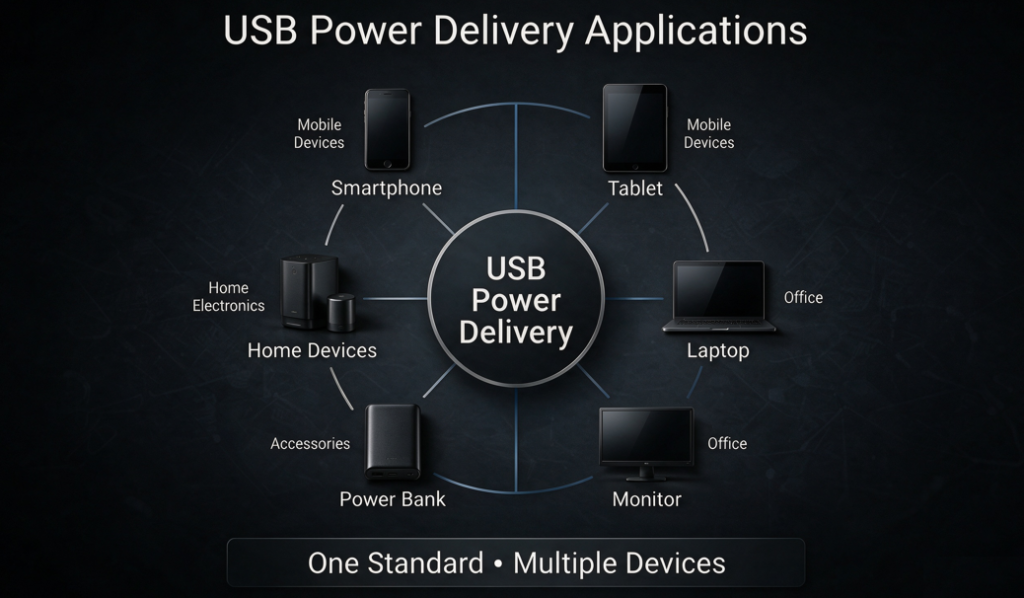
USB power delivery is everywhere in modern life, far beyond just charging phones.
- Consumer electronics: Smartphones, tablets, laptops, wireless earbuds, and power banks—almost all portable digital devices use USB power.
- Desktop peripherals: Monitors, external hard drives, and docking stations can all be powered via Type-C while transferring data. This “one-cable solution” lets you connect and power a laptop with a single cord.
- Home and lifestyle goods: Desk lamps, small fans, portable electric shavers, and mini humidifiers are increasingly using Type-C for charging, eliminating the need for piles of dedicated chargers.
- In-car use: Many new cars come with Type-C ports, which can charge phones and connect to infotainment systems for data transfer.
8. Conclusion
In short: USB power delivery is the core technical standard behind today’s global unified charging ecosystem. With one port and one cable, it delivers universal power and data transfer for everything from low-power gadgets to high-power digital devices.
Going forward, USB power delivery will continue to evolve with higher power levels and broader device support. We’ll gradually move away from the mess of having a separate charger for every device.
For everyday users, the most practical tip is this: when buying charging accessories, choose reputable products that support USB PD. They work with more devices, so you won’t have to replace your chargers every time you get a new gadget.