
Chapter 1 Introduction: Why Do We Need PPS in the Fast‑Charging Era?
Today, almost everyone relies on smartphones. Streaming videos, playing games, working, navigating — phones do more and more, and battery drains faster and faster. So “how fast does it charge” has become a concern for everyone.
A few years ago, most phone chargers were only 5W (5V/1A). Fully charging a phone took two to three hours. Then came USB BC fast charging, which improved speed but remained limited. Later, USB PD (Power Delivery) arrived, supporting higher power and significantly faster charging, while unifying the USB‑C interface — phones, tablets, and laptops could all use the same charger.
Today, phone fast charging has entered the 100‑watt era — 45W, 65W, even 100W+ fast charging is becoming common. But higher power brings more problems: phones heat up significantly during charging, battery life suffers, and chargers and phones from different brands often “don’t get along.”
Why? Traditional USB PD chargers only have a few fixed voltage levels — 5V, 9V, 15V, 20V. A charger is like a clerk who only knows a few fixed phrases — no matter what you want, it only offers those options. But a phone battery’s actual needs are constantly changing — it needs high power when low on charge, low power when nearly full, and even lower power when temperatures rise. The mismatch between fixed voltage levels and the battery’s dynamic needs forces the phone’s power management chip to do extra voltage conversion work, and these conversion losses eventually become heat.
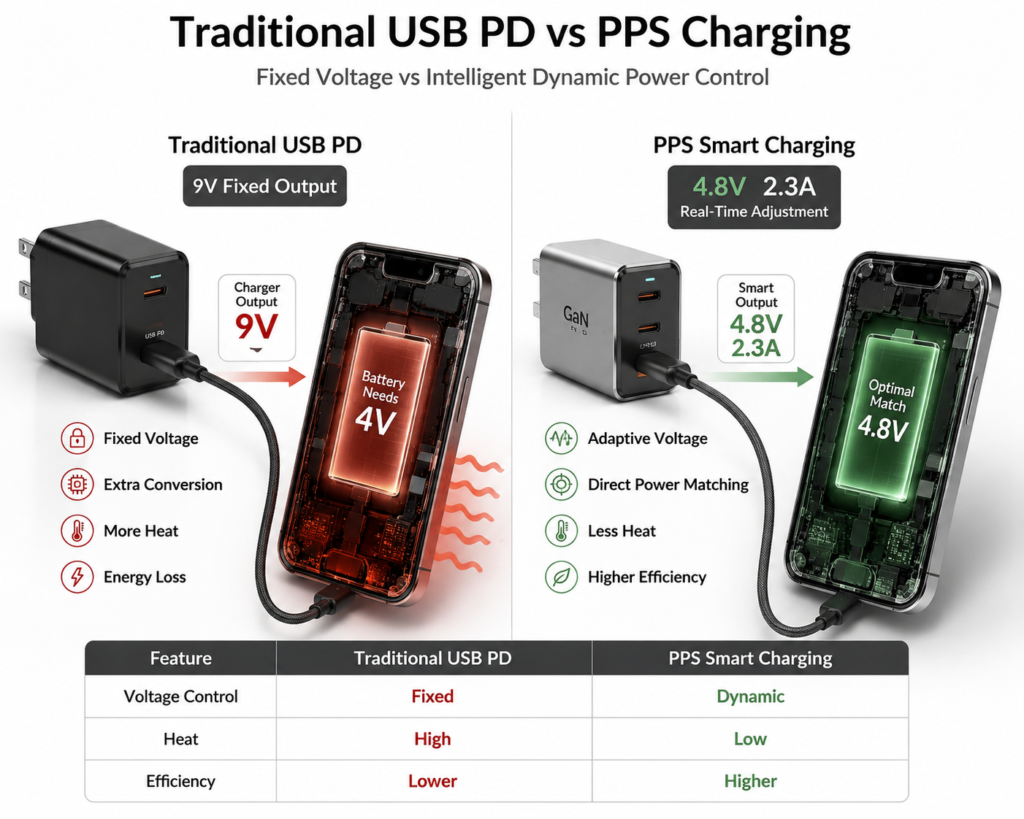
For example: the charger outputs 9V, but the phone battery only needs about 4V. What happens to the extra voltage? The phone internally steps 9V down to 4V before using it — and this process itself consumes energy and generates heat.
It was against this backdrop that in 2017, the USB‑IF (USB standard organization) officially introduced PPS (Programmable Power Supply) technology. Its core goal is simple: enable the charger to dynamically adjust output voltage and current based on the device’s real‑time needs — giving exactly what’s needed, when it’s needed.
Chapter 2 What is PPS?
PPS stands for Programmable Power Supply.
It is not an independent fast‑charging protocol, but rather an extension feature within USB PD 3.0 and later standards. Think of it this way: USB PD is the “foundational framework” responsible for basic communication and power negotiation between charger and device; PPS is the “fine‑tuning feature” built on top of that framework, making charging smarter and more precise.
So what exactly can PPS do? Here is a quick summary of its core technical specifications:
| Parameter | Specification |
|---|---|
| Voltage output range | 3.0V – 21V |
| Voltage adjustment step | 20mV (fine, nearly 900 steps) |
| Current adjustment step | 50mA |
| Maximum current | Up to 5A (depending on cable and device) |
| Communication frequency | Exchanges data with the device every 10 seconds |
With these capabilities, the charger is no longer a “clunky power tool” but has become an “intelligent power butler.”
Chapter 3 How Does PPS Work?
To understand how PPS works, you first need to know how a charger and a phone “talk” to each other.
When you plug in the charging cable, the USB‑C port’s CC pins first establish communication. The charger tells the phone: “Here are the voltages and currents I can output.” The phone replies: “Here’s what I need.” Once they agree, charging begins.
In traditional USB PD mode, the conversation is simple — the charger says “I have 5V, 9V, 15V, 20V,” and the phone picks the closest one. But in PPS mode, the conversation is much more detailed — the phone can say at any moment: “I need 4.8V at 2.3A right now.” The charger receives this and immediately adjusts to output 4.8V.
And this conversation isn’t one‑time. PPS requires the charger and device to exchange data every 10 seconds, including the battery’s current voltage, current, and temperature. Based on this real‑time information, the charger dynamically adjusts its output strategy — lowering voltage if temperatures get too high, reducing current as the battery nears full.
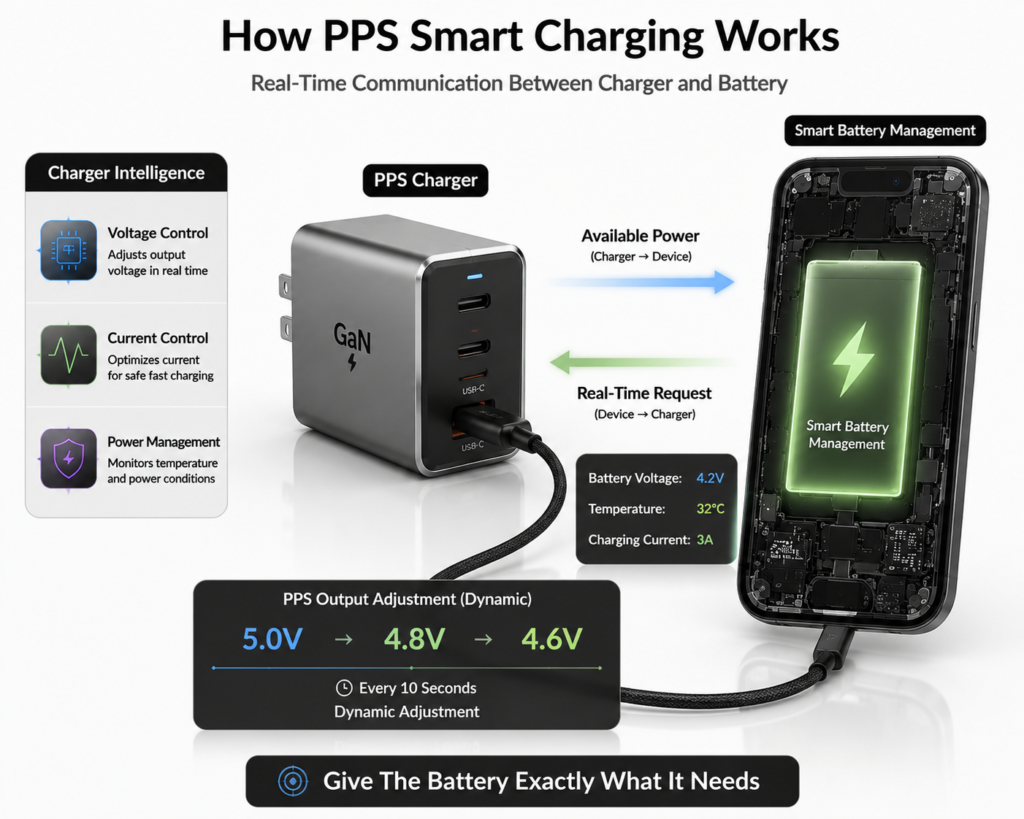
Think of it this way: traditional charging is like a fixed‑setting faucet — you turn it to the 9V setting, and it only outputs 9V, regardless of whether the cup is almost full. PPS is like a smart water pump — it constantly senses the water level and temperature in the cup, automatically adjusting the flow, giving just the right amount.
Chapter 4 The Core Advantages of PPS
First, faster charging. PPS precisely matches the optimal voltage the battery currently needs, reducing internal voltage conversion losses and delivering more power directly to the battery. Real‑world tests show that with a 25W PPS charger, a Samsung phone can go from 0 to 50% in just 26 minutes.
Second, less heat, longer battery life. In traditional fast charging, excess voltage conversion generates significant heat. Because PPS matches voltage precisely, it reduces conversion steps and significantly lowers heat generation. Lower charging temperatures mean slower battery aging and longer phone lifespan.
Third, better compatibility. PPS is an open standard, not a brand‑specific proprietary technology. One PPS‑compatible charger can fast‑charge phones from different brands — Samsung, Google, Xiaomi, Honor, Huawei, vivo, OPPO, and more. You don’t need a separate original charger for every phone.
Fourth, lower cost. Proprietary fast‑charging protocols require specially customized charging heads and cables. But PPS, as a standard feature within the PD framework, requires almost no custom parts to achieve high‑power fast charging. A PPS‑compatible phone, plus a third‑party PPS charger and a standard USB‑C 5A fast‑charging cable, can deliver high‑power charging comparable to the original charger.
Chapter 5 PPS Applications
Smartphone fast charging is PPS’s most important application. According to Charger Head, 167 mainstream phones released between 2024 and January 2026 support PPS fast charging, covering 13 major brands including Honor, Huawei, vivo, OPPO, Samsung, and Xiaomi. Samsung’s Galaxy series and Google’s Pixel series both rely heavily on PPS for fast charging. The Xiaomi 17 series and others already support 100W PPS fast charging.
Beyond phones, PPS is also used in tablets and lightweight laptops, industrial equipment for on‑demand power delivery (reducing energy consumption and extending battery life), laboratory test platforms (simulating different voltage conditions), and medical and precision electronic devices requiring stable power delivery.
Chapter 6 PPS vs. Other Fast‑Charging Technologies
To see the differences clearly, here is a comparison between traditional USB PD (with fixed PDOs) and PPS:
| Feature | Traditional USB PD (Fixed PDO) | PPS |
|---|---|---|
| Output mode | Fixed voltages (5V, 9V, 15V, 20V) | Dynamically adjustable voltage |
| Voltage adjustment | Stepwise, limited to a few levels | Continuous, fine 20mV steps |
| Conversion efficiency | Lower (more internal conversion loss) | Higher (direct matching) |
| Heat generation | Higher | Lower |
| Best suited for | Ordinary devices | High‑performance fast‑charging devices |
Compared to Qualcomm’s QC (Quick Charge): QC is Qualcomm’s proprietary protocol, mainly used on devices with Qualcomm chips; PPS is USB‑IF’s open standard, usable by any brand with broader compatibility.
Compared to OPPO’s VOOC: VOOC uses a low‑voltage, high‑current approach and is OPPO’s proprietary technology, requiring specialised cables and chargers; PPS uses dynamic voltage adjustment and is an open standard, working across brands.
Simply put: proprietary protocols are like “exclusive lanes” — only certain brands can use them; PPS is like a “highway” — anyone can get on
Chapter 7 PPS Charger Hardware
A PPS charger internally consists of roughly these components: AC input → rectification and filtering → high‑frequency switching power supply → power components → PD controller chip → PPS dynamic output → USB‑C device.
In recent years, the combination of Gallium Nitride (GaN) technology with PPS has made chargers smaller and more efficient. GaN is a new semiconductor material that operates at higher frequencies, higher efficiency, and smaller size. The combination of GaN + PD + PPS has created today’s “small size, big power” chargers.
Chapter 8 The Future of PPS
The breakthrough from 55W to 100W. In previous years, PPS’s power ceiling stayed around 55W. But with the spread of “dual‑cell series” technology in phones, battery packs can accept higher voltages, enabling PPS to leap from 55W to 100W.
USB PD 3.1 drives even higher power. The USB PD 3.1 standard introduces Extended Power Range (EPR), supporting up to 240W (48V/5A). This means future PPS chargers won’t just fast‑charge phones — they’ll also power high‑performance laptops, workstations, and even displays.
The trend of open protocols replacing proprietary ones. More and more phone manufacturers are expanding support for public fast‑charging protocols like PPS. Some argue that 2026 marks the end of the golden age of proprietary phone charging protocols. The era of “one charger for all devices” is becoming a reality.
Chapter 9 Conclusion: Why Does PPS Matter?
PPS Programmable Power Supply is not simply about increasing charging power — it fundamentally changes how USB fast charging is controlled.
Traditional fast charging is like cafeteria service — no matter how much you want to eat, the window gives you a fixed portion. PPS is like a buffet — you take exactly what you want, no more, no less.
Through 20mV fine voltage adjustments and real‑time data exchange every 10 seconds, PPS makes charging smarter, more efficient, and safer. It reduces energy waste, lowers heat generation, extends battery life, and allows devices from different brands to share the same charger.
With 100W PPS becoming mainstream and more manufacturers embracing it, the era of “one charger for all devices” is turning from an ideal into reality.