
1. Introduction
Our digital life has become extremely convenient these days. A single Type-C cable can charge smartphones, tablets, thin-and-light laptops, gaming notebooks and portable monitors at the same time. Those messy round-hole power adapters we used to pile on desks are fading out of daily use.
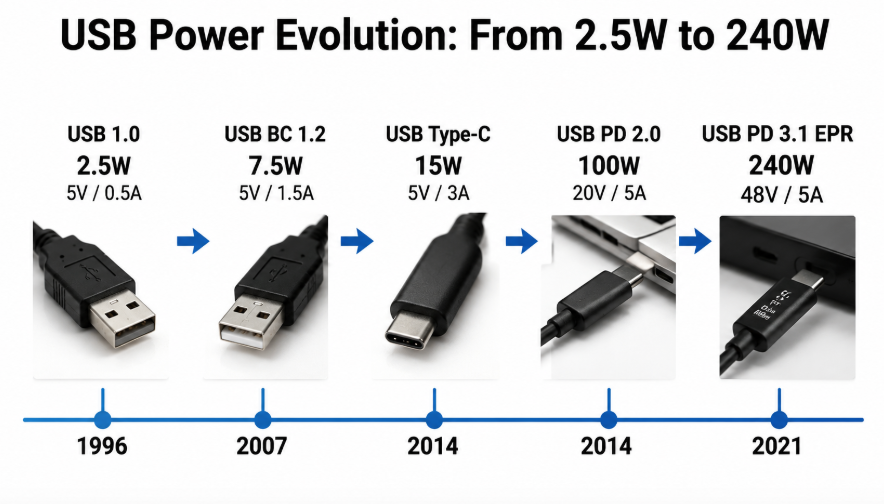
Few people know that early USB ports were far less capable. Launched in 1996, the first-generation USB only delivered a maximum power of 2.5W, enough merely for small peripherals like mice and USB flash drives. The updated USB standard released in 2021 raised the power limit to 240W, capable of powering high-performance gaming laptops, outdoor power stations and small industrial devices.
How did this simple USB port evolve from a secondary power accessory for data transfer to a global universal power transmission bus? After reading this article, you will clearly distinguish the Type-C physical interface and USB PD charging protocol, understand the basic logic of fast charging, and avoid common pitfalls of high-power charging cables and adapters.
2. Initial Stage: Low-Voltage Auxiliary Power (1996-2010 | 2.5W~7.5W)
The core feature of this period is that USB was designed primarily for data transfer, with power supply as an extra bonus. There were no unified official standards dedicated to lithium battery fast charging, and all specifications were set by the USB Implementers Forum (USB-IF).
2.1 USB 1.0/1.1 (1996): The Origin of USB Power (2.5W)
USB was originally created to unify data ports for computer peripherals, with basic auxiliary power output as an add-on function. It adopted a fixed electrical specification: 5V voltage and a maximum current of 500mA, capped at 2.5W, suitable for low-power devices such as mice, keyboards and webcams.
This standard had obvious drawbacks. The hardware locked the maximum output current without protection logic for smartphone lithium batteries. The port would cut power once overloaded, making it impossible to charge early smartphones.
2.2 USB 2.0 (2000): Faster Data Speed, Unchanged Power Output
USB 2.0 boosted data transfer speed to 480Mbps and is still widely adopted on many old devices, yet its power delivery capacity stayed exactly 2.5W, identical to the original 1996 USB standard. During this phase, USB-A and Mini-USB appeared, followed by Micro-USB which became mainstream on early Android phones.
2.3 BC 1.2 Charging Specification (2007): Industry Turning Point (7.5W)
Smartphones gained massive popularity in 2007, and the original 2.5W USB power output could not meet daily charging demands. USB-IF released BC 1.2, the first standard exclusively designed for USB battery charging.
It supported 5V and 1.5A with a peak power of 7.5W, becoming the universal charging standard for early Android devices, and for the first time enabled stable lithium battery fast charging via USB.
2.4 Stage Summary
All USB ports from 1996 to 2010 used a fixed 5V low-voltage structure. The hardware design of older ports created an inherent power ceiling. Throughout this decade, data transfer remained the core function of USB, while power supply played a secondary role.
Parameter Summary of Early Low-Speed USB Power Standards
| USB Version | Rated Voltage | Max Current | Max Power | Typical Devices |
|---|---|---|---|---|
| USB 1.0/1.1 | 5V | 0.5A | 2.5W | Mouse, Keyboard, USB Flash Drive |
| USB 2.0 | 5V | 0.5A | 2.5W | General peripherals, old media players |
| BC 1.2 (Enhanced USB2.0 Charging) | 5V | 1.5A | 7.5W | Early Android Smartphones |
| USB 3.0 | 5V | 0.9A | 4.5W | 2.5-inch Portable Hard Drive |
3. Transition Stage: Hardware Interface Breakthrough (2010-2014 | 7.5W~15W)
In this period, official USB power standards failed to keep up with consumer charging demands. The physical USB interface underwent revolutionary upgrades, while the market was flooded with incompatible private fast-charging protocols, resulting in a fragmented industrial ecosystem.
3.1 USB 3.0: Minor Power Improvement (4.5W)
USB 3.0 greatly optimized data transfer speed and slightly increased baseline power supply to 5V/0.9A (4.5W). It only supported powering portable hard drives, unable to deliver fast charging for mobile phones or supply power to laptops.
3.2 USB Type-C 1.0 (2014): Game-Changing Interface Revolution
USB-IF launched the brand-new Type-C interface in 2014, the most critical hardware upgrade in the history of USB power delivery.
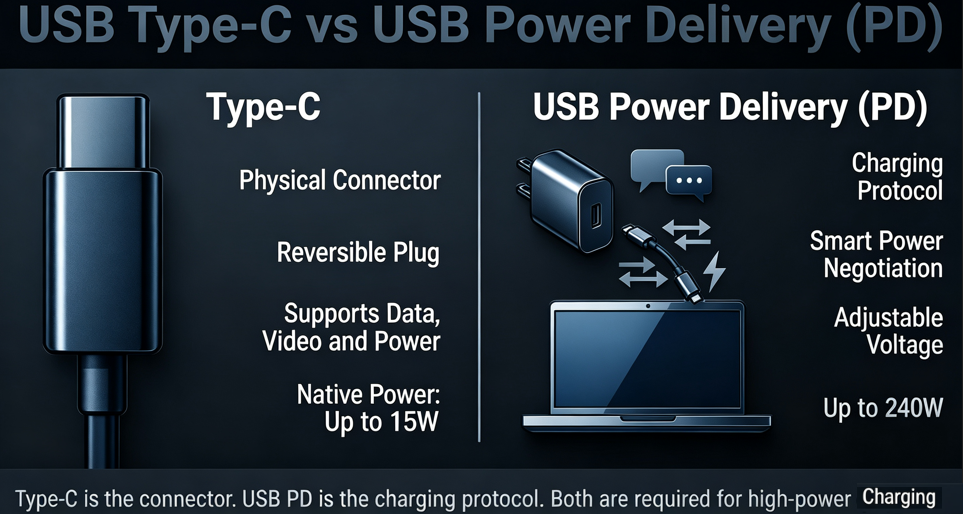
For daily use, it supports reversible plugging, features a durable casing and compact size. Its core hardware upgrade is the dedicated CC negotiation pins, which enable communication between chargers and devices to match power output.
Without activating any fast-charging protocols, the native power specification of Type-C is 5V/3A with a maximum of 15W. Simply put, Type-C removed the natural current limit of old Micro-USB ports, laying a solid hardware foundation for later 100W and 240W high-power charging.
3.3 Industry Chaos: Fragmented Private Fast-Charging Protocols
At that time, the power limit of official USB standards was too low to meet the demand for rapid phone charging. Brands including Qualcomm with QC, Xiaomi, Samsung and Huawei rolled out their exclusive closed fast-charging protocols.
The biggest downside was poor cross-brand compatibility. Original phone chargers could not deliver full-speed charging to devices from other manufacturers, forcing users to prepare multiple chargers for different gadgets.
Popular Science: Why Does Type-C Charge Faster Than Older Interfaces?
Charging speed has nothing to do with the shape of the plug. The difference lies in internal hardware. Type-C has thicker conductive pins to carry larger electric current, plus built-in CC communication pins for high-power negotiation. Micro-USB has inherent hardware limitations on current flow, so it cannot support fast high-power charging by design.
4. Breakthrough Stage: USB PD Unifies Global Standards (2014-Present | 15W→240W)
Here is the most commonly misunderstood core concept: Type-C is merely a visible physical port, while USB PD is an invisible power control protocol. To access 60W, 100W or 240W high-speed charging, both a Type-C port and USB PD protocol are mandatory.
4.1 USB PD 2.0 (2014): Standard Fast Charging Launched, Up to 100W
Released alongside the Type-C interface, USB PD 2.0 put an end to the chaos of private charging protocols as the first global universal high-power charging standard.
It includes fixed voltage levels: 5V, 9V, 15V and 20V, with a maximum rating of 20V/5A capped at 100W. It supports automatic power handshake between chargers and devices, bidirectional power transmission (laptops can charge mobile phones in reverse), and full-link safety identification and protection.
It is widely used on thin-and-light laptops, large-screen tablets and desktop docking stations.
4.2 USB PD 3.0 (2015): Mainstream Commercial Standard Compatible With Private Protocols
The 100W power ceiling remained unchanged. Its core upgrade is the PPS (Programmable Power Supply) protocol, which enables precise voltage adjustment at 20mV steps and supports most private fast-charging solutions from Qualcomm QC4+, Samsung and Xiaomi. Almost all multi-port GaN chargers available on the market adopt USB PD 3.0 as the core standard.
4.3 USB PD 3.1 (2021 Milestone): EPR Standard Unlocks 240W High Power
This historic upgrade raised the USB power ceiling from 100W to 240W, splitting the standard into two power systems:
- SPR (Standard Power Range): Retains the original 100W specification with full backward compatibility for older phones and laptops;
- EPR (Extended Power Range): The core upgrade adds high voltage levels of 28V, 36V and 48V, with a peak rating of 48V/5A capped at 240W. It supports AVS adjustable voltage regulation with 100mV steps above 15V, reducing charging heat and improving energy conversion efficiency.
A strict hardware requirement applies for 240W charging: certified EPR cables embedded with E-Marker smart chips are compulsory. Without this chip, even high-wattage chargers cannot reach full 240W output. This standard fits high-end gaming laptops, outdoor power stations, power tools and professional monitors.
4.4 USB PD 3.2 (2023 Latest Official Standard)
The maximum power of 240W under EPR stays the same, with all upgrades focusing on user experience and safety: mandatory AVS voltage regulation within the SPR range for all devices above 27W; support for short-term peak current under EPR mode to handle instant high power draw; optimized fast power role switching and arc flash protection, stricter cable voltage resistance certification, and removal of outdated redundant protocols. It is currently the optimal USB power standard for consumer and industrial equipment.
Core Parameter Comparison of All USB PD Versions
| PD Protocol Version | Max Rated Power | Core Voltage Levels | Key Features | Required Cable |
|---|---|---|---|---|
| USB PD 2.0 | 100W | 5/9/15/20V | Basic power handshake, bidirectional charging | Standard C to C / E-Marker Cable |
| USB PD 3.0 | 100W | 5/9/15/20V + PPS Regulation | Cross-protocol compatibility, default for GaN chargers | E-Marker Chip Cable |
| USB PD 3.1 | 240W (EPR) | Up to 48V High Voltage | EPR high power, precise AVS voltage adjustment | Certified EPR E-Marker Cable |
| USB PD 3.2 | 240W (EPR) | Full-range AVS Regulation | Peak current output, enhanced safety protection | Certified Dedicated EPR Cable |
5. Four Core Reasons Behind the Surge in USB Power Capacity
No complex engineering formulas needed — here are four easy-to-understand factors pushing USB power from 2.5W to 240W:
- Rising power consumption of end devices: Modern large-screen phones, high-performance gaming laptops and portable industrial equipment demand far more power than early digital gadgets;
- Global demand for unified standards: Consumers, hardware manufacturers and regional policies all aim to eliminate fragmented round-hole power supplies and private chargers, realizing universal single-cable charging;
- Mass maturity of hardware technology: E-Marker smart cables, high-voltage resistant ports and GaN power chips entered mass production with falling manufacturing costs;
- Multi-layer safety negotiation framework: Chargers and devices exchange identity information before power delivery, with four layers of hardware protection against overvoltage, overcurrent, overheating and short circuits to support stable high-voltage high-power transmission.
6. Industry Impacts, Limitations and Common User Misconceptions of 240W USB Power
6.1 Changes Brought to the Industry Chain
First, it drives upgrades across the entire digital hardware industry, boosting development of domestic PD protocol chips, E-Marker cable chips and GaN charger manufacturing.
Second, policy strongly promotes its adoption. The EU Universal Charger Regulation enforces Type-C and USB PD standards for all mobile phones, tablets and lightweight laptops, accelerating global charging standard unification.
It also delivers notable environmental benefits: cutting mass production of redundant dedicated adapters, drastically reducing global electronic waste and industrial carbon emissions.
6.2 Current Limitations of the 240W Standard
The 240W EPR standard has not yet been fully popularized. Certified dedicated EPR cables carry higher price tags. Countless unqualified cheap cables lack high-voltage tolerance, creating risks of overheating, fire or hardware burnout when used. Few desktops and large industrial machines support the 240W USB standard, and older digital hardware cannot operate under the 48V high-voltage EPR mode.
6.3 Top Three Widespread User Misconceptions
Myth 1: All Type-C ports support 240W fast charging
Fact: Port appearance does not determine power capacity. Full 240W charging requires three compatible components at once: matching charger, certified EPR cable and supported device. Basic Type-C without USB PD only delivers a slow 15W charge.
Myth 2: 240W high-power charging burns devices and damages batteries
Fact: USB PD follows a handshake-first power delivery logic. The charger only outputs the exact power required by the device. With multi-layer hardware safety protection, formal certified high-power charging is far safer than unregulated private fast-charging solutions.
Myth 3: 100W PD cables work perfectly for 240W equipment
Fact: 100W SPR cables lack high-voltage resistance for the 48V EPR mode. Using them under 240W load causes severe overheating, cable degradation and permanent damage to device ports.
7. Future Industry Development Trends
- Full interface replacement: USB-C will gradually replace laptop round DC power ports and dedicated monitor power connectors as the mainstream power supply port;
- All-in-one desktop power supply: One single Type-C cable delivers power to monitors, computer hosts, peripherals and outdoor power stations;
- Widespread high-power hardware: Multi-port 240W GaN chargers become unified desktop power hubs;
- Integrated USB4 multi-functionality: One cable handles 240W power delivery, 80Gbps high-speed data transfer and DP video output simultaneously;
- AI intelligent power management: Automatic dynamic power distribution when multiple devices charge together, with idle power reduction to improve overall energy efficiency.
8. Conclusion
We can clearly map out the complete evolution path of USB power delivery: 2.5W low-power peripheral supply → 7.5W basic smartphone charging → 15W native Type-C power supply → 100W laptop PD fast charging → 240W full-scenario power supply for high-performance devices.
Over more than 30 years, USB has completed a remarkable industrial transformation, evolving from a minor auxiliary port for data transfer into a unified global standardized power transmission bus for all digital devices. Driven by global policies and iterative hardware technology, a universal USB charging standard will cover all consumer electronics in the near future.
9. FAQ (Frequently Searched Questions)
Q1: Does every Type-C port support fast charging?
A: No. Type-C is only a physical port. Without the USB PD protocol, it only supports basic 15W slow charging.
Q2: What is the difference between USB PD and Qualcomm QC fast charging?
A: USB PD is an open, cross-device universal official standard released by USB-IF. QC is Qualcomm’s exclusive closed chip-level charging protocol. USB PD offers wider compatibility and higher industry priority.
Q3: Why can’t I charge my laptop via its Type-C port?
A: Manufacturers only enabled data and video output for this port without installing a USB PD power supply module, so charging is unavailable.
Q4: Is daily use of 240W high-power USB charging dangerous?
A: It is completely safe with officially certified accessories. Pre-charging power identification plus four layers of hardware protection eliminate risks of fire or hardware damage under normal use.
Q5: What function does the E-Marker chip serve in charging cables?
A: It acts as an exclusive ID card for high-power cables, identifying the cable’s voltage resistance and current carrying capacity to unlock permission for 100W and 240W high-power charging.