
1. What Is a TPU Jacket Cable?
1.1 Basic Definition
TPU stands for Thermoplastic Polyurethane, a high-performance polymer that blends the processability of plastic with the high elasticity of rubber.
A TPU jacket cable is a cable assembly that uses TPU as its outermost protective layer, also called the cable jacket. This outer “armor” serves three core purposes:
- Protects internal conductors, insulation, and other core components from scratches, abrasion, and physical damage
- Provides resistance to bending, oils, and environmental stress to extend the cable’s service life
- Improves grip and feel for better day-to-day usability
1.2 Where TPU Sits in a Cable Structure
In a typical shielded multi-conductor cable, the layers from inside to outside are:
- Copper Conductor: The innermost core that carries electrical current or data signals
- Insulation: Wraps around each conductor to provide electrical isolation and prevent short circuits
- Shielding: An optional layer that blocks electromagnetic interference, common in data and signal cables
- TPU Jacket: The outermost layer, which comes into direct contact with the user and the surrounding environment
Put simply, the outer surface you touch when handling a cable is the TPU jacket — it is the first line of defense against wear, oils, temperature changes, and physical damage.
2. Why Is TPU a Good Material for Cable Jackets?
2.1 Core Material Properties
What makes TPU unique is that it combines the best of two material categories:
- Rubber-like traits: Soft, highly elastic, quick to rebound after bending, and excellent at withstanding repeated flexing
- Plastic-like traits: Can be manufactured efficiently via extrusion, produces dimensionally stable parts, and is far easier to process than vulcanized rubber
This combination of flexibility and toughness makes it a popular choice for premium cables, as it delivers both a pleasant feel and strong protective performance.
2.2 Key Performance Advantages
(1) Excellent Abrasion Resistance
TPU ranks among the most abrasion-resistant common cable jacket materials. It does not easily scuff, fray, or wear through from regular rubbing and dragging.
This makes it ideal for cables that are frequently moved, such as portable charging cables, industrial machine cords, and outdoor wiring.
(2) Great Flex Endurance
TPU is highly flexible and resists cracking or whitening after thousands of bend cycles. Its flex life is far longer than that of standard plastic jackets.
For this reason, it is widely used in USB-C cables, phone chargers, and wearable device cords that get bent and coiled every day.
(3) Good Oil and Chemical Resistance
TPU withstands mineral oils, lubricants, and common mild acids and alkalis well. Unlike ordinary plastics, it does not quickly degrade or become sticky when exposed to grease.
This is why TPU jacket cables are so common in factory floors and industrial machinery environments.
(4) Reliable Low-Temperature Flexibility
Compared to traditional plastics like PVC, TPU retains much of its softness in cold conditions. It does not become stiff and brittle quickly, reducing the risk of jacket cracking in winter or cold climates.
3. How TPU Compares to Other Common Jacket Materials
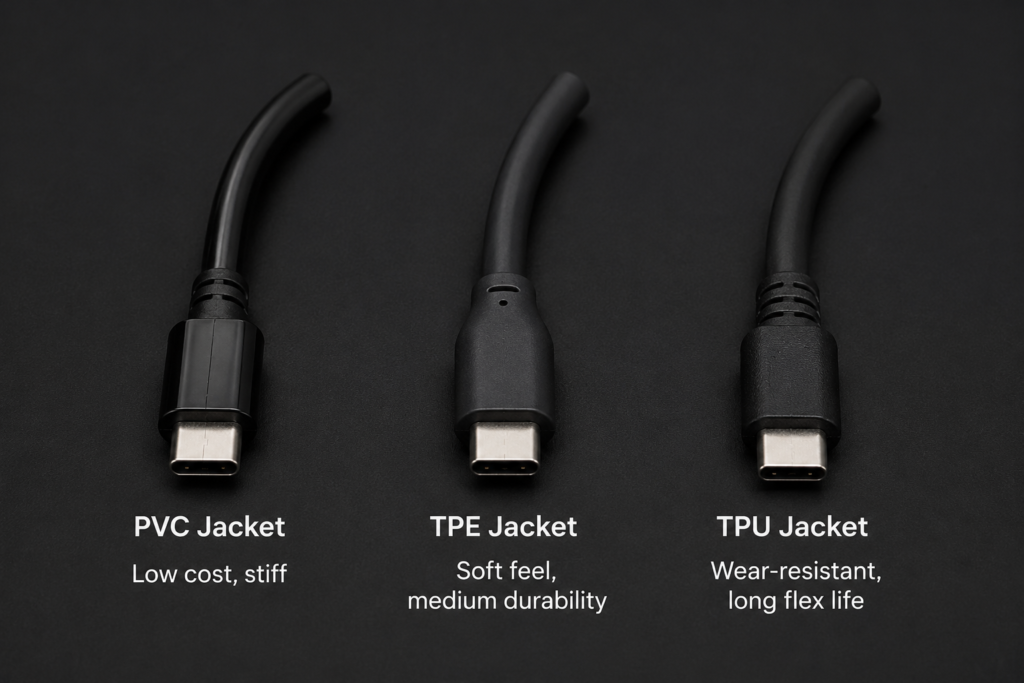
The three most widely used cable jacket materials are PVC, TPE, and TPU, each with different strengths and use cases. The table below breaks down the key differences:
| Feature | TPU Jacket | PVC Jacket | TPE Jacket |
|---|---|---|---|
| Flexibility | Good, with strong rebound | Fair, tends to feel stiff | Excellent, very soft to the touch |
| Abrasion Resistance | Excellent | Fair | Good |
| Oil Resistance | Very good | Poor | Fair, varies widely by formula |
| Feel & Texture | Firm, tough, snappy rebound | Hard, pronounced plastic feel | Soft and skin-friendly |
| Material Cost | Higher | Very low | Moderate |
| Typical Uses | Premium data cables, industrial cords, outdoor cables | Basic power cords, fixed wiring, budget cables | Consumer electronics, everyday portable chargers |
3.1 TPU vs. PVC Jacket Cables
PVC is the oldest and most widely used cable jacket material. Its main advantages are low cost and easy processing, but it falls short in abrasion resistance, low-temperature performance, and flexibility. It also releases toxic fumes when burned.
In short, PVC is the budget general-purpose option, while TPU is the durable, high-performance alternative.
3.2 TPU vs. TPE Jacket Cables
TPE is also a thermoplastic elastomer, and it often feels softer and more pleasant in hand than TPU. However, it is less resistant to abrasion, oils, and tearing, and some formulations can become oily or sticky over time.
TPU is geared toward heavy-duty, high-protection applications, while TPE prioritizes softness and comfort for everyday consumer electronics.
4. Common Applications for TPU Jacket Cables
4.1 Consumer Electronics
- USB-C Data Cables: Plugs get inserted and removed constantly, and cables get bent and coiled daily. A TPU jacket greatly improves flex life and reduces outer jacket damage.
- High-Power Fast Charging Cables: High-current cables demand long-term reliability. The tough, wear-resistant TPU jacket better protects internal structures and extends service life.
4.2 Industrial Equipment Wiring
TPU jackets are common in automation equipment cords, industrial robot cables, and sensor signal wires.
These cables move constantly with machinery, endure repeated flexing, and face oils and mechanical stress on the factory floor. TPU’s abrasion, oil, and flex resistance are perfectly suited to these harsh conditions.
4.3 Automotive and Transportation
TPU is widely used in automotive wiring harnesses, sensor cables, and on-board device connections.
The automotive environment involves constant vibration, temperature swings, and exposure to oils and fluids. TPU’s stable environmental performance ensures reliable long-term operation.
4.4 Outdoor Equipment Cables
TPU works well for outdoor lighting cords, portable outdoor gear cables, and light-duty outdoor construction wiring.
Its low-temperature tolerance and abrasion resistance hold up better to rough terrain and variable weather than standard PVC cables.
5. Limitations of TPU Jacket Cables
While TPU performs very well, it is not a universal solution. It has important limitations to consider before buying:
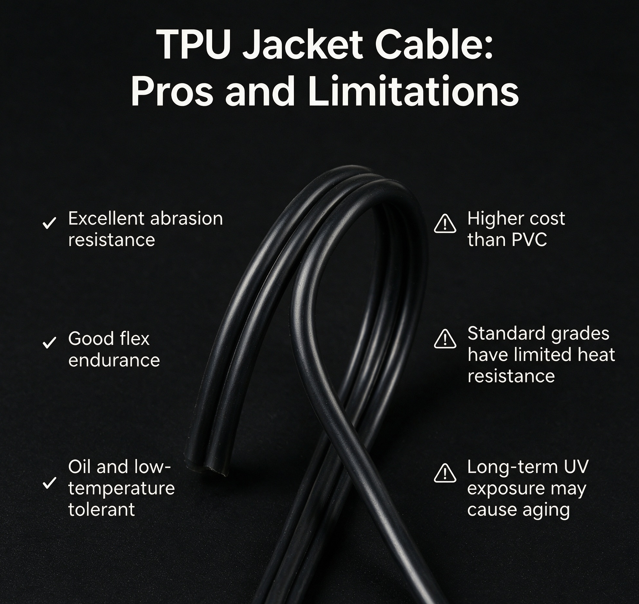
5.1 Higher Cost Than PVC
Raw TPU material is significantly more expensive than PVC, and it also places higher demands on extrusion manufacturing. This translates to a higher retail price — TPU cables typically cost noticeably more than equivalent PVC cables.
5.2 Limited Heat Resistance in Standard Grades
Heat resistance varies a lot between TPU formulations. Standard consumer-grade TPU is usually rated for continuous use at 80°C to 125°C. For extremely high-temperature industrial environments, standard TPU cables are not suitable, and specialized high-temperature materials are required.
5.3 Long-Term UV Exposure Can Speed Up Aging
Basic TPU formulations can yellow and lose mechanical performance after prolonged direct sunlight exposure. For permanent outdoor installations, you should specifically choose TPU cables formulated with UV stabilizers.
6. How to Tell If a Cable Has a TPU Jacket
6.1 Look and Feel
TPU jackets typically have a smooth, fine texture, noticeable elasticity when pressed, and quick rebound after bending. They do not easily hold permanent creases.
This is only a rough indicator, not a definitive test.
6.2 Check the Product Specifications
The most reliable way is to read the product’s technical specifications. Reputable manufacturers clearly state the jacket material, commonly labeled as TPU Jacket, TPU Cable, or Thermoplastic Polyurethane Jacket.
6.3 Don’t Judge by Feel Alone
TPE and silicone cables can also feel soft and elastic. You cannot reliably identify TPU by touch alone.
7. How to Choose the Right TPU Jacket Cable
7.1 Match It to Your Environment
- Everyday portable charging: Prioritize flexibility and flex life — a standard consumer TPU cable will work well.
- Factory or industrial use: Focus on abrasion resistance, oil resistance, and tensile strength — choose an industrial-grade TPU cable.
- Permanent outdoor use: Look for UV-stabilized TPU and check the operating temperature range.
7.2 Match It to Your Performance Needs
An important note: the jacket material only affects durability, not data speed or charging power.
Whether a cable supports USB4 speeds or high-power PD charging depends on the internal conductor gauge, shielding design, and whether it includes an E-Marker chip — not whether the jacket is TPU. Do not assume a TPU cable is automatically higher-performance.
8. Future Trends for TPU Jacket Cables
8.1 More Sustainable TPU Formulations
The industry is adopting recyclable and bio-based TPU materials that maintain performance while reducing environmental impact, in line with global sustainability and compliance trends.
8.2 Even Higher Durability
Ongoing advances in material chemistry will further improve TPU’s flex life, maximum temperature rating, and wear resistance, enabling use in even more demanding industrial and specialty applications.
8.3 Pairing With High-Performance Cable Designs
As USB4 cables, high-power USB-C chargers, and flexible industrial robot cables become more common, demand for durable jackets will grow. TPU will increasingly become the standard jacket material for premium, high-spec cables.
9. Final Summary: Who Should Choose TPU Jacket Cables?
TPU jacket cables stand out for their strong abrasion resistance, excellent flex endurance, good environmental tolerance, and long service life. They are a durable, high-performance cable solution.
They are an excellent choice for: long-lasting portable fast-charging cables, moving industrial equipment wiring, outdoor device cords, and any scenario where durability is a top priority.
They are not the best fit for: ultra-budget cables, or extremely high-temperature / highly corrosive industrial environments (these require specialized engineered materials).
All in all, if you want a cable that will hold up to years of bending, dragging, and rough use, a TPU jacket cable is a very solid choice. If you just need a cable for fixed, light-duty use, an affordable PVC cable will do the job — there’s no need to pay extra for premium materials.