
Introduction
USB-C has become the universal connector for almost everything — phones, laptops, tablets, and countless other devices. It’s fast, reversible, and capable of carrying power, data, and video through a single cable. But there’s one thing standard USB-C isn’t: tough.
If you’ve ever used a USB-C device in a workshop, on a construction site, or outdoors, you’ve probably experienced the frustration of a loose connection, a bent connector, or a port that simply stopped working after a few rough plug-ins. Standard USB-C connectors are designed for gentle indoor use — they’re not built to withstand vibration, dust, moisture, or frequent plugging and unplugging in harsh conditions.
This is where rugged USB-C connectors come in. They’re specially designed to survive the tough conditions that would quickly destroy a standard USB-C port. This guide explains what rugged USB-C connectors are, how they differ from standard ones, and what to look for when choosing one for your application.
1. What Is a Rugged USB-C Connector?
A rugged USB-C connector is a USB-C interface that has been reinforced with specialized mechanical and sealing designs. It’s not simply a standard USB-C connector with a metal shell slapped on — the differences go much deeper, into the materials, mounting methods, sealing systems, and testing standards.
These connectors are built to withstand greater insertion forces, lateral stress, continuous vibration, and environmental exposure. You’ll find them in industrial equipment, outdoor handheld devices, medical instruments, automotive applications, and rugged consumer electronics.
The core goal is simple: deliver the full functionality of USB-C while dramatically improving durability.
2. How It Differs from Standard USB-C
Housing Material
- Standard: Thin copper shell or plastic housing
- Rugged: Thickened stainless steel or zinc alloy housing
How They Attach to the Device
- Standard: The port is essentially glued and lightly soldered to the surface of the circuit board. All the force of plugging and unplugging goes straight to those tiny solder joints.
- Rugged: The connector is bolted and anchored deep into the device’s skeleton through screw anchors and positioning pegs. When you plug or unplug, the force is absorbed by solid metal anchors, not fragile solder points.
Plug/Unplug Lifespan
- Standard: Approximately 10,000 cycles
- Rugged: 20,000 to 100,000 cycles, depending on the model
Environmental Protection
- Standard: No special protection against dust or moisture
- Rugged: Optional IP65, IP67, or IP68 dust and water resistance
Vibration and Shock Resistance
- Standard: Consumer-grade — not designed for continuous vibration
- Rugged: Passes industrial-grade vibration and shock testing
Contact Design
- Standard: Standard spring contacts with thin gold plating
- Rugged: Thicker gold plating, dual-contact points, and high-elasticity materials for reliable connections
Core Advantages
- Maintains reliable connections in harsh environments
- Reduces equipment downtime and repair costs caused by port failure
- Extends the service life of devices used in industrial and outdoor applications
3. Common Applications
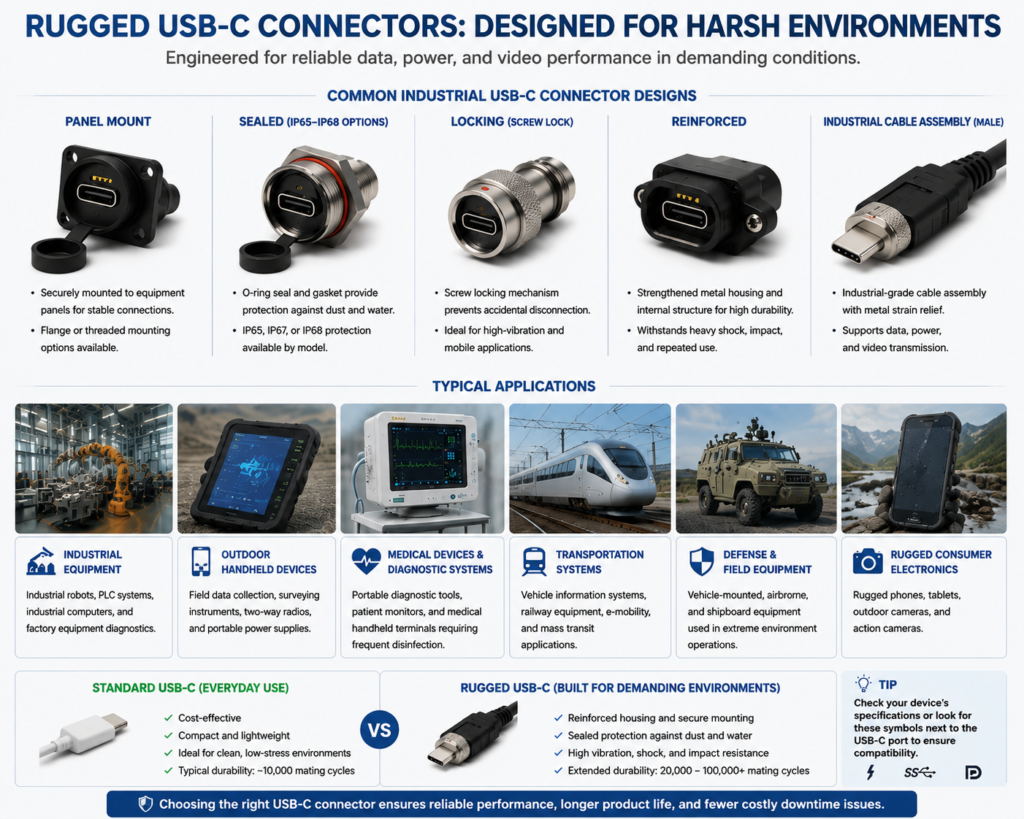
Industrial Equipment
- Industrial computers, PLC programming ports, handheld data terminals
- Production line equipment diagnostic ports
Outdoor Handheld Devices
- Surveying instruments, field data collection devices, two-way radios
- Portable power stations and outdoor power supplies
Medical Equipment
- Portable diagnostic tools, patient monitors, medical handheld terminals
- Require frequent disinfection and wiping
Transportation
- Vehicle information systems, motorcycle/bicycle electronics
- Railway and mass transit equipment
Military and Aerospace
- Vehicle-mounted, airborne, and shipboard portable equipment
- Extreme environment operations
Rugged Consumer Electronics
- Rugged smartphones and tablets
- Outdoor cameras and action cameras
4. Rugged Design Features
Housing Reinforcement
- Thickened metal housing made of stainless steel or zinc alloy
- Housing walls are 0.1-0.3mm thicker than standard connectors
- Resists crushing, deformation, and impact from drops
Anchored Mounting
This is the secret behind rugged connectors. Unlike standard ports that are simply soldered to the surface of the circuit board, rugged connectors are physically bolted into the device’s skeleton. Think of it like the difference between taping a hook to a wall and screwing it into a stud. When you plug and unplug a standard port, all that force goes to tiny solder joints that can crack over time. With a rugged connector, that same force is absorbed by solid metal anchors — screws and positioning pegs — so your circuit board never feels a thing.
Contact Reinforcement
- Thicker, more elastic contact springs
- Thicker gold plating (typically 3 to 30 microinches) for wear and corrosion resistance
- Some models use dual-contact designs for greater reliability
Center Tongue Protection
- The insulating tongue in the center uses high-strength, heat-resistant engineering plastic
- The root of the tongue is widened and thickened
- Prevents the tongue from breaking if the plug is inserted at an angle
Strain Relief
- Strain relief structures at the rear of the connector
- Reduces stress on solder joints caused by cable bending
Shielding Reinforcement
- Full 360-degree metal shielding
- Multi-layer shielding for electromagnetic interference protection
5. Sealing and Environmental Protection
Beyond mechanical reinforcement, protection against environmental factors is another key feature of rugged connectors. Below are common sealing and protection designs:
IP Ratings
- IP65: Completely dust-tight; protected against low-pressure water jets from any direction
- IP67: Completely dust-tight; protected against immersion in up to 1 meter of water for 30 minutes at room temperature
- IP68: Completely dust-tight; protected against continuous immersion under conditions specified by the manufacturer
Sealing Ring Design
- Silicone or fluororubber O-rings are embedded in the connector flange
- When installed, the O-ring is compressed against the device housing to create a watertight seal
Pin Sealing
- Sealing compound is applied between the pins and the plastic body
- Prevents water from entering the device through the pin gaps
Dust/Water Covers
- Silicone or plastic covers for use when the connector isn’t in use
- Many covers include their own sealing rings for double protection
Corrosion Protection
- Stainless steel or nickel-plated housing
- Thick gold plating on contacts for salt spray and oxidation resistance
- Suitable for coastal areas or chemically corrosive environments
6. Electrical Performance and Reliability
Plug/Unplug Lifespan
- Standard USB-C: approximately 10,000 cycles
- Rugged USB-C: 20,000 to 100,000 cycles, depending on the model
Contact Stability
- Low and stable contact resistance
- Resistance does not increase significantly after tens of thousands of cycles
- No intermittent disconnections under vibration
Current Capacity
- Supports the USB-C standard 5A high-current
- Larger contact cross-section for better current-carrying capability
- With E-Marker cables, can deliver full 100W or even 240W
High-Speed Signal Support
- Mechanical reinforcement does not affect electrical performance
- Supports USB 3.2 Gen 2, USB4, Thunderbolt, and other high-speed protocols
- Impedance control meets high-speed requirements
Insulation Performance
- Insulation resistance remains within specification even in high-temperature, high-humidity environments
- Prevents short circuits between adjacent pins
Temperature Range
- Consumer-grade rugged: -20°C to 70°C (-4°F to 158°F)
- Industrial-grade rugged: -40°C to 85°C (-40°F to 185°F)
- Military-grade: even wider temperature ranges
7. How to Care for Your Rugged Devices
A rugged connector is tough, but it still needs basic care to stay that way. Here’s what matters for everyday use:
Proper Plug/Unplug Technique
- Align the plug correctly before inserting straight in — don’t force it
- Pull straight out when unplugging, not at an angle
- For connectors with screw locks, always unscrew before unplugging
Plug Compatibility
- Standard USB-C plugs work perfectly with rugged connectors
- However, waterproof sealing requires either a matching rugged plug or the dust/water cover in place when the port isn’t in use
Cover It When Not in Use
- If your device has a dust or waterproof cover, use it when nothing is plugged in
- This keeps dirt, moisture, and debris out of the port
Keep It Clean
- Check the connector occasionally for dust, dirt, or moisture
- A quick wipe with a dry cloth is usually all it needs
- If the port is exposed to salt water or chemicals, rinse it with fresh water and dry it thoroughly
8. Common Misconceptions
Myth 1: A metal shell makes it rugged
The metal housing is just the exterior — the real differences are in the board-level mounting method, the tongue reinforcement, and the internal structure. A surface-mount connector with a metal shell is no stronger than a standard one.
Myth 2: All rugged connectors are waterproof
Waterproofing requires sealing rings, pin sealing, and proper chassis integration — it’s not automatic. Check the specific IP rating rather than assuming protection.
Myth 3: Rugged connectors can’t support high-speed data
Reinforcement is mechanical, not electrical. Rugged USB-C connectors support the same high speeds as standard ones — USB 3.2, Thunderbolt, and beyond.
Myth 4: Rugged connectors are indestructible
They offer dramatically improved durability, but they’re not unbreakable. Forced angled insertion, crushing, or severe pulling can still cause damage. Proper use and maintenance are still required.
Myth 5: Rugged connectors require rugged plugs
Standard USB-C plugs work perfectly with rugged connectors. The only exception is waterproof sealing — if you need the connector to stay waterproof while in use, you’ll need a matching rugged plug or a dust/water cover.
9. Selection and Maintenance (For Engineers & System Integrators)
While everyday users only need to worry about basic care, product designers and system integrators face a different set of challenges. If you are designing or deploying rugged equipment, here are the key criteria for selection and industrial maintenance:
Selection Criteria
- Determine the required IP rating and temperature range based on the operating environment
- Choose straight, right-angle, or recessed mounting based on available space
- Confirm protocol support (USB 2.0, 3.2, Thunderbolt) based on data requirements
- Ensure the plug/unplug lifespan meets the product’s intended service life
Routine Inspection (For Field Maintenance)
- Regularly check the connector for dust, debris, or moisture
- Inspect sealing rings for aging, deformation, or damage
- Check mounting screws for looseness (for factory-installed equipment, this is typically handled by service personnel)
Cleaning
- Use a dry cloth or compressed air to remove dust
- For connectors rated below IP67, avoid liquid cleaning
- For oxidized contacts, gently wipe with a cotton swab moistened with isopropyl alcohol
Service Life
- Assess based on plug/unplug cycles and environmental conditions
- In outdoor or corrosive environments, shorten the inspection interval
- Sealing rings should be replaced every 2-3 years as a best practice (typically by qualified service personnel)
Summary
A rugged USB-C connector is a complete engineering solution — not just a tougher-looking version of a standard USB-C port. It’s designed from the ground up to survive conditions that would quickly destroy an ordinary connector.
Key concepts to remember:
- Durability comes from the inside out — anchors, screws, and reinforced internals, not just a metal shell
- Reinforcement doesn’t compromise speed — rugged connectors support the same high-speed protocols as standard ones
- Protection is graded — IP65, IP67, and IP68 offer different levels of sealing; choose based on your actual environment
- Nothing is indestructible — even rugged connectors need proper use and regular care
- Compatibility is simple — standard USB-C plugs work just fine
Whether you’re designing industrial equipment, outdoor devices, medical instruments, or rugged consumer electronics, a rugged USB-C connector keeps your USB-C connection working when it matters most — even in conditions that would leave a standard connector broken and useless.