
If you’ve ever shopped for charging cables or data cords, you’ve probably noticed a clear difference: some feel stiff and plasticky, holding creases after bending and tangling easily in your bag; others feel surprisingly soft and flexible, bouncing back quickly after every bend. More often than not, that premium, comfortable feel comes from a silicone outer jacket.
From smartphone fast-charging cables to medical device wires, from industrial control cords to outdoor lighting lines, silicone jacket cables are showing up in more and more places. What exactly are they? How do they compare to regular PVC or TPE cables? And how do you choose and identify them as a regular user? This guide breaks it all down in plain language.
1. What Are Silicone Jacket Cables?
The Jacket Is More Than Just “Outer Skin”
Many people think a cable’s outer jacket only matters for looks and feel. In reality, it’s a cable’s first line of defense. The jacket material directly affects a cable’s flex life, temperature resistance, environmental durability, and basic safety — it is far from a cosmetic feature.
Definition of Silicone Jacket Cables
A silicone jacket cable is a cable product that uses silicone rubber as its outer protective sheath. Its core jobs are to protect the internal wire structure, resist mechanical wear and damage, and shield the inside from moisture, dust, and temperature swings.
First, let’s clear up a common confusion:
The “silicone” used in cable jackets is a flexible polymer elastomer — the same family of material as silicone baking mats or baby pacifiers. It is completely different from the granular silica gel found in desiccant packets, which is an inorganic material with an entirely different purpose.
2. The Core Material: Silicone Rubber
What Makes Silicone Rubber Special?
Silicone rubber has a molecular backbone made of alternating silicon and oxygen atoms, with organic groups attached to the sides. This semi-inorganic, semi-organic structure gives it the best of both worlds: the heat resistance and durability of inorganic materials, plus the flexibility and elasticity of organic materials.
Key Properties of Cable-Grade Silicone Rubber
- Naturally soft and elastic, bouncing back quickly after bending or squeezing with minimal permanent deformation
- Far better high and low temperature resistance than common plastic materials, with very little change in feel or performance across temperature swings
- Strong chemical stability, resisting reactions with most substances under normal conditions
- Excellent electrical insulation, making it a safe choice for power transmission
Quick Breakdown of Common Jacket Materials
Different jacket materials belong to different material families, with built-in strengths and use cases:
- PVC: A thermoplastic. Low cost and widely used, but stiff with limited temperature resistance.
- TPE: A thermoplastic elastomer. Soft and eco-friendly, with a rubber-like feel and moderate temperature resistance.
- TPU: A thermoplastic. Exceptional abrasion resistance and mechanical strength, ideal for frequent dragging.
- Silicone rubber: A thermoset elastomer. High flexibility, wide temperature range, and excellent long-term stability.
3. Inside a Silicone Jacket Cable
A silicone jacket cable is built in layers, like an onion, with each part serving a specific purpose from the inside out:
- Internal Conductors Usually made of bare copper or tinned copper, these carry power or signals. High-speed data cables include multiple pairs of signal wires plus power lines, arranged to reduce interference.
- Core Insulation Layer Every individual conductor is wrapped in its own insulation. This is the primary barrier against short circuits and electric shock. Common materials include polyethylene and cross-linked polyethylene; some high-temperature cables also use silicone for core insulation.
- Fillers and Strength Members Fillers keep the cable round and cushion the internal wires. Strength members — often high-tensile fibers like Kevlar — boost pull resistance so the cable doesn’t break internal wires when tugged.
- Shielding (Optional, on Some Models) Usually aluminum foil or braided copper mesh. Its main job is to block electromagnetic interference (EMI), keeping data transfers reliable and preventing screen glitches during charging.
- Silicone Outer Jacket The outermost layer, and the defining feature of a silicone jacket cable. It delivers the soft, pleasant feel and handles most of the environmental and mechanical protection.
4. Key Advantages of Silicone Jacket Cables
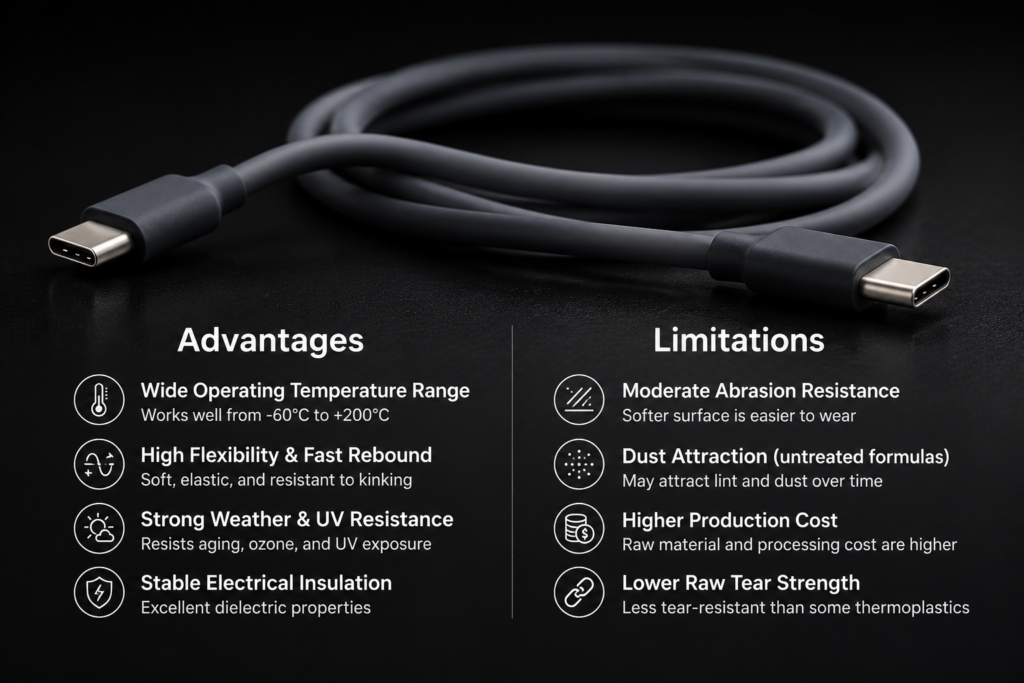
1. Exceptional Flexibility for Better Daily Use
Silicone jackets have very low bending resistance. The cables rarely knot, tangle easily less in bags, and are much more pleasant to handle on a daily basis. That soft, skin-friendly feel makes them perfect for desktop cables, phone chargers, and headphone cords you touch all day.
2. Wide Temperature Tolerance for Any Environment
This is silicone’s biggest performance advantage. General-purpose silicone jackets have a long-term working temperature range of roughly -60°C to 150°C, and high-temperature grades can handle 200°C and above.
In cold winter weather, regular PVC cables turn stiff and brittle, but silicone cables stay flexible. Near heat-generating equipment or in hot industrial settings, silicone won’t warp or degrade prematurely.
3. Flex Life and Aging Resistance for Longer Service Life
Silicone rubber has excellent elastic recovery, so it resists permanent deformation from repeated bending. It also stands up to ozone and UV light far better than regular rubber or plastic, aging much more slowly outdoors.
Real-world service life always depends on the silicone formula, internal construction, and how tight the bends are during use.
4. Stable Electrical Insulation
Silicone rubber has high resistivity and consistent dielectric strength. Its insulation performance stays reliable even in humid conditions or across temperature fluctuations, adding an extra layer of safety for power cables and industrial control wires.
5. Inert, Non-Toxic, and Eco-Friendly
Quality silicone jackets are odorless and non-toxic under normal conditions, with no harmful emissions. Special food-grade and medical-grade formulas are available to meet safety requirements for sensitive use cases.
5. Limitations of Silicone Jacket Cables
No material is perfect, and silicone has natural tradeoffs:
1. Plain Silicone Has Moderate Abrasion Resistance
Smooth, bare silicone has a relatively soft surface. It scuffs more easily than TPU when dragged across rough surfaces. For high-wear situations, choose silicone cables with a nylon braided outer layer — it dramatically improves durability.
2. Basic Grades Can Attract Dust
Untreated silicone surfaces have a slight tendency to pick up dust over time. Mid-range and premium products usually fix this with surface treatments or special coatings, so it’s rarely a noticeable issue in daily use.
3. Higher Overall Cost
Silicone rubber raw material costs more than PVC or TPE. As a thermoset material, it also requires a more complex, energy-intensive manufacturing process. For the same specifications, silicone jacket cables usually cost noticeably more than basic PVC cables.
4. Low Tear Strength on Unreinforced Jackets
On its own, silicone tears more easily than materials like TPU. For heavy-duty use, silicone cables almost always include a braided layer or internal reinforcement to prevent the jacket from splitting under stress.
6. Side-by-Side Comparison: 4 Popular Jacket Materials
Here’s how silicone stacks up against the three most common cable jacket materials across key factors:
| Feature | Silicone Jacket | PVC Jacket | TPE Jacket | TPU Jacket |
|---|---|---|---|---|
| Flexibility | High, soft with great rebound | Low, stiff feel | Moderate, slightly plasticky | Good, firm and tough |
| Long-Term Temp Rating | Excellent (150°C general grade, 200°C+ high-temp grade) | Fair (usually under 80°C) | Moderate (usually under 105°C) | Fair |
| Abrasion & Tear Resistance | Fair (weak on smooth jackets, improved with braiding) | Average | Moderate | Excellent |
| Cost Level | Higher | Low | Moderate | Moderate to high |
| Weathering & Aging | Excellent — strong UV and ozone resistance | Poor — stiffens cold, degrades in heat | Moderate | Moderate |
| Typical Uses | Premium cables, high/low temp, outdoor, medical, food equipment | Basic appliances, budget general-use cables | Mainstream consumer electronics | Heavy drag, high-wear scenarios |
7. Common Uses for Silicone Jacket Cables
Consumer Electronics
Examples: USB-C charging cables, smartphone data cords, tablet cables
Why silicone: Soft, easy to stow, and pleasant to use every day — a popular choice for premium digital accessories.
High-Power Fast Charging Cables
Examples: USB PD fast-charge cables, high-current USB-C cords
Why silicone: High-current cables are usually thicker. A silicone jacket keeps the thick cable flexible and comfortable, and handles the mild heat from high current well.
Note: A cable’s power capacity depends on its conductor size, E-Marker chip, and safety certifications — not on whether the jacket is silicone.
Medical Device Cables
Examples: Medical test equipment leads, sensor wires
Why silicone: Soft and skin-friendly, with consistent reliable performance, and available in grades that meet medical safety standards.
Industrial Equipment Cables
Examples: Automation control cables, high/low temp equipment wiring
Why silicone: Wide temperature tolerance, aging resistance, and stable electrical performance hold up well in demanding industrial environments.
Automotive and Outdoor Applications
Examples: Automotive electronics wiring, outdoor lighting cables, solar panel accessory wires
Why silicone: Heat resistance, weather resistance, and UV stability keep performance consistent through long-term outdoor exposure and temperature swings.
Food Processing Applications
Examples: Food production equipment wiring
Why silicone: Requires food-grade silicone rubber that meets standards like U.S. FDA food-contact regulations, so it won’t contaminate products.
8. How to Tell If a Cable Has a Silicone Jacket
1. Feel and Flex It (First Clue, Not Proof)
Silicone jackets typically feel soft, bend easily, and spring back quickly with a rubbery, smooth texture.
But keep in mind: feel alone isn’t definitive. High-quality TPE can also be very soft. “Soft” does not automatically mean “silicone.”
2. Check the Product Specifications (Most Reliable)
This is the most accurate method. Reputable products clearly list the jacket material in their specs. Look for these keywords: Silicone Cable, Silicone Jacket Cable, Silicone Rubber Cable.
3. Quick Secondary Checks
- Burn test (not recommended for casual use): Quality silicone rubber burns with little to no acrid black smoke, leaving behind a white ash — very different from burning plastic.
- Cold test: After spending time in a freezer, a silicone cable will stay flexible, while a PVC cable will become noticeably stiffer.
9. Buying Tips for Silicone Jacket Cables
1. Match the Material to Your Use Case
- Everyday light use: TPE, TPU, or silicone all work — pick based on preference.
- Heat, outdoor use, or frequent bending: Silicone jackets are the better choice.
- Heavy dragging or high friction: Get a braided silicone cable, or choose TPU instead.
2. Look Past the Jacket to the Internal Specs
What really determines a cable’s performance is conductor gauge, wire count, shielding, E-Marker chips, and safety certifications.
The silicone jacket only affects durability and feel. It won’t make your cable charge faster or transfer data at a higher speed. Don’t pay a premium just for the word “silicone.”
3. Look for Trusted Safety Certifications
- Electrical safety: U.S. UL certification and German VDE certification are widely recognized global safety standards.
- Environmental safety: EU RoHS compliance restricts hazardous substances.
- Special uses: Look for U.S. FDA approval for food-contact cables, and appropriate medical-grade certifications for medical use.
4. Check Basic Build Quality
A good silicone jacket should look smooth and even, with no bumps, bubbles, or color unevenness. The connector-to-cable transition should be smooth and secure, with no gaps or looseness.
10. Common Myths Debunked
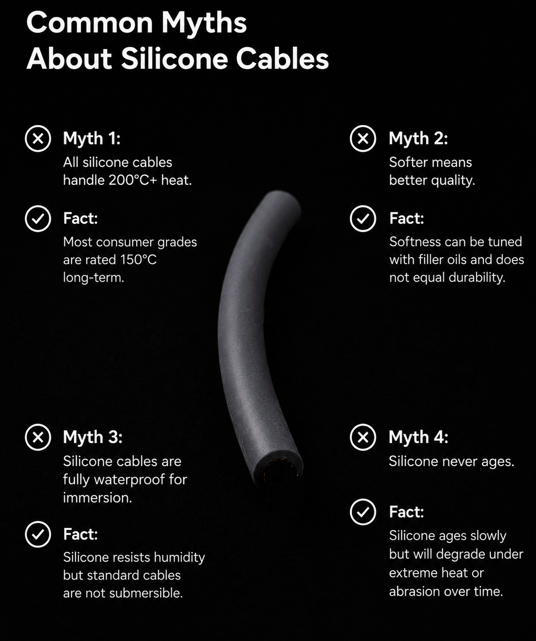
Myth: All silicone cables can handle 200°C+ heat
Fact: Temperature ratings vary widely by formula. Most consumer-grade silicone jackets are rated for 150°C long-term. Only special high-temperature formulas reach 200°C and above. Never assume all silicone cables are high-temperature rated.
Myth: The softer the silicone cable, the better the quality
Fact: Softness can be tuned by adding more filler oil to the formula. Extra oil makes a cable softer, but also reduces durability and tear strength. Softness alone is not a measure of quality — always consider certifications, materials, and construction together.
Myth: Silicone jacket cables can be submerged underwater long-term
Fact: Silicone itself resists moisture and humidity, but a regular silicone jacket cable has no full waterproof seal. It is not designed for continuous immersion. For underwater use, choose a purpose-built waterproof cable.
Myth: Silicone cables never age or wear out
Fact: Silicone ages much more slowly than regular plastic — but it does age. Long-term exposure to extreme heat, strong chemicals, or sharp abrasion will still cause cracking, stickiness, or hardening over time. Replace cables when you see these signs.
11. Final Summary: Who Should Choose Silicone Jacket Cables?
Silicone jacket cables stand out for their soft feel, wide temperature tolerance, weather resistance, and long-term reliability. They are a mid-to-premium option focused on user experience and performance, not the cheapest choice.
Silicone jackets are a great fit if:
- You use cables daily and value a comfortable, tangle-free feel
- Your cables need to work in heat, outdoors, or other demanding environments
- You prioritize long-term durability and are willing to pay for better quality
At the end of the day, if you want a cable that feels great, handles tough conditions, and lasts a long time, silicone jackets are an excellent choice. If you only need a basic cable for light, casual use and want the lowest price, regular TPE or PVC will work just fine.