
1. Introduction: The Hidden Challenge of High-Speed Signal Transmission
Limitations of Everyday High-Speed Interfaces
Common interfaces like USB, HDMI, and PCIe all share a key limitation: they only work reliably over short distances. A standard USB 3.0 cable slows down beyond 2 meters, an 8K HDMI cable may cause screen flickering past 5 meters, and long circuit board traces in servers often suffer from instability. The higher the data speed, the tighter this distance limit becomes.
Causes of Signal Attenuation, Distortion and Jitter
When high-speed electrical signals travel through copper wires or circuit board traces, they steadily lose energy — a process called attenuation, much like how sound fades as it travels through air. At the same time, high-frequency signals become distorted: clean, sharp waveforms become rounded and blurred.
Signals also develop timing inconsistencies, where data arrives slightly too early or too late. This is known as jitter, similar to a marching group falling out of step over distance. When these issues combine, the receiving end can no longer read the data correctly.
The Role and Value of Signal Repair Devices
Signal repeaters and signal retimers were created to solve exactly these problems. Placed along the signal path, both devices repair damaged signals so data can travel farther and more reliably. But they work in fundamentally different ways: one amplifies the existing signal, while the other rebuilds it from scratch. They also differ greatly in cost and ideal use cases.
2. Core Basics: Understanding Signal Integrity in Simple Terms
Key Metrics of Signal Quality
You do not need advanced math to judge if a high-speed signal is good. There are three core factors: how strong the signal is, how clean its shape stays, and how consistently it arrives on time. Together, these define what the industry calls signal integrity — whether a signal can be correctly read at the receiving end.
Common Signal Conditioning Techniques
The industry uses several basic methods to preserve signal integrity. For example, pre-emphasis boosts high-frequency parts of the signal at the source to offset later losses. Equalization amplifies weakened high-frequency signals at the receiving end. These techniques only compensate for losses up to a point. When transmission distances are too long, dedicated in-line repair devices are required.
Category Definitions: Repeaters vs. Retimers
High-speed signal repair devices fall into two main categories, ordered by repair capability:
- Signal repeaters (also called redrivers): Analog signal boosters that only compensate for signal amplitude and waveform shape.
- Signal retimers: Full-featured signal regeneration devices that not only fix waveforms but also correct timing errors, producing an entirely clean signal.
3. Signal Repeaters: Boosting Signal Strength and Extending Reach
Basic Definition and Operating Logic
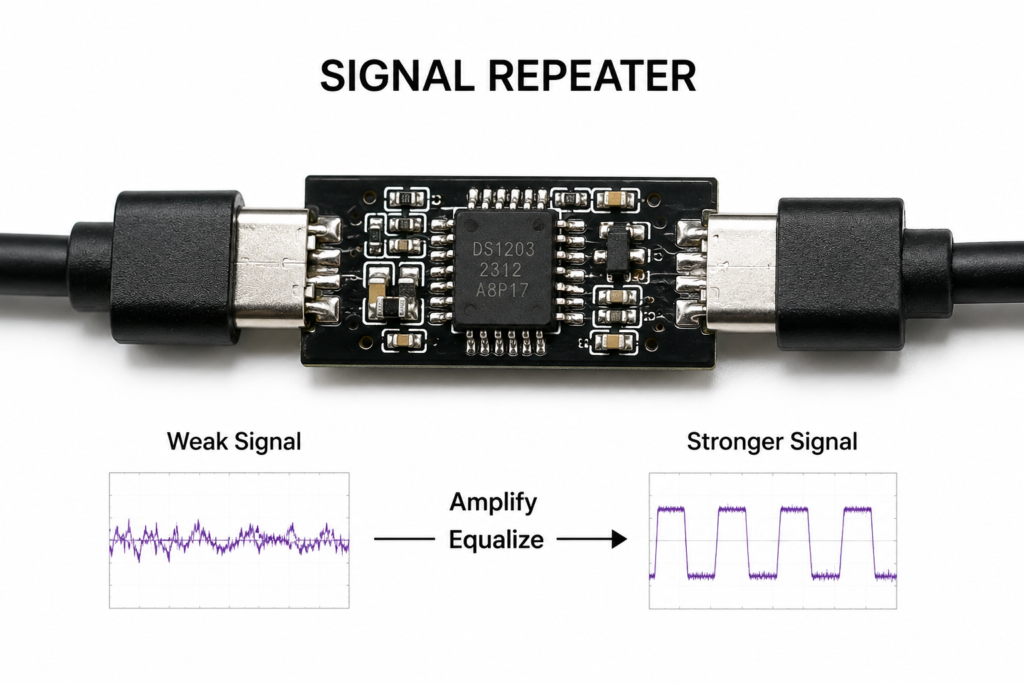
A signal repeater is the simplest type of signal booster. Its logic is straightforward: it receives a weakened signal from one end, amplifies its amplitude, partially corrects its shape, and immediately passes it on to the next segment of the line. It never reads the actual data content or changes the signal’s timing — think of it like a megaphone for electrical signals, making quiet signals loud enough to travel farther.
Core Functions and How They Work
Repeaters serve two core functions. First, signal amplification: they replace the energy lost during transmission, restoring the signal to a sufficient amplitude. Second, equalization: they reshape high-frequency parts of the signal that have been smoothed out by the cable, reducing distortion. Better repeaters also offer adjustable pre-emphasis to match cables of different lengths.
Capabilities and Inherent Limitations
Repeaters have clear limits. When they amplify the useful signal, they also amplify any line noise and jitter that came with it — they cannot remove accumulated interference. They also cannot fix timing errors, so jitter carries on down the link. For this reason, repeaters cannot be cascaded indefinitely. Adding more stages only adds more noise, until the signal eventually becomes unreadable.
4. Signal Retimers: Rebuilding Signals From Scratch
Basic Definition and Core Logic
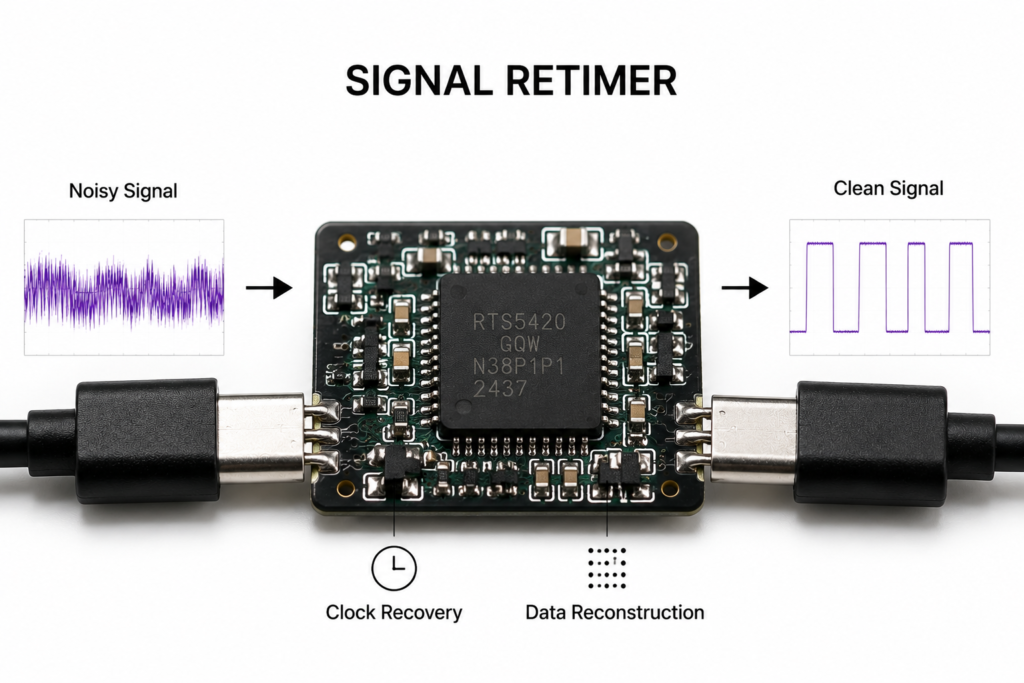
If a repeater is a megaphone, a retimer is a transcriber and a speaker. Instead of amplifying the incoming signal directly, it first reads the data content cleanly, then generates a brand-new, perfect signal timed to a precise standard and sends it onward. In effect, it creates a fresh starting point in the middle of the link. All noise and jitter from the previous cable segment are completely eliminated.
Key Technology: Clock Recovery and Signal Reconstruction
The core technology inside a retimer is Clock and Data Recovery (CDR). Put simply, it extracts a stable timing reference (clock) from the messy incoming signal, then uses that reference to sample the data and determine whether each bit is a 0 or a 1. Once all data is confirmed, it outputs a perfectly timed, clean digital signal. All jitter and noise from the incoming side are filtered out, leaving an output nearly as clean as the original source signal.
Key Advantages and Practical Requirements
The biggest advantage of retimers is that they fully reset signal quality. In theory, they can be cascaded across multiple stages to achieve extremely long transmission distances without building up noise. Most also support protocol awareness, working with standards like USB and PCIe to complete link training for better compatibility.
They do have requirements, however. They need an external reference clock, have more complex internal design, draw more power, and typically cost several times more than a repeater. They also add a fixed latency measured in nanoseconds — a delay so small it is completely unnoticeable in almost all everyday use cases.
5. Full Comparison: How Repeaters and Retimers Differ
Operating Principle and Signal Processing
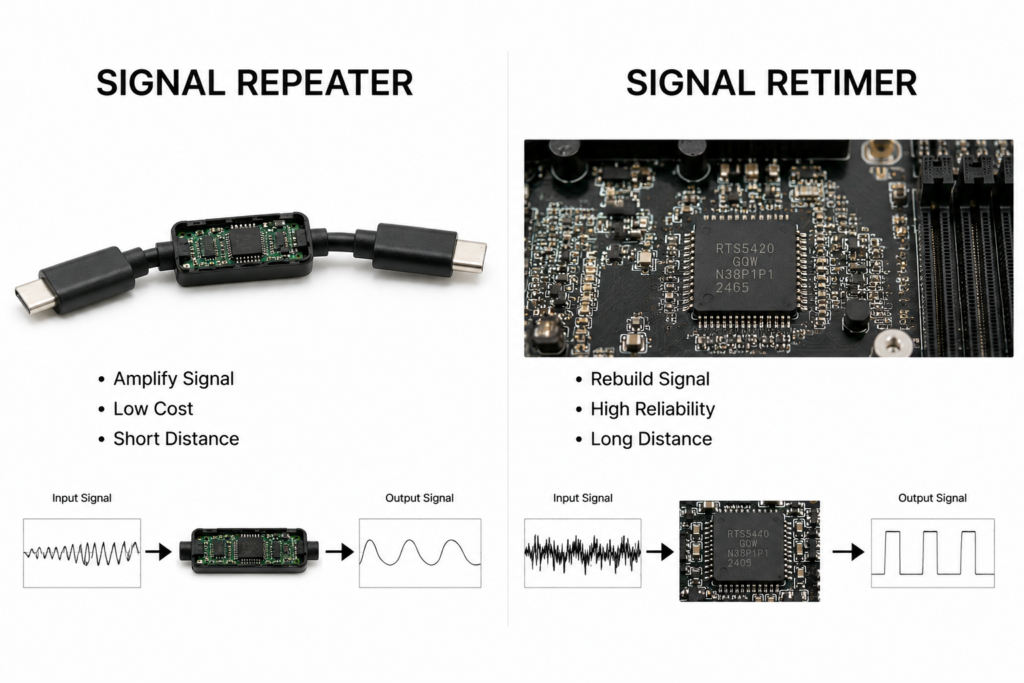
Repeaters use pure analog processing. They never decode the data, only amplify and reshape the electrical signal. Retimers use digital processing: they decode the data, recover the clock, then regenerate the signal — effectively rebuilding the data from scratch.
Jitter Reduction and Signal Repair Capability
Repeaters can only slightly improve waveform distortion. They cannot remove jitter, and actually amplify noise. Retimers completely eliminate jitter and noise from the previous link segment, producing near-original signal quality. The difference in repair capability is dramatic.
Latency, Power Consumption and Cost
Repeaters add almost no extra latency, run on very little power, and are inexpensive per chip. Retimers introduce a fixed processing delay due to clock recovery and data reconstruction, use more power, and usually cost several times more than repeaters.
Protocol Compatibility and Cascading Ability
Repeaters are completely protocol-transparent. As long as the speed matches, they work with almost any high-speed signal, but they cannot be cascaded across many stages. Retimers usually need to be certified for specific protocol standards, so they have narrower compatibility, but they can be cascaded across multiple stages to extend transmission distance.
Table 1 Core Differences Between Signal Repeaters and Retimers
| Comparison Category | Signal Repeater | Signal Retimer |
|---|---|---|
| Core Logic | Amplifies and boosts the existing signal | Rebuilds and regenerates a brand-new signal |
| Jitter Handling | Cannot eliminate jitter; accumulates over the link | Fully removes jitter; resets the jitter budget |
| Signal Repair Level | Partially corrects waveform distortion | Restores near-original signal quality |
| Processing Latency | Extremely low, almost negligible | Fixed nanosecond-scale latency |
| Power and Cost | Low power, low cost | Higher power, higher cost |
| Cascading Ability | Not recommended for multiple stages | Supports multi-stage cascading |
6. Common Real-World Applications
Consumer Electronics: USB Cables, Docks and Video Transmission
Most short USB extension cables, basic docking stations and short HDMI cables use signal repeaters — they are low cost and sufficient for the job. Longer active USB4 cables, long-distance 8K HDMI cables and high-end Thunderbolt docks almost always use signal retimers to guarantee stable high-speed performance.
PC Hardware: PCIe Expansion and High-Speed Storage
For short PCIe extension cables and M.2 drive adapters in desktop PCs, repeaters are usually enough. In workstations, high-end motherboards with long PCIe traces, and multi-drive backplanes, retimers are commonly used to maintain speed and stability.
Servers and Data Centers: Long-Haul High-Speed Backplanes
Inside servers and switches, high-speed backplane traces run long distances and pass through many connectors, causing heavy signal loss. For technologies like PCIe 5.0 and high-speed Ethernet, retimers are almost universally used to repair signals in segments and keep entire systems running reliably.
Industrial and Specialized Use Cases
Long-distance high-speed control lines in industrial equipment, and long-range video transmission for security systems, operate in harsh, high-interference environments. Because reliability is critical, these scenarios also rely heavily on the stronger interference resistance of signal retimers.
7. Selection Guide and Common Misconceptions
Three Widespread Misconceptions
First misconception: Repeaters can be cascaded infinitely to extend distance. In reality, every repeater stage adds more noise. Usually one or two stages are the practical limit; adding more will eventually break the signal entirely.
Second misconception: Retimers add so much latency that they ruin the user experience. Most retimers add only tens of nanoseconds of delay. This is completely unnoticeable for file transfers, video streaming or even gaming. It only matters in extremely specialized, precision applications.
Third misconception: Higher speeds always require a retimer. Over very short distances — for example, a few centimeters of trace on a circuit board — even very high speeds may work fine with a repeater or no device at all. Choosing a retimer blindly just wastes money.
Core Selection Factors
For most users and designers, there are three key factors to consider: transmission distance (longer distances favor retimers), data speed (higher speeds favor retimers), and budget (short, cost-sensitive setups favor repeaters).
Table 2 Selection Guide for Common Scenarios
| Use Case | Recommended Device | Key Reason |
|---|---|---|
| Short USB/HDMI cable extension (under 1m) | Signal Repeater | Short distance, low loss, lower cost |
| Long active USB4/Thunderbolt cables (2m+) | Signal Retimer | High speed, long distance, reliability required |
| Short on-board PCIe trace extension | Signal Repeater | Controllable loss, lower latency |
| Server backplanes and multi-board connections | Signal Retimer | High link loss; full signal reset needed |
| Long-haul industrial high-speed transmission | Signal Retimer | Strong interference resistance, higher stability |
Selection Guidance for Different Needs
In short: for short-distance, low-speed, cost-sensitive scenarios, a repeater is fully sufficient. For long-distance, high-speed scenarios that demand high reliability, a retimer is the better choice. There is no need to chase premium components blindly — matching your actual needs is always the optimal solution.
8. Technology Trends and Future Outlook
Evolution Driven by Faster Protocol Standards
As USB4 2.0, PCIe 6.0, 8K and even 16K video become mainstream, signal speeds keep doubling, raising the bar for signal repair. Scenarios that once worked with repeaters are gradually shifting to retimers, driving fast growth in demand for retimer chips.
Integration and Low-Power Development
Signal repair devices are becoming highly integrated. Single chips now support multiple channels and multiple protocols, while packaging keeps getting smaller. Advances in chip manufacturing also continue to cut power use, making retimers viable even in battery-powered portable devices.
Signal Repair in the Photonic-Electronic Era
More and more long-haul high-speed links will switch to optical fiber in the future, but device connectors will remain electrical. Signal repair devices will still be essential at the points where optics and electronics meet. We will see more integrated opto-electronic solutions that combine signal repair with optical conversion.
9. Conclusion
Signal repeaters and signal retimers are two very different kinds of “relay stations” for high-speed data. Repeaters are simple and affordable, ideal for short-distance, cost-sensitive jobs where basic signal boosting is enough. Retimers offer powerful, full signal restoration, suited for long-distance, high-speed scenarios that demand maximum reliability.
For most consumers, you do not need to memorize the technical details. Just remember: budget short cables and basic docks usually use repeaters, while premium long cables and high-end high-speed devices almost always use retimers. That is enough to help you understand the build quality and capabilities of the products you buy.