
Quick Summary
All electronic devices need stable direct current (DC) to work, but the electricity from your wall outlet is alternating current (AC). Linear power supplies and switching power supplies (SMPS) are the two most common technologies for converting AC to usable DC.
- Linear power supplies regulate voltage by dissipating extra energy as heat. They produce very clean output but are bulky and inefficient.
- Switching power supplies regulate voltage by rapidly switching energy on and off. They are small, lightweight, and highly efficient, but generate switching noise that must be managed.
- Neither is universally “better.” The right choice depends on your priorities: low noise and precision, or small size and energy savings.
1. What Does a Power Supply Actually Do?
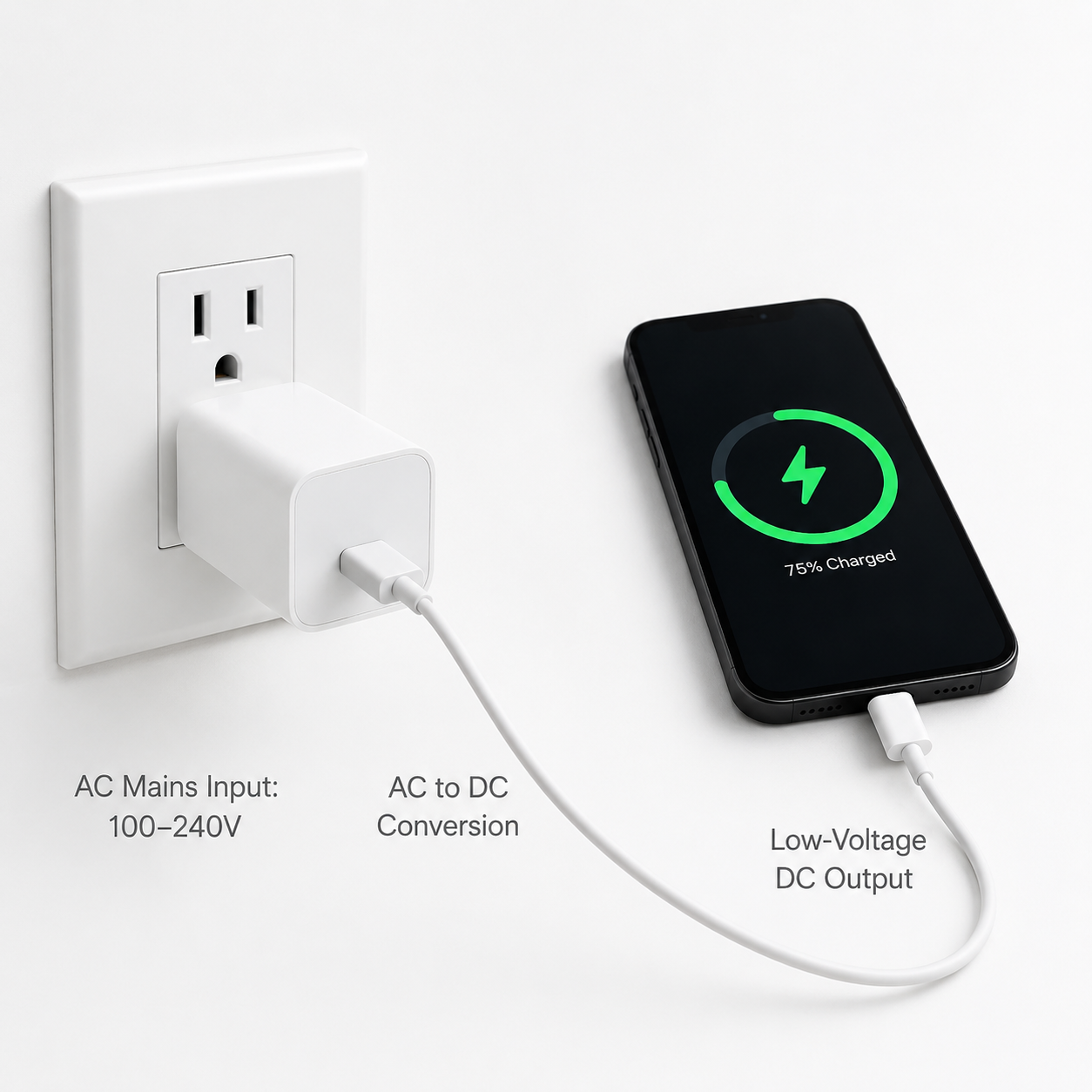
Nearly every phone, laptop, router, speaker, and sensor runs on low-voltage DC power. The electricity coming out of a standard wall outlet is 100–240V AC in most countries, which is too high and the wrong format for most electronics.
A power supply has one core job:
Convert high-voltage AC from the wall into stable, low-voltage DC that your device can safely use.
Most designs also include electrical isolation, so dangerous mains voltage never reaches the device itself.
There are two main technologies used to do this job: linear regulation and switching regulation. Both achieve the same end goal — they just use very different methods.
2. What Is a Linear Power Supply?
How It Works (Simple Analogy)
Think of a linear power supply like a precision water faucet.
Water comes in at very high pressure. The faucet narrows the flow to deliver exactly the pressure you want on the other side. All the extra energy is converted into heat, which must be removed by the regulator and heat sink.
Typical AC-input linear power supply flow:
- A heavy line-frequency transformer steps down the AC voltage
- Diode rectifier converts AC to pulsing DC
- Large capacitor smooths out the ripples
- Linear regulator circuit fine-tunes the output to a steady voltage
- Clean DC power flows to the device
The transformer works at the same 50/60 Hz frequency as your wall power, so it must be large and heavy to handle the power.
Key Advantages
- Very clean output: low ripple and low high-frequency switching noise
- Simple design: fewer components, easier to understand and repair
- Fast load response: recovers quickly when the device suddenly draws more or less power
- Proven reliability: simple architecture means fewer points of failure
Key Disadvantages
- Low efficiency: typically 30–60%. A lot of input power is wasted as heat
- Large and heavy: bulky iron-core transformer takes up most of the size and weight
- Lots of heat: requires large heat sinks to dissipate wasted energy
- Narrow input range: usually designed for one specific mains voltage
Important Note
Linear power supplies are not “obsolete old technology.” They are still the preferred choice for applications where clean, noise-free power matters more than size or efficiency.
Common Uses
- Precision laboratory test equipment and bench power supplies
- High-end audio amplifiers and headphone amps
- Sensitive low-noise analog circuits and measurement sensors
3. What Is a Switching Power Supply (SMPS)?
How It Works (Simple Analogy)
A switch-mode power supply (SMPS) works like a very fast automatic valve.
Instead of continuously restricting flow and wasting energy, it turns the power on and off tens of thousands to hundreds of thousands of times per second. It stores small packets of energy and releases them to the output in carefully controlled amounts.
Typical SMPS flow:
- Mains AC is rectified and filtered into raw high-voltage DC
- A high-speed switch turns the power on and off at high frequency
- A small high-frequency transformer steps the voltage down
- Output is rectified and filtered into smooth DC
- A feedback loop constantly adjusts the switching timing to keep voltage stable
Because the transformer operates at very high frequency, it can be dramatically smaller and lighter than a 50/60 Hz line transformer. This is the main reason modern phone chargers can be so small.
Key Advantages
- High efficiency: typically 75–95%. Very little energy is wasted as heat
- Small and lightweight: high-frequency magnetics drastically reduce size and weight
- Wide input range: many consumer models work with 100–240V AC worldwide
- High power density: delivers a lot of power in a small package
Key Disadvantages
- Output noise: high-speed switching creates ripple and switching noise, which requires filtering
- More complex design: more components, more difficult to repair or troubleshoot
- Electromagnetic interference (EMI): requires filtering and design measures to meet regulatory limits
Important Note
Modern high-quality SMPS designs use advanced filtering, shielding, and control techniques. A well-built switching power supply can deliver noise performance good enough for almost all everyday applications.
Common Uses
- Smartphone chargers and laptop power adapters
- Desktop PC ATX power supplies
- TV, router, and home appliance internal power
- USB PD fast chargers and industrial power modules
4. Side-by-Side Comparison
| Category | Linear Power Supply | Switching Power Supply (SMPS) |
|---|---|---|
| Efficiency | Low (30–60%) | High (75–95%) |
| Heat Output | High; requires large heat sinks | Low; minimal waste heat |
| Size & Weight | Large and heavy | Compact and lightweight |
| Noise & Ripple | Very low; clean output | Higher; requires filtering |
| Load Response | Fast; recovers quickly from load changes | Slower; depends on control loop |
| Circuit Complexity | Simple; fewer parts | Complex; more components |
| Input Voltage Range | Narrow; matched to transformer | Wide; many support 100–240V |
| Cost Profile | Cheaper for very low power | Cheaper for medium/high power |
| Best For | Low-noise precision devices | General-purpose and high-power use |
5. Real-World Examples You Already Know
Phone and Laptop Chargers
Almost all modern phone and laptop chargers use switching power supply technology.
- Why: small, light, energy efficient, and capable of fast charging
- You can confirm this yourself: a modern USB-C fast charger produces much less heat compared with traditional linear adapters
High-End Audio Equipment
Some professional and high-end consumer audio gear uses linear power supplies.
- Why: low noise reduces interference in sensitive analog audio circuits
- Note: many modern audio products also use well-designed SMPS with excellent noise performance
Old-Style Wall Adapters
Vintage electronics and older home appliances often came with big, heavy “brick” adapters.
- These were almost always linear power supplies
- Key clue: they feel heavy for their size and get noticeably warm during use
6. Beginner’s Guide: Which One Should You Choose?
Choose a Linear Power Supply If:
- You need extremely low noise for audio, measurement, or precision sensor work
- It is a low-power application and size/weight do not matter
- Your top priority is signal purity and stability
Choose a Switching Power Supply If:
- You need a compact, lightweight charger or power adapter
- You want high efficiency and low energy waste
- You need a single device that works with mains voltages around the world
- You are powering general consumer electronics, appliances, or high-power equipment
7. Common Myths Debunked
Myth 1: Linear power supplies are always higher quality
False. There is no universal “better” technology. Linear power supplies excel at low noise, while switching power supplies excel at efficiency and size. The right choice depends on the application.
Myth 2: Switching power supplies cause dangerous interference
False. Properly designed and certified consumer power supplies include EMI filtering and measures to control interference. They are designed to meet international safety and emissions standards and are safe for normal everyday use when properly manufactured.
Myth 3: Higher efficiency means better power quality
False. Efficiency describes how little energy is wasted as heat — it does not directly equal better output quality. Power quality depends on ripple, noise, and voltage stability, which are separate characteristics.
Final Thoughts
Linear and switching power supplies are two different tools for the same job. Linear power supplies trade size and efficiency for ultra-clean output, making them ideal for precision and audio applications. Switching power supplies trade a small amount of output noise for dramatically smaller size and higher efficiency, which is why they dominate modern consumer electronics.
For most everyday uses — phone chargers, laptops, TVs, and routers — a good-quality switching power supply is the clear practical choice. For specialized low-noise and measurement work, linear power supplies still offer unmatched performance.