
Chapter 1 Introduction: Divergent Paths of Fast Charging Technology
Many people have had this experience: a charger with the same Type-C port charges very quickly when it is the original one, but slows down noticeably when using a charger from another brand. This is not a quality issue with the charger, but a mismatch of fast charging protocols.
With the popularity of mobile devices and the continuous increase of fast charging power, two technical routes have gradually formed in the industry: universal fast charging, an open standard compatible across all brands, and private fast charging, a proprietary solution developed by manufacturers only for their own devices. Balancing speed, compatibility, safety and ecosystem has always been the core contradiction of the industry, and the coexistence of proprietary protocols and open standards has become the normal pattern in the current consumer electronics field.
Chapter 2 Definitions and Main Solutions of the Two Fast Charging Systems
2.1 Universal Fast Charging System: The Open Standard Path
Universal fast charging is formulated by industry organizations with publicly available technical specifications. Devices of all brands can access and use it, and its core advantage is openness and compatibility. Current mainstream universal standards include USB PD, PPS programmable power supply, and the China-led UFCS unified fast charging. Among them, USB PD is the most widely used standard in the world, covering various devices such as mobile phones, tablets and laptops.
2.2 Private Fast Charging System: Customized Proprietary Solutions
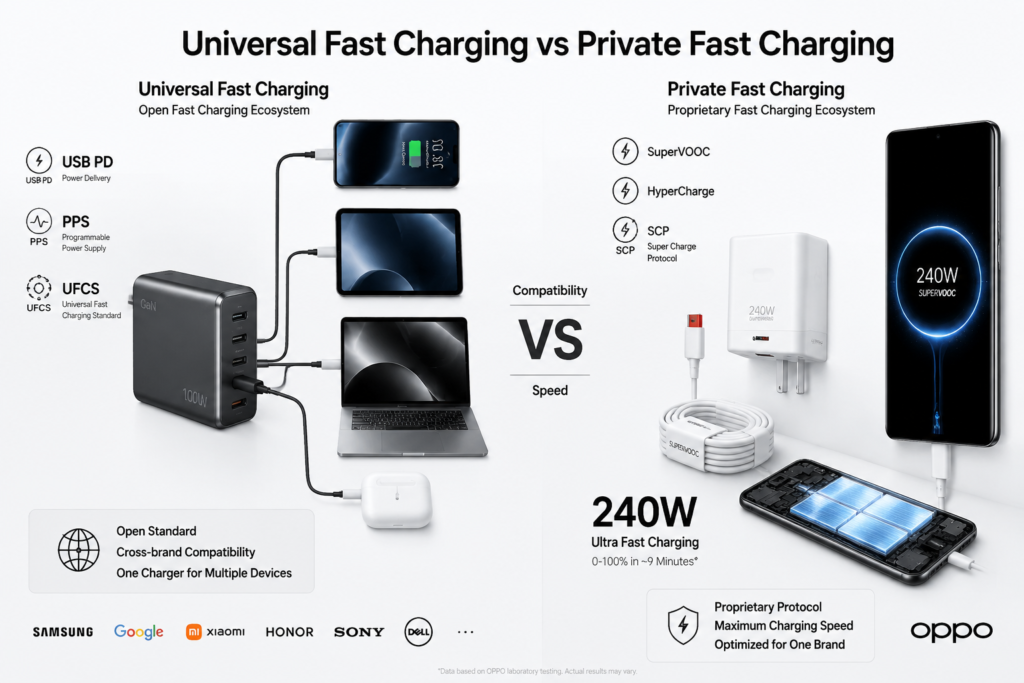
Private fast charging is a deeply customized technology developed by mobile phone manufacturers for their own devices. The protocol is not fully disclosed to the public, and the maximum charging power can only be achieved with officially certified chargers and cables. At present, major brands have their own exclusive fast charging solutions, which are mainly divided into two technical routes: low-voltage high-current solution with better heat control, and high-voltage solution with relatively lower requirements for cables.
| Type | Representative Protocol | Initiator | Typical Max Phone Power | Core Feature |
|---|---|---|---|---|
| Universal | USB PD | USB-IF | 100W (up to 240W) | Globally compatible, covers all types of electronics |
| Universal | PPS | USB-IF | 100W | Dynamic voltage/current adjustment, balances efficiency and heat control |
| Universal | UFCS | CAICT (China) | 40W (upgrading) | Cross-brand interoperability, unified domestic standard |
| Private | SuperVOOC | OPPO | 240W | Low-voltage high-current, extremely fast charging |
| Private | HyperCharge | Xiaomi | 210W | High-power solution, compatible with basic PPS |
| Private | SCP | Huawei | 100W+ | Low-voltage direct charging, excellent thermal performance |
Chapter 3 Underlying Technology: Implementation Principles and Core Differences
Before charging starts, the charger and the phone will first perform a protocol “handshake” to confirm the power levels supported by both parties. The handshake rule of universal fast charging is public and unified, while the handshake rule of private fast charging is exclusive to the manufacturer. If they do not match, it can only run at the basic charging speed.
In terms of power adjustment, universal fast charging has standardized power levels with limited adjustment range; private fast charging can make finer voltage and current adjustments for its own batteries, maintaining efficient charging throughout the process. To achieve ultra-high power, private fast charging also makes more use of technologies such as charge pumps and multi-cell batteries to reduce heat and increase speed, while universal fast charging applies these technologies more conservatively for compatibility reasons. There are also differences in hardware requirements and safety mechanisms: private fast charging requires accessories with proprietary chips with a higher degree of customized safety protection, while universal fast charging can be used as long as it meets the standard, with industry-unified basic safety mechanisms.
Chapter 4 Multi-Dimensional Comparison: Performance, Experience and Cost
From the dimensions that ordinary users care about most, private fast charging and universal fast charging have their own focuses.
| Comparison Dimension | Private Fast Charging | Universal Fast Charging |
|---|---|---|
| Charging Speed | Peak up to 240W; flagships commonly exceed 100W, fully charging in just over 10 minutes | Generally under 100W on phones; most models support 25-65W, full charge takes over 40 minutes |
| Compatibility | Full speed only for the same brand; other brands get basic slow charging | Works with all standard-compliant devices; one charger covers multiple types of devices |
| Accessory Cost | Original sets are expensive; third-party accessories rarely reach full speed | Wide third-party selection, high-quality chargers available at low cost |
| Portability | Users with multiple brands need multiple chargers, adding travel bulk | One charger covers multiple devices, more convenient for business trips |
Overall, users loyal to a single brand get better speed experience with private fast charging, while users with multiple devices get more practicality with universal fast charging.
Chapter 5 Market Landscape and Industry Ecosystem
At present, major mobile phone manufacturers have laid out their own private fast charging solutions, and take high-power fast charging as a core selling point of products to build brand ecosystem barriers. In the third-party accessory market, the universal fast charging ecosystem is the most mature, with a wide range of products covering different price ranges; there are few third-party accessories that fully support private protocols at full speed, and they are also more expensive. Upstream chip manufacturers are the technical foundation of the fast charging industry, and the popularization of GaN technology has reduced the size of high-power chargers, further promoting the popularization of universal fast charging.
Chapter 6 Policy Drivers and Industry Standardization
Fragmented fast charging standards not only trouble consumers, but also cause waste of electronic resources. Global policies are promoting the unification of charging standards. The EU mandates that portable electronic devices uniformly use the USB-C port, which directly promotes the popularization of USB PD universal fast charging and forces private protocols to be compatible with basic universal standards. China’s UFCS unified fast charging standard continues to advance, with major mobile phone manufacturers participating, aiming to achieve cross-brand fast charging interoperability. International industry organizations are also continuously updating specifications to guide the industry towards compatibility and unification.
Chapter 7 Limitations and Core Industry Pain Points
Both fast charging routes have their own limitations. The core problem of private fast charging is ecosystem closure. When users switch phone brands, the original accessories basically lose their fast charging value, which not only increases user costs but also generates electronic waste. The limitation of universal fast charging lies in its performance ceiling. In order to be compatible with all categories of devices, it cannot be deeply customized and optimized, and its peak charging speed and thermal performance are weaker than private fast charging at the same power level. Standard fragmentation is a common pain point for the entire industry. There are many types of protocols on the market, which are difficult for ordinary consumers to distinguish, and it is easy to buy mismatched accessories.
Chapter 8 Convergence Trends and Future Technology Evolution
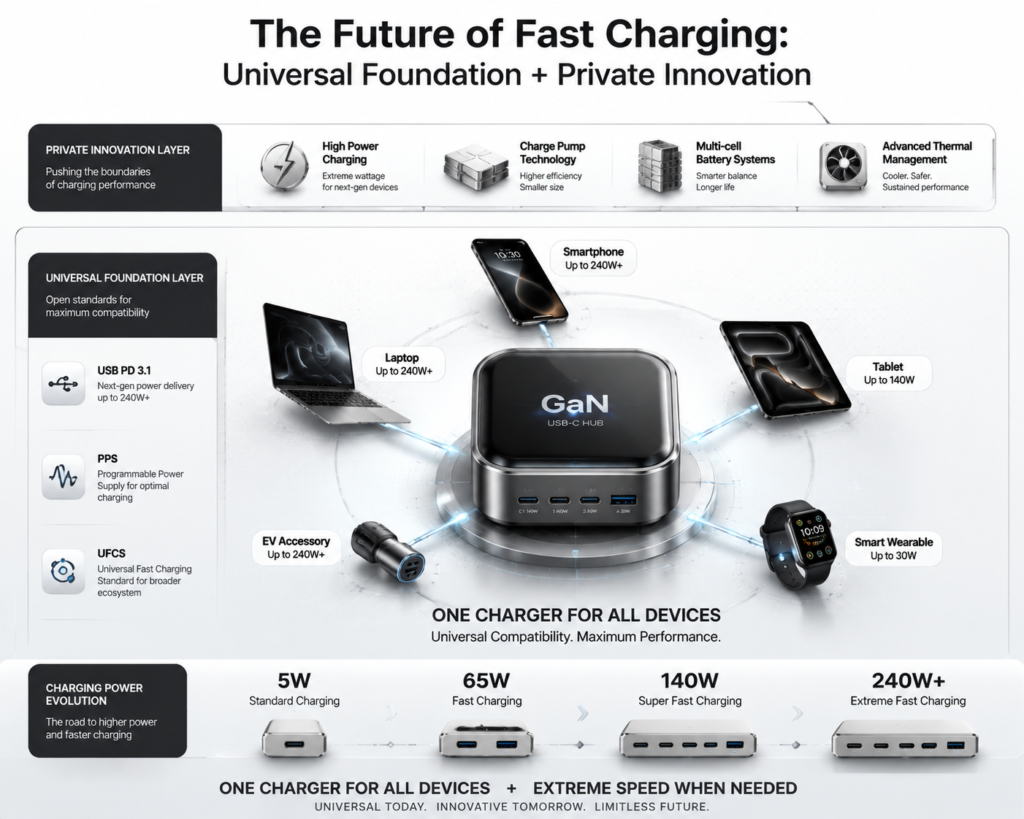
Now the industry is moving towards a convergence development model of “universal as the base, private for peak performance”. All mobile phones will be compatible with universal fast charging standards to ensure basic charging experience, while manufacturers continue to deepen their private protocols to pursue extreme charging speed in flagship products. PPS technology is an important bridge connecting the two types of fast charging. Many private protocols are custom-developed based on PPS, and their underlying technologies are gradually approaching. In the future, higher-power universal standards will gradually become popular, and new battery materials will also improve the charging experience. The two types of technologies will coexist for a long time, meeting different needs for extreme performance and universal compatibility respectively.
Chapter 9 Conclusion and Recommendations
For ordinary consumers, there is no absolutely optimal choice, just buy according to your needs. Users who use the same brand of mobile phone for a long time and pursue extreme charging speed are most suitable to choose the original private fast charging set; users with multi-brand devices and frequent business trips should give priority to chargers supporting universal protocols for higher practicality. When purchasing, don’t just look at the nominal power, confirming protocol matching is the key. From the perspective of industry development, balancing performance and openness is an inevitable direction. With the gradual unification of standards, the experience of “one charger for all devices” is gradually being realized.