
Chapter 1 Introduction: USB-C Fast Charging Enters the Era of Dynamic Power Management
1.1 The Evolution of Fast Charging Technology and Growing Power Demands
Remember charging your phone a few years ago? Plug it in, wait over an hour for a full charge. Today, many phones boast “five minutes of charging, two hours of talk time” — that’s the power of fast charging technology.
As phone screens get bigger, processors get more powerful, and 5G networks become ubiquitous, our demand for battery power is growing rapidly. Gaming, video streaming, short-form content — every activity consumes significant battery. Users are no longer satisfied with “plug it in before bed, wake up to a full charge” — they want their phone to recover most of its battery during a coffee break.
1.2 The Limitations of Traditional USB PD Fixed-Voltage Charging
Early USB PD (USB Power Delivery) charging protocols used a “fixed voltage” model. Think of it like a reservoir with only a few fixed water levels — either 5V, 9V, or 12V, with no in-between options.
A phone battery’s actual voltage is constantly changing — lower when charging begins, higher when nearly full. If the charger can only provide fixed voltage levels, it’s like having a reservoir with only a few heights while the phone needs a specific “water level” that falls between two options — you have to pick the higher one, and the phone internally steps the voltage down.
The problem lies in this “voltage conversion” step. Every conversion generates heat, and higher power means more heat. Phones are compact with limited heat dissipation — when temperatures rise, the system throttles charging speed to protect the battery. This is why many devices can only maintain “peak fast charging” for a few minutes before slowing down.
1.3 The Need for USB PD Dynamic Voltage Regulation
What’s the ideal charging method? The charger should adjust its output voltage in real-time based on the battery’s current state — whatever voltage the battery needs, the charger provides, no more and no less. This way, the phone doesn’t need to perform additional voltage conversion internally, significantly reducing heat generation and improving charging efficiency.
This “dynamic voltage regulation” philosophy is the core direction of USB PD protocol evolution.
1.4 Purpose and Technical Positioning of the PPS vs AVS Comparison
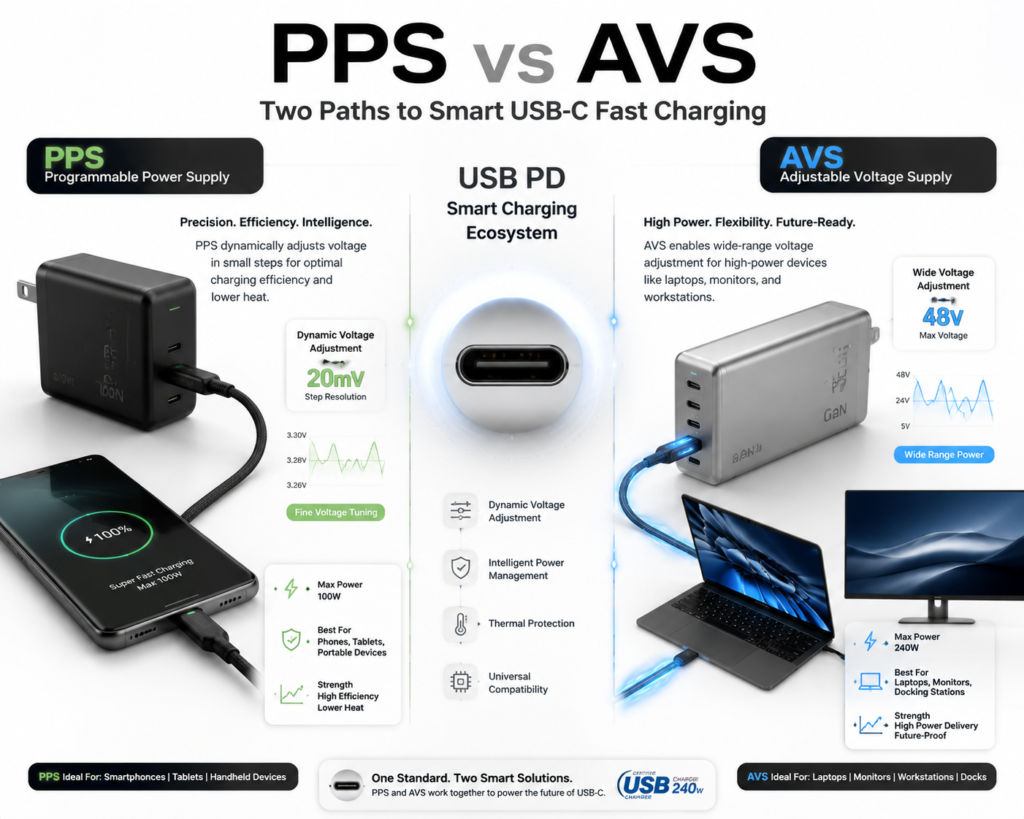
Currently, the two most mainstream dynamic voltage regulation technologies are PPS and AVS.
PPS came first and has been widely adopted in Android phones for years. AVS is a newer technology, with Apple’s iPhone 17 series being among the first to adopt it. So what’s the difference? Which is better? What should you look for when buying a charger? This article explains PPS and AVS in the most accessible way possible.
Chapter 2 USB Power Delivery Protocol Architecture and Dynamic Power Technology Evolution
2.1 The Development History of USB PD Standards
USB PD is a charging protocol standard developed by the USB-IF organization. In simple terms, it defines how a charger and a device (like a phone) should “communicate” — what voltage to provide, what current, when to stop charging.
From its earliest versions to today, the USB PD standard has undergone multiple upgrades, each addressing the same core question: how to make charging faster, safer, and more efficient.
2.2 USB PD 2.0/3.0 Fixed-Voltage Charging Architecture
In USB PD 2.0 and early 3.0 versions, chargers provided several fixed voltage levels — 5V, 9V, 12V, 15V, 20V — with a maximum power of 100W. Once the charger and device agreed on a level, the voltage remained fixed.
This model is simple and reliable, but inflexible — a phone battery’s voltage changes dynamically, meaning the phone must handle voltage matching internally, which generates heat.
2.3 USB PD 3.0 Introduces PPS Programmable Power Supply
In 2017, USB-IF officially introduced PPS (Programmable Power Supply) in the PD 3.0 standard.
PPS’s breakthrough: chargers can now continuously adjust output voltage and current within a certain range, rather than providing only fixed levels. It’s like going from “a faucet with only a few settings” to “a continuously adjustable faucet” — whatever you need, you get.
2.4 USB PD 3.1 EPR Introduces AVS Adjustable Voltage Supply
In May 2021, USB-IF released the PD 3.1 standard, raising the maximum charging power from 100W to 240W. It also introduced a new technology — AVS (Adjustable Voltage Supply).
AVS shares the same philosophy as PPS — dynamic voltage regulation. But AVS targets higher-power scenarios — laptops, monitors, and other devices that need more power.
In 2024, the USB PD 3.2 standard extended AVS capabilities to the sub-100W power range, bringing AVS to phones, tablets, and other devices.
2.5 The Position and Relationship of PPS and AVS in the USB PD Framework
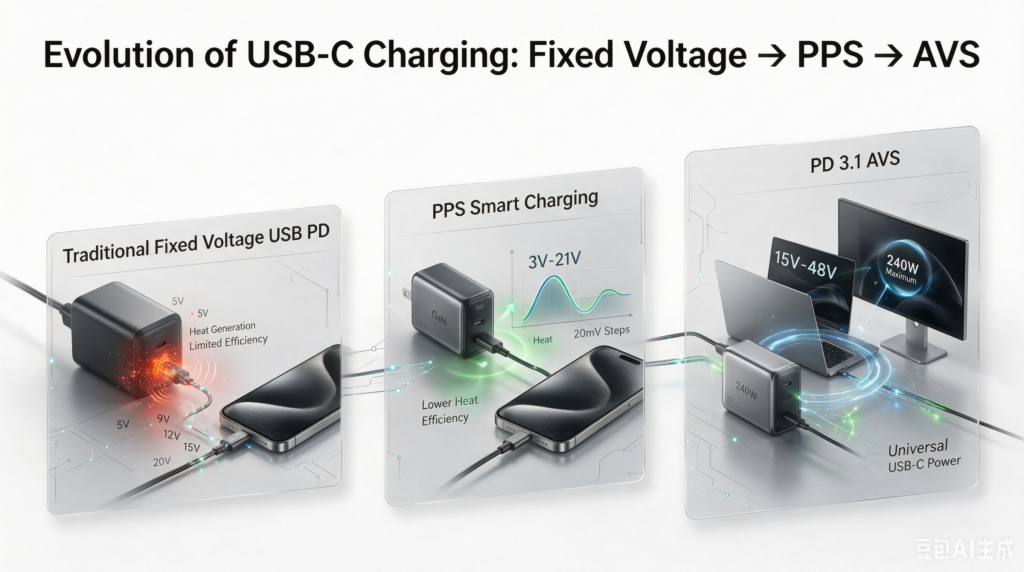
Think of PPS and AVS this way:
USB PD protocol is like a set of “charging traffic rules” that define how chargers and devices communicate.
PPS is a “feature module” added to these rules in 2017, designed for dynamic voltage regulation in small-to-medium power devices like phones.
AVS is another “feature module” added in 2021, initially for high-power devices and later extended to medium-power scenarios.
They are not replacements for each other, but two dynamic voltage regulation solutions for different power ranges and device types.
Chapter 3 PPS (Programmable Power Supply) Technical Analysis
3.1 Definition and Standard Positioning of PPS
PPS stands for Programmable Power Supply. It’s an optional feature introduced in the USB PD 3.0 standard.
“Optional” means charger manufacturers can decide whether to support PPS — it’s not mandatory. However, most mainstream fast chargers on the market today already support PPS.
3.2 PPS’s Technical Role in USB PD 3.0
PPS’s core function in one sentence: enabling chargers to adjust output voltage and current in real-time based on device needs.
Traditional fixed-voltage charging is like a “one-size-fits-all” approach — the charger delivers a fixed voltage regardless of what the device needs. PPS is like “custom-tailored” — whatever voltage the device needs, the charger provides.
3.3 How PPS Dynamic Voltage Regulation Works
PPS works like this:
The phone and charger “shake hands” and communicate via the USB-C port.
The phone tells the charger: “I need X volts and Y amps right now.”
The charger adjusts its output to precisely match the phone’s needs.
Every 10 seconds, the phone and charger renegotiate, fine-tuning parameters based on the battery’s current state.
It’s like an attentive waiter checking in every few minutes: “Still want the same? Need any adjustments?”
3.4 PPS APDO (Augmented Power Data Object) Structure Explained
This term sounds technical, but don’t worry about it. Simply put, APDO is the data format PPS uses to transmit “voltage adjustment instructions” between charger and device — it tells the charger what voltage range is available, what the maximum current is, and more.
3.5 PPS Voltage, Current Range, and Precision Characteristics
PPS has remarkably fine technical specifications:
Voltage range: 3.0V to 21V
Voltage adjustment step: 20mV (0.02V) per step
Current adjustment step: 50mA (0.05A) per step
What does 20mV mean? It’s an incredibly fine adjustment — finer than a hair’s breadth. PPS can dial in almost any exact voltage a phone battery might need.
3.6 PPS vs Traditional Fixed PDO Charging
Traditional mode (fixed PDO): Charger can only output a few fixed voltages like 5V, 9V, 12V.
PPS mode: Charger can arbitrarily adjust between 3V and 21V in 20mV steps.
Think of it this way: traditional mode is like a fan with 3 speeds — low, medium, high. PPS is like a continuously variable fan — however fast you want, you get.
3.7 Typical PPS Applications and Technical Limitations
PPS is mainly used in Android phones, tablets, power banks, and other small-to-medium power devices.
Its advantage is extremely high adjustment precision, precisely matching battery needs to reduce heat and improve efficiency.
But PPS has limitations: its maximum power is 100W, insufficient for higher-power devices like laptops. Additionally, some argue that 20mV steps are overly precise for real-world use — cable loss, contact resistance, and other factors often exceed 20mV, making such “over-precision” difficult to fully realize in practice.
Chapter 4 AVS (Adjustable Voltage Supply) Technical Analysis
4.1 Definition and Standard Positioning of AVS
AVS stands for Adjustable Voltage Supply. It’s a new feature introduced in the EPR (Extended Power Range) mode of the USB PD 3.1 standard.
Simply put: AVS is “PPS for higher power” — dynamic voltage regulation with support for much higher power levels.
4.2 AVS’s Technical Role in USB PD 3.1 EPR
PD 3.1 raised the maximum charging power from 100W to 240W. To support this power, voltage also had to increase — from a maximum of 20V to a maximum of 48V.
AVS’s role: enabling dynamic voltage regulation in high-voltage, high-power scenarios, avoiding the efficiency loss and heat issues of “fixed voltage” charging.
4.3 How AVS Dynamic Voltage Regulation Works
AVS works similarly to PPS — the device tells the charger what voltage it needs, and the charger adjusts dynamically.
But there’s a key difference: AVS does not support stepwise current adjustment. AVS only regulates voltage, with current automatically determined by power limits.
4.4 AVS and the EPR High-Power Charging Architecture
EPR (Extended Power Range) is a new mode introduced in PD 3.1.
In EPR mode, chargers can output:
Three fixed high voltages: 28V, 36V, 48V
Plus AVS dynamic regulation: adjustable ranges of 15V~28V, 15V~36V, and 15V~48V
4.5 AVS Voltage Range, Power Levels, and Adjustment Precision
AVS comes in two versions:
EPR AVS (PD 3.1, high-power version):
Voltage range: 15V~48V (three sub-ranges: 15~28V, 15~36V, 15~48V)
Voltage step: 100mV (0.1V)
Maximum power: 240W
SPR AVS (PD 3.2, standard-power version):
Voltage range: 9V~20V
Voltage step: 100mV
Power range: 27W~100W
4.6 AVS vs Traditional SPR Fixed-Voltage Mode
Traditional SPR (Standard Power Range) mode only offers fixed levels like 5V, 9V, 15V, 20V.
AVS allows continuous voltage adjustment within a range. While AVS’s step (100mV) is less fine than PPS’s (20mV), it’s more than sufficient for high-power devices.
4.7 Typical AVS Applications and Technical Limitations
AVS has broader applications than PPS:
EPR AVS: Laptops, monitors, docking stations, and other high-power devices
SPR AVS: Phones, tablets, and other medium-power devices (Apple’s iPhone 17 series is among the first to adopt it)
AVS’s limitations: less fine adjustment steps than PPS (100mV vs 20mV) and no independent current adjustment. However, these differences have minimal impact in high-power scenarios.
Chapter 5 PPS vs AVS: Core Technical Parameter Comparison
| Parameter | PPS | AVS (EPR) | AVS (SPR) |
|---|---|---|---|
| Release Date | 2017 (PD 3.0) | 2021 (PD 3.1) | 2024 (PD 3.2) |
| Voltage Range | 3.0V ~ 21V | 15V ~ 48V | 9V ~ 20V |
| Voltage Step | 20mV | 100mV | 100mV |
| Current Adjustment | Supported (50mA steps) | Not supported | Not supported |
| Max Power | 100W | 240W | 100W |
| Primary Devices | Android phones, tablets | Laptops, monitors | Phones, tablets |
The table clearly shows: PPS offers higher precision, AVS offers higher power. Each excels in different scenarios.
Chapter 6 PPS vs AVS: Working Mechanisms and System Architecture
6.1 PPS Fast Charging System Workflow
The complete PPS charging process:
Phone connects to charger; the two sides communicate via USB-C.
Phone reads the charger’s “capability list” — what voltages and currents are supported.
Phone selects the optimal voltage/current combination based on battery status.
Charger adjusts output and begins charging.
Every 10 seconds, phone and charger renegotiate, fine-tuning parameters as battery voltage changes.
The entire process is like an ongoing conversation: “I need this much now.” “OK, adjusted.” “Now I need a little less.” “OK, adjusted again.”
6.2 AVS High-Power Charging System Workflow
AVS works similarly to PPS, but for higher-power scenarios.
The difference: AVS only negotiates voltage; current is automatically determined by power limits. For example, in a 140W charging scenario, the device tells the charger “I need 28V,” and the charger automatically outputs 5A (28V × 5A = 140W).
6.3 PPS and Phone PMIC (Power Management IC) Coordination
PPS’s brilliance: it moves the “voltage conversion” heat source from inside the phone to the charger.
In traditional charging, the phone’s PMIC must step down the charger’s high voltage to the battery’s low voltage — a process that generates significant heat.
In PPS mode, the charger directly outputs the exact voltage the battery needs, and the phone’s PMIC does almost no voltage conversion. Less heat means faster, more sustained charging.
6.4 AVS and Laptop Power Conversion System Coordination
Laptops require much more power than phones — often 60W, 100W, or more.
AVS enables chargers to directly output the voltage a laptop system needs (e.g., 20V, 28V), reducing internal voltage conversion losses. For high-power devices, even a few percentage points of efficiency improvement translate to significant battery savings and heat reduction.
6.5 Impact of Both Technologies on Charger Design
Both PPS and AVS impose higher requirements on chargers:
More complex control chips capable of responding to real-time voltage adjustment requests.
Better thermal design, as dynamic regulation itself generates heat.
Support for wider output voltage ranges — from 3V to 48V.
6.6 GaN Power Devices in PPS and AVS Applications
GaN (Gallium Nitride) chargers have become increasingly popular in recent years. GaN is a new semiconductor material that offers higher efficiency, smaller size, and lower heat than traditional silicon.
The popularization of GaN technology allows chargers to support complex features like PPS and AVS while remaining compact. This is why many 65W and 100W chargers today are no larger than traditional 18W chargers.
Chapter 7 PPS vs AVS: Charging Efficiency and Performance Comparison
7.1 Voltage Conversion Path Differences
This is one of the core differences between PPS and AVS:
Traditional charging: Charger outputs fixed high voltage → Phone internally steps down → Battery
PPS/AVS charging: Charger directly outputs battery’s required voltage → Battery
The latter eliminates the “internal voltage step-down” step, reducing energy loss and heat generation.
7.2 Energy Loss and Conversion Efficiency Comparison
Every voltage conversion incurs energy loss, typically released as heat.
Both PPS and AVS shift voltage conversion from the device to the charger. Chargers have much better heat dissipation than phones — larger size, ventilation holes, even fans. So performing voltage conversion in the charger is significantly more efficient than doing it in the phone.
7.3 Heat Control and Temperature Rise Comparison
Heat is the biggest enemy of fast charging — when temperatures rise, the system throttles.
PPS and AVS significantly reduce heat generation during charging by minimizing internal voltage conversion in the phone. This means phones can charge at higher power for longer periods, rather than “fast for a few minutes then slow down.”
7.4 Battery Charging Curve Adaptation Differences
Battery charging typically has several phases:
Constant current phase: When battery voltage is low, charge with constant high current for rapid charging.
Constant voltage phase: When battery is nearly full, trickle charge with constant low voltage.
PPS’s 20mV fine steps allow the charger to precisely match battery needs at every phase. AVS’s 100mV steps, while less fine than PPS, are sufficient for high-power devices.
7.5 High-Power Output Stability Analysis
Voltage stability is critical during high-power output — voltage fluctuations can damage devices.
AVS was specifically designed with high-power scenario stability in mind. While PPS has finer steps, some argue its “power cliff” phenomenon (sudden power drops at low voltages) makes it less suitable for high-power scenarios compared to AVS.
Chapter 8 PPS vs AVS: Device Compatibility and Application Scenarios
8.1 PPS in Smartphone Fast Charging
PPS is currently the mainstream standard for Android phone fast charging.
Fast charging technologies from Samsung, Xiaomi, OPPO, vivo, and other major brands are largely based on PPS. If you buy a PPS-compatible charger, you can fast-charge most Android phones on the market.
8.2 PPS and Charge Pump Architecture Integration
Charge Pump is an internal power conversion technology that enables efficient voltage conversion in extremely compact spaces.
Many Android phones combine PPS with Charge Pump: the charger uses PPS to output a voltage slightly higher than the battery, and the phone’s internal Charge Pump performs the final efficient step-down. This combination leverages both PPS’s flexible voltage adjustment and Charge Pump’s high efficiency.
8.3 PPS in Tablets, Power Banks, and Other Devices
Beyond phones, many tablets and power banks also support PPS fast charging. This means you can use one PPS charger to fast-charge your phone, tablet, and power bank — one charger for all your devices.
8.4 AVS in Laptop USB-C Charging
Laptops are one of AVS’s primary application scenarios.
Traditional laptops typically require proprietary power adapters — bulky, heavy, and only compatible with that specific laptop. With AVS, a single AVS-compatible USB-C charger can power multiple laptop models, greatly improving charger versatility.
8.5 AVS in Monitors, Docking Stations, and High-Power Devices
Beyond laptops, AVS can also power:
Monitors: USB-C power delivery to monitors, which can reversely charge connected laptops.
Docking stations: A single USB-C connection that powers the laptop while connecting multiple peripherals.
Other high-power devices: Drones, power tools, and more.
8.6 Why Different Devices Choose PPS or AVS
| Device Type | Preferred Technology | Reason |
|---|---|---|
| Android phones | PPS | Mature ecosystem, high precision, ideal for low-voltage high-current direct charging |
| iPhone 17 series | AVS (SPR) | Apple’s chosen technology path |
| Laptops | AVS (EPR) | Requires higher power (>100W) |
| Tablets | Either | Depends on specific product and power requirements |
| Monitors/Docking stations | AVS (EPR) | Requires high-power delivery |
Chapter 9 PPS vs AVS: Advantages, Limitations, and Future Trends
9.1 PPS Advantages and Limitations
Advantages:
Extremely high adjustment precision (20mV steps)
Supports both voltage and current fine adjustment
Mature Android ecosystem with broad device compatibility
Ideal for low-voltage high-current direct charging with excellent heat control
Limitations:
Maximum 100W power, insufficient for high-power devices
20mV steps may be overly precise for real-world use
“Optional” feature in USB PD standard, not mandatory
9.2 AVS Advantages and Limitations
Advantages:
Supports up to 240W power
Covers devices from phones to laptops
Mandatory requirement for chargers above 27W in PD 3.2
More stable constant-current output logic
Limitations:
Less fine voltage steps than PPS (100mV vs 20mV)
No independent current adjustment
Ecosystem still developing (Apple took the lead in adoption, other manufacturers following)
9.3 Do PPS and AVS Replace Each Other?
No, they do not replace each other.
PPS and AVS target different power ranges and device types. PPS focuses on sub-100W devices like phones and tablets; AVS focuses on above-100W devices like laptops, while also covering sub-100W through SPR AVS.
They are more like relay partners rather than substitutes — PPS for lower power, AVS for higher power, with partial overlap yet respective focuses.
9.4 The Complementary Relationship of PPS and AVS in the USB PD Ecosystem
PPS and AVS together form the complete USB PD dynamic voltage regulation picture:
PPS: Fine regulation, ideal for precision-sensitive low-voltage scenarios.
AVS: Wide-range regulation, ideal for power-demanding high-voltage scenarios.
A well-designed USB PD charger should support both PPS and AVS to cover all devices from phones to laptops.
9.5 The Trend Toward USB-C Universal Charging Standards
USB-C is becoming the “one port for everything” universal standard.
Phones, tablets, laptops, monitors, headphones, gaming consoles — more and more devices are adopting USB-C charging. PPS and AVS make USB-C not just “universal” but also “fast” — different devices with different power needs can all get optimal charging from the same charger.
9.6 Future Directions in Dynamic Power Management
Future dynamic power management technologies will evolve toward:
Higher power: 240W may not be the end point; higher power standards will likely emerge.
Smarter regulation: AI-based charging strategies that optimize charging curves based on user habits.
Broader compatibility: One charger for all devices, eliminating the “box of chargers” problem.
Higher efficiency: Reducing energy waste, lowering heat, extending device lifespan.
Chapter 10 Conclusion: PPS and AVS Drive USB PD into the Smart Power Era
10.1 PPS Drives High-Efficiency Fast Charging for Mobile Devices
PPS moved phone fast charging from “fixed levels” to “precision regulation”. 20mV fine steps enable chargers to precisely match battery needs in real-time, significantly reducing heat during charging and improving efficiency.
Today, PPS has become the de facto standard for Android phone fast charging. Whether you use Samsung, Xiaomi, or any other brand, a PPS-compatible charger delivers fast, cool charging.
10.2 AVS Propels USB-C into the High-Power Charging Era
AVS upgrades USB-C from a “phone charging port” to a “universal power port”.
With up to 240W of power, it can power laptops, monitors, and even some small appliances. Apple’s iPhone 17 series being among the first to adopt AVS serves as powerful validation of this technology.
10.3 PPS and AVS Together Complete the USB PD Dynamic Power Ecosystem
PPS and AVS are not rivals — they are teammates.
PPS handles fine-tuned regulation for small-to-medium power devices, while AVS provides broad coverage for high-power devices. Together, they build a complete dynamic power ecosystem spanning from 3V to 48V and from a few watts to 240 watts.
In the future, when you pick up a USB-C charger, whether you’re charging a phone, tablet, or laptop, it will automatically identify, match, and adjust — giving you the fastest, safest, and most efficient charging experience. That’s the future PPS and AVS are building together.