
1. The Tier System Behind Fast Charging Power Upgrades
If you’ve followed charging technology over the years, you’ve likely noticed how quickly power ratings have advanced. What started as 10W standard charging has grown to 240W ultra-fast charging in today’s devices. As power levels rise, industry standards have also evolved, with SPR and EPR emerging as the two core categories.
Many people wonder: why split fast charging into two separate standards? Wouldn’t a single specification be simpler?
In reality, defining SPR and EPR makes fast charging more unified and safer. It matches power levels to the actual needs of different devices, prevents market chaos from conflicting specs, and ensures cross-brand compatibility. By the end of this article, you’ll clearly understand three key points: what SPR and EPR are, how their charging processes differ, and how to choose the right accessories for daily use.
2. Background: USB PD and the Origin of Power Tiers
Before diving into SPR and EPR, we first need to cover a foundational concept: the USB PD protocol.
Think of USB PD as the universal language of global fast charging. Before it became widespread, every brand used its own proprietary fast charging standard. Your phone charger might not fast-charge your tablet, and your laptop power adapter might not speed up your phone. This wasted accessories and created safety risks. USB PD is a globally accepted fast charging standard — as long as both the charger and device “speak” this language, fast charging works properly.
From PD 2.0 to PD 3.0, the protocol steadily improved compatibility and safety. Then, with the release of PD 3.1, the standard officially split fast charging power into two distinct tiers: SPR and EPR.
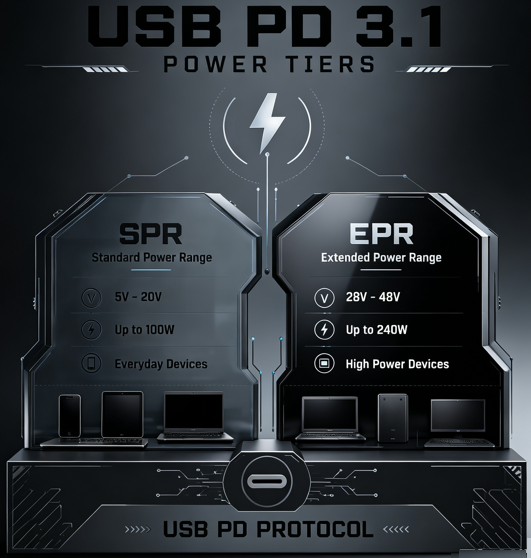
At its core, this power tier system balances charging speed with safety and compatibility. Low-power devices don’t need high voltage and current; they run safely on the basic tier. High-power devices need stronger delivery, so they use the extended tier. The two tiers work independently while maintaining backward compatibility, avoiding specification chaos.
3. SPR: The Widespread Standard Power Range
SPR stands for Standard Power Range. It is the fast charging tier we encounter most often in daily life.
Its core specifications are straightforward: it includes five fixed voltage levels — 5V, 9V, 12V, 15V and 20V — with a maximum current of 5A. This adds up to a peak power of 100W (20V × 5A). Like the basic gears in a car, these levels cover nearly all everyday usage scenarios.
To activate SPR fast charging, three hardware requirements must be met:
- Charger: Simply needs to support the USB PD protocol
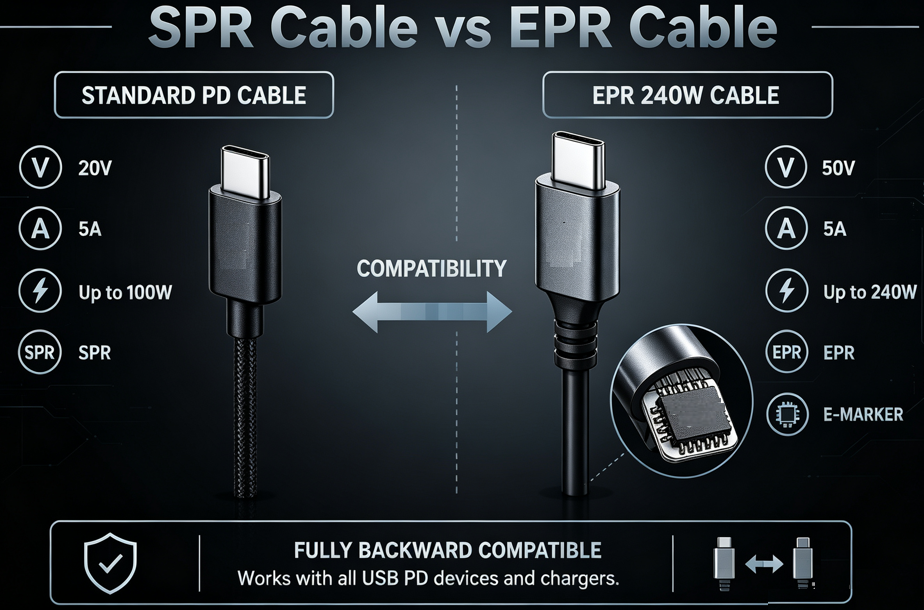
- Cable: Must be a 5A cable with an E-Marker chip
- Device: Must have a built-in PD protocol receiver chip
The E-Marker chip acts as the cable’s electronic ID. It actively tells the charger how much current it can safely carry, preventing the cable from overheating due to overload.
SPR covers an extremely wide range of use cases: smartphones, tablets, wireless chargers, thin-and-light laptops, portable monitors — nearly all common consumer digital devices fall within SPR’s scope. Simply put, almost all PD fast charging under 100W uses the SPR standard.
4. EPR: The Extended Power Range Beyond 100W
EPR stands for Extended Power Range. It is a new standard created to break through the 100W power limit.
As digital devices grow more powerful, their power consumption rises too. For products like gaming laptops and high-performance monitors, 100W is no longer enough to run at full capacity. This is where the EPR standard comes in.
On top of SPR’s five base voltage levels, EPR adds three higher voltage tiers: 28V, 36V and 48V, corresponding to power levels of 140W, 180W and 240W respectively. Notably, EPR still uses a maximum current of 5A. It increases total power by raising voltage instead of making cables thicker and bulkier, balancing convenience and safety.
The hardware requirements for EPR are far stricter than SPR — all three conditions must be satisfied:
- Charger: Must have official EPR certification
- Cable: 240W EPR-specific cable with a dedicated E-Marker chip
- Device: Equipped with a high-voltage EPR receiver circuit
If any component fails to meet the standard, charging automatically drops to the SPR tier instead of forcing high-voltage output.
EPR is designed primarily for high-power device scenarios, such as gaming laptops, mobile workstations, all-in-one PCs and high-power monitors. Beyond that, small home appliances, power tools and portable power stations can also use EPR for high-power unified charging.
5. How They Work: The Charging Negotiation Process
Many people worry: will a high-power charger damage my low-power device? There’s no need for concern. Fast charging never delivers full power immediately. Instead, it follows a two-way negotiation system: handshake first, power later.
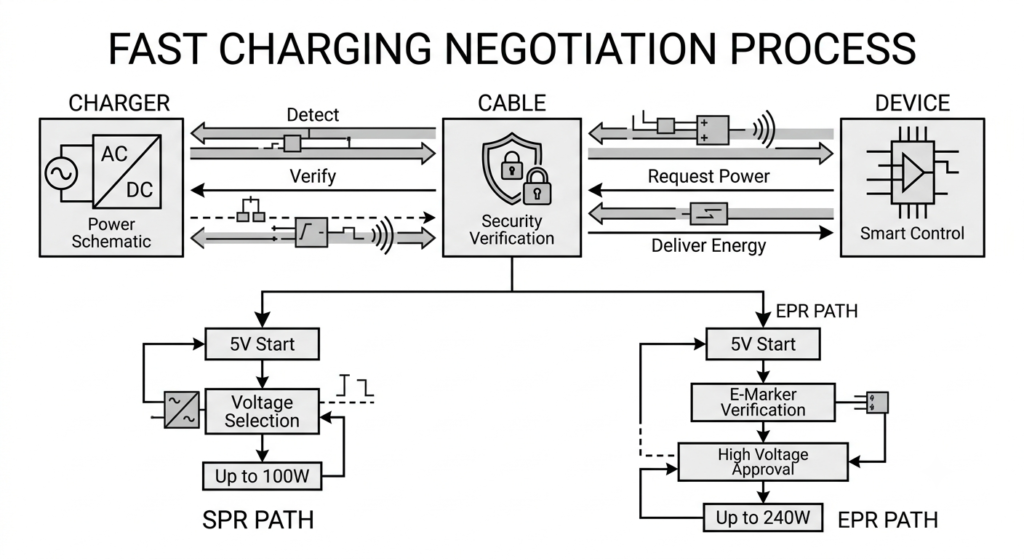
Here’s a simple analogy: the charger is a restaurant, the device is a customer, and the cable is the food delivery path. Before serving anything, the system confirms how much the customer can eat, what the restaurant can serve, and whether the path can handle the order. Everything is agreed upon in advance — nothing is forced.
The SPR Charging Negotiation Process
- When the cable is first plugged in, the charger starts with the basic 5V voltage for safe initial power.
- The charger sends the device a full list of all supported SPR voltage levels.
- The device selects the most suitable voltage and current level based on its own battery status.
- After both sides confirm the agreement, the charger switches to the selected level and delivers steady power.
- Power adjusts dynamically throughout charging. Once the battery is full, it automatically drops back to a safe low voltage.
The EPR Charging Negotiation Process (With Extra High-Voltage Verification)
- After plugging in, the system still starts at 5V and completes the basic SPR handshake first.
- The charger additionally sends information about its supported EPR extended voltage levels (28V, 36V, 48V).
- The E-Marker chip inside the cable reports its own EPR power rating, confirming the cable can safely carry high voltage.
- Only after confirming it supports EPR does the device request the corresponding extended voltage from the charger.
- Once the charger, cable and device all pass verification, the system switches to high-voltage power delivery.
- Temperature and voltage are monitored in real time during charging. If any abnormality occurs, the system immediately drops to a safe voltage level.
Put simply, EPR adds two extra steps compared to SPR: cable qualification verification and a second high-voltage confirmation. This is essentially a double layer of safety protection for high-power scenarios.
6. SPR vs EPR: Key Differences at a Glance
It’s easy to mix up the two standards, but their differences are very clear when broken down into four key dimensions.
Core Specifications
SPR covers a voltage range of 5V–20V with a maximum power of 100W. EPR adds 28V–48V high-voltage tiers, reaching a maximum of 240W. Both use a maximum current of 5A.
Hardware Requirements
SPR only requires a standard PD charger and a 5A E-Marker cable. EPR requires a certified charger, a dedicated cable and a high-voltage compatible device — all three must meet the standard.
Compatibility Rules
Fast charging follows the principle of “backward compatible, upward limited”. An EPR charger can charge SPR devices perfectly, automatically adapting to the appropriate SPR level without damaging the device. However, an SPR charger cannot activate EPR high-voltage tiers; it will cap out at 100W when charging an EPR device.
Use Cases
SPR covers most everyday digital devices like phones, tablets and thin-and-light laptops. EPR serves professional, high-power scenarios such as gaming laptops, workstations and heavy-duty equipment.
7. Common Myths and Buying Tips for Everyday Users
When shopping for charging accessories, many people fall for common misconceptions. Here are four of the most frequent myths to watch out for.
Common Myths
Myth 1: Any PD-enabled charger supports EPR
This is not true. The PD protocol has multiple versions. Only PD 3.1 and newer include the EPR standard. Many older PD chargers only support SPR power up to 100W and do not support EPR high-voltage tiers.
Myth 2: A high-power charger will burn out low-power devices
It will not. As explained in the negotiation process, the device requests the power level; the charger never forces output. Plugging a high-power charger into a smartphone will only deliver the voltage and current the phone asks for — it will not cause damage.
Myth 3: Any 5A cable can handle 240W EPR
No. A standard 5A cable only supports SPR power up to 100W. EPR high voltage requires a dedicated cable with corresponding chip certification. Even if a cable looks thick, without a dedicated E-Marker chip, it cannot deliver 240W.
Myth 4: Higher wattage always means faster charging
Not necessarily. The upper limit of charging speed is determined by the device itself. If your phone only supports 65W maximum, using a 240W charger won’t make it charge any faster — it will still cap at 65W.
Practical Buying Tips
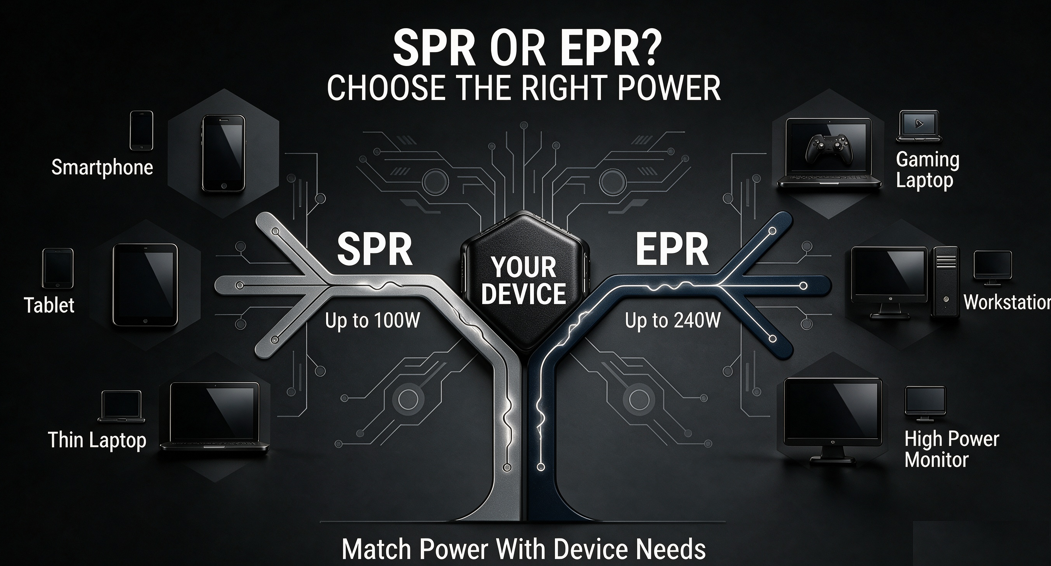
- For everyday devices like phones, tablets and thin-and-light laptops: An SPR PD charger under 100W is more than sufficient.
- For high-power devices like gaming laptops and high-wattage monitors: Always look for the EPR label to achieve full-speed charging.
- When buying cables: Don’t judge performance by thickness alone. Prioritize products with clear power rating markings and official certification.
Safety Tips
Always choose chargers and cables with official certification, and avoid unbranded, uncertified no-name products. If you notice unusual overheating, strange odors or other abnormalities during charging, unplug immediately and stop use.
8. Conclusion and Looking Ahead
To sum up, SPR is the foundational standard of consumer fast charging, covering most everyday digital devices and representing the tier we interact with most often. EPR is the high-end extended specification, built to meet the power needs of high-wattage devices and representing the direction of higher-power charging technology.
Looking forward, fast charging technology will continue to evolve toward higher power, smarter regulation and greater safety. Unified standards will also make accessories more versatile and interchangeable for everyone.
One simple piece of advice for everyday consumers: there’s no need to blindly chase ultra-high wattage. Choose SPR or EPR accessories that match your actual devices — sufficient power and safety are the most important principles when shopping.