
Introduction: Why Should We Care About PD Power Ratings?
When shopping for chargers or charging cables, you’ve probably seen labels like “100W PD Fast Charging” and “240W PD Fast Charging.” Many people’s first thought is: the higher the wattage number, the faster the charge, so bigger is always better?
The truth is not that simple. 100W and 240W are not just “higher vs. lower power” within the same generation of standards. They represent the power ceilings of two generations of the USB PD fast charging ecosystem, designed for completely different use cases and device types.
This article is written for everyday consumers, tech beginners, and anyone trying to decide which charger to buy. We’ll break down the differences in plain language, help you avoid common buying mistakes, and pick the product that works best for you.
Fast Charging Basics: Understanding USB PD and Power Rules
2.1 What Is USB PD Fast Charging?
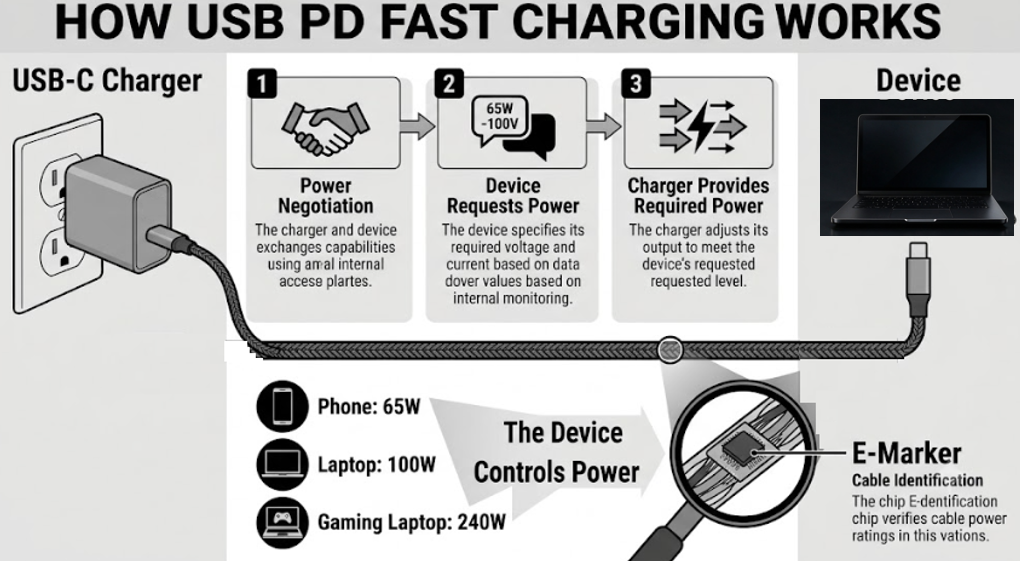
USB PD, short for USB Power Delivery, is a universal fast charging standard built on the Type-C connector. It is currently the most widely supported fast charging protocol in consumer electronics.
Its core logic is simple: when a charger is connected to a device, they first perform a “handshake negotiation.” The device tells the charger what voltage and current it needs, and the charger delivers only that amount. Power is not forced into the device just because the charger can supply more.
2.2 The Two Main Power Ranges of PD
Today’s mainstream PD standard is divided into two power ranges, corresponding to different protocol versions:
- SPR (Standard Power Range): The mainstream specification of PD 3.0, with a maximum power limit of 100W. This is the PD fast charging spec you see most often.
- EPR (Extended Power Range): Added in the PD 3.1 standard, it raises the power ceiling to 240W, designed specifically for high-power devices.
If you’re new to power ratings, just remember this simple formula:
Power (Watts, W) = Voltage (Volts, V) × Current (Amps, A)
Higher power means more energy can be transferred per unit of time, which in theory leads to faster charging — but only if the device can actually accept that much power.
2.3 The Essence of 100W vs 240W: Two Generations of PD Power Ceilings
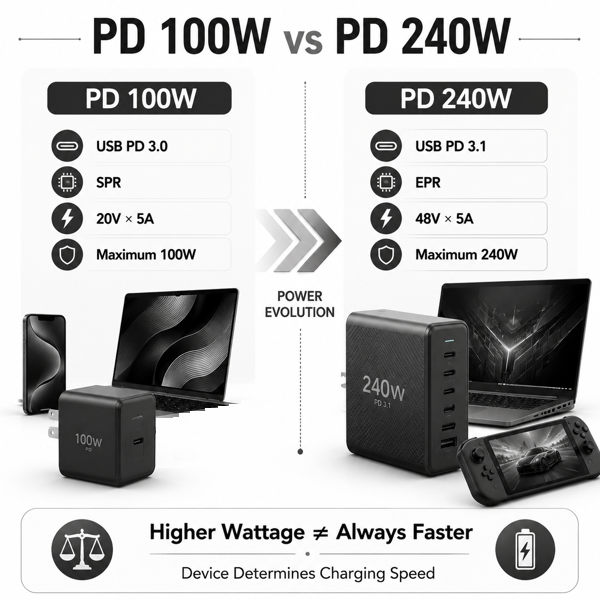
Put simply, 100W is the “upper limit” of the previous PD standard, and 240W is the “new upper limit” of the latest PD standard. They are not just high-end and low-end versions of the same tier. They represent two generations of technology with different use cases and hardware requirements.
Full Comparison of Core Specifications
To help you grasp the key differences at a glance, here is a side-by-side overview:
| Comparison Category | 100W PD | 240W PD |
|---|---|---|
| Protocol Standard | PD 3.0 SPR (Standard Power Range) | PD 3.1 EPR (Extended Power Range) |
| Max Output Spec | 20V / 5A | 48V / 5A |
| Key Voltage Levels | 5V, 9V, 12V, 15V, 20V | Supports all 20V and lower levels, adds 28V, 36V, 48V |
| Cable Requirement | 5A Type-C to Type-C cable with E-Marker chip | EPR-grade 5A Type-C cable rated for 48V |
| Typical Compatible Devices | Smartphones, tablets, thin-and-light laptops, handheld consoles, portable monitors | All 100W devices, plus gaming laptops, workstations, high-performance mini PCs |
| Size & Portability | Generally more compact and portable | Larger with the same design; GaN technology greatly reduces size |
| Primary Use Case | Charging everyday personal electronics | Powering high-wattage devices and multi-device desktop setups |
Below we explain each dimension in more detail.
3.1 Protocol and Electrical Specifications
- 100W PD: Falls under the PD 3.0 SPR standard, with a maximum output of 20V at 5A (20 × 5 = 100W).
- 240W PD: Falls under the PD 3.1 EPR standard, with a maximum output of 48V at 5A (48 × 5 = 240W).
You might wonder: why raise the voltage instead of just increasing the current?
This is because charging cables lose energy as heat, and higher current means more energy loss and more heat buildup. Raising the voltage allows the same amount of power to be delivered with lower current, reducing cable heat and energy waste. It also enables power delivery over longer distances and for larger devices — this is the key reason 240W can power gaming laptops.
3.2 Charging Cable Requirements
Higher power demands stricter cable standards, and this is a detail many people overlook.
- 100W PD: Requires a 5A-rated Type-C to Type-C cable with a built-in E-Marker chip. A regular 3A Type-C cable can only deliver up to 60W, not the full 100W.
- 240W PD: The requirements are even higher. You must use an EPR-grade 5A Type-C cable rated for 48V. Regular 100W cables do not have enough voltage rating to trigger the 240W mode, and using the wrong cable can cause overheating or even damage your devices.
Important reminder: cables are the “hidden barrier” of fast charging. Buying a high-power charger without upgrading to the right cable is a waste of money. Poor-quality, unlabeled cables not only fail to deliver full power, but also pose safety risks like short circuits and fire hazards.
3.3 Charger Hardware and Form Factor
Higher power means upgraded internal components across the board:
- Core parts like high-voltage capacitors and power semiconductors are built to higher specifications in 240W chargers, to handle higher voltage and current.
- In terms of size, a 240W charger is usually larger and heavier than a 100W charger using the same technology. However, with the spread of Gallium Nitride (GaN) technology, high-power chargers have shrunk dramatically. Many 240W GaN chargers are now about the same size as older 65W chargers.
- When it comes to heat and cooling, 240W chargers generate more heat at full load, so they usually include better internal cooling structures to maintain stable performance over long periods.
3.4 Device Compatibility
PD fast charging has a very useful rule: higher-power chargers are backward compatible with lower-power devices.
- A 100W PD charger works with most everyday electronics: smartphones, tablets, thin-and-light laptops, handheld gaming devices, portable monitors, and more — basically any device that charges at 100W or less.
- A 240W PD charger works with all of those devices, plus ones that 100W can’t handle: gaming laptops, mobile workstations, high-performance mini PCs, and other high-power products.
And since PD is a universal standard, it works across brands. This is its biggest advantage: one charger can power phones, laptops, and tablets from different brands, so you don’t have to carry a pile of original chargers.
Real-World Usage Experience Differences
Specifications are one thing — but what’s the actual difference in daily use? Let’s look at four common scenarios.
4.1 Charging Smartphones and Tablets: Is There a Noticeable Difference?
Short answer: almost no difference at all.
Today, the peak charging power of most smartphones is below 100W, and tablets typically charge at 30W to 67W. When you plug a 240W charger into a phone, it will only charge at the maximum power the phone supports. It won’t charge faster just because the charger is more powerful. The experience is identical to using a 100W charger — the 240W unit is just acting as a backward-compatible power source.
For smartphone and tablet users, a 100W PD charger fully covers the fast charging needs of mainstream devices. There’s no reason to buy 240W just for your phone.
4.2 Charging Laptops: The Most Noticeable Difference
Laptops are where the gap is biggest, and the experience varies a lot by laptop type:
- Thin-and-light / business laptops: Most of these charge at 65W to 100W. A 100W PD charger can deliver full-speed charging, and can even keep the battery growing while you use the laptop. A 240W charger won’t improve the experience here.
- Gaming / high-performance creative laptops: These usually come with 150W to 240W original power adapters. A 100W PD charger doesn’t have enough power — it might charge slowly, or the battery might even drain while you’re gaming. A 240W PD charger can replace the original power adapter and deliver full power. This is the core value of 240W.
4.3 Charging Multiple Devices at Once: Power Distribution Differences
Many chargers today have multiple ports, so you can charge several devices at the same time. This is where total power makes a big difference:
- With a 100W multi-port charger, power is split when two devices charge at once — for example, 65W for a laptop plus 30W for a phone uses up the full 100W. Add more devices, and each one charges even slower.
- With a 240W multi-port charger, there’s plenty of total power. You can charge a laptop, tablet, phone, and even a portable monitor all at the same time, each still getting fast charging speeds without fighting for power. For people with multi-device desk setups, or who travel with lots of electronics, a 240W multi-port charger is much more practical.
4.4 Charging Safety and Battery Health
Many people worry that high-power chargers will damage their batteries. There’s really no need.
Thanks to PD’s intelligent voltage regulation, devices only draw the power they need. The charger never “forces” extra power into the device. What actually affects battery lifespan is the device’s own charging management, and your usage habits — like charging in high heat, or always draining the battery completely. It has nothing to do with the maximum power of the charger.
In short: as long as it’s a certified, quality PD charger, whether it’s 100W or 240W, it won’t damage your device’s battery.
Common Misconceptions to Avoid
Myth 1: A 240W charger always charges faster than a 100W one
Reality: Charging speed follows the “bucket effect” — the shortest slat determines how much water the bucket can hold. That shortest slat is the maximum power your device supports. If your phone only supports 65W fast charging, it will charge at exactly the same speed with a 240W charger as it would with a 65W charger.
Myth 2: High-power chargers can burn out low-power devices
Reality: The PD handshake negotiation exists specifically to prevent this. Before charging starts, the device and charger agree on the power level. The device takes only what it needs, and the charger never forces high power. Charging a low-power device with a quality PD charger is no different from using its original small charger.
Myth 3: Any Type-C cable can handle 240W
Reality: Type-C is just the shape of the connector — it doesn’t tell you anything about power capability. Type-C cables vary widely in internal wiring, chips, and voltage ratings. Any cable not labeled PD 3.1 EPR or 240W will not deliver full 240W power, and cheap, low-quality cables can overheat and cause fire hazards.
Myth 4: 240W is the future, so buying 100W now is a waste
Reality: While more high-power devices will come in the future, everyday devices like phones, tablets, and thin-and-light laptops won’t exceed 100W for a very long time. 100W covers 90% of daily charging needs and is more than enough for most users. 240W is for specialized high-power use cases — not something everyone needs.
Buying Guide: Choose Based on Your Needs, Not the Biggest Number
6.1 Who Should Choose a 100W PD Charger
A 100W charger is the best value if:
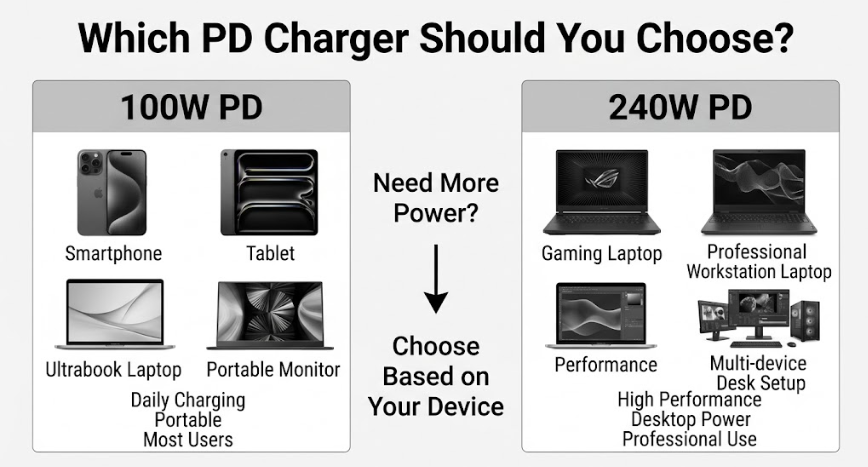
- Your main devices are a smartphone, tablet, or thin-and-light laptop, with no high-power laptop;
- You value portability and often carry a charger for commuting or travel;
- You only charge 1–2 devices on a regular basis, with no need for simultaneous multi-device fast charging;
- You’re on a budget and want the most affordable option for everyday fast charging.
6.2 Who Should Consider a 240W PD Charger
A 240W charger is worth it if:
- You use a gaming laptop, high-performance creative laptop, or mobile workstation, and want a PD charger to replace your bulky original power adapter;
- You have a desk full of electronics and want one charger to power your laptop, tablet, phone, monitor, and more;
- You want a “one charger for everything” solution with headroom for future devices, so you don’t have to upgrade your charger as often.
6.3 Tips to Avoid Bad Purchases
- Look for official certifications: Prioritize products clearly labeled “PD 3.1 EPR” or “USB-IF certified.” They have more reliable specs and better safety guarantees.
- Upgrade your cable too: When buying a 240W charger, make sure the included cable (or any cable you use with it) supports 240W EPR. Both charger and cable must meet the spec.
- Stick to reputable brands: Avoid no-name, unlabeled products. Cheap, low-quality chargers often lie about their power ratings and can be unsafe.
Conclusion: The Simple Rule for Choosing
- 100W PD: The mainstream, “good enough” choice for most people. It covers 90% of daily charging scenarios, works with phones, tablets, and thin-and-light laptops, and is portable and affordable.
- 240W PD: A specialized solution for high-performance devices. It’s made for high-power scenarios like gaming laptops and multi-device desk setups.
The core rule never changes: choose based on the devices you actually own, not the biggest number on the box. The right choice is the one that fits your needs.