
Quick Summary
- You don’t need to be an electrician to figure out volts, amps, and watts for everyday gadgets.
- The one formula to remember: Watts = Volts × Amps
- Things with motors (fridges, AC units) use a little extra current that doesn’t do real work — we call this the power factor.
- The voltage number on wall outlets (120V in the US, 230V in Europe) is the number you plug directly into formulas.
- We’ll use a simple water pipe analogy for everything, so no confusing jargon.
Introduction
Ever wondered why a 65W charger charges your phone faster than a 25W one? Or how many amps your new air fryer uses?
All of these questions come down to three basic numbers: volts, amps, and watts.
You don’t need a math degree for this. With one simple formula and a little common sense, you can work out charging speeds, appliance currents, and even roughly how much something adds to your electric bill.
We’ll start with the absolute basics, compare everything to water pipes, and work up to calculations you can use around your home today.
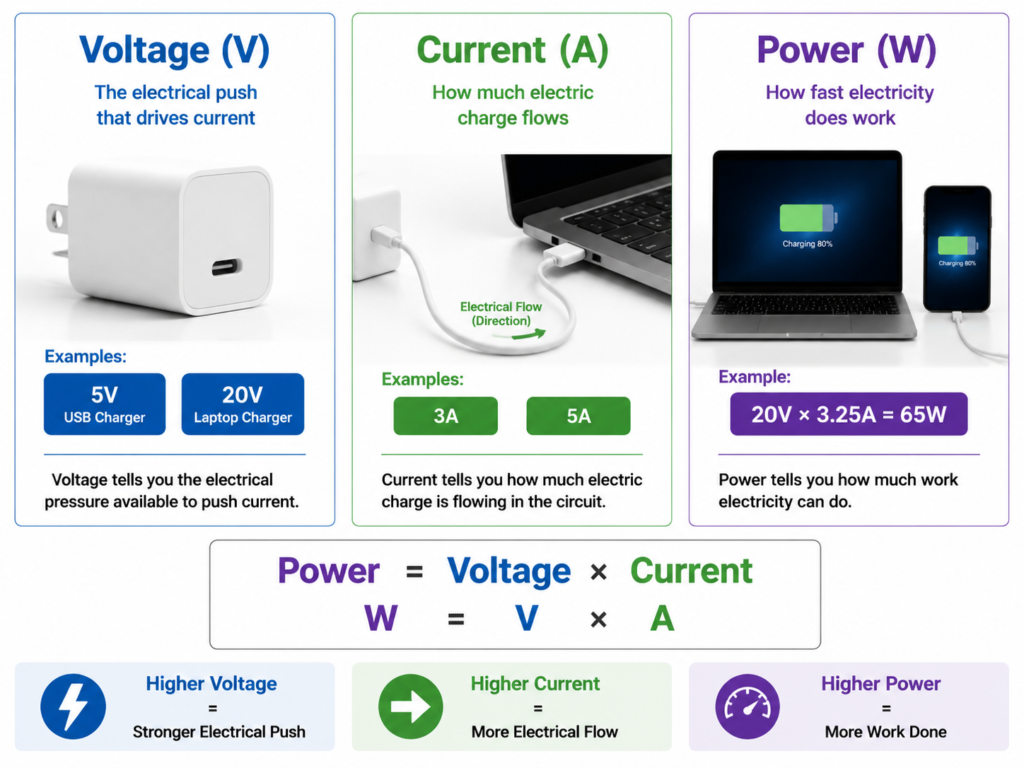
Part 1: 4 Basic Terms
Think of electricity like water flowing through pipes. This trick makes every term easy to remember.
1. Volts (V) – The “Push”
Volts measure how hard electricity is being pushed through a wire.
- Water analogy: Water pressure inside a pipe. More pressure = stronger push.
- Everyday examples:
- AA battery: 1.5V
- Phone USB charger: 5V
- Wall sockets: 120V (US/Canada), 230V (EU/UK/Australia)
2. Amps (A) – The “Flow”
Amps measure how much electricity is flowing through the wire every second.
- Water analogy: How much water flows through the pipe each second.
- Everyday examples:
- Small LED light: 0.1–0.5A
- Phone charging: 0.5–3A
- Window AC unit: 5–15A
Quick fact: Amps measure the amount of flow, not the speed.
3. Watts (W) – The “Power”
Watts measure how fast electricity is being used to do something — make heat, light, or movement.
- Water analogy: How much work the water can do, like spinning a water wheel. More push + more flow = more power.
- Everyday examples:
- LED light bulb: 5–20W
- Electric kettle: 1500W
- Home air conditioner: 1000–3000W
4. Ohms (Ω) – The “Blockage”
Ohms measure how much something slows down the flow of electricity.
- Water analogy: A narrow or blocked pipe that makes it harder for water to flow.
- Everyday examples:
- Copper wires: very little blockage
- Heater coils: more blockage (they get hot because of this)
Part 2: Simple DC Math (Batteries, USB, Phone Chargers)
DC means electricity flows in one steady direction. This is what batteries, phone chargers, and USB devices use.
The Only Formula You Really Need
Watts = Volts × Amps
If you know two of the numbers, you can find the third:
- To find watts: multiply volts × amps
- To find amps: divide watts ÷ volts
- To find volts: divide watts ÷ amps
Beginner tip: This one formula answers 90% of everyday questions.
More Useful Formulas (Using Ohms)
If you also know the resistance (ohms), you can calculate the other values:
- If you know amps + ohms:
- Volts = Amps × Ohms
- Watts = Amps × Amps × Ohms
- If you know volts + ohms:
- Amps = Volts ÷ Ohms
- Watts = (Volts × Volts) ÷ Ohms
Quick note: These formulas work best for simple things like heaters and wires. They don’t work perfectly for LEDs, chargers, or smart gadgets.
Part 3: Simple AC Math (Wall Outlets and Home Appliances)
AC means electricity switches direction back and forth many times per second. This is the power that comes out of your wall sockets.
It adds a few extra ideas, but the basic math stays almost the same.
3.1 The Voltage Number on the Wall Is Ready to Use
The 120V or 230V written on wall outlets is the “equal DC value” — it produces the same amount of heat as that DC voltage.
You don’t need to convert or adjust it. Just plug 120 or 230 straight into the formula.
3.2 AC Has a Little Extra “Drag”
In AC circuits, things with coils and motors add extra drag beyond simple resistance. You don’t need to calculate this yourself for everyday use.
Just remember: motors and transformers are a bit more complex than plain wires.
3.3 Power Factor: Why Motors Use Extra Current
Here’s the biggest difference between DC and AC math.
Some appliances (especially ones with motors) borrow a little extra current and then send it back. Only some of the current actually does useful work.
Power factor is a number between 0 and 1 that tells you how much of the current is doing real work.
- Heaters, kettles, light bulbs: power factor = 1 (all current does work)
- Fridges, AC units, fans: power factor = 0.7–0.95 (some current is “wasted” back and forth)
Lower power factor means you need more current to get the same amount of real work done.
3.4 Two Ways to Talk About Power
- Real power (watts): The power that actually does useful work. This is what you pay for on your bill.
- Apparent power (VA): Volts × amps, just a simple multiplication. It looks bigger than real power for motor devices.
3.5 Formula for Normal Wall Outlets
For things you plug into a regular socket:
- Real watts = Volts × Amps × Power Factor
- Amps = Watts ÷ (Volts × Power Factor)
Easy rule: For heaters and kettles, you can ignore power factor (it’s 1). For fridges and AC units, use 0.8 as a rough number.
3.6 Big Equipment Power (Three-Phase)
Factories and large AC units use a bigger type of power called three-phase. It uses a slightly different formula with a ×1.732 multiplier.
Most home users will never need this. Stick to the single-phase formula for everyday house stuff.
Part 4: Energy and Waste — What Shows Up on Your Bill
Watts tell you how fast something uses electricity. Your bill charges you for the total amount of electricity used over time.
Energy (What You Pay For)
- Formula: Energy = Power × Time
- Units: watt-hours (Wh) or kilowatt-hours (kWh)
- 1 kWh = 1000 Wh
Example: A 100W light bulb left on for 5 hours uses 500 Wh, or 0.5 kWh.
Efficiency (Nothing Is Perfect)
No gadget uses 100% of its power for useful work. Some is always lost as heat.
- Good phone chargers and power supplies waste about 5–15% as heat
- When sizing wires or breakers, always account for this wasted power
Part 5: Everyday Examples You Can Try Right Now
Example 1: Phone Charger
A USB charger outputs 5V and 25W. How many amps does it put out?
Amps = Watts ÷ Volts
Amps = 25 ÷ 5 = 5A
Note: Real fast chargers change volts and amps depending on the phone. This is the 5V mode result.
Example 2: Electric Kettle
A 2000W kettle runs on 230V. How many amps does it draw?
It’s a heater, so power factor = 1.
Amps = 2000 ÷ 230 ≈ 8.7A
Example 3: Daily Electricity Cost
A 1500W kettle runs for 30 minutes every day. How much energy does it use?
30 minutes = 0.5 hours
Energy = 1.5 kW × 0.5 hours = 0.75 kWh per day
Multiply by your local electricity price to find the daily cost.
Part 6: Common Mistakes Beginners Make
- Using the simple watts = volts × amps formula on fridges and AC units
Motors have power factor less than 1. If you ignore it, you’ll get a number lower than the real current. - Thinking higher watts always means higher amps
Same wattage at a higher voltage uses fewer amps. 1000W at 100V = 10A, but 1000W at 500V = only 2A. - Applying ohm’s math to every gadget
It works for heaters and wires, but not for LEDs, chargers, and smart electronics. - Confusing watts (speed) with energy (total amount)
Watts is how fast you use it. kWh is how much total you used — that’s what you pay for. - Forgetting about wasted power
Chargers and power supplies lose some energy as heat. The power going in is always more than the power coming out.
How a Power Voltage Current Calculator Works
A basic calculator follows these simple modes:
DC Mode (Batteries / USB)
- Type in volts + amps → it tells you watts
- Type in watts + volts → it tells you amps
- Type in watts + amps → it tells you volts
- Optional: add efficiency to see the real input power
AC Mode (Wall Outlets)
- Pick normal household power or big three-phase power
- Type in your wall voltage and power factor
- Type in watts or amps
- It tells you the real working power and current
Now you understand exactly what every online electrical calculator is doing — no more black box math.