
Have you ever had these experiences: your phone is about to die when you rush to the subway, and you drop a bunch of things when taking out your power bank and charging cable; or when you work in a cafe, you have to ask the waiter for a charging cable because your phone is out of power? In recent years, magnetic wireless power banks have become increasingly popular, claiming to “charge as soon as they stick on”, but some people say they charge slowly, generate heat, have inflated capacity, and are not as practical as regular power banks. Which one should you choose? Today we will fully explain the definitions, principles, experience, and pitfall avoidance of the two types of products, from beginner to proficient, and you will be able to make your own decision after reading.
Clarify Before Comparison: Definitions and Unified Rules for the Two Types of Products
Many people find that they are not talking about the same thing after comparing for a long time, just because they did not clarify the product boundaries first. Let’s explain the basic concepts first, so that the subsequent comparison will not be chaotic.
What Is a Magnetic Wireless Power Bank
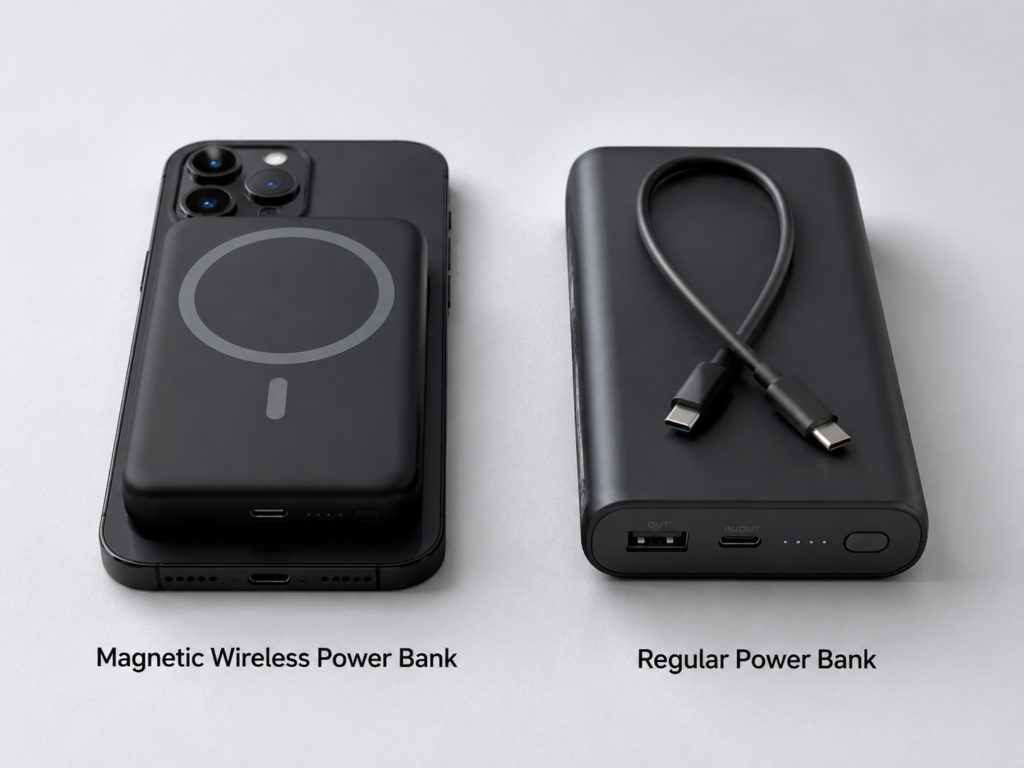
In plain terms, a magnetic wireless power bank is a mobile power supply that attaches to the back of a phone via a magnetic ring on its back, and then powers the phone through a wireless charging coil. It is common in Apple’s MagSafe ecosystem, Qi2 standard products, and various third-party magnetic models. You can think of it as “a wireless charging pad + battery that can stick to your phone”.
It’s easy to identify: check if there is a circle of magnetic positioning ring on the back of the power bank, and whether the main selling points are “charge as soon as it sticks” and “no need for cables”. Current magnetic models come in thin sheet shapes, square shapes, and some with stands or battery level displays. Many also have a USB-C wired output port. Here is a key point: The magnet is only responsible for adsorption and fixation, aligning the two coils; it does not transmit electricity itself. The actual electricity transmission is done by the internal wireless charging coil — don’t think the magnet can directly power the phone.
What Is a Regular Power Bank
A regular power bank is the conventional mobile power supply we have used for many years: it mainly powers devices through ports such as USB-A and USB-C by plugging in a charging cable. Its core identification point is “wired output as the main function”, with no magnetic positioning ring on the back. When promoting, manufacturers usually emphasize capacity, number of ports, fast charging power, and cost-effectiveness.
Regular power banks have a wide range of compatibility. As long as the port and fast charging protocol match, they can charge phones, tablets, earbuds, cameras, handheld game consoles, and even some thin and light laptops. Here we also need to clarify a boundary: some regular power banks have built-in wireless charging pads but no magnetic positioning, requiring you to align the phone with the coil yourself. These belong to “regular wireless power banks”, a derivative of regular power banks, and are not real magnetic wireless power banks — because they cannot automatically align and stick firmly, the user experience is completely different from magnetic models.
How to Classify Hybrid Forms
Now product forms are becoming more and more diverse, you can judge the classification by this rule:
- Magnetic + wired output models: as long as the main selling point is “adsorptive wireless charging”, it is classified as a magnetic wireless power bank, and the wired output capability can be compared separately.
- Regular wireless power banks: can charge wirelessly but cannot stick, require manual alignment, and still belong to the category of regular models.
- Non-magnetic phone + magnetic case/magnetic ring: can indeed achieve adsorption, but whether wireless charging is stable depends on whether the phone itself supports Qi wireless charging, coil position, phone case thickness, and magnetic ring accuracy — it’s not a done deal just by sticking a magnetic ring.
- Regular wired power bank with a magnetic ring attached: only improves the fixation method, does not magically become a wireless magnetic power bank, you still have to plug in the cable when needed.
Unified Comparison Rules to Avoid Invalid Comparisons
To avoid situations such as “comparing no-name brands with official ones” or “comparing wired with wireless”, let’s first set the premise for all subsequent comparisons:
- The comparison covers products of the same capacity tier, same brand grade, same price range, and from formal channels. Unbranded shoddy products, models with falsely marked ultra-large capacity, outdoor power supplies, and industrial-grade mobile power supplies are not within the comparison scope.
- Magnetic wireless power banks will be discussed separately in “wireless mode” and “wired mode”, while regular power banks are mainly based on the most commonly used wired output.
- We value actual experience more: the actual charge delivered to the phone, charging speed, heat generation, carrying feel, and safety, rather than just looking at the maximum mAh or maximum W marked on the packaging — many of those nominal values are under ideal laboratory conditions, which may not be achieved in daily use.
Why Is the Experience So Different Between the Two? Explain the Working Principle in Plain Language
Many people think they are both power banks, why do they feel completely different to use? The core is the different power transmission paths, let’s explain it in plain language.
Charging Process of Magnetic Wireless Power Banks
When you stick the magnetic power bank on the back of the phone, the function of the magnet is to precisely align the transmitting coil of the power bank with the receiving coil in the phone, reducing offset. After alignment, the coil of the power bank generates an electromagnetic field, and the phone’s coil generates current after sensing the electromagnetic field — that’s how electricity is transmitted. This is electromagnetic induction. Common wireless charging standards include Qi, Qi2, and Apple’s MagSafe ecosystem.
The key here is “coil alignment”: the more accurate the alignment, the more stable the charging and the higher the efficiency; if there is an offset, it will heat up, slow down, or even stop charging. A real example: the same magnetic power bank may charge stably all afternoon with a bare phone or thin magnetic case; but if you use a thick case, metal case, or the magnetic ring is stuck crookedly, it may not even stick firmly, and will repeatedly disconnect charging.
Charging Process of Regular Power Banks
The power transmission path of regular power banks is much more direct: the electricity from the battery cell goes through the circuit for step-up or step-down, then negotiates the fast charging protocol with the phone, and is directly transmitted to the phone through the charging cable. Because there is no wireless conversion link of “coil to coil” in the middle, the loss is lower and the speed is more stable.
Its charging speed is determined by four factors: the output power of the power bank, the input power supported by the phone, whether the fast charging protocol matches, and whether the specification of the charging cable is sufficient. Common fast charging protocols include PD, PPS, QC, AFC, SCP, etc. Different brands of phones support different protocols, you can’t just take a high-power power bank to get fast charging.
Core Reason for Efficiency Difference
So the core of the efficiency difference between the two is simple: Magnetic wireless charging has one more wireless conversion from coil to coil, and the extra loss is dissipated as heat. Wired charging lacks this conversion, so under the same conditions, the actual charge delivered to the phone is more, and the temperature is lower.
Of course, this difference is not fixed: if the ambient temperature is very high, charging while using the phone, the phone’s battery level exceeds 80% (the phone will activate protection and slow down), or the coils are not aligned, the efficiency and speed of magnetic wireless charging will drop more significantly.
The Most Confusing Point: Having Wireless Charging ≠ Magnetic Wireless Power Bank
Let’s emphasize again the most easily confused concept: a power bank with wireless charging is not necessarily a magnetic wireless power bank. The core difference is whether there is a magnetic positioning structure, whether it can automatically align the coils and stick firmly.
Regular wireless power banks require you to find the coil position yourself, and they will shift if you move a little when put in a bag or walking, often disconnecting while charging. The advantage of magnetic models is stable alignment, suitable for short-term on-the-go top-ups, but this does not mean their charging speed is necessarily fast — many people think magnetism means fast charging, but they are two different things.
Item-by-Item Comparison of Core Experience: Conclusions Vary by Scenario
We compare from 7 dimensions that everyone cares about most. Each dimension will clearly state the conclusion, and under what circumstances the conclusion will change.
Operational Convenience: Magnetic Models Win in “On-the-Go Use”
What we compare is: whether you need to find a cable, whether you can operate it with one hand, whether you will be hindered by the cable when using while charging.
When using the wireless mode of magnetic models, it really charges as soon as it sticks, no need to find a cable, no need to plug in the port. You can just stick it on when commuting and scrolling on your phone, driving navigation, or in meetings. It can be operated with one hand, and there is no trouble of cables dangling around. The wired mode of regular models requires you to carry a cable with you, find the port to plug and unplug, and the cable will get in the way when using while charging, but the advantage is that it is very stable after plugging in, and will not disconnect easily.
This gap is not absolute: if you are used to putting the power bank in your bag and always carry a charging cable with you, the gap between the two will be much smaller — after all, you have to take it out of your bag, and the magnetic one also has to be taken out and stuck on, not much difference.
Charging Speed: Regular Wired Fast Charging Is Faster
We don’t compare the nominal maximum power on the packaging, but the actual time to charge from low battery (e.g., 20%) to usable battery (e.g., 80%) at the same price and same capacity — after all, the nominal maximum power is mostly under ideal conditions, and it is difficult to reach full capacity in daily use.
First look at the wireless mode of magnetic models: common wireless power levels are 5W, 7.5W, 10W, 15W. Many people think all magnetic ones are 15W fast charging, but that’s not true: only Apple officially certified MagSafe accessories, or combinations that meet the Qi2 standard, can reach the corresponding high power, and it requires the phone, system, and power bank to all support it. For example, many third-party “MagSafe compatible” magnetic power banks only actually charge iPhones at around 7.5W. The 15W marked on the packaging may only apply to some Android phones that support Qi, or it is an ideal laboratory value.
If using the wired mode of magnetic models, the common USB-C output is about 12W to 20W, a few new models can be higher, but because magnetic models are usually small in size and have limited heat dissipation, the power will not be particularly high.
Then look at the wired fast charging of regular power banks: common powers are 18W, 20W, 22.5W, 30W, 45W, 65W. High-power models can even charge tablets, handheld game consoles, and thin and light laptops.
Both magnetic and regular models will have speed reduction: after the phone’s battery reaches 80%, it will automatically slow down to protect the battery; too high ambient temperature, charging while using, substandard cables, mismatched fast charging protocols will also cause the speed to slow down.
So the conclusion is clear: if you pursue charging speed, choose regular wired fast charging models first; if you only need fragmented top-ups, such as topping up 20%-30% on the way to work, magnetic wireless charging is slower but easier to use, which is acceptable.
Effective Battery Life: Regular Models Have More Usable Power at the Same Capacity
Many people think you can judge battery life by looking at mAh, but that’s not right — mAh is a unit of current, not total energy. The more accurate one is Wh (watt-hour), the calculation formula is: Wh = Capacity (mAh) × Nominal Voltage ÷ 1000. In addition, regular power banks will mark “rated capacity”, this value is closer to the actual power that can be output to the phone than the most prominent “cell capacity” on the packaging.
Let’s look at the loss difference between the two:
- Magnetic model wireless mode: total loss is about 30%-45%, including circuit step-up/step-down loss, wireless conversion loss, and heat loss; if the coil is offset, the temperature is high, or charging while using, the loss will be even higher.
- Regular model wired mode: total loss is about 10%-20%, the actual usable power is significantly more at the same capacity.
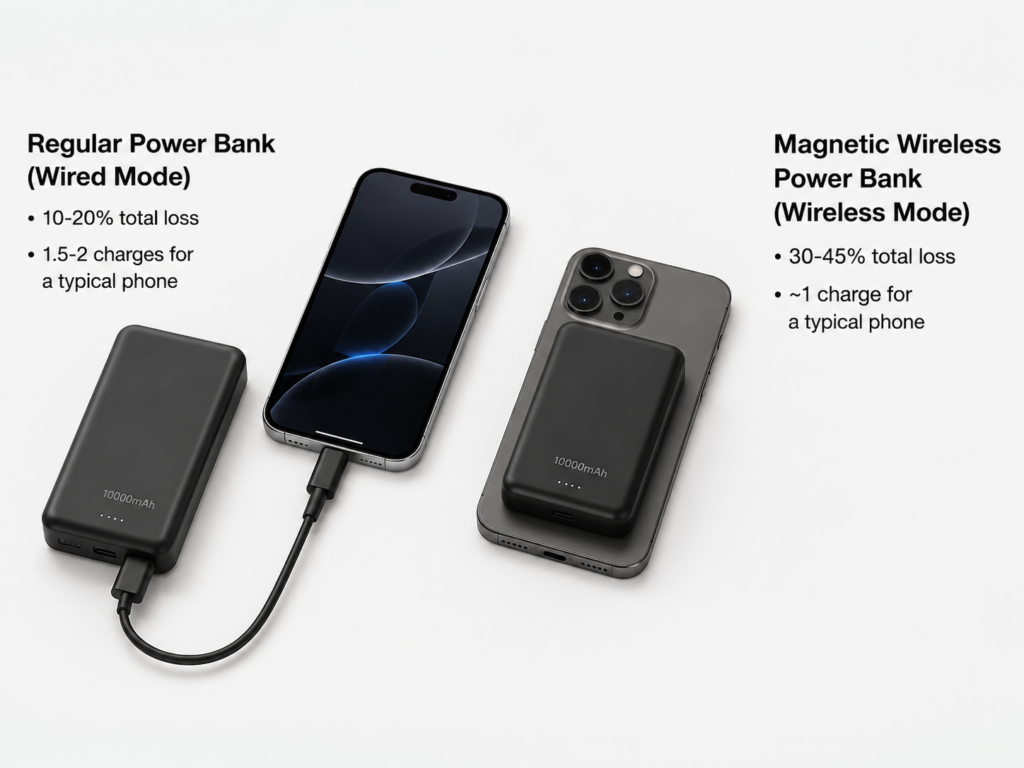
An intuitive example: both are 10000mAh power banks from regular brands, the regular wired model may charge your phone 1.5 to 2 times, while the magnetic wireless model may only charge about 1 time, or even less. So magnetic models are more suitable for “topping up 20%-50% of power on the go”, not for using the capacity to the maximum.
This difference also depends on the scenario: if you only charge low-power devices such as earbuds and smart watches, or just top up a little for a short time, you may not feel the efficiency gap; but if it’s a long trip or you need to power multiple devices, the advantage of regular wired models is very obvious.
Compatibility: Regular Models Have a Wider Coverage
The best experience of magnetic models requires matching with phones with native magnetism, compliant magnetic cases, and Qi2/MagSafe compatible devices. Missing any one may reduce the experience. For example, only iPhone 12 and above models have built-in MagSafe magnetic structure, but the specific wireless power it can reach depends on the model, system version, and whether the power bank has the corresponding certification. For Android phones, some models support Qi wireless charging, and can be used with a magnetic case or magnetic ring, but the power, heat generation, and alignment stability depend on the specific model, and cannot be generalized.
The compatibility of regular power banks is much wider: as long as there is a corresponding port and charging cable, and the fast charging protocol matches, it can charge phones, tablets, cameras, earbuds, handheld game consoles, and even some thin and light laptops.
So the conclusion is: if all your devices are in the magnetic/Qi2 ecosystem, magnetic models will be very smooth to use; if you have a variety of device types, including tablets, cameras, etc., regular wired models are more reliable.
Portability and Feel: Each Has Its Pros and Cons
We compare the weight, thickness, grip impact, and carrying method under the same effective power.
The advantage of magnetic models is that they stick to the phone, no need to hold them separately, very convenient for short commutes, you just need to carry your phone. But a large-capacity magnetic model stuck on the back of the phone will make the phone significantly thicker and heavier, uncomfortable to hold when taking photos, also uncomfortable to hold horizontally when playing games, and tiring to hold for a long time.
Regular power banks have many shape options, including mini models, long models, large-capacity models. They can be put in a bag or on the desktop, no need to hold in hand normally. But if you use it while walking, you have to hold the phone in one hand and the power bank in the other, with cables winding around, which is more troublesome.
Another influencing factor here: thick phone cases, non-magnetic cases, metal cases will weaken the magnetic suction force, or even make it unable to stick firmly; and the larger the capacity of the magnetic model, the more obvious the impact on the feel.
Heat Generation and Safety: Regular Products Are All Safe, Magnetic Models Generate More Heat
We compare the heat generation level and protection mechanisms of regular brands under normal use conditions.
When using the wireless mode of magnetic models, due to the large loss of wireless conversion, both the back of the phone and the power bank heat up together. In summer, in a closed car, or when charging while using, the temperature will rise quickly, easily triggering temperature control protection, leading to speed reduction or even suspension of charging. When using the wired mode of regular models, the heat generation is usually lower, the heat is mainly concentrated in the circuit and port positions, and the efficiency is more stable.
But here’s a reassurance for everyone: regular brand power banks, whether magnetic or regular, have protection mechanisms such as overcharge, over-discharge, over-current, short circuit, over-temperature, foreign object detection, etc. They are safe for normal use. What is really dangerous is not the category of “magnetic or regular”, but unbranded products, swollen battery cells, shoddy products with falsely marked capacity, unqualified charging cables, and charging in high-temperature closed environments — these are the main sources of safety hazards.
Price and Cost-Effectiveness: Regular Models Are More Cost-Effective
We compare the selling prices of products with the same capacity, same brand grade, and same channel. We will not compare low-priced no-name models with regular brands.
Because magnetic models have additional magnets, wireless coils, heat dissipation design, and possible certification costs, they are usually more expensive than regular models at the same capacity. Regular power bank technology is very mature, with a wide range of capacity options, higher cost-effectiveness at the same capacity. Especially for large-capacity models above 10000mAh, the gap will be more obvious.
Of course, the price difference is not fixed: for small-capacity thin models around 5000mAh, the price difference between the two may be relatively small; but for models above 10000mAh that pursue actual usable power, regular models will be much more cost-effective.
Scenario-Based Product Selection: Which One Should You Choose
Don’t struggle with “which is better”, just see which one is more suitable for your usage scenario.
Situations to Prioritize Magnetic Wireless Power Banks
If you meet the following characteristics, prioritize magnetic models:
- You use a phone with native magnetism, or have a stable magnetic case, and often need on-the-go top-ups
- You hate carrying charging cables, and value convenience during commuting, meetings, short trips, and navigation
- You mainly charge your phone, rarely charge other devices such as tablets, laptops, cameras
- You can accept that wireless charging is a bit slower, generates more obvious heat, and has less effective capacity
- You are already using magnetic car mounts, desktop magnetic mounts, magnetic phone cases, and want to unify the accessory ecosystem
Situations to Prioritize Regular Power Banks
If you meet the following characteristics, prioritize regular models:
- Your phone does not support wireless charging, or you don’t want to change to a magnetic case
- You need to power multiple devices, such as tablets, handheld game consoles, cameras, earbuds, laptops
- You pursue fast charging speed, long battery life, high effective power
- You often travel long distances, go outdoors, go on business trips and other scenarios that require stable power supply
- You have a limited budget, and hope to get larger capacity or higher output power for the same price
Compromise Solutions When You Are Torn
If you have needs for both, you don’t have to choose one, you can try these solutions:
- Magnetic model with USB-C wired output: use magnetic wireless for daily top-ups, plug in the cable to speed up when in a hurry, balancing convenience and speed.
- Non-magnetic phone + magnetic case/magnetic ring + magnetic power bank: suitable for users who want to experience magnetism, but be sure to confirm that the phone supports Qi wireless charging, and the magnetic ring should be stuck accurately at the coil position, otherwise it is easy to disconnect charging.
- Dual combination: buy a thin magnetic model of around 5000mAh for daily commuting, and then buy a regular fast charging model of 10000mAh or 20000mAh for travel and multi-device power supply. The two together may be cheaper than a large-capacity magnetic model, and the experience is better.
- Desktop use: you can choose a magnetic model that supports charging while discharging, equivalent to a magnetic charging dock plus a power bank, but confirm that the product clearly supports this function, and pay attention to heat generation.
10-Second Quick Judgment Checklist
If you still can’t make up your mind, you can quickly match these items:
- Often forget to bring charging cable, and phone supports magnetic/wireless charging: prioritize magnetic
- Can’t accept slow charging, obvious heat generation, reduced effective capacity: prioritize regular
- Have multi-device needs such as tablets, handheld game consoles, laptops: prioritize regular
- Only want to top up 20%-50% of the phone’s power in a short time: magnetic is more convenient
- Often travel long distances or need more than one day of battery life guarantee: regular large-capacity is more stable
Advanced Pitfall Avoidance: Understand Parameters, Don’t Be Fooled by Promotion
It’s not enough to just look at the scenario when choosing. Merchants have many promotion tricks. Master these skills, and you can avoid most pitfalls.
Exclusive Pitfall Avoidance for Magnetic Wireless Power Banks
- Distinguish three types of power: magnetic wireless power, wired output power, and total output power are three different things. Many merchants mark “20W fast charging”, but it is actually the power of USB-C wired, the magnetic wireless may only be 7.5W or 10W. Be sure to find the “wireless output power” in the parameter page when buying.
- Certification is not marked randomly: “MagSafe certification”, “Qi2”, “regular Qi”, “MagSafe compatible” are completely different things. The clearer the certification, the more predictable the power and compatibility. For example, “MagSafe compatible” may just have a magnet added, no Apple certification at all, and the power can’t go up when charging iPhones. In addition, Qi2’s 15W requires both the phone and the power bank to support the corresponding standard, it’s not that marking Qi2 will definitely run at 15W.
- Don’t just look at “how many grams” for suction force: compared with the nominal suction value, it’s more important to see if it can stick firmly with a case, whether it will slide horizontally, whether it is too hard to take off, whether it will block the camera — some have particularly strong suction, which can pull off the phone case when taking it off, which is not easy to use instead.
- Thin models are not necessarily better: although thin models look good, they have small heat dissipation space. When the temperature is high in summer or charging while using, it is easy to slow down due to too high temperature, the actual experience is not as good as slightly thicker models with better heat dissipation.
Exclusive Pitfall Avoidance for Regular Power Banks
- Rated capacity ≠ cell capacity: the most prominent 10000mAh, 20000mAh on the packaging is the cell capacity, not the actual output power. The rated capacity is closer to the actual output, the higher the value, the better.
- Fast charging is not faster with higher power: the phone must support the corresponding protocol and the cable must meet the standard to reach full power. For example, if your phone only supports PD 20W, buying a 65W power bank will only run at a maximum of 20W, which is a waste of money.
- Cables should also match: high-power fast charging requires a USB-C cable that supports the corresponding current and protocol. Using an ordinary old cable may limit the speed, or even generate heat due to too large resistance, which has safety hazards.
- Power will be split when charging with multiple ports at the same time: for most multi-port power banks, when charging at the same time, the single-port power will decrease, not every port can run at full power. Be sure to see the power distribution rules marked on the product when buying.
- Don’t ignore input power: the input power determines how long it takes to fully charge the power bank itself. If you buy a 20000mAh power bank with only 5W input power, it takes more than ten hours to charge once, which will be very troublesome.
How to Choose Capacity Tiers
Don’t blindly pursue large capacity, just choose according to your needs:
- Around 5000mAh: suitable for commuting, light top-ups, thin magnetic models. The advantage is light weight, the disadvantage is limited actual top-up, can only charge the phone about 0.5-1 times.
- Around 10000mAh: the most mainstream tier, suitable for one day out, can charge the phone 1-2 times; regular models have high cost-effectiveness, for magnetic models, pay attention to weight and thickness.
- Around 20000mAh: suitable for travel, multi-device power supply, long-term outings; regular models are more common and cost-effective, magnetic models will be very thick and heavy, basically can’t be held in hand while stuck on the phone.
- 30000mAh and above: focus on the Wh value and air travel carrying restrictions. Unless you often go outdoors or power multiple devices, otherwise it is not needed for daily commuting, heavy and inconvenient.
General Pitfall Avoidance Judgment Method
Whether it’s a magnetic or regular power bank, you can use these methods to avoid pitfalls:
- Ultra-low price + ultra-large capacity are basically high-risk products. Don’t believe “tens of thousands of mAh ultra-thin and only a dozen yuan”, the cost of regular battery cells is there.
- Capacity and weight are roughly proportional: a regular 10000mAh power bank weighs about 180-250g. Be wary of false marking if it is significantly lighter.
- Prioritize looking at Wh and rated capacity, much more reliable than just looking at mAh.
- Choose products from formal channels, with clear brands, warranty, and transparent parameters. Don’t buy unbranded shoddy products.
- Air travel carrying rules: based on Wh, below 100Wh can usually be carried on board, 100-160Wh usually requires airline approval. All mobile power supplies are prohibited from being checked in, subject to the specific regulations of airlines and airports.
Key Points for Buying Hybrid Models (Magnetic + Wired)
If you want to buy a hybrid model with both magnetic and wired functions, also pay attention to these points:
- Check wireless power, wired power, rated capacity, Wh, weight, thickness at the same time. Don’t just look at the magnetic function and ignore the wired performance.
- Prioritize USB-C integrated input and output ports. You only need to bring one C to C cable, which can charge the power bank and also fast charge the phone by wire, reducing the trouble of carrying cables.
- If you want to use it as a desktop magnetic charger, confirm that the product supports charging while discharging, and pay attention to the heat generation performance.
- Don’t sacrifice core experience for “full functions”: a too thick and heavy magnetic model is hard to use when stuck on the phone, it’s better to buy two separately.
Quick Troubleshooting of Common Misconceptions and Problems
Finally, we have sorted out the most commonly asked misconceptions and usage problems to help you avoid detours.
Common Misconceptions About Magnetic Wireless Power Banks
- “Magnetism will damage the battery”: Inaccurate. When using compliant products normally, the magnet itself will not damage the battery. What really damages the battery is high temperature, inferior battery cells, and long-term abnormal heat generation — the heat of wireless charging is indeed higher than that of wired, but the heat of regular products is within the safe range, no need to worry too much.
- “Magnetic power banks can only charge wirelessly”: Wrong. Many models have USB-C wired output, and the wired mode is usually faster and more power-efficient. You can plug in the cable when in a hurry.
- “If it can stick, it’s MagSafe certified”: Wrong. Many third-party products just add a ring of magnets, no Apple MagSafe certification or Qi2 certification at all. The power and compatibility will be discounted.
- “Magnetic charging is faster than wired”: Wrong. Magnetism solves the problems of alignment and convenience, not equal to high power. The current mainstream magnetic wireless power is still much slower than wired fast charging.
- “Sticking a magnetic ring enables wireless charging”: Wrong. The magnetic ring only helps with adsorption, the phone and power bank themselves must support wireless charging.
Common Misconceptions About Regular Power Banks
- “The larger the capacity, the better”: Wrong. Larger capacity is usually heavier. If it’s just for emergency during daily commuting, 5000 or 10000mAh is enough. Buying a 20000mAh one to carry every day is tiring instead.
- “The higher the power, the faster”: Wrong. The phone must support the corresponding protocol and the cable must meet the standard to reach full power, otherwise no matter how high the power is, it’s useless.
- “Nominal mAh is the number of charges”: Wrong. Due to conversion loss and voltage difference, the actual number of charges is less than “cell capacity ÷ phone battery capacity”. It should be estimated by rated capacity and Wh.
- “Each port runs at full power when charging with multiple ports at the same time”: Wrong. Most power banks will reallocate the total power when using multiple ports at the same time, and the single-port output will decrease.
Daily Usage Precautions
- General: Avoid high temperature exposure, closed car environment, charging covered by pillows or quilts; stop using immediately if there is swelling, odor, abnormal heating, or damaged casing.
- Exclusive to magnetic models: Do not stick closely to magnetic-sensitive items such as magnetic stripe cards and mechanical hard drives for a long time; users with implanted medical devices such as pacemakers should follow the recommendations of the device manufacturer and doctor; avoid hard pulling when taking off, push slowly along the edge to prevent damage to the casing or magnetic surface.
- Exclusive to regular models: Avoid violent plugging and unplugging of ports, use compliant cables; do not continue high-power charging when the port is loose or has poor contact.
Quick Troubleshooting of Common Minor Problems
- Magnetic suction is not firm: It may be that the phone case is too thick, non-magnetic case, metal case, magnetic ring is stuck crookedly, or the magnetic structure of the power bank is weak.
- Slow charging: It may be that the phone’s battery is higher than 80% (normal protection speed reduction), too high temperature, mismatched protocol, substandard cable. For wireless mode, also consider that the power itself is low.
- Repeated disconnection of charging: Most likely due to coil offset, foreign object obstruction, temperature control protection, too low power of the power bank. Thick phone cases affecting heat dissipation may also cause disconnection.
- No charging at all: First check whether the device supports wireless charging (in wireless mode), whether the power bank is turned on or out of power, whether the port/cable is faulty. Wireless mode may also trigger protection due to foreign object detection.
- Obvious heat generation: First take off the phone case, stop charging while using, move to a cool and ventilated place; if it is still abnormally hot, stop using it and check the product status.
Final Summary
Having said that, I believe you already have a clear understanding of the difference between the two types of power banks. One-sentence summary:
- If you pursue convenience and mainly charge your phone on the go, choose a magnetic wireless power bank;
- If you pursue speed, actual battery life and cost-effectiveness, or need to power multiple devices, choose a regular power bank;
- If you want to have both, a magnetic model with USB-C wired output is the most reliable compromise, you just have to accept the slightly higher price and the heat generation of the wireless mode.
After reading this article, you should be able to accurately distinguish the boundaries of the three types of power banks, understand the core parameters, quickly select the suitable product according to your usage scenario, and also troubleshoot the causes of common problems such as slow charging, weak suction, and heat generation by yourself.