
Introduction
If you’ve ever shopped for a budget fast charger, traveled internationally with a plug adapter, or found a dead charger after a storm, you’ve probably heard the term “fuse” thrown around. Some call it a non-negotiable safety lifesaver. Others complain it blows for no reason and is just a nuisance. And far too many people think the smart fix when one blows is to wrap it in copper wire or jam a paperclip in its place. All of these takes are either oversimplified or straight-up dangerous.
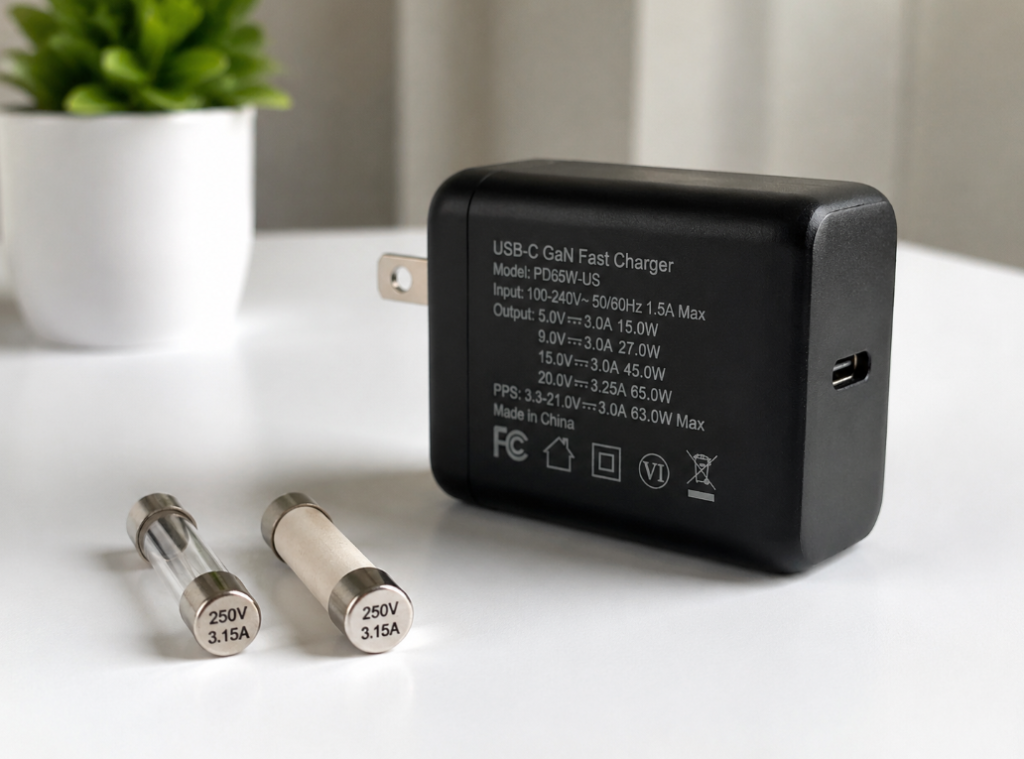
The fuse inside a charger is a simple but widely misunderstood safety component. It’s not a magic “protect everything” shield, and it’s not a pointless hassle. It’s the last physical line of defense in a charger’s entire safety system, acting only when all other protections fail. In this guide, we’ll break down everything you need to know — what fuses do, how they work, common types, how to tell if one is blown, and what to do if it is. No electronics degree required.
How Fuses Work: Heat, Melting, and Automatic Circuit Cutoff
Fuses have a simple structure, but their parameter design is extremely precise — you can’t just stick any piece of metal wire in and expect it to work.
Core Structure: Simple Design, Strict Specs
A standard current fuse has just four main parts:
- Melt element: The core metal wire, strip, or thin film, made from a specific low-melting-point alloy. When current gets too high, it heats up and melts. Its composition, thickness, and shape are all carefully calculated — even a small change can make it blow too early or not at all.
- Insulating housing: Made of glass, ceramic, plastic, or tiny surface-mount packaging. Its job is to isolate the melt element from the rest of the circuit and stop sparks from escaping when it blows.
- Filling material: High-breaking-capacity fuses often have quartz sand or similar filler inside to extinguish the arc (small electrical spark) that forms when the element melts, absorb energy, and prevent arcing or bursting.
- Pins/pads: The parts that connect to the circuit board. They have to handle normal operating current and heat without failing first.
The Full Blowing Process: 3 Steps From Overcurrent to Power Cut
Many people assume fuses blow the second current exceeds their rating, but that’s not true. Blowing is a heat buildup process, with three general steps:
- When current rises above normal levels, the melt element heats up due to its electrical resistance, like a tiny heating coil — just much less intense.
- As heat accumulates past the element’s melting point, the metal softens, thins, and starts to melt in localized spots.
- The element breaks completely. An arc forms at the break point, and a properly rated fuse will safely extinguish this arc within its rated voltage range, so no sparks escape. The circuit is then physically disconnected.
After blowing, the charger will be completely dead — no indicator light, no output power — because the entire input circuit is cut.
Key Rule: It Doesn’t Blow Instantly When Current Exceeds Its Rating
This is the most important thing to understand about fuses: they respond to heat buildup, and heat depends on both current magnitude and how long it lasts. The industry uses the term I²t to describe this characteristic, but you don’t need to memorize it. Just remember: the higher the current and the longer it lasts, the faster heat builds up, and the faster the fuse blows. Short surge currents, even if very high, may not blow the fuse at all.
The most common example is the inrush current when you plug in a charger. The large internal capacitors charge up instantly, creating a current much higher than normal operating current, but it only lasts a few milliseconds — not enough time for significant heat buildup, so the fuse doesn’t blow. If you used a fast-acting fuse sensitive to short surges, it would blow every time you plug the charger in, making it useless.
In short: A mild overload might take minutes or even hours to blow a fuse; a severe short can blow it in milliseconds.
Why It’s the Last Line of Defense: Pure Physical Action, No Chips Required
We mentioned earlier that fuses are the last line of defense, and the core reason is their fully physical operation. They don’t rely on software, protocol chips, or extra power. Even if the control chip crashes, the power transistor shorts out, or the whole circuit board is about to catch fire, the fuse will still blow if current is high enough.
And once it blows, it cannot reset itself, meaning power stays permanently cut off — no repeated power cycling that makes the fault worse. The tradeoff is that once it blows, you either need a professional repair or to replace the charger entirely. Most users cannot fix it themselves.
Ambient Temperature Affects Blow Speed and Lifespan
Since fuses rely on heat to operate, the surrounding temperature changes their performance:
- High-temperature environments: Leaving a charger in a hot car in summer, under a blanket while charging, or in a tight, poorly ventilated outlet raises the fuse’s base temperature. It will blow faster during an overload, and may even blow early under normal load.
- Low-temperature environments: Blow speed may slow slightly, but that does not mean protection is broken — heat just builds up slower.
- Long-term aging: Constant exposure to high heat, repeated surges, or full-load operation fatigues the metal melt element over time, shortening its lifespan. It may blow early for no obvious reason.
For daily use, avoid leaving high-power chargers in enclosed, covered, or damp spaces — it shortens their lifespan and creates safety risks.
Common Fuse Types: What They Look Like and Where They’re Used
You’ve probably seen fuses of different shapes: small glass tubes, tiny surface-mount chips, or parts that look like regular resistors. Fuses are categorized in many ways; we’ll focus on the types relevant to chargers.
By Appearance: Glass Tube, Ceramic Tube, SMD, and Fuse Resistors
The most common charger fuses fall into these外观 categories:
- Glass tube fuses: Common in older or larger power supplies. The clear glass case lets you see the metal element inside, so you can tell if it’s blown at a glance. But their breaking capacity isn’t always high — they may crack during a severe short.
- Ceramic tube fuses: Ceramic housing offers better heat resistance, burst resistance, and arc quenching than glass models. They’re used in higher-power chargers or applications with stricter safety requirements.
- SMD (Surface-Mount Device) fuses: The standard in modern compact fast chargers and GaN chargers. They’re tiny, soldered directly to the circuit board, so you can’t see them from the outside or tell if they’re blown just by looking.
- Fuse resistors / wirewound fuse resistors: Used in some low-power chargers. They act as both a current-limiting resistor and a fuse, making them a low-cost dual-purpose option.
Important note: Appearance does not equal safety level. Ceramic isn’t automatically better than glass, and SMD isn’t inherently safer. What matters is the overall charger design and safety certifications.
By Blow Speed: Fast-Acting vs. Slow-Blow (Time-Delay)
Fuses are also categorized by how quickly they blow, and chargers almost always use the slow-blow type:
- Fast-acting fuses (F class): Very sensitive to short overcurrent events, blowing at the smallest surge. They’re used in circuits that can’t handle any significant inrush current.
- Slow-blow fuses (T class, also called time-delay): Can withstand short, high-current surges without blowing, so they don’t trip from the inrush current of capacitor charging when you plug in the charger. They’re ideal for the input side of switching power supplies.
Why slow-blow for chargers? Switching power supplies have large input capacitors that draw a huge surge of current when first plugged in. A fast-acting fuse would blow immediately, making the charger unusable. If your charger dies the second you plug it in, it could be a real internal short, bad surge protection, a wrong fuse rating, or an abnormal grid voltage spike.
By Function: Current Fuses, Thermal Fuses, and Resettable Fuses
There are three “fuse-like” components that are often mixed up. This guide focuses on the first one, but you should know the difference between all three:
- One-time current fuse: The type we’ve been discussing this whole time. Usually located on the AC input side, responsible for the final cutoff of severe overcurrent and short circuits. It’s one of the core safety defenses.
- Thermal fuse: Doesn’t respond to current at all. It’s mounted to heat-generating parts like transformers, windings, or power transistors. When temperature exceeds its threshold, it blows once to cut power, preventing temperatures from rising to dangerous levels. It handles overheating, not overcurrent.
- Resettable fuse (PPTC, or polymeric positive temperature coefficient): Usually used on the low-voltage output side or USB ports. When current gets too high, its resistance spikes to limit current, and it returns to normal once it cools down. It can be used repeatedly, and only handles low-voltage side overcurrent — it can’t withstand high AC line voltage.
Key takeaway: When people say “charger fuse”, they almost always mean the one-time current fuse on the input side. Don’t mix it up with thermal or resettable fuses.
Input vs. Output Side Protection: They’re Not Interchangeable
Many people confuse the roles of input and output side protection, so let’s clarify:
- Input side fuse: Handles high-voltage side faults like abnormal AC input, primary side short circuits, rectifier or power transistor breakdown. It’s one of the core safety defenses for the whole charger.
- Output side protection: Includes electronic current limiting, short circuit protection, PPTC, and more. Handles low-voltage side issues like USB port shorts, damaged cable shorts, or device-side abnormalities.
They work together, not as replacements. When the output side shorts, the output electronic protection usually kicks in first, cutting power in milliseconds — it never even reaches the input fuse. Only if the output protection fails and the fault spreads to the primary side will the input fuse blow.
So don’t think, “I shorted the USB port and the charger still works, so it has no fuse.” The electronic protection handled the problem before the fuse needed to act. On the flip side, if the input fuse blows, that doesn’t mean your phone was protected — it just means the charger’s internal fault was cut off.
Key Fuse Specs: What They Mean (And Why You Should Never Replace One Yourself)
Fuses have many parameters, and regular users don’t need to understand all of them. But you should know the core specs to avoid being misled by marketing — and to never attempt a DIY replacement.
Rated Current (In): Matching Is Safer Than Bigger
The rated current is the number printed on the fuse, like 2A or 3.15A. In simple terms, it’s the nominal current the fuse can handle continuously long-term. Important: It does not blow instantly when current exceeds this value — as we covered earlier, it depends on heat buildup.
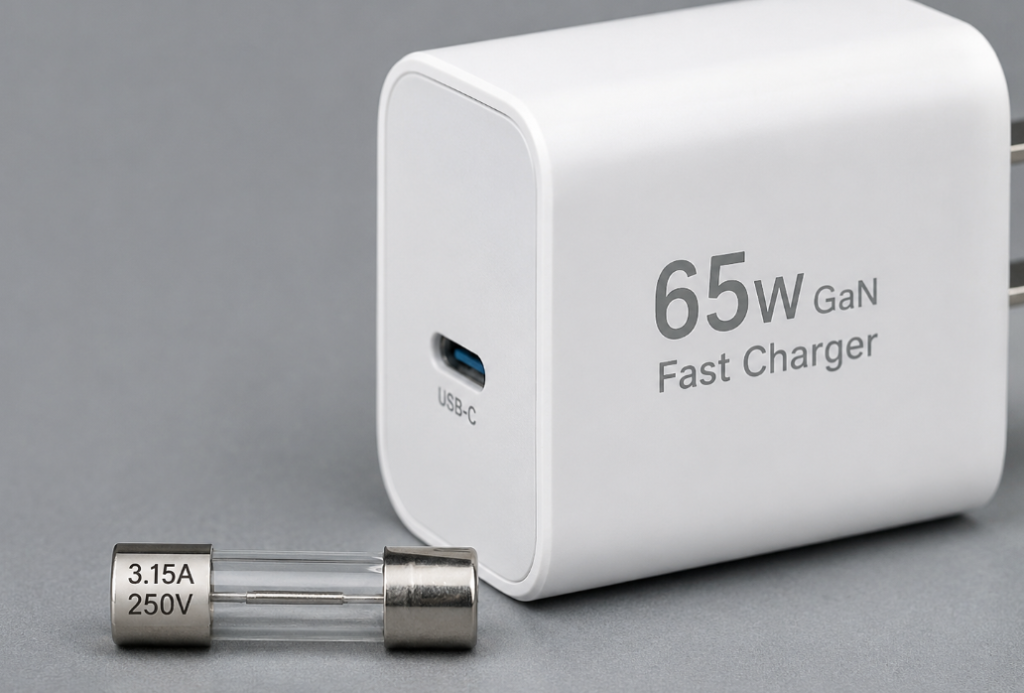
Choosing the right rated current depends on many factors: output power, input voltage, efficiency, power factor, inrush current, ambient temperature, time-current curve, and more. It’s not a guess. For reference, small USB chargers usually have input fuses from a few hundred milliamps to 1A. Fast chargers 65W and up may use 2A, 3.15A, or higher, depending on the design.
A key note for 100-120V regions: For the same output power, input current is higher than in 230V regions, so the fuse rated current may be higher. For example, a 65W charger draws roughly 0.7A at 110V (higher when accounting for efficiency), but only ~0.3A at 230V — so the fuse rating will be different.
Never replace a fuse with a higher-rated one. If it doesn’t blow when it should, you’ll get burnt boards, smoke, or fires. This is extremely dangerous.
Rated Voltage (Un): Determines If It Can Safely Disconnect When It Blows
Rated voltage is another core parameter. Put simply: it’s the voltage level where the fuse can safely extinguish the arc when it blows, without sustained arcing, failure to disconnect, or bursting.
Common ratings are 125V, 250V, and others. Wide-voltage chargers must have input fuses rated for at least 250V, otherwise if you use them in a 230V region and they blow, they may not extinguish the arc, leading to sustained sparking that can burn through the case.
Regular users don’t need to take apart a charger to check the fuse voltage. Just check the input voltage range on the charger label and that it has the right regional safety certifications. Reputable wide-voltage products will have matching input protection components.
Breaking Capacity: Can It Safely Disconnect During a Severe Short?
Breaking capacity is a spec many people don’t know about, but it’s critical. In simple terms: it’s the maximum short-circuit current the fuse can safely interrupt without bursting, sustained arcing, or sparking.
Why does this matter? Mains short circuits have huge energy — if the live and neutral wires touch directly in an outlet, short-circuit current can be hundreds or thousands of amps. If the fuse’s breaking capacity is too low, it might shatter, or keep arcing and catch fire, instead of protecting you. So input side fuses have to be rated for the grid’s fault current levels.
How can regular users tell if breaking capacity is adequate? You don’t need to check the individual fuse spec. If the whole charger has passed the regional safety certification, that means the protection components meet requirements for standard fault tests. A brand saying “high breaking capacity” in marketing means nothing without official certification backing it up.
Time-Current Curve: Why Fuses Blow at Different Speeds for the Same Current
The time-current curve shows roughly how long a fuse will take to blow at different overload multiples. For example, at 2x rated current, it might take a few minutes to blow. At 10x+ short-circuit current, it might blow in milliseconds.
This curve matters because charger fuses have to hit a balance: they have to survive normal startup inrush current without blowing, but blow fast enough during a real short to protect other components. It’s not just “if operating current is lower than rated current, it’s fine” — you have to account for surges, temperature, safety margin, and more. Regular users don’t need to try to calculate this themselves.
The Right Way for Regular Users to Check Specs
You don’t need to take apart the charger to read the fuse printing. Use these methods instead:
- Check the label on the charger itself: input voltage range, maximum input current, output power, and certification marks. These are required by regulation — if they’re missing, it’s almost certainly a no-name junk product.
- Check the official website, user manual, safety certification documents, or reputable third-party teardown reviews. These usually mention protection component details.
- Prioritize whole-device safety certifications, not individual fuse specs. Safety is a system design, not a single part.
Critical safety reminder: The high-voltage capacitors inside a charger can hold a dangerous charge even after you unplug it. Never take apart a charger yourself — you risk severe electric shock.
Real-World Scenarios: What Blows a Fuse, and How to Spot It
When a charger stops working, many people immediately assume the fuse is blown, but that’s not always the case. Let’s break down the situations that actually blow fuses, and the faults that are often mistaken for blown fuses.
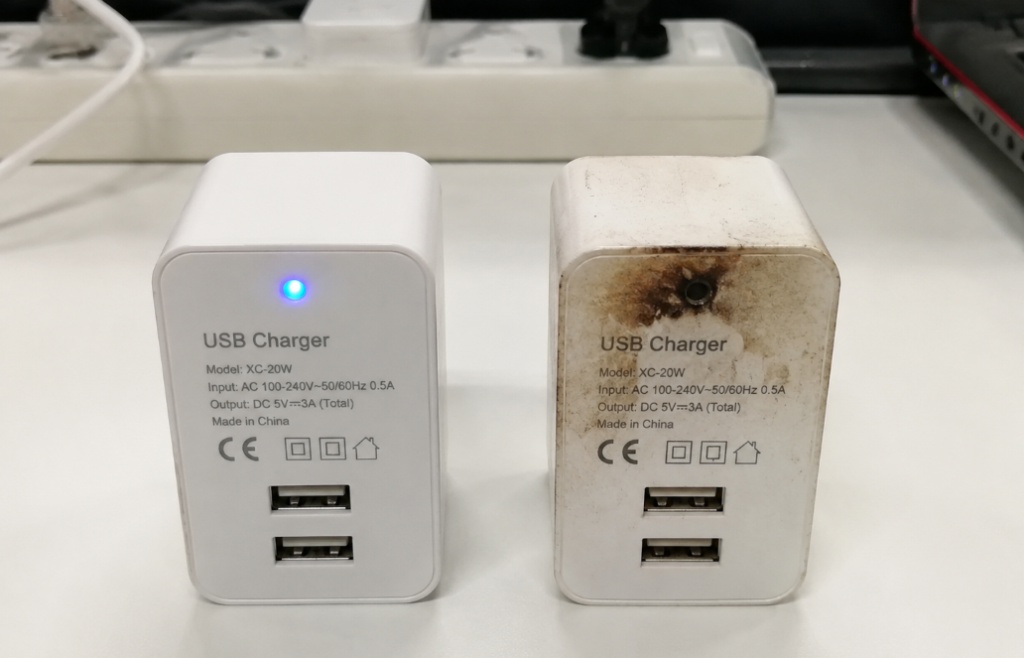
Common Situations That Actually Blow a Fuse
Fuses only blow when current is high enough for long enough. Common scenarios include:
- Severe internal short circuit: Water damage, a dropped charger with shifted components touching, solder bridges, rectifier or power MOSFET breakdown. All of these cause input current to spike, and the fuse blows quickly.
- Extreme output side short: For example, a charging cable pierced by a metal object, shorting positive and negative directly, and the charger’s electronic current limiting fails, so the fault spreads to the input side. Normal output shorts are handled by electronic protection, so the fuse never gets involved.
- Lightning/grid surge: If surge protection components can’t handle an abnormally high voltage, they break down and short out, creating a sustained overcurrent. The fuse then blows to cut input power and stop the fault from spreading.
- Long-term high load + high heat: Constant full-load operation plus high ambient temperature ages the fuse and surrounding components, fatiguing the melt element until it blows early.
- Wrong voltage use: For example, a 110V-only charger plugged into a 230V outlet. Input components break down from overvoltage, create a short, and blow the fuse. This is why you always check input voltage range before traveling.
Common Faults That Get Mistaken for a Blown Fuse
Many issues look like a blown fuse but aren’t:
- A dead outlet or power strip, or poor electrical contact. The charger won’t turn on at all, but works fine when plugged into a different outlet.
- Triggered overheat protection. If the charger was under a blanket, it will shut off temporarily when it gets too hot, and work again once it cools down.
- A broken charging cable, dirty phone port, or device-side BMS issue. The charger itself is fine, but it won’t charge the device.
- Fast charging protocol handshake failure. For example, using a non-PD cable with a PD charger — you might get slow charging or no charging at all, but it has nothing to do with the fuse.
- A tripped home circuit breaker or power strip overload protection. That doesn’t mean the charger’s internal fuse is blown.
Typical Signs of a Blown Fuse (Don’t Take It Apart to Check)
The core sign of a blown fuse is no response at all when plugged in: no indicator light, no output power. But this is only a preliminary sign — other internal faults can cause the same symptom.
It’s more likely to be a blown fuse if there are other clues: water exposure before it broke, it was dropped, there was a visible spark when you plugged it in, you smelled burning, it broke after a storm/grid glitch, or the case is deformed or has burn marks.
Troubleshoot in this order: First try a known working outlet, then a known good charging cable, then a different device. If it still does nothing, it’s probably an internal fault — but not necessarily a blown fuse. Final diagnosis requires professional testing. Never open the case to measure it yourself — electric shock risk is high.
Special Cases for International Travel and Car Chargers
For travelers or people who use car chargers regularly, watch for these unique scenarios:
- Travel adapters: They only change the plug shape, not the voltage! If your charger doesn’t support the local voltage, even if the adapter fits, it will suffer overvoltage breakdown and blow the fuse.
- Old outlets/power strips: High contact resistance can cause the plug or power strip to overheat locally, even burn out, but the charger’s fuse might not blow — because the current isn’t necessarily too high; the problem is bad contact.
- Car chargers: When you start or turn off your car, the cigarette lighter voltage fluctuates a lot. Usually this triggers electronic protection first, but severe fluctuations can damage internal components — not necessarily blow the input fuse.
- Unstable voltage regions: Frequent surges and power cycles make properly rated slow-blow fuses and good surge protection even more important. No-name chargers break easily in these areas.
How to Tell If a Charger’s Fuse Protection Is Actually Reliable
Many brands use “built-in fuse” as a selling point, but having a fuse is one thing — having a properly designed, reliable fuse protection system is another. Here are a few simple ways to judge without taking the charger apart.
Check Certifications (But Know the Difference Between Safety, Compliance, and EMC Marks)
Certifications are the most reliable way to assess safety, but not all certifications are equal. Don’t be fooled:
- North America: UL Listed, ETL Listed, and CSA are safety-focused certifications that test for electrical safety, fire resistance, and shock protection. FCC is mainly for electromagnetic compatibility (EMC) and wireless — it is not an electrical safety certification. Don’t see an FCC mark and assume the product is safe.
- EU/UK: CE and UKCA are compliance marks, meaning the manufacturer self-declares the product meets relevant requirements. They do not necessarily mean a third party tested for safety. Third-party marks like GS or TÜV carry much more weight.
- Japan: PSE is a mandatory requirement for electrical appliance safety. Products officially imported or sold in Japan should meet these regulations.
- Other regions: Look for locally recognized safety certifications and sales compliance requirements, like SAA for Australia, KC for South Korea, and so on.
Remember: Whole-device safety testing verifies that the product won’t cause fire or shock under fault conditions. The fuse is just one part of that evaluation. A product with proper certification will have a correctly rated fuse, which is way more reliable than a brand just saying “it has a fuse”.
Avoid These 2 Fake “Protection” Tricks
Two types of fake protection are extremely dangerous, and you should avoid them at all costs:
The first is replacing the fuse with copper wire, steel wire, or solder. This is the same as having no protection at all. It won’t blow during a short, so fire risk is extremely high. Some cheap no-name products or unprofessional repairs do this.
The second is mismatched fuse specs. For example, a low-power charger with a far too high rated current fuse. It won’t blow when it should, so the fault causes more damage.
Uncertified cheap products may skip the input fuse entirely, along with surge protection, flame-retardant case, and creepage distance (the required gap between high-voltage and low-voltage components to prevent arcing). They run on pure luck. Any product that only says “multi-protection” or “smart power off” but has no certification, no model number, no manufacturer, and no full input/output specs — never buy it.
What to Do If You Suspect a Blown Fuse: Don’t Replace It, Don’t Short It
If you think the fuse is blown, never take apart the charger to replace it, and never bypass it with wire. There are three key reasons:
- Electric shock risk: The high-voltage capacitors inside can hold a dangerous charge even after unplugging. Non-professionals don’t know how to discharge them safely.
- It doesn’t fix the root cause: Fuses almost always blow because of an internal fault, like a broken power transistor. If you just replace the fuse, it will blow again immediately, and may cause worse damage.
- It breaks the safety design: If you use a fuse with wrong specs — too high current, too low voltage, insufficient breaking capacity — you disable the protection entirely, leading to worse consequences.
The correct approach: For regular phone/tablet chargers, which are relatively inexpensive, just replace it with a new, certified product. For high-value original laptop power adapters, contact the manufacturer or a professional repair service to see if it’s worth fixing.
Frequently Asked Questions
- Q: Do fast chargers blow fuses more often?
A: Not if they’re properly designed. Manufacturers choose fuses matched to the charger’s power, surge characteristics, and temperature rise. Normal use shouldn’t cause frequent blows. Only no-name chargers, bad thermal design, or wrong fuse ratings cause frequent issues. - Q: Can a resettable fuse replace the input side fuse?
A: Absolutely not. Resettable fuses (PPTC) are for low-voltage output side use. Their voltage rating and breaking capacity are way too low to handle mains voltage and high short-circuit energy. Using one on the input side is extremely dangerous. - Q: Do fuses have a lifespan?
A: Yes. Long-term exposure to high heat, repeated surges, and full-load operation accelerates aging of the melt element, shortening its life. Usually, the lifespan is matched to the whole charger’s lifespan, so you don’t need to replace it separately under normal use. - Q: I dropped my charger — is it still safe to use?
A: If the case isn’t cracked, there’s no rattling inside, it doesn’t get hot when plugged in, there’s no burning smell, and output is normal, it’s probably fine for now. But if the case is cracked, there’s rattling, abnormal heating, burning smell, or unstable output, stop using it immediately. Internal components may have shifted, creating a short-circuit risk.
Reality Check: Fuses Aren’t Magic — They Work Best With Multi-Layer Protection
For all their importance, fuses have clear limits. A safe, reliable charger relies on multiple layers of protection working together, not just a single fuse.
Key Limitations of Current Fuses
Current fuses have very clear boundaries you need to understand:
- They only handle overcurrent and short-circuit risks. They can’t directly fix overcharging, protocol errors, mild overheating, insulation aging, or electrical leakage.
- They have a delay before blowing. Mild overload can take a long time to trigger them — they don’t blow the second current goes over the rating.
- Their protection range is limited. They mainly target severe faults on the charger’s input side and internal parts. They don’t handle full battery safety management for your phone.
- They can’t fix structural issues like cheap materials, non-flame-retardant cases, or insufficient creepage distance. Even if the fuse blows, if the case is flammable plastic, it can still catch fire.
Common Supporting Protections in a Good Charger
A proper charger has far more than just an input fuse. All these work together as a coordinated safety system:
- Input surge protection: Uses MOVs, NTCs, TVS diodes, and more to absorb or clamp abnormal grid spikes, protecting downstream components.
- Overheat protection: Reduces power first if temperatures get too high, then shuts off if needed. Severe cases trigger a thermal fuse for one-time cutoff.
- Output overcurrent/short protection: Electronic current limiting, super fast, resettable. Handles daily issues like USB port shorts or damaged cables.
- Overvoltage/undervoltage protection: Stops working immediately if input or output voltage is abnormal, preventing damage to connected devices.
- Insulation and flame-retardant design: Isolation transformers, safety capacitors, sufficient creepage distance, and a flame-retardant case all work together to reduce shock and fire risk.
Why Good Chargers Need Multiple Layers of Protection
You might wonder: Why have all these protections? Why not just use a fuse? Because faults come in different severities, and you need different levels of protection for each:
- Minor daily issues: Like a shorted output cable or high ambient temperature. Electronic protection handles these first — fast, resettable, no interruption to normal use.
- Severe hard faults: Like internal power transistor breakdown or severe component short. Electronic protection can’t handle these, so one-time protections like the input fuse and thermal fuse cut power completely to stop the fault from spreading.
- Structural safety: Even if something burns inside, the flame-retardant case and isolation design contain the fire, so it doesn’t ignite surrounding materials or shock anyone.
Multiple layers of protection cover everything from minor glitches to catastrophic failure. No single part can do it all.
Which Protection Acts First for Different Faults?
Here’s a quick breakdown of which protection will trigger first for common faults, so you can make a rough guess if you run into issues:
- If the charger is covered or the environment is very hot: Overheat protection or the thermal fuse will act first. Only if the fault gets bad enough to cause a short will the current fuse blow.
- If a charging cable is damaged and shorted: Electronic short protection acts first. Only if that fails and the fault spreads to the input side will the current fuse blow.
- If you have a cheap outlet with bad contact: The plug or power strip will overheat and burn first. The charger’s fuse might not blow, because the current isn’t necessarily too high.
- If there’s a lightning surge: Surge protection components take the hit first. Only if the surge is bad enough to short them out will the input fuse blow.
- If an internal power transistor breaks down: Input current spikes immediately, so the input fuse blows very fast to cut power.
Buying & Using Chargers Safely: A Simple Decision Framework for Regular Users
After all the theory and specs, let’s get practical: How do regular users choose and use chargers to minimize safety risks? You don’t need to memorize every parameter — just follow this logic.
Safety Checks When Buying a Charger
Don’t just look at power and price. Prioritize these factors:
- Buy from reputable brands and authorized sellers. The product should have compliance marks for your region and a full, clear label with all specs. If it doesn’t list input and output specs clearly, skip it.
- Check the input voltage range: If you travel internationally a lot, make sure it’s 100-240V wide voltage. Don’t just check if the plug fits.
- Check output specs: Total power, per-port power, supported protocols, and maximum input current should all be clearly listed. If they’re vague, don’t buy it.
- Check build quality: Does the case have a flame-retardant mark? Are the prongs tight? No strong chemical smell? Even gaps, no loose parts? Small details reflect overall build quality.
- Never use “has a fuse” as your only safety standard. Look at the overall safety design and certifications.
Daily Habits to Reduce Risk
Even a high-quality charger can be dangerous if used wrong. Follow these simple rules:
- Don’t use damaged charging cables, loose outlets, cheap adapters, or overloaded power strips.
- Don’t cover chargers with blankets, pillows, or clothes while charging. Keep them well-ventilated.
- When using multiple ports at once, don’t exceed the rated total power for long periods.
- Never plug in a charger that’s been water-damaged, dropped and deformed, makes rattling noises, or smells like burning.
- Avoid plugging high-power laptop chargers into low-quality extension cords or old power strips.
What to Do When Something Goes Wrong
Don’t panic if your charger acts up. Follow this troubleshooting order:
- If it occasionally won’t charge, no heat, no burning smell: First try a known working outlet, then a good cable, then a different device. Most of the time the problem is the cable or outlet.
- If the indicator light is on but it won’t charge: Check the cable, port, protocol compatibility, or the device itself. It’s almost never the fuse.
- If the charger gets noticeably hot, cuts in and out, or has unstable output: Stop using it, even if it still works. Replace it with a certified charger.
- If you smell burning, see smoke, the case is deformed, the plug is burnt, or it trips your breaker when you plug it in: Unplug it immediately, move it away from flammable materials, and dispose of it properly. Don’t try to fix it or plug it back in.
- If multiple devices have issues on the same outlet: Don’t just blame the charger. Check the outlet, power strip, or grid first.
Extra Tips for Travel, Car Use, and High-Power Chargers
If you travel a lot, use a car charger, or have a high-power laptop charger, keep these additional tips in mind:
- Before traveling, confirm your charger’s input voltage covers the local mains voltage. Don’t just check if the plug fits. Plug adapters only change shape, not voltage. Voltage transformers change voltage — they’re not the same thing.
- Buy reputable brand car chargers. Avoid ones with loose cigarette lighter plugs or cheap high-power multi-port models. Car voltage fluctuates a lot when starting the engine, and cheap ones break easily.
- In areas with unstable voltage, avoid leaving charging devices unattended, especially high-power ones.
- If you travel to multiple countries often, prioritize chargers with clear labels, full certifications, and wide-voltage input — you won’t have to swap them out for each trip.
Final Thoughts
By now, you should have a full picture of what charger fuses do and how they fit into overall charging safety. At their core, they’re simple: a physical last line of defense that sacrifices itself during severe overcurrent or short-circuit faults. They’re not magic, but they’re absolutely essential.
You don’t need to memorize every spec. Just remember these key points: Fuses only handle severe overcurrent and shorts, not overcharging, overheating, insulation issues, or protocol problems. Slow-blow fuses are the right choice for chargers, because they survive plug-in inrush current while still blowing during real faults. To judge safety, prioritize brand reputation, certifications, and overall design — not just whether it has a fuse. If your charger breaks, don’t take it apart to replace the fuse, and never bypass it with wire. Just replace it with a certified product.
Charging safety doesn’t come from one single part. It comes from compliant design, manufacturing, and use from start to finish. Knowing the basics helps you avoid almost all common risks.