
1. Introduction: The Invisible Conductor Behind Fast Charging
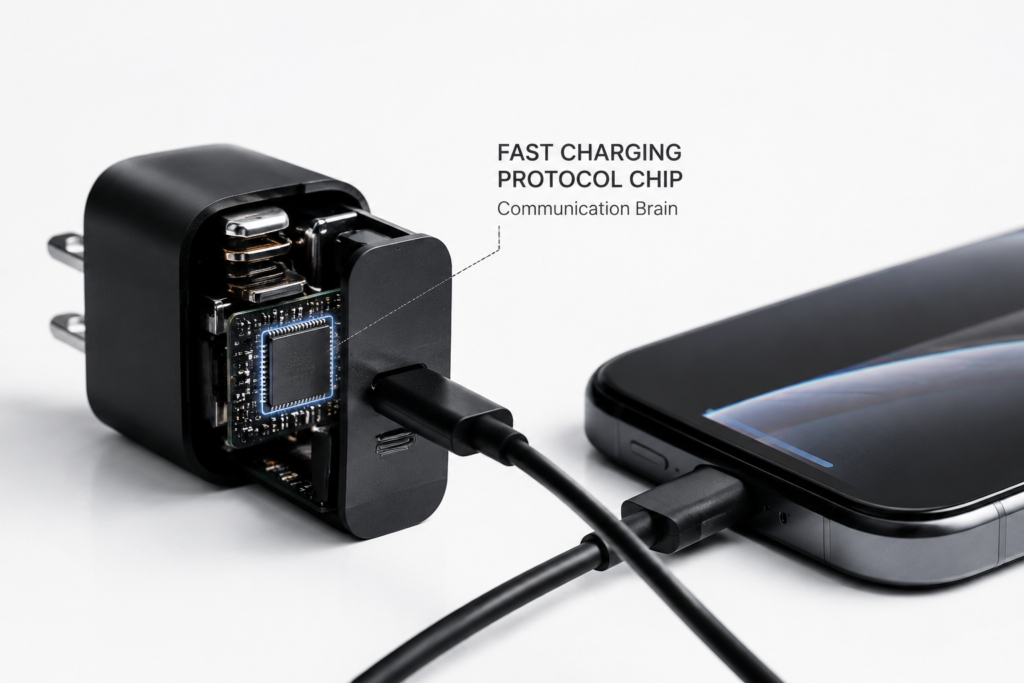
When you plug in a fast charger and get full-speed charging right away, there is an unseen core chip making it all work: the fast charging protocol chip.
From the early days of 5V slow charging to today’s 100W+ fast charging, simply raising voltage and current is not enough. If the charger and device cannot match their parameters, charging speed will drop at best, and damage the device or cause safety risks at worst. This is why charging requires an “intelligent negotiation” system, and the fast charging protocol chip acts as the communication brain for this process.
Put simply, the fast charging protocol chip is the negotiator between the charger and the device. It confirms the charging capabilities on both sides and matches the optimal power level. It has a different role from other well-known chips: power components (such as GaN transistors) handle the actual delivery of high voltage and current, power management ICs (PMIC) manage battery charging inside the device, and protocol chips specialize in communication and rule matching between the two ends.
2. Development of Fast Charging Protocols and Main Standards
2.1 Early USB Charging: The Low-Power Era of Fixed 5V
The earliest USB charging used a fixed 5V voltage, with a maximum output of only a few watts to over a dozen watts. It worked with all devices, but charged very slowly and could not keep up with the power needs of large-screen phones.
2.2 Rise of Proprietary Protocols: Fast Charging Technologies From Major Brands
To speed up charging, major manufacturers launched their own proprietary fast charging standards, such as Qualcomm Quick Charge, Huawei SCP, OPPO VOOC and Samsung AFC. These protocols delivered faster charging, but were not compatible with each other. Using a charger from a different brand often resulted in only slow charging.
2.3 Mainstream Universal Standard: The USB PD Protocol Family
The USB-IF organization introduced the USB PD universal fast charging protocol, which has become the accepted “common language” for charging. From PD 2.0 and PD 3.0 to the latest PD 3.1, the maximum power has increased from 100W to 240W. Today, most USB-C phones and laptops support the USB PD standard.
2.4 New Trend of Unified Charging: UFCS Universal Fast Charging Standard
To solve the problem of fragmented protocols, China launched the UFCS universal fast charging standard. Its goal is to break down barriers between proprietary protocols from different brands, enabling cross-brand fast charging between chargers and devices. It is currently being rolled out gradually.
Table 1: Comparison of Common Fast Charging Protocols
| Protocol Name | Protocol Type | Typical Max Power | Common Devices |
|---|---|---|---|
| USB PD 3.0 | Universal public protocol | 100W | Smartphones, laptops, tablets |
| USB PD 3.1 EPR | Universal public protocol | 240W | High-performance laptops, portable monitors |
| Qualcomm Quick Charge | Proprietary protocol | 100W+ | Android phones with Qualcomm chipsets |
| Huawei SCP | Proprietary protocol | 100W+ | Huawei and Honor smartphones |
| UFCS | Unified universal protocol | 240W | Chinese smartphones and chargers with unified fast charging support |
3. How Fast Charging Protocol Chips Work
3.1 Full Charging Handshake Process: From Plug-in to Full-Speed Charging
A complete fast charging session is like a short conversation: when the cable is plugged in, the charger first detects a connected device; both sides then share their supported charging specifications; they select the fastest mode supported by both sides; finally the charger adjusts its output voltage and current and starts full-speed charging. When the battery is nearly full or gets too hot, the chip will automatically reduce power.
3.2 Two Core Communication Methods
Fast charging protocols communicate mainly through two paths: one is the dedicated communication pin inside the USB-C connector, used mainly for USB PD protocol; the other is the data pins of traditional USB connectors, used mostly for older protocols like QC and AFC.
3.3 Three Core Functions: Power Negotiation, Dynamic Voltage Adjustment and Safety Protection
Fast charging protocol chips have three core jobs. First, power negotiation to match the maximum capabilities of charger and device. Second, dynamic voltage adjustment to tweak voltage and current in real time as charging progresses. Third, safety protection that cuts off output immediately when an anomaly is detected, protecting both the device and the battery.
4. Common Types of Fast Charging Protocol Chips
4.1 Classified by Working Role
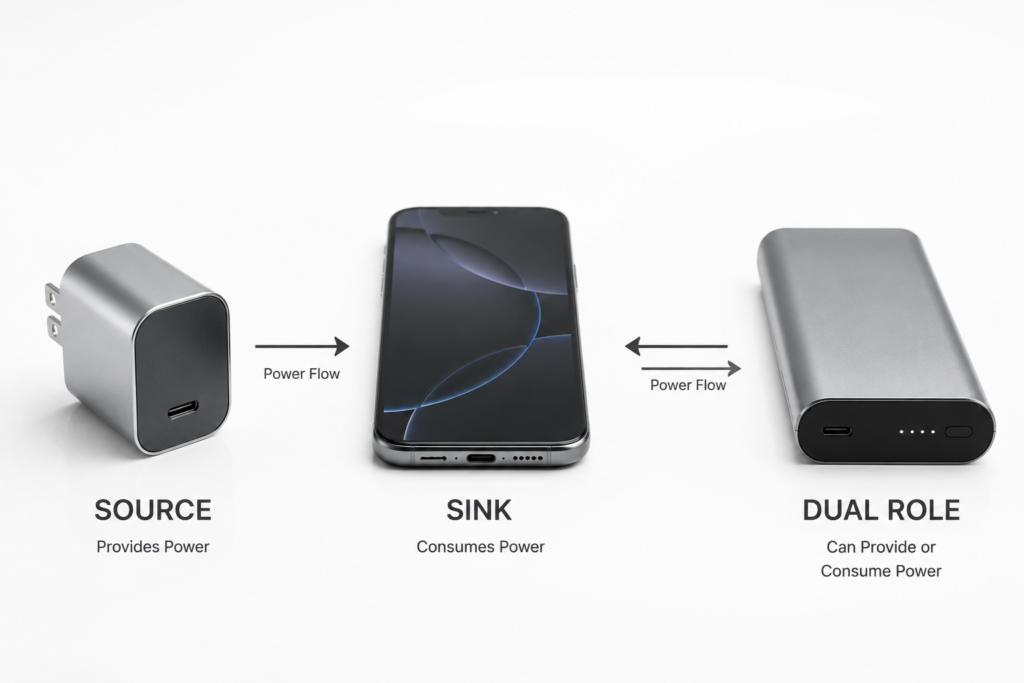
- Source-side chips: the control core of chargers and car chargers Installed in power supply devices such as wall chargers and car chargers, they broadcast charging capabilities, receive charging requests from devices, and adjust output power.
- Sink-side chips: power intake management for phones and end devices Installed in powered devices like phones and tablets, they identify charger specifications, request appropriate power levels, and manage the power intake process.
- Dual-role chips: multi-role adaptation for devices like power banks They can switch between source and sink roles, and are mainly used in power banks and docking stations to charge other devices as well as receive charging themselves.
4.2 Classified by Integration Level
- Standalone protocol control chips They only handle protocol communication and work together with other power chips, suitable for high-power, customized fast charging products.
- Highly integrated SoC chips They combine protocol control, power regulation and safety protection all in one chip. With fewer external components, smaller size and lower cost, they are widely used in regular chargers and power banks.
Table 2: Comparison of Fast Charging Protocol Chips by Role
| Chip Type | Main Installation Location | Core Function | Typical Products |
|---|---|---|---|
| Source-side chip | Wall chargers, car chargers, fast charging power strips | Broadcast power capabilities and adjust output | GaN chargers, in-car fast charging adapters |
| Sink-side chip | Phones, laptops, small appliances | Identify charger specs and request suitable power | Smartphones, USB-C desk lamps, electric shavers |
| Dual-role (DRP) chip | Power banks, portable docking stations | Switch between charge and discharge modes | Bidirectional fast charging power banks, portable energy storage |
5. Major Manufacturers and Representative Products
5.1 Leading International Chip Manufacturers
International manufacturers have early beginnings, deep technical expertise and full certifications. They are widely used in high-end fast charging products. Representative companies include Texas Instruments (TI), Infineon, STMicroelectronics (ST) and NXP.
5.2 Leading Domestic Chip Manufacturers
Domestic Chinese chips have developed rapidly, offer high cost performance and better support for local proprietary protocols, and now account for most of the consumer fast charging market. Representative companies include Injoinic, Southchip, Smartrons and Chipsea.
6. Everyday Applications: Where Fast Charging Protocol Chips Are Hidden
6.1 Phone Chargers and GaN Fast Chargers
This is the most common application. In GaN chargers, protocol chips work together with GaN power devices to deliver high power in a small form factor.
6.2 Power Banks and Bidirectional Energy Storage Devices
Power banks contain dual-role protocol chips that can both recognize a phone’s charging needs to deliver power, and recognize a charger’s power level to recharge themselves.
6.3 Car Chargers
The protocol chip inside a car charger converts the car’s 12V power into the fast charging levels supported by a phone.
6.4 Laptops, Tablets and Other Digital Devices
The USB-C charging ports on laptops and tablets have built-in sink-side protocol chips that support USB PD fast charging for universal compatibility.
6.5 Smart Home and Small Appliance USB-C Power
More and more small appliances such as desk lamps, electric shavers and portable speakers now use USB-C power, with small protocol chips inside to work with fast chargers.
7. Key Specs Everyday Users Should Understand
7.1 Protocol Compatibility: Determines Whether Fast Charging Works
The more protocols a chip supports, the more devices it can work with, and the less likely you will get slow charging with a fast charger.
7.2 Power Rating: Determines the Upper Limit of Charging Speed
The maximum power supported by the chip sets the speed ceiling. Around 20W is enough for regular phones, 65W and above can charge laptops, and 240W is for high-performance devices.
7.3 Safety Protection Capability: The Foundation of Charging Safety
Genuine fast charging protocol chips all come with four standard protections: over-voltage, over-current, over-temperature and short-circuit protection. This is the foundation of safe charging.
7.4 Integration and Power Consumption: Affect Device Size and Energy Use
Higher integration allows chargers to be made smaller. Lower standby power means less wasted electricity when the charger is idle.
8. Industry Challenges and Future Trends
8.1 Current Pain Point: Protocol Fragmentation and Compatibility Issues
Today there are many proprietary protocols with inconsistent standards, leading to poor cross-brand fast charging experiences and confusion for consumers. This is the biggest pain point in the industry.
8.2 Technology Evolution Directions
- Higher power: popularization of 240W and above fast charging With the rollout of the PD 3.1 standard, 240W fast charging will gradually become common, covering more high-power devices like gaming laptops and monitors.
- Higher integration: more functions in a single chip Protocol chips will continue to integrate power drivers, protection circuits and more, making chargers smaller and lower cost.
- Smarter charging: adaptive charging and battery health optimization Smart charging algorithms will adjust speed based on battery temperature, charge level and usage habits, extending battery lifespan.
- Greater standardization: continued growth of unified charging ecosystems Unified standards like UFCS will continue to spread, gradually breaking down protocol barriers and eventually enabling “one charger for all devices”.
8.3 Development and Breakthroughs of Domestic Fast Charging Chips
Domestic Chinese fast charging protocol chips have caught up with global leaders. They have made remarkable progress in multi-protocol compatibility and high-integration design, and now dominate the consumer market thanks to their cost advantage and local support.
9. Conclusion
Though small and unseen, the fast charging protocol chip is the intelligent bridge connecting chargers, cables and devices. It determines how fast you can charge, how many devices your charger works with, and how safe the whole process is. As universal charging standards spread and chip technology advances, charging will become simpler and more reliable, bringing us a truly universal, safe and efficient charging experience.