
If you’ve shopped for phone or laptop chargers lately, you’ve probably seen the term “GaN” everywhere. These chargers promise more power in a smaller, lighter package — but what exactly is GaN, and why does it make chargers better? This guide breaks it down in plain language, no engineering degree required.
1. What Is a GaN Charger, Anyway?
A GaN charger is a modern power adapter built with gallium nitride, a new type of semiconductor material.
The core upgrade is simple: traditional chargers use silicon to make the internal high-speed switch that controls electricity flow. GaN chargers replace that silicon switch with one made of gallium nitride, which switches much faster and wastes less energy as heat.
GaN is not a new charging cable or charging standard. It is just an upgrade to the internal parts inside the charger. It works with all your regular USB-C devices and supports standard fast charging rules like USB PD.
2. Why GaN Chargers Are Smaller
The biggest reason people buy GaN chargers is their compact size. Here is the logic in plain terms:
The “bucket brigade” rule
Think of electricity inside a charger like water being passed along a bucket brigade.
- The switch turns on and off to move energy forward.
- The “buckets” are the internal parts that store and transfer energy (mainly the transformer and inductor).
- A faster brigade can move the same total amount of water with smaller buckets.
Old silicon chargers
Silicon switches are relatively slow. To deliver enough power, they need large, bulky “buckets” (big transformers and inductors). That is why old 65W laptop chargers were so big and heavy.
GaN chargers
GaN switches can turn on and off many times faster. Faster switching means the energy-storing parts can be much smaller. The end result: the same 65W of power fits into a charger roughly half the size.
The miniaturization chain
Faster GaN switch → higher switching speed → smaller internal parts → smaller and lighter charger
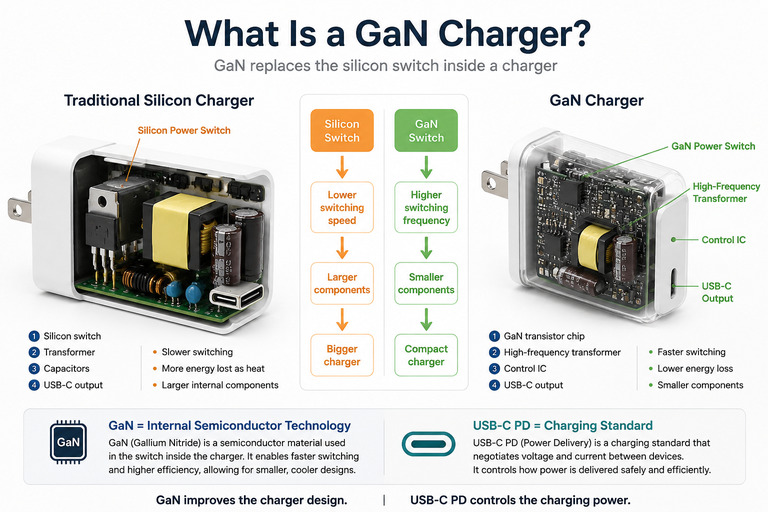
3. What’s Inside a GaN Charger
You don’t need to memorize every part, but it helps to know the basic steps electricity takes from the wall socket to your phone:
- Input filter
Cleans up noisy, fluctuating electricity from the wall socket. - AC-to-DC converter
Turns the alternating current (AC) from your wall into steady direct current (DC). - GaN power switch
The core component. It turns the high-voltage DC on and off at extremely high speed. - Transformer
Steps the high voltage down to a low, safe level for your phone or laptop, and also keeps dangerous high voltage separated from your device. - Smart control chip
Talks to your phone or laptop, figures out how much power it needs, and adjusts the output accordingly. - Output stage & protection
Smooths out the final power, and includes safety features to stop overheating, overcharging and short circuits.
4. Common Power Levels & What They’re For
GaN chargers come in different wattages. Pick the right one based on what you charge:
30W–65W
The most popular and affordable range. Perfect for smartphones, tablets, handheld game consoles and other small gadgets. Great for everyday carry.
100W–140W
The sweet spot for laptop users. Charges most thin-and-light laptops at full speed, and usually has multiple ports so you can charge your phone and laptop at the same time. Ideal for travel.
200W and above
Mostly desktop charging stations. For gaming laptops, or people who want to charge 3–4 devices at once from one plug. Best kept on a desk rather than carried around.
5. GaN vs. Traditional Silicon Chargers
At the same power rating, here is how they compare:
| Feature | Old Silicon Charger | GaN Charger |
|---|---|---|
| Size for the same wattage | Bulky and large | Compact and small |
| Heat during charging | Runs warmer | Runs noticeably cooler |
| Energy wasted as heat | More | Less |
| Price | Cheaper | More expensive |
| Portability | Mediocre | Excellent |
| Design complexity | Simple | More advanced |
They each have their place. Silicon chargers are still great for cheap, stationary use. GaN chargers shine when you want small size, light weight and less heat.
6. Common Myths Debunked
Myth 1: GaN chargers automatically charge your phone faster
Fact: Charging speed mostly depends on the wattage and what your phone supports.
A 25W GaN charger will not charge faster than a 65W silicon charger. GaN does not make charging faster by itself — it lets high-power chargers be made smaller.
Myth 2: GaN chargers never get warm
Fact: They run cooler than old chargers, but all power adapters produce some heat.
It is normal for a fast charger to feel warm during a quick top-up. Good design keeps the temperature safe and comfortable.
Myth 3: All “GaN” chargers perform the same
Fact: Quality varies a lot between brands.
Two 65W GaN chargers can differ a lot in real efficiency, heat and safety. Build quality, internal design and safety components matter just as much as the GaN chip itself.
Myth 4: GaN will completely replace silicon chargers
Fact: They work side by side.
Silicon chargers are still cheaper and work perfectly for low-power, basic use. GaN is for the premium, small-size, high-power segment.
7. How to Choose a Good GaN Charger
Follow these simple rules to avoid bad buys:
- Match the wattage to your devices
Get 30–65W for phones and tablets; 100W+ for laptops. - Check fast charging compatibility
Make sure it supports the standards your device uses (most modern devices work with USB PD, which is universal for USB-C). - Read the fine print on multi-port models
A 100W multi-port charger usually cannot deliver 100W to every port at the same time. Check how power splits when multiple devices are plugged in. - Stick to trusted brands with safety marks
Look for safety certifications like UL, CE or FCC. These are a much better sign of quality than marketing words like “3rd generation GaN.” - Compare size for the same wattage
For two 65W chargers, the smaller one generally uses better design and more advanced engineering.
8. Limitations of GaN Chargers
GaN is great, but it is not perfect:
- It costs more than basic silicon chargers.
- The high-speed design requires more careful engineering, so cheap no-name GaN chargers can have quality issues.
- If you just need a cheap charger that stays on your desk forever, a regular silicon charger is still a very cost-effective choice.
9. The Future of GaN Chargers
- Prices will keep falling as the technology becomes more mainstream.
- More power in even smaller sizes will become standard.
- GaN will show up in more devices, not just phone and laptop chargers — including power supplies for TVs, small appliances and even car electronics.
- Multi-port desktop chargers and ultra-slim travel adapters will become the norm.
Final Summary
GaN chargers are not some magical new charging invention. They are simply a much better way to build a power adapter.
By using gallium nitride for the internal switch, chargers can run faster, waste less energy and use much smaller internal parts. The result is a smaller, lighter, cooler charger that delivers the same or more power.
For anyone who travels, carries multiple devices, or just hates bulky brick chargers, GaN is a very practical and worthwhile upgrade.