
1. Introduction: Why Are There So Many Shielding Designs?
1.1 What Does Cable Shielding Do?
We are surrounded by invisible electromagnetic interference (EMI) — think of it as background noise for electronics. Just as noise can ruin a conversation, EMI disrupts signals traveling inside cables, leading to slow data speeds, glitchy video, corrupted files, and unstable performance.
A cable’s shielding acts like a soundproof barrier for the wires inside. It blocks external interference from reaching the signal cores, and also prevents internal signals from leaking out and disturbing nearby devices. Different applications demand different levels of shielding performance, which is why so many designs exist.
1.2 Why Isn’t There One Universal Shield Type?
No single shielding structure works perfectly for every scenario. There are four key reasons for this variety:
- Interference comes in different frequency ranges — like high-pitched vs. low-frequency sound — and each shield type handles certain bands better than others.
- Flexibility and bend durability requirements vary wildly: some cables are installed permanently, while others are bent and flexed every day.
- There are constant tradeoffs between material cost, weight, and manufacturing complexity.
- Real-world environments range from low-interference homes to extremely noisy industrial settings.
1.3 What This Guide Covers
- What are the most common cable shielding types?
- What are the pros and cons of each?
- Which type is right for your use case?
2. The 4 Most Common Shielding Structures
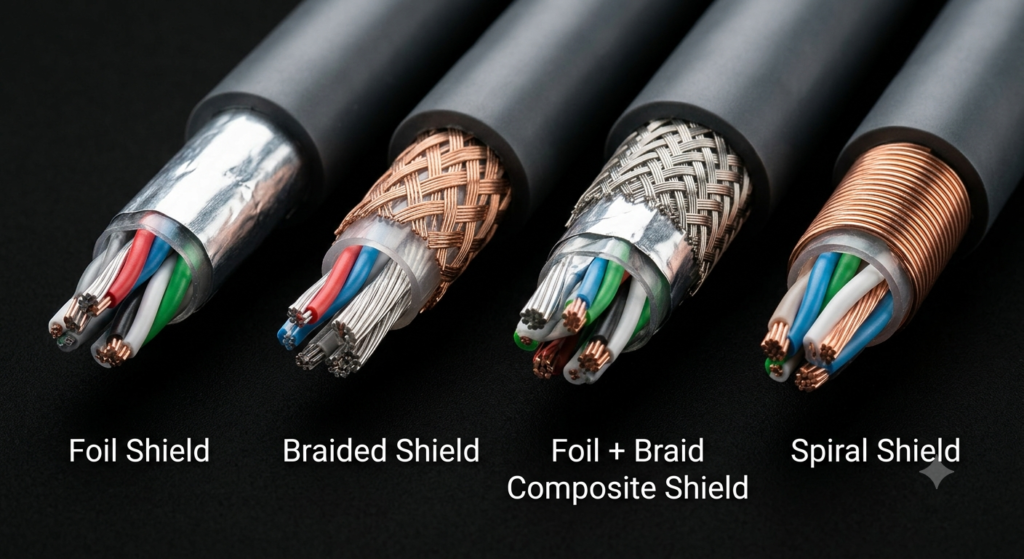
2.1 Foil Shield
Structure
A thin layer of aluminum foil (or occasionally copper foil) is tightly wrapped around the inner wire cores. It is almost always paired with a drain wire — a thin conductor that connects the foil to ground and safely carries away captured interference.
Key Advantages
- Delivers nearly 100% coverage of the wire cores
- Excellent performance against high-frequency electromagnetic interference
- Lightweight and low-cost to manufacture
Limitations
- Foil is relatively brittle and has average bend resistance
- Repeated flexing can cause cracks that degrade shielding performance
Common Uses
Standard USB cables, USB-C cables, HDMI cables, DisplayPort cables, FTP network cables
2.2 Braided Shield
Structure
Multiple strands of tinned copper wire are woven in a crisscross pattern to form a flexible mesh sleeve around the wire cores. It is one of the most classic and widely used shielding designs.
Key Advantages
- Great flexibility and excellent bend durability — stands up well to daily plugging and unplugging
- Provides a reliable ground connection
- Very effective at blocking low-frequency interference
Limitations
- Natural gaps in the weave allow some high-frequency interference to pass through
- Uses more material, so it costs more than foil shielding
Common Uses
Everyday general-purpose cables, audio/video cords, industrial communication cables, premium durable connection cables
2.3 Foil + Braid Composite Shield
Structure
A dual-layer design: an inner foil shield provides full, gap-free coverage, while an outer braided shield adds mechanical strength and low-frequency protection. Think of it as a sealed liner plus a reinforced outer barrier.
Key Advantages
- Delivers solid protection against both high and low frequency interference
- The most well-rounded, comprehensive EMI suppression available
- Maximizes signal stability for high-speed data transmission
Limitations
- Higher manufacturing cost
- Results in a thicker, stiffer, heavier cable
Common Uses
USB4 cables, Thunderbolt cables, HDMI 2.1 high-bandwidth video cables, high-resolution DisplayPort cables, flagship high-speed data cables
2.4 Spiral (Serve) Shield
Structure
Metal wires are wrapped helically around the wire cores in a spiral pattern. Unlike braided shielding, the wires run parallel to each other rather than crossing over.
Key Advantages
- Exceptional flexibility — the best bend performance of any shielding type
- Perfect for cables that are constantly moved and flexed
Limitations
- Moderate overall shielding effectiveness
- Weak performance against high-frequency interference
Common Uses
Headphone cables, microphone cords, wearable device cables, portable device cables where flexibility is a top priority
3. Less Common Shielding Structures
3.1 Longitudinal Metal Tape Shield
Structure
A rigid metal tape (usually copper or aluminum) is formed into a solid tube around the cable core, creating a fully sealed, highly conductive shield.
Typical Applications
RF coaxial cables, base station feeder lines, and other fixed industrial/telecom installations where sealing performance is critical and frequent bending is not required.
Why It’s Rare in Consumer Electronics
Very poor flexibility — easily damaged by everyday bending. It also requires complex manufacturing and comes at a high cost, making it unsuitable for consumer products.
3.2 Multi-Layer Composite Shield
- Double-layer shields: Typically combine two different materials (such as foil + braid) to cover both high and low frequency interference. This is common in high-end consumer cables.
- Three or more layers: Used in extremely harsh electromagnetic environments, such as aerospace, military communications, and high-precision medical equipment. These high-grade designs are almost exclusively used in professional and industrial systems, and rarely encountered by everyday consumers.
4. Other Ways to Classify Cable Shielding
4.1 By Coverage Scope
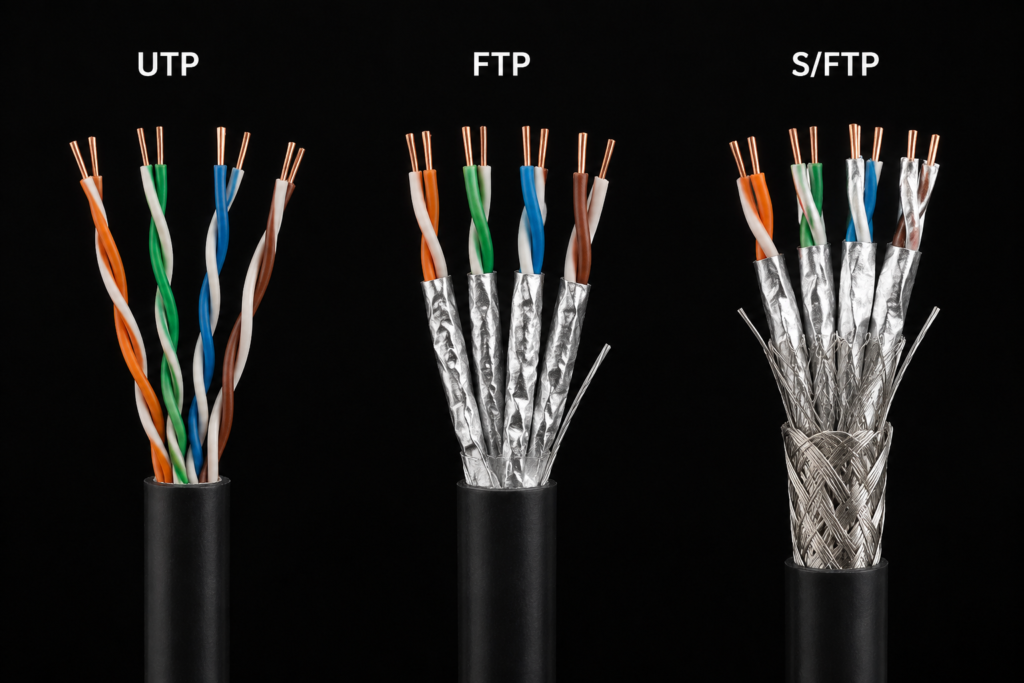
- Overall Shield: A single shield wraps around all wire cores inside the cable, like soundproofing an entire room. Simple and cost-effective for cables with low crosstalk risk.
- Individual Pair Shield: Each pair of wires (for example, each twisted pair in an Ethernet cable) gets its own separate shield, like soundproofing every individual room. It greatly reduces crosstalk — interference between wire pairs inside the same cable.
- Combined Shield: Uses both individual pair shielding and an overall shield for the highest level of protection. For example, S/FTP Ethernet cable has foil shielding on each twisted pair, plus an overall braided outer shield.
4.2 By Shield Material
- Tinned Copper: Copper strands coated with a thin layer of tin. Offers strong oxidation resistance and good solderability — the most widely used shielding material today.
- Bare Copper: Pure copper with superior conductivity and better shielding performance, but prone to oxidation. Used mostly in high-performance premium cables.
- Aluminum Foil: Excellent high-frequency performance, low cost, and near 100% coverage — the standard material for foil shields.
- Other materials: Copper-clad steel (high strength, low cost, but lower conductivity than pure copper), aluminum-magnesium alloy (popular for lightweight portable applications), and specialty composites for extreme high-frequency or corrosion-resistant use cases. These are uncommon in everyday consumer products.
5. Side-by-Side Comparison of Shielding Types
The table below summarizes how the four main shielding types perform across key criteria:
| Shielding Type | High-Frequency Performance | Low-Frequency Performance | Flexibility | Cost | Common Applications |
|---|---|---|---|---|---|
| Foil Shield | Excellent | Fair | Fair | Low | USB cables, HDMI cables, FTP Ethernet |
| Braided Shield | Fair | Good | Good | Medium | Everyday cables, audio cords, industrial wires |
| Foil + Braid Composite | Excellent | Excellent | Poor | High | USB4/Thunderbolt, 8K video, high-speed data |
| Spiral Shield | Poor | Fair | Excellent | Medium | Headphones, microphones, wearables |
Note: There is no universal “best” or “worst” shielding. Each type excels in specific scenarios, and the right choice depends on your actual needs.
6. How to Choose the Right Shielding for Everyday Use
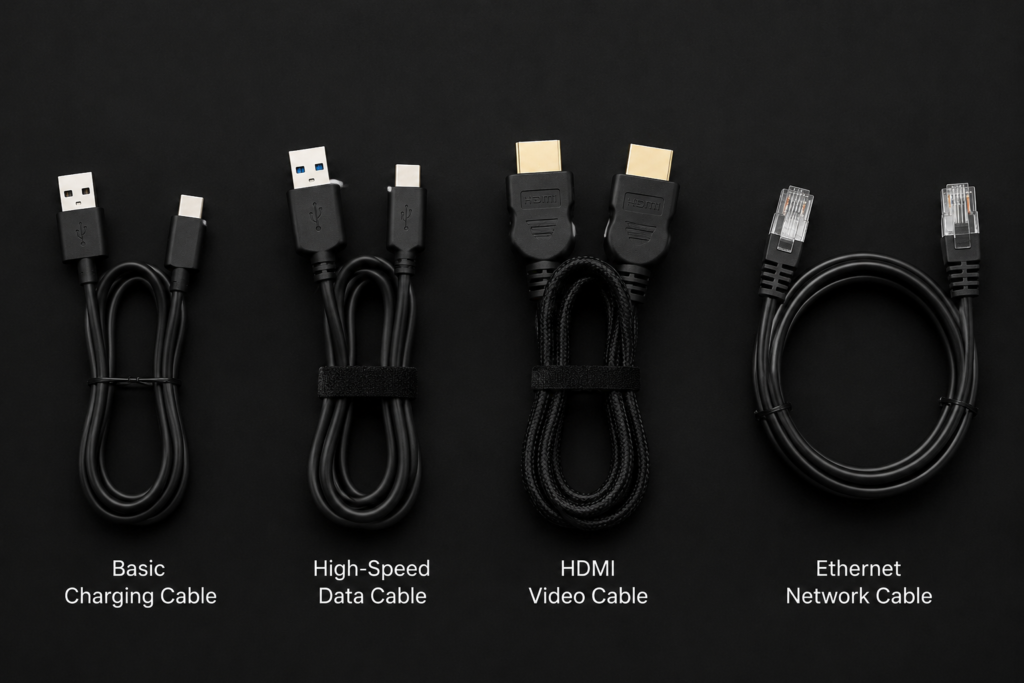
6.1 Basic Charging Cables
Single-layer foil shielding is more than sufficient. Charging primarily delivers power and has low signal integrity requirements, so premium shielding offers no practical benefit.
6.2 High-Speed Data Cables
Prioritize cables with foil + braid composite shielding. For USB 3.0 and above, or cables used regularly for large file transfers, composite shielding ensures more consistent speeds and fewer data errors.
6.3 Video Output Cables
We recommend dual-layer composite shielding for video use. 4K, 8K, and high-refresh-rate video places very high demands on signal quality. Insufficient shielding is a common cause of screen flickering, artifacts, or failure to reach full resolution and refresh rates.
6.4 Network Cabling
- Typical home use: Unshielded (UTP) Ethernet cable works perfectly well for most residential environments.
- High-interference areas (near electrical panels, server rooms, office equipment): Choose FTP or S/FTP shielded cable for more reliable, consistent network speeds.
6.5 Don’t Obsess Over the Number of Shield Layers
More layers do not automatically equal better performance. Shielding only works properly with good grounding design — with poor grounding, extra layers can actually act as antennas and make interference worse. More layers also mean stiffer, heavier, more expensive cables that are overkill for most daily use.
7. Common Myths Debunked
7.1 Is braided shielding always better than foil?
Not at all. The two excel in different areas. For high-speed data and high-definition video (high-frequency signals), foil’s 100% coverage delivers better results. Braided shielding shines at low-frequency interference suppression and bend durability. Neither is universally superior — it all depends on the application.
7.2 More shield layers = a better cable?
Not necessarily. Shielding performance is highly dependent on proper grounding. Without good grounding, extra layers are useless or even counterproductive. Adding layers also increases cost and reduces flexibility, with rapidly diminishing returns for everyday use.
7.3 Do all USB-C cables have the same shielding?
No — shielding varies drastically between USB-C cables of different specifications.
Cheap charging-only cables may have minimal foil shielding or none at all, while high-end Thunderbolt and USB4 cables use multi-layer composite shielding. This difference in shielding build is one of the biggest reasons USB-C cables can range in price from a few dollars to over a hundred.
7.4 Does shielding eliminate all interference completely?
No. No shielding can block 100% of interference. Low-frequency magnetic interference, for example, is very difficult to stop with standard shielding. Real-world performance also depends on grounding quality, device design on both ends, and installation method. Good shielding greatly reduces interference, but never eliminates it entirely.
8. Final Summary
8.1 Recap of the 4 Main Shielding Types
- Foil Shield: Strong high-frequency performance, low cost, average bend resistance
- Braided Shield: Strong low-frequency performance, highly durable, mid-to-high cost
- Foil + Braid Composite: Balanced all-around performance, best overall protection, highest cost, stiffer cable
- Spiral Shield: Best flexibility, average shielding, ideal for audio and wearable devices
8.2 Each Design Has Its Strengths
There is no single “best” shielding method. Every design represents a different balance of shielding performance, flexibility, and cost.
8.3 Key Buying Principle
Don’t choose a cable based only on the number of shield layers — match the shielding to your actual use case. Great shielding performance comes from the combination of structure, materials, build quality, and proper grounding design. The best cable is always the one that fits your needs.