
1. Introduction
A common frustration in daily life is that phone charging cables and earphone cords often break at the connector end after months of use, and excessive pulling can even snap the internal wires. Hidden inside many durable cables is a material that drastically improves longevity: Kevlar fiber. Often called the “invisible steel bar” of cables, it is found in everything from budget fast-charging cables to cross-city fiber optic lines and industrial robot cables, and has become a standard feature in high-performance wiring.
2. Getting to Know Kevlar Fiber
2.1 Basic Definition and Material Nature
Kevlar is a high-performance synthetic fiber belonging to the aramid family, originally developed by DuPont. Its most famous trait is being “incredibly strong yet lightweight”: weight for weight, it is about 5 times stronger than steel, but only around one-fifth the density, making it a classic high-strength, low-weight material.
2.2 The Relationship Between Kevlar and Aramid Fiber
Kevlar and aramid are often confused, but aramid is the general name for this class of high-strength synthetic fibers — the material category — while Kevlar is DuPont’s brand name for its aramid product. It is similar to the relationship between “cola” and “carbonated soft drink”. When people refer to “Kevlar cables”, they essentially mean cables reinforced with aramid fiber.
2.3 Core Basic Performance Features
Four key advantages make Kevlar widely used in cables: first, extremely high tensile strength, meaning it is very hard to break; second, extremely light weight, so it does not make cables bulky; third, wide temperature tolerance, working reliably from around -196°C up to 200°C; and fourth, excellent wear and corrosion resistance, so it does not degrade easily with long-term use.
2.4 Common Forms of Kevlar in Cables
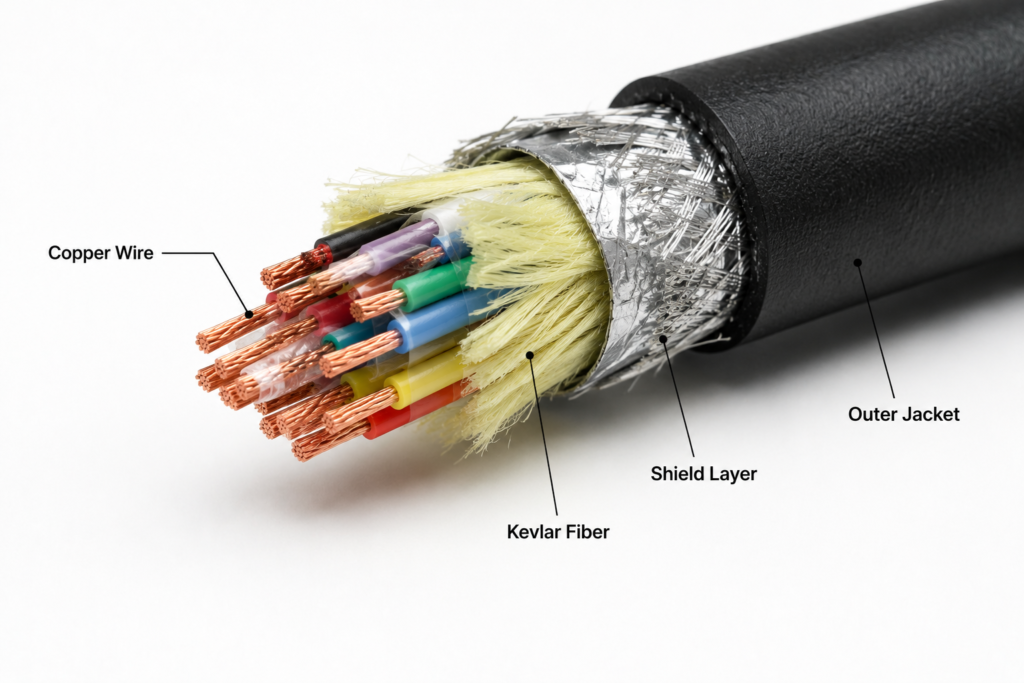
Kevlar is never used as a conductor itself inside cables. It usually appears in three forms: most commonly as bundled continuous filament yarns for filling or strength members; secondly as braided tapes or mesh wraps around the cable core; and in a few special cables, as short-cut Kevlar fibers for filling and reinforcement.
3. Core Functions of Kevlar Fiber in Cables
3.1 Boosting Tensile Strength to Protect Internal Conductors and Fibers
This is Kevlar’s most essential role. When a cable is pulled, the Kevlar fibers absorb the tension first, taking the load and preventing the delicate copper wires or optical fibers inside from snapping. It acts like an internal “safety rope” for the cable’s core transmission components.
3.2 Enhancing Bend Resistance and Extending Service Life
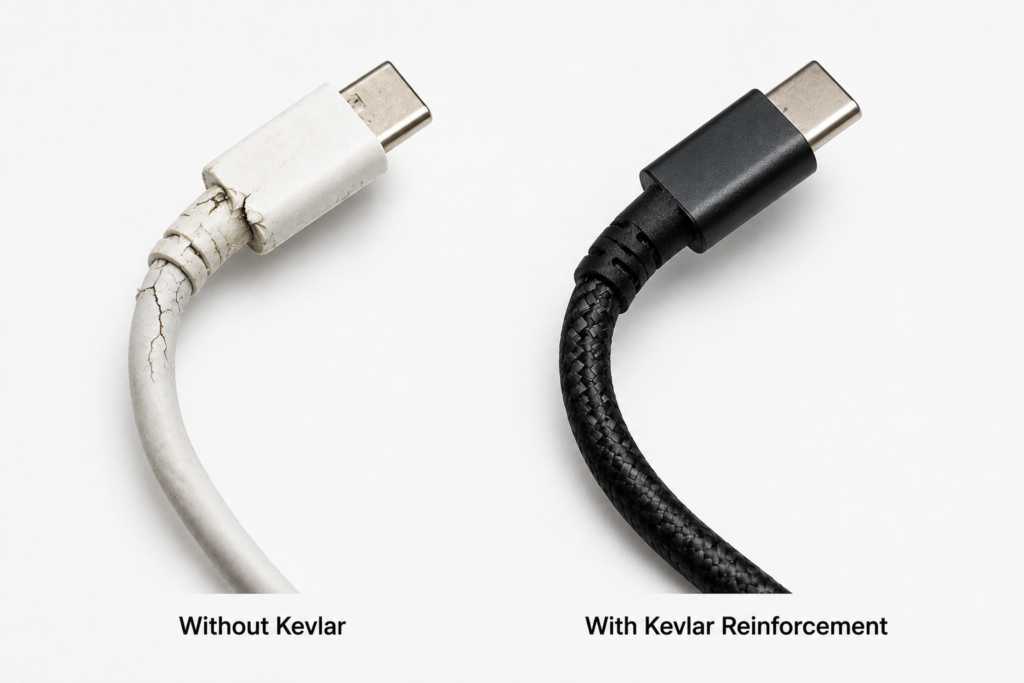
Daily data cables and earphone cords are bent repeatedly, which often causes internal wire breakage. Kevlar fibers distribute bending stress, cushioning damage to the core wires with every flex, greatly increasing a cable’s bend lifespan and making it far more durable.
3.3 Enabling Lightweight, Slim Cable Designs
If steel wire were used for reinforcement, cables would be thick and heavy. Kevlar delivers very high strength with minimal weight, making it ideal for slim cables. For example, ultra-thin fast-charging cables and thin fiber patch cords can stay compact and portable while still maintaining sufficient tensile strength.
3.4 Improving Weather Resistance for Special Operating Environments
Kevlar withstands extreme temperatures, moisture, and chemical corrosion, so it performs reliably outdoors, on factory floors, and in harsh temperature environments. Compared to ordinary nylon or plastic fillers, it allows cables to handle far more complex and demanding conditions.
4. Where Kevlar Fiber Sits in a Cable Structure
4.1 Central Strength Member Structure
This is the most classic design: multiple strands of Kevlar yarn are twisted together and placed at the very center of the cable as its “backbone”. Outdoor fiber optic cables and patch cords mostly use this design, which bears axial tension and protects the surrounding optical fibers from strain.
4.2 Peripheral Braided / Wrapped Reinforcement Layer
Kevlar fibers are braided into a mesh and wrapped around the outside of the cable core, like a protective net. This structure not only resists pulling, but also improves crush and abrasion resistance. Many high-end data cables and industrial drag chain cables use this design.
4.3 Internally Filled Yarns
Kevlar yarns are dispersed into the gaps between multiple core wires, filling empty space to keep the cable round while also adding tensile strength. This approach is common in thin earphone cords and small data cables, where it adds strength without taking up extra space.
4.4 End and Connector Reinforcement
The most common failure point for cables is right at the connector root. Manufacturers often add dedicated Kevlar reinforcement at the junction between the cable and the connector — the popular “strain relief” design — which drastically reduces the chance of breakage at this weak point.
5. Typical Applications in Common Cables
Kevlar is used in different ways for different cable types, with varying priorities. The table below summarizes the most common applications:
| Cable Type | How Kevlar Is Used | Core Purpose |
|---|---|---|
| Consumer electronics (fast-charge cables, data cables, earphones) | Internal filled yarn + connector strain relief | Tear resistance, longer bend life, soft flexible feel |
| Communication cables (fiber patch cords, indoor/outdoor fiber cables) | Central strength member + core filling yarn | Protect fiber from breakage, support stable cable structure |
| Industrial specialty cables (robot drag chain cables, equipment harnesses) | Outer braided reinforcement + internal filling | Withstand millions of bend cycles, resist tension, suit high-motion use |
| Special-environment cables (aerospace, deep-sea cables) | Multi-layer braided composite reinforcement | Ultra-lightweight weight savings, extreme environment tolerance, high-load tension capacity |
5.1 Consumer Electronics Cables: Fast-Charge Cables, Data Cables, Earphone Cords
Most premium fast-charging and braided data cables we use daily include Kevlar filling inside, plus Kevlar reinforcement at the connectors. It makes the cable more pull-resistant and bend-resistant, without sacrificing softness — keeping it portable and durable.
5.2 Communication Cables: Fiber Patch Cords, Indoor and Outdoor Fiber Cables
Optical fiber itself is very brittle and can break with even a hard tug. The Kevlar strength member in fiber cables acts as a “bodyguard” for the fiber, absorbing all tension during installation and use, so the fiber remains unstressed and transmits signals reliably.
5.3 Industrial Specialty Cables: Robot Drag Chain Cables, Equipment Harnesses
Robot cables and drag chain cables in factories bend thousands of times every day, placing extreme demands on durability. Kevlar’s bend resistance and high strength are perfectly suited to this high-cycle motion, greatly extending the service life of industrial cables.
5.4 Special-Scenario Cables: Aerospace and Deep-Sea Operation Cables
Aerospace applications have extremely strict weight requirements, while deep-sea cables must withstand enormous water pressure and tension. Kevlar’s unique combination of light weight and high strength is irreplaceable here: it meets strength requirements while minimizing weight and resisting corrosion, making it the reinforcement material of choice for these high-end specialty cables.
6. Comparison of Kevlar With Common Cable Reinforcement Materials
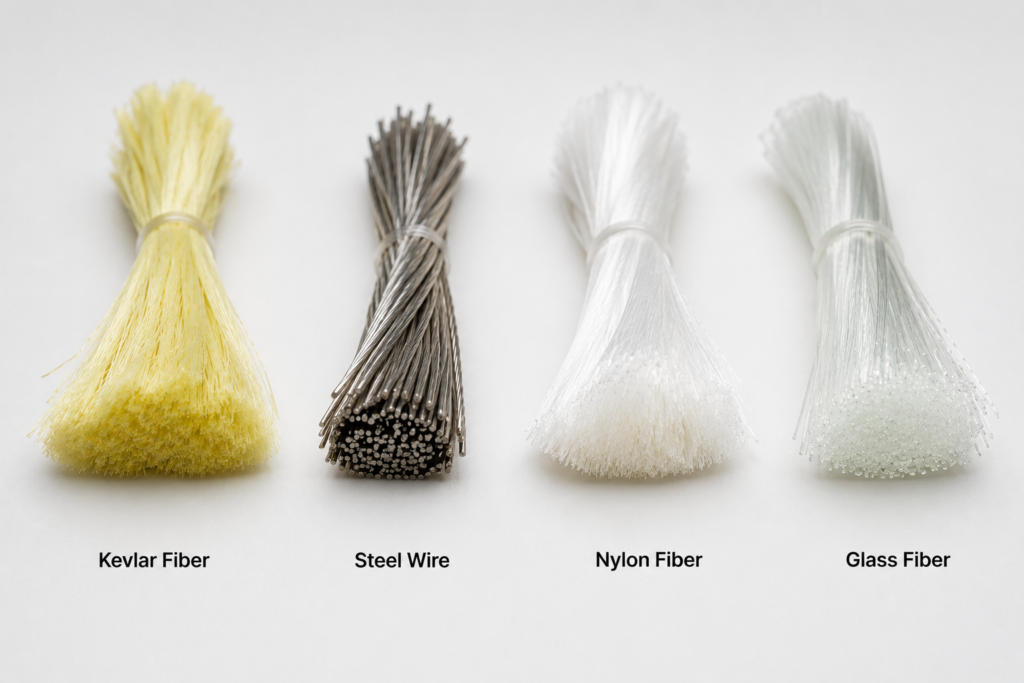
Kevlar is not the only reinforcement material used in cables, and different materials have very different characteristics. The table below compares them:
| Reinforcement Material | Weight | Flexibility | Tensile Strength (weight-for-weight) | Temperature & Corrosion Resistance | Typical Use Case |
|---|---|---|---|---|---|
| Kevlar fiber | Extremely light | Excellent, soft and flexible | Highest, ~5x that of steel | Excellent temperature and corrosion resistance | Premium data cables, fiber optics, specialty cables |
| Steel wire | Very heavy | Poor, stiff, hard to bend | High absolute strength, but very heavy | Prone to rust, moderate temperature tolerance | Heavy power cables, armored cables |
| Nylon / polyester fiber | Light | Good, very soft | Moderate, stretches easily under load | Poor heat resistance, softens at high temps | Budget cables, low-end filling |
| Glass fiber | Light | Poor, brittle, breaks with repeated bending | Decent strength, but brittle | Good heat resistance, but poor bend tolerance | Basic fiber strength members, fire-resistant filling |
6.1 Compared to Steel Wire: Weight, Flexibility and Corrosion Differences
Compared with steel wire, Kevlar’s biggest advantages are light weight, flexibility and rust resistance. Steel has high raw strength, but it is heavy, stiff and prone to corrosion, so it only suits heavy-duty cables. Kevlar, by contrast, is soft and lightweight, ideal for everyday and precision cables.
6.2 Compared to Nylon / Polyester Fiber: Strength and Heat Resistance Differences
Nylon and polyester are cheap and soft, but they have low strength, stretch easily under tension, and soften at high temperatures. Kevlar is much stronger, does not deform easily, and has far better heat resistance than ordinary synthetic fibers, making it suitable for cables that demand durability.
6.3 Compared to Glass Fiber: Flexibility and Bend Resistance Differences
Glass fiber is inexpensive and heat-resistant, but it is brittle, stiff, breaks easily with repeated bending, and can irritate skin. Kevlar has far better flexibility and bend resistance, and feels smoother to handle, making it ideal for cables that are frequently flexed.
7. Practical Tips and Buying Guide
7.1 Key Process Points for Kevlar in Cable Production
How well Kevlar works depends heavily on manufacturing quality. First is tension control: pay-off tension must be uniform — too loose and it provides no tensile benefit; too tight and the cable becomes stiff and unpleasant to use. Second is even distribution, especially for filled Kevlar; uneven distribution leads to inconsistent strength along the cable.
7.2 How to Identify Genuine Kevlar Cables and Avoid Fakes
To check if a cable really contains Kevlar, you can do a simple test: cut open the outer jacket of a cable advertised as Kevlar-reinforced, and look for pale yellow, tough filaments inside. Pull firmly with your fingers — genuine Kevlar barely stretches and is very hard to break. Burn it with a lighter: it does not melt and drip like plastic; instead it slowly carbonizes, with a faint odor similar to burning hair.
7.3 Usage and Storage Precautions
Kevlar is abrasion-resistant but vulnerable to sharp cuts. In daily use, avoid deliberately scoring it with knives, scissors or sharp edges. For long-term storage, keep it out of direct sunlight, as UV light accelerates Kevlar aging. Also, avoid prolonged immersion in strong acid or alkali liquids, which can degrade its strength.
8. Common Misconceptions and the Truth
8.1 Myth: More Kevlar Always Means Better Cable Performance
Many people assume that adding more Kevlar makes a cable stronger. In reality, excessive Kevlar makes the cable stiff, ruins the feel, and adds unnecessary cost. The right amount, paired with good structural design, is what delivers the best balance of strength and flexibility.
8.2 Myth: Kevlar Blocks Electromagnetic Interference
Kevlar fiber itself does not conduct electricity, so it has no electromagnetic shielding ability and cannot reduce interference. A cable’s interference protection comes from internal copper foil, metal braid or other shielding layers — do not confuse Kevlar’s reinforcement role with shielding function.
8.3 Myth: Kevlar Cables Are Completely Immune to Wear and Cutting
Kevlar does have very good wear and tensile strength, but it is not indestructible. It can still be cut by sharp knife edges, glass or other sharp objects, and will gradually wear down with heavy friction against rough surfaces. It holds up well to normal use, but should not be subjected to intentional abuse.
8.4 How to Spot Fake “Kevlar” on the Market
Many low-priced cables use ordinary nylon or polyester fiber and pass it off as Kevlar. Spotting fakes is simple: first, check the color — fake Kevlar is usually pure white, while genuine Kevlar is pale yellow. Second, pull it — fakes stretch noticeably, while real Kevlar barely deforms. Third, burn it — fakes melt, drip and produce black smoke, while real Kevlar only carbonizes without dripping.
9. Development Trends and Conclusion
9.1 Technology Trends for Kevlar Fiber in Cables
Going forward, Kevlar in cables will develop in three main directions: first, higher-strength, finer fiber grades to suit even more compact cable designs; second, combination with water-blocking, flame-retardant and other materials to deliver multiple functions in one material; and third, as domestic production technology matures and costs fall, it will become more common in mainstream consumer cables.
9.2 Conclusion: The Core Value of Kevlar for High-Performance Cables
Kevlar fiber is hidden inside cables, invisible in daily use, yet it is a core material that improves cable durability and reliability. With barely any added weight, it adds a “tensile armor” to cables, protecting the delicate internal conductors and fibers while extending the cable’s service life. For everyday consumers, checking whether a cable includes Kevlar reinforcement is a simple, practical way to judge how durable it will be.