
1. Basic Understanding of Cable Fillers
1.1 What Are Cable Fillers?
Many people think cables only contain copper wires and plastic sheaths. In fact, between the gaps of multiple inner conductors, there are dedicated materials filling the space — these are cable fillers. They are not leftover scraps from production, but a critical component that determines a cable’s service life and performance.
1.2 Where Fillers Sit in a Cable Structure
A complete cable, from inside to outside, typically follows this structure: conductive core → core insulation → stranded cable core → filler material → shielding layer (optional) → outer jacket. Fillers sit in the gaps formed by multiple stranded cores, filling all uneven spaces and keeping the entire cable core neatly round.
1.3 Why Cables Need Fillers
When multiple independent cores are stranded together, they naturally form irregular gaps. Without fillers, the outer jacket would sink into these gaps during extrusion, resulting in an uneven, bumpy cable shape. The inner cores would also shift and rub against each other, leading to easy damage and short circuits over time. Fillers exist to fill these gaps and build an internal “framework” for the cable.
2. Core Functions of Cable Fillers
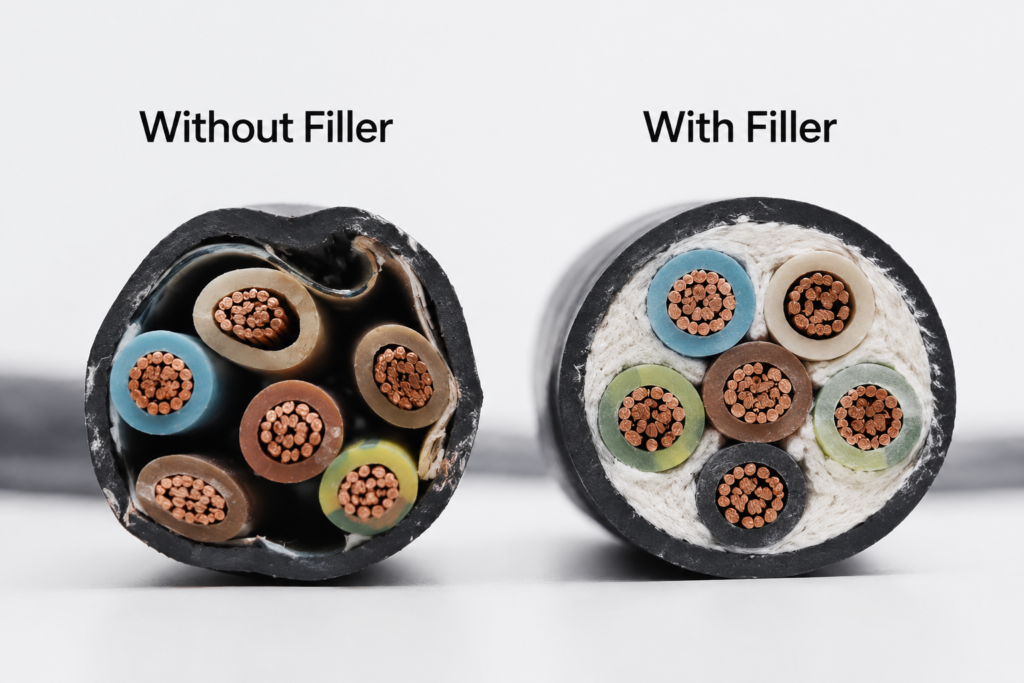
2.1 Stabilizing Internal Structure and Maintaining a Round Shape
The most basic function of fillers is to fill gaps in the cable core, keeping the entire cable uniformly round. A round shape not only looks neat, but also ensures consistent jacket thickness, preventing thin spots that wear out easily.
2.2 Cushioning Against Pressure and Improving Mechanical Durability
Cables are inevitably stepped on, bent, or squeezed during installation and use. Fillers act as an internal “cushion” that distributes external force, protecting thin conductor cores from being crushed or abraded, and greatly improving the cable’s durability and service life.
2.3 Stabilizing Core Spacing for Better Signal and Electrical Performance
For signal cables like Ethernet or HDMI cables, even slight changes in the distance between conductor pairs can cause signal interference, slower internet speeds, or choppy video. Fillers firmly lock each core in place to ensure stable signal transmission.
2.4 Adding Special Protection: Water Resistance, Flame Retardancy and Heat Resistance
Different functional fillers can add extra protection to cables. Water-blocking fillers stop moisture from seeping along the cable core gaps; flame-retardant fillers slow down burning and reduce toxic fumes; high-temperature fillers maintain performance even in hot environments.
3. Common Types and Features of Cable Fillers
In everyday cables, fillers are mainly divided into four categories by form and function, each with distinct features and use cases:
| Material Category | Common Types | Key Features | Typical Applications |
|---|---|---|---|
| Fiber Rope Fillers | PP filler ropes, PET filler ropes, cotton yarn | Low cost, good structural support, easy to process | Household wires, general power cables, control cables |
| Paste-Type Water-Blocking Fillers | Cable filling jelly, optical fiber filling compound | Excellent waterproof sealing, strong longitudinal water blocking | Outdoor fiber optic cables, direct-burial power cables, underwater cables |
| Tape & Foam Fillers | Non-woven filler tapes, foamed PE/PP | Light weight, good flexibility, excellent dielectric properties | Ethernet cables, USB/HDMI data cables, communication cables |
| Flame-Retardant & Fire-Resistant Fillers | Fiberglass ropes, ceramifiable silicone rubber fillers | Flame retardant, low smoke & non-toxic, high temperature resistant | Fire safety circuits, building fire-resistant cables, new energy high-voltage cables |
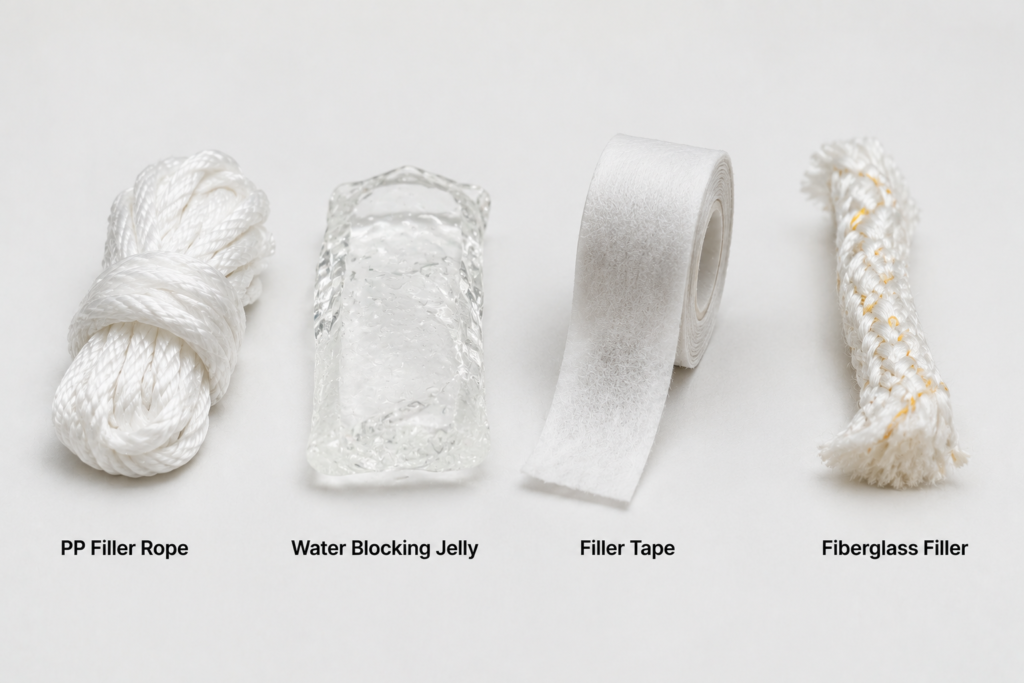
3.1 Fiber Rope Fillers
This is the most common and widely used filler type, mostly made of polypropylene (PP) or polyester (PET) plastic ropes, as well as traditional cotton yarn. Like “support ribs” inside the cable, they are low-cost and effective at shaping, making them the first choice for ordinary power cables.
3.2 Paste-Type Water-Blocking Fillers
These are semi-solid grease-like materials, similar to household petroleum jelly. They fill every tiny gap in the cable core, completely blocking water from seeping lengthwise along the cable. They are essential for outdoor, underground, and underwater cables.
3.3 Tape & Foam Fillers
These fillers are lighter and softer, and do not make the cable stiff. Foam fillers contain tiny air bubbles, are lightweight, and do not interfere with signal transmission — ideal for data and Ethernet cables that require flexibility and signal quality.
3.4 Flame-Retardant & Fire-Resistant Specialty Fillers
Made from fiberglass or ceramifiable materials, these fillers do not burn easily in open flame. At high temperatures, they even form a hard ceramic protective layer that keeps the cable working for a period of time during a fire. They are standard for fire safety and high-rise building cables.
4. Filler Solutions for Common Cables in Daily Life
Different cable scenarios use completely different fillers. The cables we encounter every day all have matching filler solutions:
| Cable Type | Common Fillers | Core Purpose |
|---|---|---|
| Household wires / building power cables | PP filler ropes, LSZH flame-retardant filler ropes | Support round structure, meet fire safety requirements |
| Ethernet / USB / HDMI high-speed data cables | Polyester fiber, non-woven filler tapes | Fix pair positions, reduce signal interference, maintain flexibility |
| Automotive / new energy vehicle cables | High-strength PET fiber, high-temperature flame-retardant fillers | Resist vibration, withstand temperature swings, meet high-voltage safety |
| Outdoor fiber / direct-burial engineering cables | Water-blocking jelly, water-blocking yarn + tape | Full moisture blocking, withstand harsh outdoor environments |
4.1 Household Wires and Building Power Cables
Wires for home renovation and power cables in buildings mainly use ordinary PP filler ropes, which are low-cost and sufficient for daily use. For fire circuits and cables in crowded places, low-smoke zero-halogen (LSZH) flame-retardant fillers are used to ensure escape safety during fires.
4.2 Ethernet, USB, HDMI and Other High-Speed Data Cables
The Ethernet cables, charging cables and HDMI cables we use are thin and require high flexibility. These cables usually use fine polyester fiber or non-woven fillers, which can fix the internal wire pairs for stable internet and video, while keeping the cable soft and easy to bend.
4.3 Automotive and New Energy Vehicle Cables
Cables inside cars are subject to constant vibration and temperature changes; new energy vehicles also have high-voltage circuits. These cables mostly use high-strength, temperature-resistant polyester fillers, and high-voltage lines add flame-retardant fire-resistant fillers to handle the harsh automotive environment.
4.4 Outdoor Fiber Optic and Engineering Cables
Cables buried underground or installed outdoors are most vulnerable to water damage. They generally use a combined filling solution of water-blocking jelly, yarn and tape to completely block moisture penetration and ensure long-term outdoor reliability.
5. Performance Evaluation and Selection Principles for Cable Fillers
5.1 Key Indicators of Filler Quality
Even non-professionals can judge filler quality by a few core points: how easily it breaks when pulled (tensile strength), whether it deforms or leaks oil at high temperatures, whether it cracks after bending, and whether it meets the required flame retardant or waterproof rating.
5.2 Selection Basis for Different Usage Scenarios
There is no “best” filler, only the “most suitable” one. For ordinary indoor environments, cost-effective PP fillers work fine. For outdoor humid environments, water-blocking types are a must. For fire or high-temperature scenarios, look for certified flame and heat resistance. For high-speed data cables, choose materials with low dielectric loss that do not interfere with signals.
5.3 Compatibility Requirements with Other Cable Components
Fillers are in long-term contact with the core insulation and outer jacket, so material compatibility is essential. If the materials are mismatched, over time the filler may chemically react with the plastic sheathing, causing insulation cracking and accelerated aging — actually shortening the cable’s life.
6. Filling Process and Basic Quality Knowledge
6.1 Basic Manufacturing Process of Fillers
Fiber-type fillers are made by heating plastic pellets into filaments, then twisting them into ropes of different thicknesses. Paste fillers are made by blending base oils and additives according to formulas. Tape fillers are made by impregnating non-woven substrates with functional coatings and slitting them to size.
6.2 Key Points of the Cable Filling Process
Fillers are fed into the cable core simultaneously during the stranding process, when multiple cores are twisted together. Production requires careful tension control: too loose and the filler will wrinkle and shift; too tight and the filler rope will break, making the cable stiff.
6.3 Common Filling Quality Problems and Their Effects
Poorly filled cables easily develop problems. Insufficient filling causes flat, lopsided cables and eccentric jackets. Overfilling makes cables stiff and hard to bend, making installation difficult. Poor-quality water-blocking jelly can drip at high temperatures or harden in cold weather, eventually losing its waterproof effect.
7. Common Misconceptions About Choosing and Using Cable Fillers
7.1 Myth 1: The More Filling, the Better
Many people assume fuller filling means stronger cables. In reality, excessive filling makes cables stiff, creates high internal stress when bent, and actually makes them more prone to damage — while also unnecessarily increasing cost and weight. The right filling ratio is always the optimal solution.
7.2 Myth 2: All Fillers Are the Same
A lot of people think fillers are just “gap fillers” and work interchangeably. In fact, indoor fillers cannot be used outdoors; non-water-blocking fillers will quickly fail when buried underground; and non-flame-retardant fillers pose safety hazards in fire-rated applications.
7.3 Myth 3: Only Cost Matters, Not Performance Match
Fillers account for a small share of total cable cost, but have a huge impact. Always choosing the cheapest filler can lead to poor aging resistance, low flame safety, or contamination of the conductor cores — causing the entire cable to fail early, which ends up costing more in the long run.
8. Development Trends of Cable Fillers
8.1 Eco-Friendly: Low-Smoke Zero-Halogen and Biodegradable Materials
The industry is increasingly focused on environmental protection. Traditional halogenated flame-retardant fillers are being replaced by LSZH materials, which produce less smoke and lower toxicity when burned. Meanwhile, bio-based and biodegradable fillers are being rolled out to reduce the environmental impact of discarded cables.
8.2 Functional: Lightweight and Multi-Functional Composite
Future fillers will no longer only “fill gaps”. They will evolve toward multi-functionality in a single material — for example, composite fillers that combine water blocking, flame retardancy and heat dissipation, while also being lighter to make cables softer and easier to handle.
8.3 Scenario-Specific: Adapted to High-Speed Communication and New Energy
With the spread of 8K transmission, 10G Ethernet and high-voltage new energy vehicle cables, more scenario-specific fillers will emerge. For example, ultra-low dielectric loss fillers for high-speed cables, and high-temperature, high-voltage flame-retardant fillers for new energy applications.
9. Conclusion
Cable fillers may seem unremarkable, hidden inside cables and out of sight, but they are a key component that determines structural stability, service life and safety performance. They are not trivial “filler material” — they are the internal skeleton and protective layer of every cable. For everyday consumers, understanding the differences between filler materials helps you better judge cable quality, and choose more durable, safer products.