
1. Introduction
Wireless charging has evolved from a secondary backup function to a mainstream daily charging solution for smartphones. However, traditional wireless charging has long suffered from obvious drawbacks: easy coil misalignment, low energy efficiency, severe heat generation, low power limit, unstable charging in car scenarios, and fragmented compatibility across different brands.
With the launch of the new Qi2 series standards by the Wireless Power Consortium (WPC), especially the officially released Qi2.2 (Qi2 25W) specification in 2025, matched with mature MPP magnetic architecture, mandatory low-temperature temperature control and professional security authentication, the long-standing pain points of traditional wireless charging have been completely solved. This article comprehensively sorts out the iteration history, core technical upgrades, latest market pattern, user purchase guidance and future development trends of the full-range Qi standards in plain language.
2. Basic Definition of Qi Wireless Charging
Qi (pronounced “Chee”) is the world’s universal international wireless charging standard formulated by the WPC. Officially launched for commercial use in 2010, it adopts electromagnetic induction technology for wireless power transmission. In 2025, the Qi 2.0 standard was officially included in the IEC international standard (IEC 63563), becoming the most recognized and widely adapted wireless charging specification worldwide.
Compared with wired charging and private wireless protocols, Qi has core advantages: no frequent plugging and unplugging to protect device interfaces; better dustproof and waterproof performance due to closed ports; cross-brand universal compatibility; unified official security certification; and full-scenario adaptability for desktop, vehicle, outdoor and public charging environments.
The traditional non-magnetic Qi standards have inherent shortcomings. Users need to manually align the coils, and slight displacement will cause speed reduction or charging interruption. It features large energy loss, concentrated heat, low power limit and poor stability during vehicle bumps, failing to meet daily fast charging needs.
3. Official Development History of Full Qi Versions
3.1 Qi 1.0 (2010): Industry Foundation
As the first unified wireless charging standard in the industry, it supports a fixed 5W basic power, only suitable for low-speed emergency charging of mobile phones and earbuds. Without magnetic alignment and fast charging mechanism, it relied entirely on manual coil positioning.
3.2 Qi 1.1 (2012): Stability Optimization
No power upgrade was made, maintaining 5W output. It mainly optimized the communication handshake logic between devices and chargers, slightly improved the stability of foreign object detection, and reduced abnormal charging interruptions.
3.3 Qi 1.2 (2015): First Wireless Fast Charging Upgrade
The EPP extended power protocol was introduced, raising the maximum wireless charging power from 5W to 7.5W. It initially realized practical wireless fast charging and basically met the daily charging needs of smartphones.
3.4 Qi 1.3 (2019): Mature Mainstream Standard
As the global mainstream standard from 2019 to 2022, it fixed the maximum power at 15W, and added basic device identity authentication and FOD foreign object detection functions, effectively avoiding safety hazards caused by inferior chargers and metal foreign objects.
3.5 Qi 2.0 (2023): Revolutionary Architectural Upgrade
It introduced the core MPP (Magnetic Power Profile) technology, industrializing Apple’s exclusive MagSafe magnetic charging technology for the entire industry. While maintaining 15W power, it realized automatic precise magnetic alignment, greatly reducing energy loss and heat generation. It ended the monopoly of Apple magnetic charging and filled the gap of official Android magnetic charging standards. It passed the IEC international standard certification at the end of 2024.
3.6 Qi 2.1 (2024): Scenario-Oriented Optimization
The newly added Qi2 Ready certification system allows Android phones without built-in magnetic coils to achieve complete Qi2 magnetic charging experience with certified magnetic phone cases, lowering the threshold for Android devices to join the Qi2 ecosystem. The movable coil transmission technology was launched to solve the misalignment problem of in-vehicle charging, optimizing stability in bumpy driving environments.
3.7 Qi 2.2 / Qi2 25W (Finalized Late 2024, Brand Released July 2025)
Marking a historic breakthrough in the industry, the official standard power increased directly from 15W to 25W with a 67% performance improvement, completely changing the stereotype of slow wireless charging. It enforces a strict 40°C maximum temperature limit to solve overheating problems, and mandates dual-way authentication chips for chargers to eliminate hidden safety risks. The upgraded dynamic power algorithm ensures no speed drop during bright screen and high-load gaming scenarios, with full backward compatibility for all old Qi devices.
4. Core Parameter Comparison of All Qi Versions
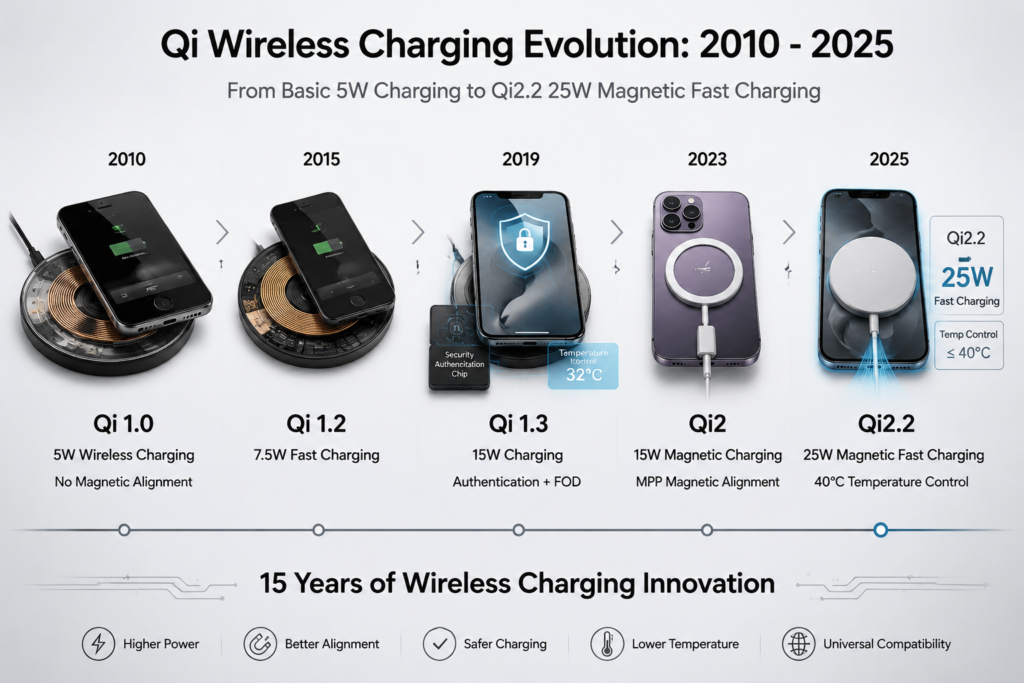
Qi 1.0 (2010): 5W, no magnetic alignment, fixed coil, basic temperature control, no authentication, basic slow charging.
Qi 1.2 (2015): 7.5W, no magnetic alignment, fixed coil, basic temperature control, no authentication, entry-level fast charging.
Qi 1.3 (2019): 15W, no magnetic alignment, fixed coil, basic temperature control, basic authentication, mainstream standard fast charging.
Qi 2.0 (2023): 15W, MPP magnetic alignment, fixed coil, optimized temperature control, basic security, universal magnetic charging ecosystem.
Qi 2.1 (2024): 15W, MPP magnetic alignment, fixed/movable coil, optimized temperature control, basic security, in-vehicle and magnetic case adaptation.
Qi 2.2 (Late 2024): 25W, enhanced MPP magnetic alignment, fixed/movable coil, 40°C mandatory temperature limit, mandatory dual-way authentication, flagship low-temperature high-speed magnetic fast charging.
| Version | Release Year | Max Power | Core Feature |
|---|---|---|---|
| Qi 1.0 | 2010 | 5 W | Basic induction charging, manual alignment |
| Qi 1.2 | 2015 | 7.5 W | First entry-level wireless fast charging |
| Qi 1.3 | 2019 | 15 W | Added foreign object detection & security authentication |
| Qi 2.0 | 2023 | 15 W | MPP magnetic auto-alignment, no manual adjustment |
| Qi 2.2 | Late 2024 | 25 W | 40°C mandatory temp limit, stable high-speed magnetic charging |
5. In-Depth Analysis of Qi2 Core Technologies
5.1 MPP Magnetic Power Profile: Core Technological Innovation
As the core of the Qi2 series, the standardized annular magnetic array realizes automatic adsorption and precise alignment between phones and chargers. It completely solves energy loss, overheating and frequent charging interruption caused by coil displacement, and unifies the magnetic physical specifications of Apple MagSafe and Android devices to achieve cross-brand interconnection.
5.2 Qi2 Ready Compatibility System
For Android devices without built-in magnetic coils, the Qi2 Ready certification system enables complete Qi2 magnetic charging experience with certified magnetic phone cases, allowing old Android models to access the new magnetic ecosystem without device replacement.
5.3 Movable Coil Transmission Technology: In-Vehicle Scenario Optimization
Specially developed for in-vehicle charging, the movable transmitting coil actively tracks and aligns with the phone, effectively solving charging interruption and speed reduction caused by vehicle bumps and slight device displacement, greatly improving the practicality of in-vehicle wireless charging.
5.4 Qi2.2 25W Upgrade: Dual Breakthrough in Speed and Temperature Control
The new 25W high-power output matches the high-load transient power maintenance algorithm, ensuring stable charging speed during gaming and video playback. The full-link energy efficiency optimization and mandatory 40°C low-temperature control realize fast charging without overheating, solving the core pain point of wireless charging.
5.5 Comprehensive Security System Upgrade
The upgraded FOD foreign object detection accurately identifies metal obstacles to avoid overheating and fire risks. The new dual-way device identity authentication prevents inferior chargers and modified protocol devices. The magnetic safety mechanism automatically reduces power for misalignment and cuts off power instantly when detached, ensuring full-process charging safety.
6. Relationship Between Qi2 and Apple MagSafe
MagSafe is Apple’s exclusive private magnetic wireless charging technology, deeply adapted to the Apple ecosystem but closed and incompatible with Android devices. The core magnetic technology of Qi2 is standardized and open-sourced by WPC based on Apple’s MagSafe solution, providing Android devices with the first official standard magnetic charging scheme, replacing unreliable third-party magnetic patches and modifications.
In short, MagSafe is an Apple-exclusive private solution, while Qi2 is a global open universal standard applicable to all Apple and Android devices with unified WPC certification and superior cross-brand compatibility.
7. 2025–2026 Latest Market Pattern
The Qi wireless charging ecosystem is highly mature. As of early 2026, WPC has 328 member enterprises, 299 of which focus on the Qi ecosystem. There are more than 2665 Qi2 certified products and 114 certified mobile phone models worldwide, covering mobile phones, power banks, in-vehicle chargers, desktop chargers and magnetic accessories.
Major brands have fully deployed the Qi2 ecosystem: iPhone 12 and later models support basic Qi2 functions, while iPhone 16/17 series are fully equipped with Qi2.2 25W fast charging. Samsung Galaxy S25 series is the first batch of Android flagships adapted to Qi2.1. Google Pixel 10 series natively supports Qi2. Domestic brands including Huawei, OPPO, vivo and Xiaomi have launched native magnetic models with built-in magnets, ushering in the era of native magnetic charging for Android devices.
8. Universal Qi Standard vs. Brand Private Wireless Fast Charging Protocols
Current wireless charging systems are divided into brand private protocols and WPC universal Qi standards. Private protocols from Xiaomi, Huawei and OPPO support up to 80W high power, but they are closed systems that only work with original brand chargers without cross-brand compatibility.
The universal Qi standard features moderate power, full-brand compatibility, stable performance and authoritative international certification, enabling one charger to power all digital devices. The launch of Qi2.2 25W fills the power gap of universal standards, achieving a perfect balance of compatibility, safety and fast charging speed for daily use.
| Dimension | Universal Qi2 Standard | Brand Private Protocol |
|---|---|---|
| Max Power | 25 W (unified official standard) | Up to 80 W (brand-exclusive) |
| Compatibility | Works across all certified brands | Only supports same-brand devices |
| Certification | Mandatory WPC official certification | Internal brand standards |
| Suitable For | Universal daily multi-device charging | High-speed charging for same-brand flagships |
9. Practical Upgrade of Reverse Wireless Charging
Reverse charging used to be a useless emergency function with slow speed and high power consumption. With the iteration of Qi standards and hardware upgrades, it has become a practical daily function. Current Huawei flagship models support 20W wireless reverse output, and some high-end devices support 27W wired reverse charging.
Integrated into major phone ecosystems, it supports power supply for earbuds, watches and cross-brand mobile phones. The intelligent battery protection mechanism automatically turns off reverse charging when the phone power is below 20%-30%, avoiding deep discharge damage to the battery.
10. WPC Official Certification and Logo System
Users can easily distinguish product quality through official logos. The traditional Qi logo represents basic low-power induction charging without magnetic function; the new Qi2 lightning logo represents standardized MPP magnetic architecture, high compatibility and high security.
All Qi2 certified products must pass strict tests including magnetic consistency, low-temperature control, energy efficiency, interoperation and security authentication. New flagship devices and accessories launched in 2025-2026 prioritize the Qi2.2 25W standard, eliminating uncertified inferior products from the market.
11. Core User Experience Advantages of Qi2
Compared with traditional wireless charging, Qi2 upgrades focus entirely on user experience: automatic magnetic adsorption for instant charging without manual adjustment; lower energy loss and heat generation to reduce battery aging; greatly improved stability in vehicle and outdoor scenarios; one charger for all digital devices; 25W high power upgrades wireless charging from slow supplementary charging to mainstream fast charging that can replace wired charging.
12. Full-Scenario Application Implementation
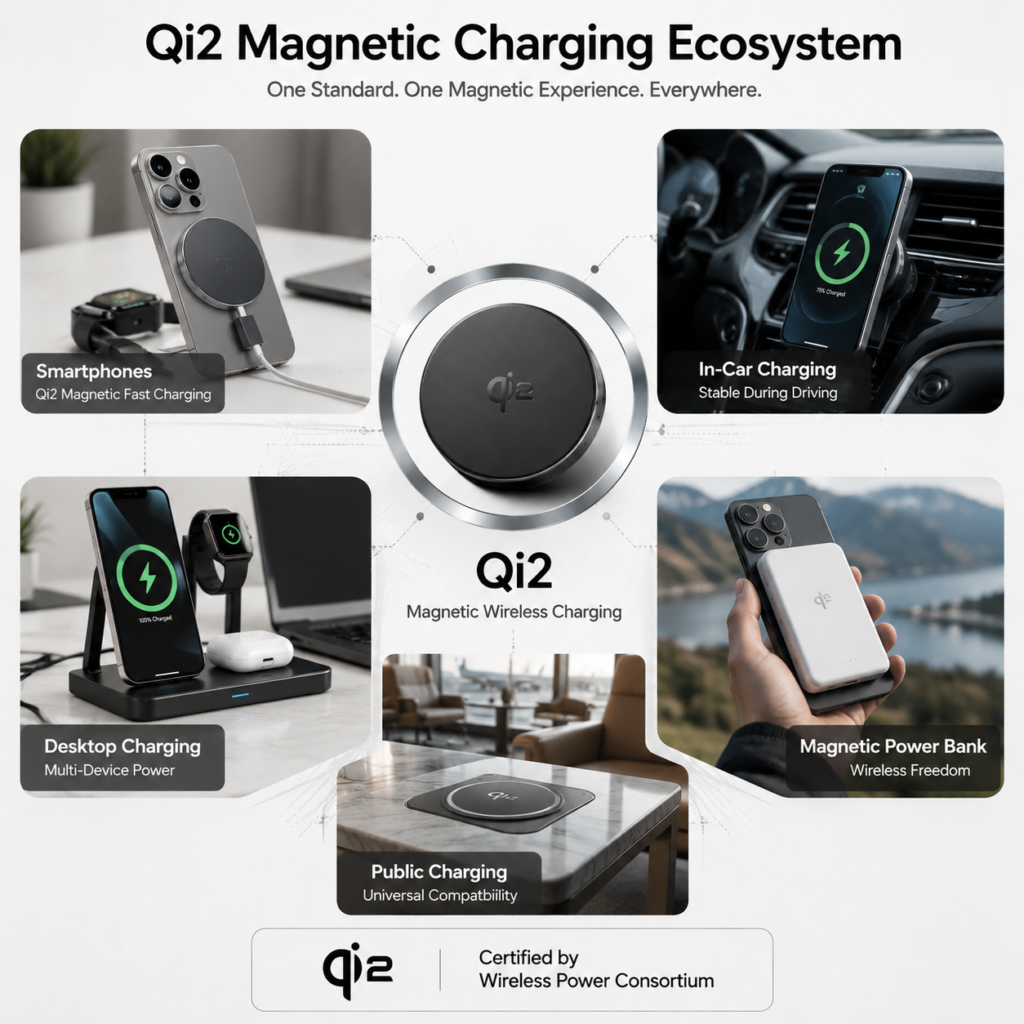
Qi2 wireless charging has achieved full-scenario popularization: it adapts to mobile phones, tablets, earbuds and smart watches for personal use; multi-in-one magnetic desktop chargers support multi-device power supply for office scenarios; magnetic power banks eliminate wire entanglement for outdoor use; mainstream car brands such as Audi are factory-equipped with Qi2.2 in-vehicle charging panels; public wireless power panels in hotels, airports and offices are also fully compatible with Qi2 standards.
13. Current Industry Challenges
Despite the comprehensive upgrade of Qi2.2, the industry still faces challenges: high-power 25W wireless charging still needs to balance heat dissipation and energy efficiency; a large number of uncertified inferior magnetic accessories cause poor compatibility and potential safety hazards; massive old devices do not support MPP magnetic architecture, leading to a long transition period for the new and old ecosystems; private high-power protocols and universal Qi standards coexist, resulting in temporary ecological fragmentation.
14. Future Official Development Trends
WPC has clarified the next iteration direction: the Qi 50W ultra-high-power wireless charging standard is under development. In June 2026, Xiaomi hosted the WPC international special meeting, jointly formulating standard details with Apple, Huawei and Google. The standard is expected to be officially released in 2028 and mass-produced on devices from 2028 to 2029, making wireless charging speed comparable to mainstream wired fast charging.
The period of 2026-2027 will witness an outbreak of native magnetic Android devices. Full-scenario wireless power supply for vehicles and smart homes will be rapidly popularized. Domestic self-developed technologies have been incorporated into international Qi standards, enhancing the voice of the domestic industrial chain. AI intelligent temperature control and adaptive battery protection algorithms will be fully popularized to make wireless charging smarter and more battery-friendly.
15. User Purchase Guide & Battery Life Science
Many users worry that wireless charging damages batteries. In fact, under the strict 40°C temperature control mechanism of Qi2.2, the battery loss caused by proper wireless charging is only 3%-5%, which is negligible. Long-term high-temperature charging and inferior accessories are the real causes of battery aging.
Three key purchase tips: prioritize products with official Qi2 certification and avoid uncertified accessories supporting only old BPP/EPP protocols; match 25W wireless fast charging with a 30W+ power adapter to achieve full power; use bare phones or ultra-thin certified magnetic cases, as thick unbranded cases will seriously reduce charging speed.
Avoid using wireless charging in high-temperature sun exposure environments to protect battery health and interface integrity.
16. Conclusion
Over fifteen years of iteration, Qi wireless charging has achieved leaps and bounds: from 5W basic slow charging, 15W standard fast charging, 15W magnetic intelligent charging, to the current 25W low-temperature high-speed magnetic fast charging, and the upcoming 50W flagship wireless fast charging.
The core reform is not only the improvement of charging speed, but also the upgrade from traditional inefficient charging to a standardized, precise, low-temperature, high-speed and fully unified intelligent wireless power supply system. The Qi2 series completely breaks the ecological barriers of brand private protocols, realizes full compatibility of Apple and Android devices, and promotes wireless charging to evolve from a backup function to a mainstream daily charging method for global users.