
Have you ever wondered why your phone switches between slow standard charging and fast turbo charging randomly? Why won’t a high-wattage charger burn out your smartphone battery? The core answer lies in thecharging handshake mechanism. This article explains the full logic of the charging handshake in plain, non-technical language, easy for ordinary readers with zero professional electronics knowledge to understand.
1. What Is the Charging Handshake Mechanism?
1.1 Definition of Charging Handshake
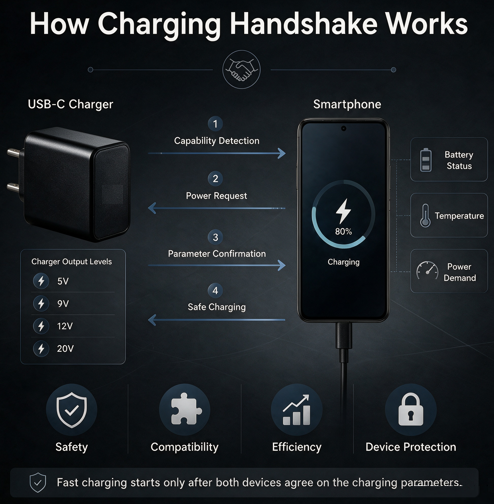
The Handshake in charging refers to a simple information interaction between your phone and the charger.
Fast charging cannot start immediately after plugging in the cable. The device and charger must finish a handshake first. Simply put, the handshake is a mutual detection process where two devices exchange their hardware operation parameters.
1.2 Life Analogy: A Business Negotiation
You can understand the charging handshake as a business negotiation between two parties:
The charger is the power supplier with multiple power output gears (5V, 9V, 12V, 20V); your phone is the demander that knows its battery’s maximum withstand voltage and current. The two sides negotiate and confirm mutual capabilities before formal power supply.
This is why chargers cannot output maximum power immediately after connection: every phone has different battery tolerance limits. Blind full-power output will permanently damage the phone’s battery and main circuit board.
1.3 Four Core Functions of the Handshake Mechanism
- Guarantee charging safety: Prevent overvoltage, overcurrent, circuit fire and hardware burnout
- Improve device compatibility: Support normal basic charging for third-party chargers and data cables
- Optimize charging efficiency: Match the optimal power parameter to charge devices faster
- Protect digital hardware: Prevent damage to phone batteries, charging ports and chargers
2. Why Slow Standard Charging Hardly Needs a Handshake
The common 5V low-speed charging rarely requires complex handshake procedures, for three simple reasons:
2.1 Default USB Universal Charging Standard
All USB interfaces follow a basic bottom rule: default 5V low-voltage output with fixed low current limit. The charger starts power supply automatically once the cable is connected.
2.2 Low Threshold and Low Risk for Slow Charging
Almost all digital devices (smartphones, earbuds, power banks) support the 5V universal charging standard. Low power output means negligible charging risks, with no need for parameter communication.
2.3 Why Fast Charging Mandatorily Needs a Handshake
The essential difference between fast charging and slow charging is adjustable voltage, current and sharply increased total power. High-power charging brings higher safety risks. The handshake is a mandatory precondition for all fast charging functions to avoid hardware damage.
3. The Complete 6-Step Fast Charging Handshake Process
All formal fast charging systems follow this 6-step handshake workflow. The whole process completes within milliseconds automatically without manual operation:
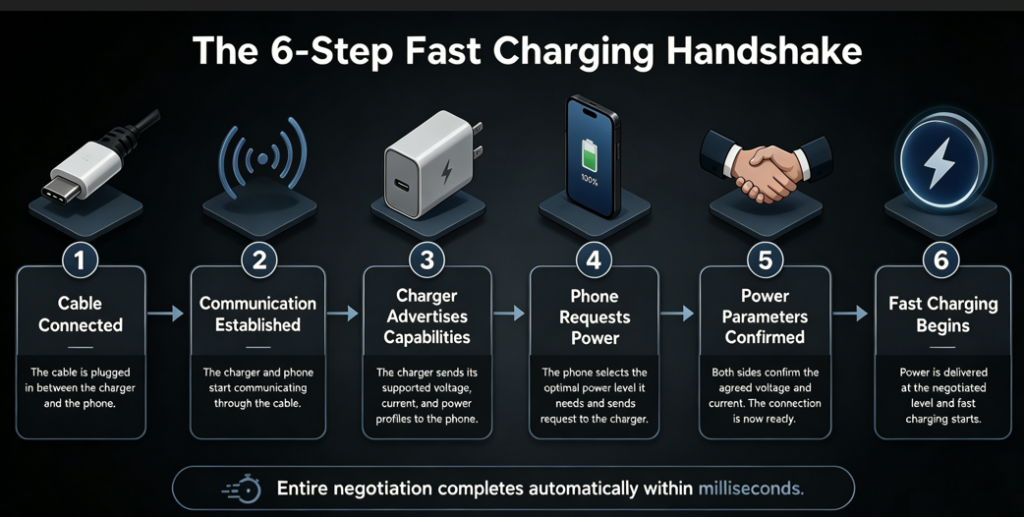
- Step 1: Attachment Detection: Insert the USB cable; the charger identifies device connection; Type-C ports detect plug direction and build physical circuit access.
- Step 2: Communication Establishment: The charger and phone start data interaction and identify mutually supported fast charging protocols.
- Step 3: Capability Advertisement: The charger broadcasts all its available output parameters: supported voltage gears, maximum current, peak power and PPS adjustable voltage support.
- Step 4: Device Power Request: The phone detects battery level, device temperature and hardware status, then sends a power demand to the charger (5V/9V/12V/20V or PPS continuous voltage regulation).
- Step 5: Mutual Parameter Confirmation: The charger verifies its output capacity, accepts the phone’s request and locks formal power parameters.
- Step 6: Formal Fast Charging with Dynamic Adjustment: The charger outputs specified power to start fast charging; both devices exchange real-time data to fine-tune power during the whole charging cycle.
4. Division of Responsibilities: Charger, Phone and USB Cable
The charging handshake involves three core hardware components with clear divided work:
4.1 Charger (Power Source)
Broadcast maximum output capacity; stably output power according to device requests; monitor circuit safety and cut off power under overheating or overload risk; adjust output parameters on demand.
4.2 Smart Device (Power Demander)
The decision-maker of charging power: Detect battery health, shell temperature and remaining power; initiate reasonable power requests; control the whole charging rhythm and temperature management.
4.3 USB Data Cable (Transmission Medium)
Build physical circuit and data communication channels; transmit handshake signal data; bear charging current; E-Marker equipped high-power cables report maximum bearing capacity to limit over-standard power output.
5. Case Study: USB PD Standard Handshake Process
USB PD is the most popular universal fast charging protocol for iPhones, Android phones and laptops. Its handshake process is the most representative:
- Start with default safe 5V output after device connection;
- The charger pushes all power profile options: 5V/3A, 9V/3A, 15V/3A, 20V/5A;
- The phone selects the optimal gear according to its real-time status;
- The charger confirms the request and completes power preparation;
- Switch to target high voltage and start official USB PD fast charging.
6. Why PPS Protocol Needs Continuous Handshake
Different from USB PD (one-time handshake before formal charging), the PPS (Programmable Power Supply) protocol needs continuous real-time handshake communication.
The core reason: the phone’s battery status changes constantly during charging. Battery tolerance, device temperature and real-time load fluctuate all the time. PPS supports stepless continuous voltage regulation. Continuous handshake helps dynamically adjust voltage and current to balance charging speed and heat generation.
7. Consequences of Handshake Failure
Handshake failure is the most common fast charging fault, with only three possible results:
7.1 Downgrade to 5V slow charging (Most Common)
The system activates the safest backup solution. Fast charging is unavailable, and the device charges at low speed, mostly caused by protocol incompatibility or unqualified data cables.
7.2 Complete failure to activate fast charging
Main causes: No mutual supported fast charging protocol, low-spec data cable, insufficient charger output capacity.
7.3 Unable to charge at all (Rare Situation)
Caused by damaged charging ports, broken data cables or faulty hardware communication modules.
8. Handshake Differences of Mainstream Fast Charging Protocols
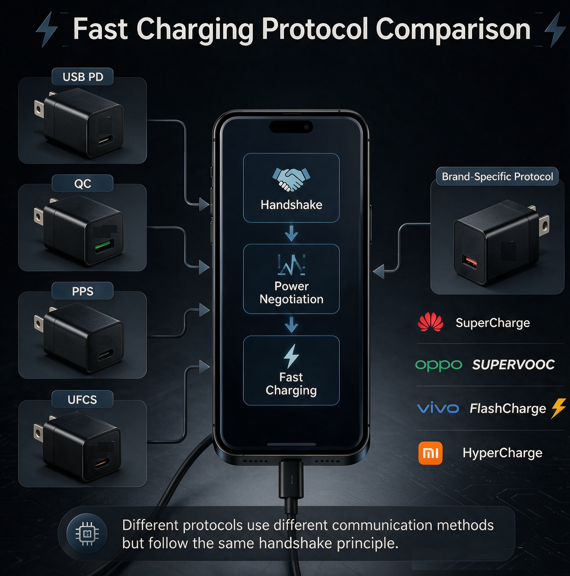
All mainstream mobile fast charging protocols follow the same core handshake logic, differing only in communication channels and industry standards:
- USB PD: Universal Type-C interface protocol; complete handshake via CC pins with best cross-brand compatibility
- QC (Qualcomm Quick Charge): Early Android exclusive protocol; handshake via data pins of USB cables, gradually phased out by USB PD
- PPS: Derived from USB PD; same basic handshake logic with dynamic stepless voltage regulation
- UFCS: China universal fusion fast charging protocol; optimize cross-device handshake compatibility for different brand smartphones
- Manufacturer Private Protocols: Huawei SuperCharge, OPPO SUPERVOOC, vivo FlashCharge, Xiaomi HyperCharge; self-defined handshake rules, only support fast charging with original matched chargers and cables
9. 7 Key Factors Affecting Handshake Success
Almost all fast charging failures stem from the following 7 factors:
- Incompatible fast charging protocols between charger and smartphone (Primary cause)
- Ordinary low-spec USB cables without high-power transmission support
- Lack of essential E-Marker identification chip for high-current charging
- Insufficient maximum output power of the charger
- Mobile system battery protection and charging limit settings
- Overhigh phone shell temperature triggers system fast charging prohibition
- High remaining battery level terminates fast charging handshake actively
10. Common Public Misconceptions about Charging Handshake
Misconception 1: High-wattage chargers always output full power
Fact: The charger cannot decide output power independently. The phone actively requests and controls the final charging power; the charger only executes device commands passively.
Misconception 2: Higher charging power means lower safety
Fact: The handshake mechanism strictly limits power output within the phone’s hardware tolerance. Qualified high-power fast charging is as safe as standard slow charging.
Misconception 3: All Type-C ports support USB PD fast charging
Fact: Type-C only refers to the physical interface shape, not fast charging function. Most low-end Type-C devices only support 5V slow charging with no PD handshake function.
Misconception 4: High-wattage chargers will burn out smartphones
Fact: Double protection from the handshake mechanism prevents overload output. Using a 120W high-power charger for low-power devices causes no hardware damage at all.
Misconception 5: Fast charging failure means a broken charger
Fact: 90% of fast charging failures are caused by protocol incompatibility or unqualified cables, not hardware damage.
11. Conclusion
The charging handshake mechanism is the cornerstone of all fast charging technology. We can summarize its core value in three simple sentences for ordinary users:
- Fast charging is not forced power injection from chargers, but a bidirectional confirmation interaction between phone and charger;
- The handshake mechanism balances charging safety, cross-device compatibility and high charging efficiency;
- Understanding the handshake mechanism helps you select matched chargers and cables, and avoid daily charging pitfalls.