
1. Introduction: The Basic Foundation of Fast Charging
When charging our smartphones and tablets, most people have the same confusion: Why do some chargers charge devices extremely fast while others work slowly? What do the marks 5V/3A and 20V/3.25A on chargers mean? Why can’t a 120W high-power charger reach full fast charging speed on your phone?
All mobile fast charging technologies are built on three basic physical parameters: voltage, current and power. These are the core fundamentals of consumer electronic charging. Once you understand them, you can master all fast charging rules, select qualified chargers and avoid common charging misunderstandings.
This article is written for non-professional ordinary users with no complex terminology or complicated formula derivation. You will understand all charging parameters and the underlying logic of fast charging after reading.
2. Basic Definition of Three Core Parameters
We use an easy-to-understand water pipe analogy for better comprehension: regard the circuit as a tap water pipeline, wires as water pipes, and electric charges as tap water.
2.1 Voltage (Symbol: U, Unit: Volt/V) — The Water Pressure of Charging
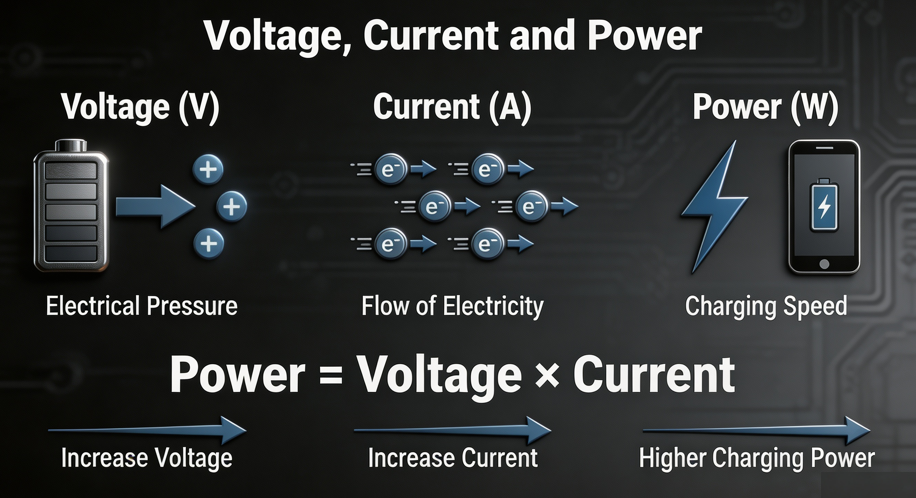
Definition: Voltage is the driving force that pushes electric charges flow through conductors, equivalent to water pressure in pipelines.
No water pressure, no flowing water; no voltage, no flowing electric charges. Higher voltage provides stronger power for electric energy transmission. The typical voltage for mobile phone charging is 5V, 9V, 12V and 20V.
2.2 Current (Symbol: I, Unit: Ampere/A) — The Water Flow of Charging
Definition: Current refers to the flow rate of electric charge passing through the circuit, equivalent to the water flow in pipelines.
High voltage cannot guarantee fast charging if the current is limited. Typical current values for daily charging are 1A, 2A, 3A, 5A and 6A; small digital devices use mA (1A=1000mA) for low current marking.
2.3 Power (Symbol: P, Unit: Watt/W) — Charging Speed
Definition: Power means the total electric energy transmitted per unit time, which directly determines the charging speed. It equals the overall transmission efficiency of the water supply system.
Higher power means faster charging speed. The 66W, 80W and 120W logos we see on chargers are power parameters, which are the core standard of fast charging. High power transmits massive electric energy in a short time to charge the battery quickly.
3. Mathematical Relationship Between Voltage, Current and Power
3.1 Core Calculation Formula
Only one simple formula is needed for all charging scenario calculation:
Power (W) = Voltage (V) × Current (A) (P=U×I)
Example: A standard slow charger marked 5V/2A has 10W rated power; a 9V/2A charger outputs 18W fast charging power.
3.2 Supplementary Ohm’s Law (For Basic Understanding Only)
Resistance hinders electric energy transmission and causes equipment heat generation, just like bends and filters in water pipes. Ohm’s Law: I=U/R (Current = Voltage ÷ Resistance).
For ordinary users, only one conclusion needs to be remembered: With fixed device hardware, higher voltage brings higher current and higher charging power.
3.3 Key Conclusions
- Charging speed is only determined by power. Single voltage or current cannot judge the charging speed;
- There are only two ways to improve charging speed: raise voltage or increase current. All commercial mobile fast charging technologies follow these two schemes.
4. Common Misconceptions About Charging Parameters
Misconception 1: Higher voltage means faster charging
This is incorrect. Voltage is only the driving force of electric flow. If the data cable or mobile phone limits the current, high voltage cannot improve charging speed. There is no inevitable fast charging correlation with high voltage alone. Besides, voltage can exist without current (open circuit), but current cannot exist without voltage.
Misconception 2: Phones reach the rated power of chargers
The 66W/120W mark on chargers is the maximum rated output power of the charger. The actual charging power of the mobile phone is always lower than this value. Mobile phone hardware, data cables and temperature will limit the real charging power.
Misconception 3: Household AC power supports direct fast charging
Household wall sockets output AC (Alternating Current), while mobile phone batteries only store and use DC (Direct Current). The core function of a charger is converting AC to DC available for phones.
Energy conversion will cause power loss and heat generation. All fast charging power data adopts DC output parameters of chargers instead of AC input data.
Misconception 4: Phones keep full-speed fast charging all the time
Mobile phones cannot maintain peak fast charging power during the whole charging process. The system will adjust parameters automatically to protect the battery.
5. Parameter Change Rules in the Whole Charging Process
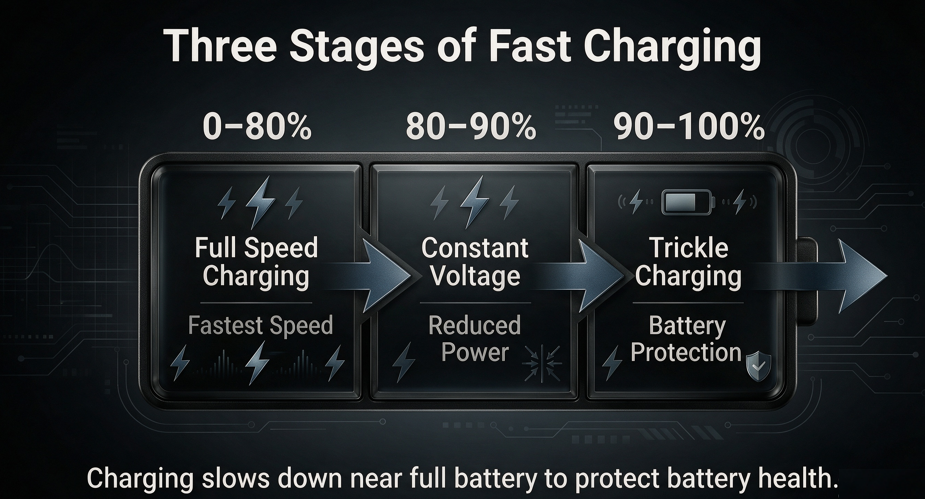
To ensure charging safety and battery service life, all smartphones follow three fixed charging stages, which explains why peak fast power only lasts for a few minutes:
Stage 1: Constant Current Stage (0%-80% battery)
For low battery level, the device maintains fixed high current and rising voltage to reach peak fast charging power.
Stage 2: Constant Voltage Stage (80%-90% battery)
Voltage reaches the upper limit and stays stable; current drops gradually, charging power decreases and the charging speed slows down obviously.
Stage 3: Trickle Charging Stage (90%-100% battery)
The system adopts tiny low current to fill the battery fully and avoid overcharging, which protects battery health. This is the slowest charging stage.
There are two mainstream fast charging technical routes in the market:
- High Voltage & Low Current: Improve power by raising voltage; low heat generation and low requirement for data cables;
- Low Voltage & High Current: Improve power by raising current; higher heat generation, special certified fast charging cables are mandatory.
Note: The exact percentages vary by device, battery management system (BMS), charging protocol, and temperature.
6. Read Charger Labels Correctly for Full-speed Fast Charging
6.1 How to read charger output marks
Modern fast chargers support multi-gear adaptive output. For example, 5V3A, 9V2A, 12V1.5A means the charger switches matching power gear automatically according to device protocol. The 100-240V input mark means global wide voltage adaptation for worldwide use.
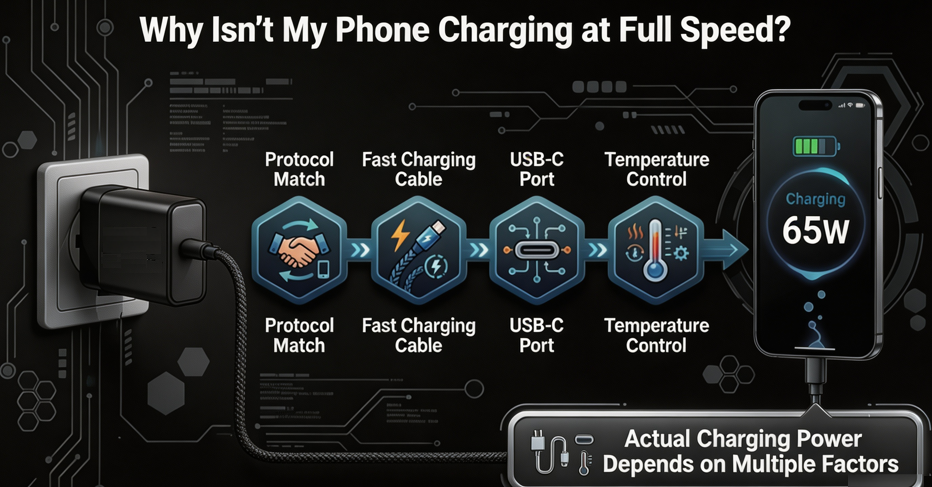
6.2 Core Factors Restricting Actual Charging Power
- Protocol Matching: The mobile phone and charger must support the same fast charging protocol;
- Qualified Fast Charging Cable: Ordinary data cables cannot bear high current;
- Interface Specification: Type-C interface supports higher power than old Micro-USB interface;
- Device Status: Overheating, high battery level and aging battery will trigger system power limit.
7. Summary
Voltage is the driving force of electric flow, current is the electric flow rate, and power determines charging speed. The formula P=U×I is the core logic of all fast charging technologies. Charging speed depends on actual output power instead of single physical parameter.
Mastering these three basic parameters helps you select qualified chargers and data cables, and solve slow charging problems easily. The mobile phone built-in system will control voltage and current automatically to guarantee charging safety in daily fast charging use.