
Chapter 1 Introduction
1.1 Research Background
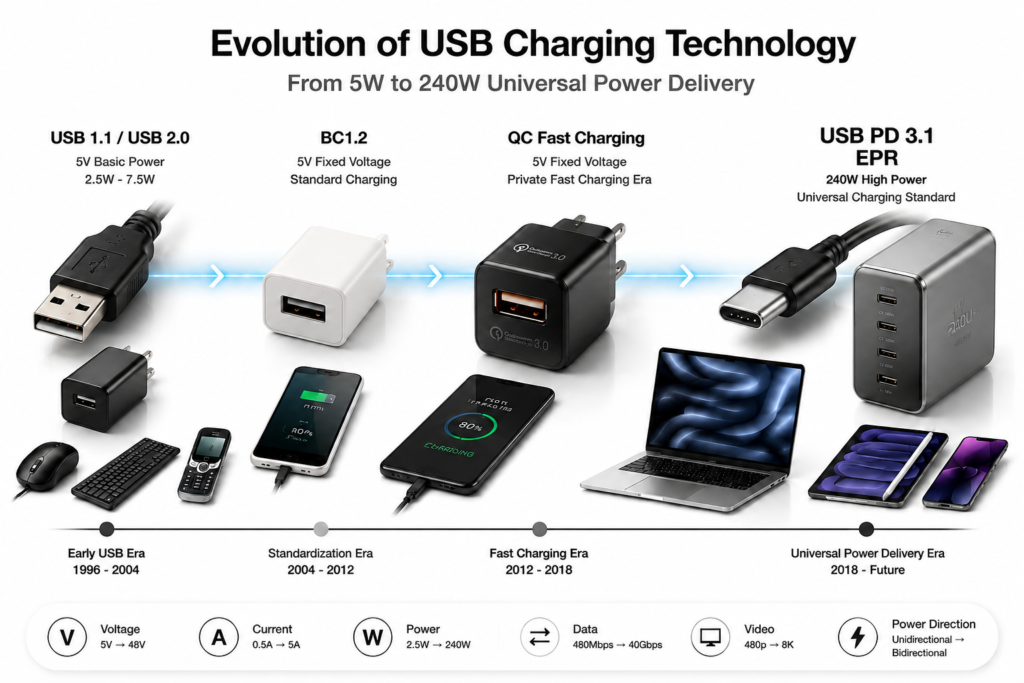
In the early stage of USB technology, USB interfaces were mainly used for data transmission and low-speed charging for small devices. The original USB charging power was very low and could only meet the basic needs of mice, keyboards and old mobile phones. With the popularization of smartphones, tablets, laptops and portable power stations, device batteries have become larger, and users have higher requirements for charging speed and compatibility.
In the past, different electronic devices required exclusive chargers, causing inconvenience and electronic waste. To solve the problems of slow charging, inconsistent interfaces and messy accessories, the USB official organization has continuously updated the USB power delivery protocol. USB has evolved from low-voltage slow charging to a universal one-cable solution that supports high-power charging, high-speed data and video transmission.
1.2 Core Concept Definition
USB power supply standards can be divided into three categories for public understanding.
The first category is basic USB power supply specifications, including USB2.0, USB3.2 and BC1.2 standards. They form the basic charging rules for all USB devices with stable compatibility but relatively slow charging speed.
The second category is the USB PD standard fast charging protocol. As the official universal fast charging standard, USB PD is widely used in Type-C devices such as modern mobile phones, tablets and laptops. It features strong compatibility and stable performance.
The third category is vendor private fast charging protocols. In the early years, brands such as Qualcomm, Huawei and OPPO developed exclusive fast charging technologies to improve charging speed. These protocols only support full-speed charging for their own devices, resulting in poor cross-brand compatibility.
1.3 Research Status at Home and Abroad
Internationally, the USB Implementers Forum has long led the iteration and unified optimization of USB power supply standards, promoting the standardization of global charging interfaces, cables and power levels. European and American device manufacturers mainly adopt the universal USB PD standard to ensure versatility and safety.
Domestic research focuses on practical user experience. Chinese manufacturers iterate fast charging technologies faster with higher charging power, and are gradually adapting to international universal standards to achieve better compatibility.
1.4 Research Significance and Innovation
Studying the iteration of USB power protocols helps ordinary users understand the differences between chargers and data cables, and master the working principles of fast charging technology. This article comprehensively sorts out the complete evolution of USB charging technology in a popular and easy-to-understand way, distinguishes official standards from private protocols, and clearly presents the development logic of USB fast charging.
Chapter 2 Original USB Power Delivery Protocols
2.1 Evolution of Native USB Basic Power Supply
Early USB1.1 and USB2.0 adopted a fixed 5V low-voltage power supply design with a maximum power of only 7.5W. There was no fast charging function, which could only meet slow charging for small electronic devices.
USB3.2 slightly optimized power supply stability but still maintained the 5V low-voltage limit without fast charging capability, failing to adapt to the fast charging needs of smart devices.
2.2 USB BC1.2 Charging Specification
BC1.2 is the basic universal charging standard for traditional USB-A interfaces. It divides USB ports into three types to standardize low-voltage charging logic. However, BC1.2 only supports 5V fixed voltage with low power ceiling, lacking high-speed fast charging capability, which gradually became unable to meet market demand.
2.3 Early Private Fast Charging Protocols
Before the maturity of official high-power fast charging standards, mobile phone brands launched private protocols such as QC2.0 and early VOOC to improve charging speed. Although these technologies improved user experience, they caused serious compatibility problems. Different brands’ chargers and devices could not share fast charging, resulting in a fragmented charging ecosystem.
Chapter 3 Iteration and Update of USB PD Protocol
3.1 USB PD 1.0 (2012)
PD 1.0 first proposed the concept of 100W high-power USB power supply, but its technical architecture was immature. It lacked unified Type-C interface adaptation and stable communication mechanism, and had almost no commercial application, so it was quickly eliminated.
3.2 USB PD 2.0 (2014)
PD 2.0 is the first widely popular universal fast charging standard. It fully adapts to Type-C interfaces, adds CC communication mechanism to automatically match charging power, and supports bidirectional power supply. It sets fixed voltage gears and two power levels of 60W and 100W, laying the foundation for modern USB fast charging.
3.3 USB PD 3.0 (2015)
PD 3.0 optimizes device identification, safety verification and overload protection mechanisms to make charging more stable and reliable. The PPS programmable fast charging patch launched in 2017 realizes precise voltage adjustment, enabling universal PD chargers to be compatible with most Android private fast charging solutions.
3.4 USB PD 3.1 EPR (2021)
PD 3.1 is a milestone upgrade of USB power delivery technology. It includes SPR standard power mode with 100W maximum power for backward compatibility, and EPR extended power mode with new 28V, 36V and 48V high-voltage gears, raising the maximum power to 240W. It supports high-power power supply for gaming laptops, workstations and outdoor power stations, and adds professional high-power safety protection mechanisms.
3.5 USB PD 3.2 Supplementary Update
PD 3.2 does not increase power limit, but optimizes high-power device certification, compatibility rules and power distribution standards, making the 240W fast charging ecosystem more standardized and reliable.
| Protocol Version | Release Year | Max Power | Key Features |
|---|---|---|---|
| USB PD 1.0 | 2012 | 100 W | First high-power concept; rarely used commercially |
| USB PD 2.0 | 2014 | 100 W | First widely adopted standard; full Type-C support |
| USB PD 3.0 (PPS) | 2015 (PPS: 2017) | 100 W | Better safety; compatible with most Android fast charging |
| USB PD 3.1 EPR | 2021 | 240 W | Milestone upgrade; supports high-power devices |
| USB PD 3.2 | Supplementary update | 240 W | Improved certification & ecosystem standardization |
Chapter 4 Synchronous Update of Supporting Hardware Standards
4.1 Type-C 2.1 Interface Upgrade
To adapt to 240W high-power fast charging, the Type-C 2.1 specification optimizes interface heat dissipation, voltage resistance and current carrying capacity, ensuring the safety and stability of high-voltage and high-current charging.
4.2 E-Marker Cable Classification Standard
| Cable Grade | Rated Power | Typical Applications |
|---|---|---|
| Entry-level | 60 W | Smartphones, tablets, basic peripherals |
| SPR Standard | 100 W | Ultrabooks, fast-charging mobile phones |
| EPR High-power | 240 W | Gaming laptops, outdoor power stations |
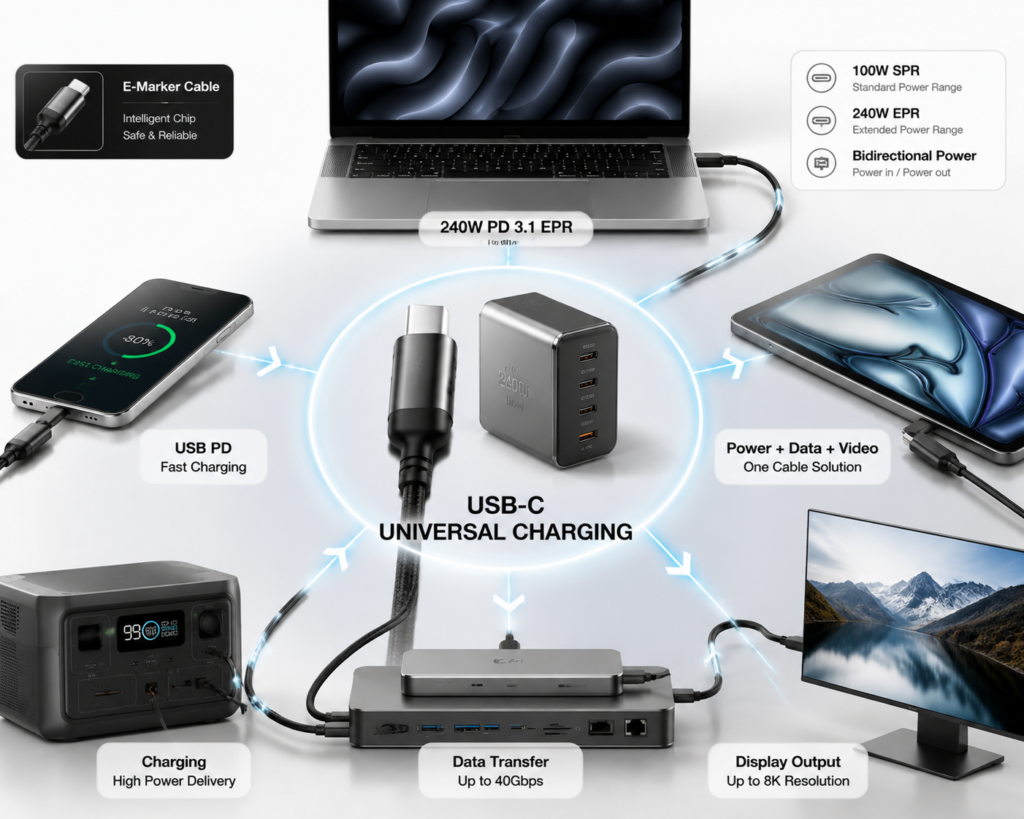
Type-C cables are divided into three grades: 60W ordinary cables, 100W SPR cables and 240W EPR high-power cables. Different cables carry different power limits. Mismatched cables will fail to trigger high-power fast charging and may cause potential safety risks.
4.3 USB4 and Thunderbolt PD Mandatory Specification
The latest USB4, Thunderbolt 3 and Thunderbolt 4 interfaces all built-in USB PD protocol, realizing one-cable integration of high-speed data transmission, video output and high-power charging.
Chapter 5 Iteration and Integration of Private Fast Charging Protocols
5.1 Iteration of Qualcomm QC Protocol
Qualcomm QC fast charging has iterated from QC2.0 to QC5, gradually changing from closed private protocol to PD-compatible public standard, balancing charging speed and universal compatibility.
5.2 Iteration of Domestic Manufacturer Fast Charging
Domestic fast charging technologies such as Huawei FCP/SCP, OPPO VOOC and vivo FlashCharge continue to upgrade in charging power and speed, and gradually adapt to universal international standards.
5.3 Compatibility Between Private Protocols and PD PPS
Relying on the PPS function of USB PD 3.0, universal chargers can adapt to most domestic mobile phone fast charging modes. The industry has transformed from closed independent ecology to an open pattern dominated by official standards and supplemented by private technologies.
Chapter 6 Industry Reform and Application Expansion
6.1 Unified Interface for Consumer Electronics
With the iteration of USB protocols, mobile phones, tablets, laptops and other devices have fully unified Type-C interfaces. Users no longer need to carry multiple chargers and cables, greatly improving portability.
6.2 Universal Power Supply for High-Power Devices
The 240W USB PD standard enables gaming laptops, workstations and outdoor energy storage devices to use universal Type-C high-power power supply, replacing traditional bulky dedicated power adapters.
6.3 Multi-Functional Peripheral Ecosystem
Monitors, docking stations and portable peripherals can realize power supply, data transmission and video output through one single cable, simplifying desktop wiring and improving efficiency.
6.4 Industrial and Environmental Value
The unification of charging standards reduces redundant production and abandonment of chargers and cables, reduces electronic waste, and realizes energy-saving and environmentally friendly development.
Chapter 7 Existing Problems and Future Trends
7.1 Current Industry Pain Points
Mismatched high and low power cables bring potential safety hazards. Some private fast charging protocols cannot be fully compatible with universal PD standards. In addition, the cost of 240W high-power equipment and dedicated cables is relatively high, limiting market popularization.
7.2 Future Development Direction
In the future, PD universal fast charging will be fully popularized across all devices. Intelligent dynamic power distribution technology will optimize charging efficiency and safety. Global unified high-power charging safety certification standards will be continuously improved to promote the popularization of high-speed and safe fast charging technology.
Chapter 8 Summary and Prospect
8.1 Full Text Summary
After more than 20 years of iteration, USB power delivery protocol has developed from the original 5V low-voltage slow charging to a 240W high-power universal charging system. From fragmented private charging ecology to unified official standard, from single charging function to integrated multi-function transmission, USB technology has completely changed the power supply mode of global digital devices.
Each protocol update solves the defects of the previous generation, realizing faster charging speed, stronger compatibility and higher safety. Supporting interfaces and cables have also been fully upgraded to form a complete and mature industrial system. Although problems such as cable mismatch and partial compatibility defects still exist, the overall technical maturity and generalization have reached a high level.
8.2 Future Prospect
USB power delivery technology will continue to develop towards generalization, intelligence, safety and energy saving. In the future, all electronic devices will fully support PD fast charging, completely eliminating the chaos of multiple interfaces and multiple chargers. Intelligent power regulation and bidirectional power supply technology will enrich application scenarios, and unified safety standards will further promote the popularization of high-power fast charging.
8.3 Research Conclusion
The iteration of USB power protocols represents the evolution of digital charging technology from chaos to unification, from low efficiency to high performance, and from single function to integrated intelligence. With continuous technical updates, USB will become a universal, safe, stable and green core power transmission solution for future intelligent hardware devices.