
When you use smartphones, tablets and laptops, you must have encountered this common trouble: your device runs out of power, and standard charging takes too long. Fast charging solves this problem perfectly. Many people use fast charging every day, but they do not understand its working principle, whether it damages phone batteries, or whether chargers can be used across brands. This article will explain fast charging in simple, easy-to-understand language for ordinary users with no professional technical background.
1. Definition and Development Background of Fast Charging
1.1 Basic Definition of Fast Charging
In simple terms, fast charging is a charging technology that greatly shortens the charging time of electronic devices by increasing charging power.
In a broad sense, fast charging is not only a high-power charger, but a complete technical system. It consists of unified charging protocols, mobile phone power management systems, dedicated battery structures, matching chargers and data cables.
1.2 Why Fast Charging Was Invented
The birth and popularization of fast charging stem from three real life demands:
First, modern electronic devices have larger battery capacity to support high-performance screens and multi-function operation; traditional slow charging cannot meet the charging demand of large-capacity batteries.
Second, the traditional 5W slow charging has obvious technical bottlenecks, and its low power cannot be improved under the old technical framework.
Third, modern people have a fast-paced lifestyle and only have fragmented idle time to charge devices. Users need quick temporary power supplementation instead of long-time static charging.
1.3 Development History of Fast Charging Technology
The development of consumer electronic charging technology is divided into three stages:
1. Standard slow charging stage: 5W and 10W low-power charging were the industry standard, with slow charging speed and low heat generation.
2. Initial popularization stage of fast charging: 18W to 30W fast charging became mainstream, and fast charging gradually became a standard built-in function of smartphones.
3. High-power fast charging stage: 60W to 120W high-power fast charging is widely popularized now. Most smartphones can be fully charged in more than ten minutes.
2. Core Working Principle of Fast Charging
2.1 Basic Charging Power Formula
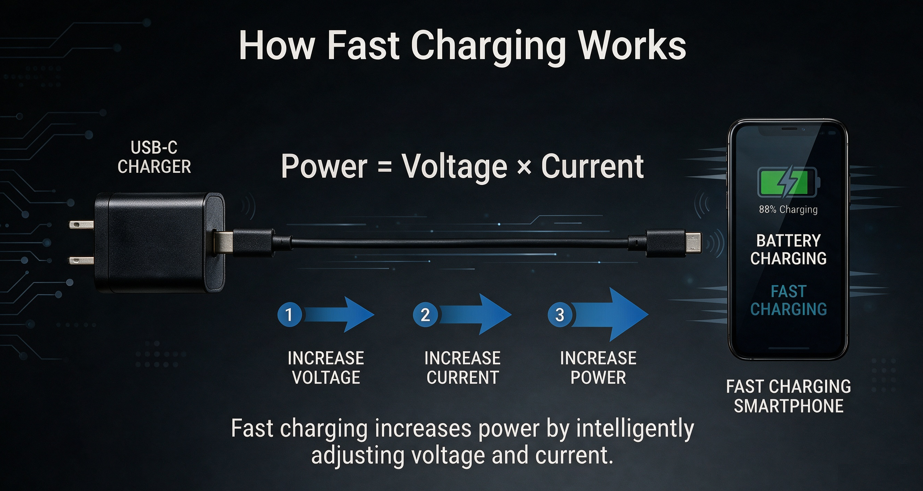
The core formula of all charging technologies is simple:Power (W) = Voltage (V) × Current (A).
There are only two ways to speed up charging: raise voltage or raise current. All fast charging technologies are designed around these two directions.
2.2 Three Mainstream Fast Charging Technical Schemes
All mobile phone fast charging solutions on the market fall into three categories:
High voltage and low current scheme: Mostly adopted by early Qualcomm QC fast charging. It improves charging speed by raising voltage. Its advantages lie in low requirements for data cables; its disadvantage is that most heat accumulates on the mobile phone body.
Low voltage and high current scheme: First popularized by OPPO VOOC flash charging. It increases current under standard low voltage. The mobile phone generates little heat during charging, but it needs dedicated original chargers and data cables to trigger fast charging.
High voltage and high current scheme: The mainstream solution for current 60W+ high-power fast charging. It adopts dual-cell battery and multi-channel charge pump chips to raise voltage and current simultaneously. It has the fastest charging speed and best heat control effect, with a more complex internal battery structure.
2.3 Three Stages of the Complete Charging Process
Many users find charging speed slows down obviously when the battery reaches 80%. This is a universal battery protection mechanism with three fixed stages:
1. Full-speed fast charging stage (0%-80% battery): The device runs at full power with the fastest charging speed.
2. Constant voltage slow charging stage (80%-90% battery): The system automatically reduces charging power to protect the battery core.
3. Trickle charging stage (90%-100% battery): Tiny current fills the battery gently to avoid overcharging and extend battery service life.
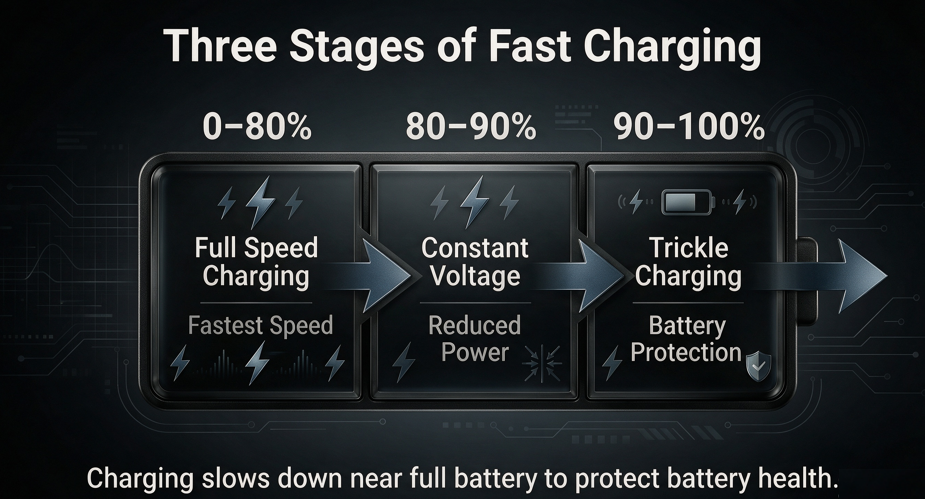
Note: The exact percentages vary by device, battery management system (BMS), charging protocol, and temperature.
3. Mainstream Fast Charging Protocols and Classification
3.1 Public Universal Fast Charging Protocols
These open industry standards are compatible with all brands of electronic devices:
USB PD Protocol: Formulated by the international USB-IF organization, it is the global universal fast charging standard, compatible with mobile phones, tablets, laptops and most digital devices.
Qualcomm QC Protocol: Mainly adapted to Android devices with Qualcomm Snapdragon chips, with strong compatibility with third-party charging accessories.
3.2 Private Brand-exclusive Fast Charging Protocols
Main mainstream Chinese mobile phone brands launch self-developed private fast charging protocols: Huawei SCP/FCP, OPPO VOOC/SuperVOOC, vivo FlashCharge and Xiaomi Surge Charging.
The characteristics of private protocols: higher peak charging power and faster charging speed; poor cross-brand compatibility. Cross-brand chargers cannot trigger high-power fast charging, only standard slow charging.
3.3 Fast Charging for Apple Devices
Apple has no self-developed high-power private fast charging protocol. All iPhone fast charging relies on the universal USB PD standard, with a stable upper limit of 20W-27W. Apple MagSafe magnetic wireless charging is the official supplementary wireless fast charging solution for Apple devices.
4. Core Hardware Required for Fast Charging
Complete high-power fast charging requires three essential hardware components:
4.1 Charger (Power Adapter)
The charger provides basic charging power. Most modern fast chargers adopt GaN (Gallium Nitride) technology, featuring smaller size, lower heat generation and multi-device compatibility. The charger can automatically identify device protocols and match appropriate charging power.
4.2 Fast Charging Data Cable
Unqualified data cables are the most common reason for fast charging failure. High-power fast charging cables are built with E-Marker identification chips to bear large current. At present, Type-C has become the mainstream interface for all fast charging devices.
4.3 Built-in Mobile Phone Hardware
The mobile phone’s internal power management chip, charge pump step-down chip, dual-cell battery and battery protection circuit are the core hardware to receive fast charging signals. High-power fast charging phones are mostly equipped with dual-cell batteries to control overall temperature.
5. Battery Life and Safety of Fast Charging
5.1 Does Fast Charging Damage Battery Life?
High temperature and long-term high-current operation are the two main causes of battery aging. Formal brand fast charging is equipped with intelligent temperature control and power adjustment systems. Standard use of certified fast charging has almost no negative impact on battery service life, same as traditional slow charging.
5.2 Fast Charging Safety Protection System
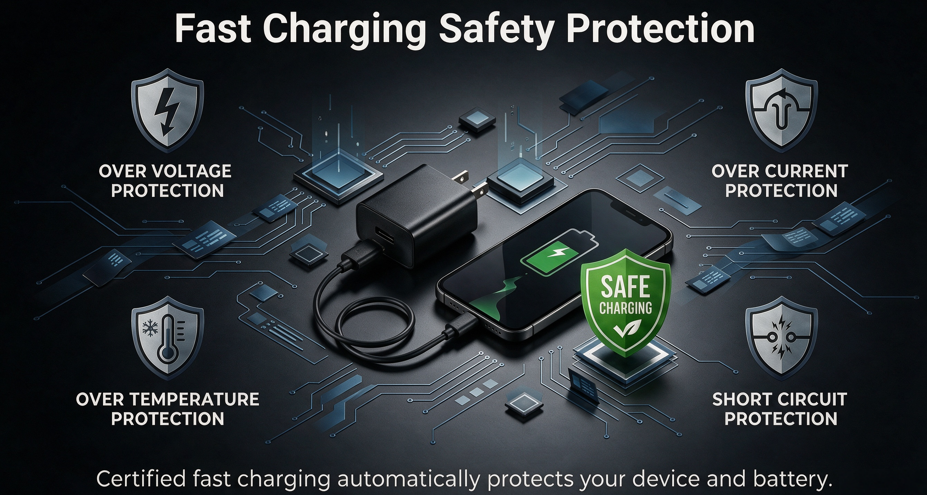
Certified fast charging devices have complete multi-layer protection: over-voltage protection, over-current protection, over-temperature protection and short-circuit protection. All commercial smartphones pass strict safety tests before launch.
5.3 Potential Safety Risks
Fast charging technology itself is safe. Potential hazards come from bad user habits: using uncertified inferior third-party chargers and cables; charging in closed high-temperature environment; using high-power fast charging for aging and bulging batteries.
6. Common Misconceptions About Fast Charging
1. Misconception 1: Fast charging will damage phone batteries seriously. Fact: Certified official fast charging has perfect protection mechanisms, which will not damage batteries in daily use.
2. Misconception 2: Higher power means faster charging speed. Fact: Marked high power is only instantaneous peak power. Actual charging speed is limited by battery capacity and phone temperature control.
3. Misconception 3: Chargers cannot be used across different brands. Fact: Chargers with universal public protocols work normally across brands; only brand-exclusive high-power fast charging cannot be used universally.
4. Misconception 4: Overnight charging damages batteries. Fact: Modern smartphones will automatically cut off power when fully charged. Overnight charging will not cause overcharging or battery damage.
7. Accessory Selection and Correct Use Guidelines
7.1 How to Choose a Qualified Charger
Prioritize chargers matching your phone’s fast charging protocol; choose products with official 3C safety certification; users with multiple digital devices can choose GaN multi-port chargers to charge all devices with one adapter.
7.2 How to Choose a Fast Charging Data Cable
60W+ high-power fast charging needs formal cables with E-Marker chips. Match cable specifications with charging power, and avoid cheap uncertified inferior data cables.
7.3 Daily Battery Maintenance Tips
Avoid fast charging under high temperature environment; keep mobile phone battery between 20%-80% for daily use to prolong battery life; maintain 50% battery level for long-term idle storage of electronic devices.
8. Conclusion and Future Development Trend
8.1 Core Summary
In short, fast charging is a mature intelligent charging system that balances high charging efficiency and equipment safety. The current industry pattern is clear: universal charging protocols focus on cross-device compatibility, while private brand protocols focus on ultra-high charging speed.
8.2 Future Development of Fast Charging
The future development of fast charging has three main directions: continuous upgrade of wired high-power charging; popularization and speed improvement of wireless fast charging; unified global fast charging industry standards; new battery materials to realize lower-temperature, safer and faster charging.