
Preface
Why Learn Safety and Certification Terminology
USB charging devices have been widely used in daily life. With the popularization of fast charging technology, electronic product safety has become a critical public concern. Many consumers mistakenly believe all chargers, data cables and power banks have the same safety performance. In fact, low-quality uncertified accessories bring huge fire and electric shock risks. Various confusing certification marks are printed on product shells; learning basic safety and certification terms is more important than simply choosing famous brand products to protect your personal and equipment safety.
Target Audience
This article is written for non-professional ordinary users, including general consumers, digital enthusiasts, e-commerce purchasers and enterprise bulk procurement staff. No complex professional terminology and technical formulas are involved.
Chapter 1 Basic USB Safety Terminology
Safety: Product safety means electronic products will not cause personal injury or equipment damage under normal use scenarios. It includes two core categories: electrical safety and general use safety.
Electrical Safety: The core basic safety standard of USB devices, mainly preventing electric shock, short circuit and current leakage.
Reliability: The ability of USB devices to work stably for a long time. High reliability does not mean high safety, while qualified safe products have basic working stability.
Protection Mechanism: The built-in self-protection system of electronic products, divided into hardware physical protection and software program protection, to avoid circuit abnormality damage.
Isolation (Electrical Isolation): Separate high-voltage municipal circuit and low-voltage charging circuit to block dangerous high voltage flowing to mobile phones and human bodies; the core design of formal chargers.
Ground: Discharge abnormal leakage current to the ground, prevent equipment shell electrification and electric shock accidents.
Insulation: Materials that block current transmission. Double insulation means two independent protective insulation layers to ensure safety when one layer fails.
Chapter 2 USB Charging Protection Terminology
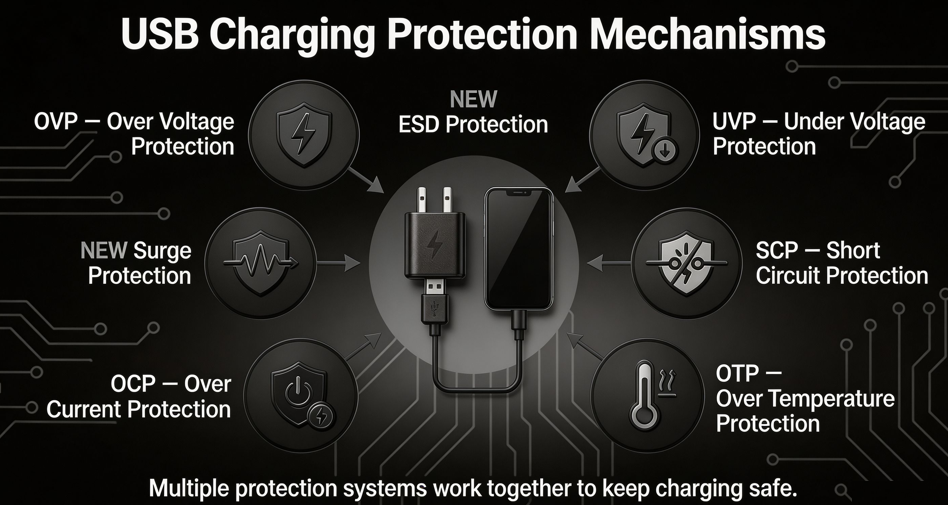
OVP (Over Voltage Protection): Automatically cut off output when voltage exceeds standard to prevent equipment burnout.
UVP (Under Voltage Protection): Protect devices from abnormal low input voltage and unstable power supply.
OCP (Over Current Protection): Limit excessive output current to protect charging ports and batteries.
SCP (Short Circuit Protection): Cut off power instantly when short circuit occurs to avoid fire and device damage.
OTP (Over Temperature Protection): Reduce power or stop charging automatically when overheating to prevent battery swelling and fire hazards.
OPP (Over Power Protection): Limit output power within factory design parameters to prevent overload failure.
Surge Protection: Resist instantaneous high-voltage impact caused by lightning strike and grid fluctuation.
ESD (Electrostatic Discharge): Prevent static electricity generated by dry environment and human friction from damaging exposed USB interface chips.
Chapter 3 USB Type-C and PD Safety Terminology
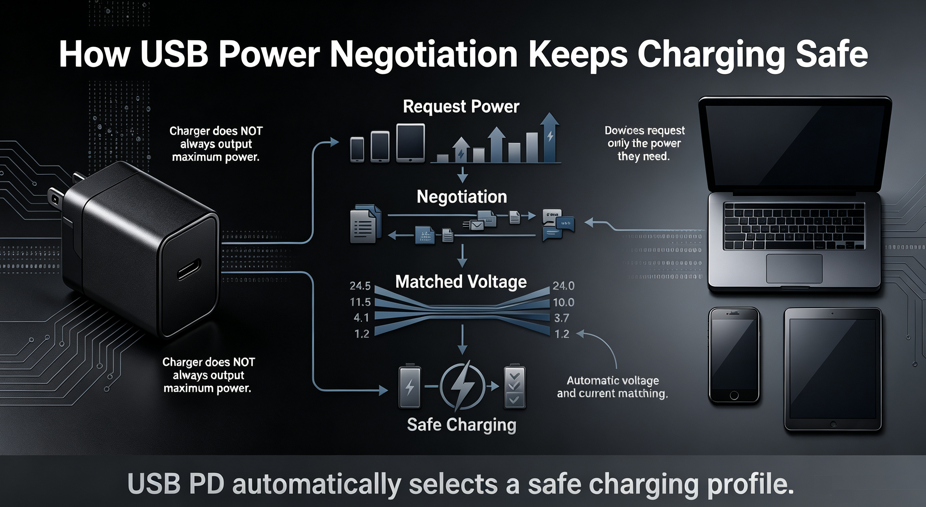
USB PD Safety: USB PD is the mainstream universal fast charging protocol, which standardizes high-power charging rules to control overall charging safety.
Power Negotiation: The automatic communication and matching process between charger and terminal equipment. The charger outputs matched power instead of full maximum power to adapt to equipment bearing capacity.
PDO (Power Data Object): The formal power output parameter list of PD chargers, the basic standard for safe fast charging matching.
PPS Safety (Programmable Power Supply): Dynamic voltage regulation fast charging protocol, lower working heat and smaller battery loss than traditional fast charging.
EPR Safety (Extended Power Range): 240W ultra-high power PD charging standard, with stricter safety thresholds for heat dissipation and circuit protection.
Cable E-Marker: Built-in identification chip for high-power Type-C cables. Cables above 100W must be equipped with E-Marker chips to identify wire load capacity.
Authentication: Mutual capability verification between Type-C devices to avoid wrong high-voltage power supply to low-load equipment.
Chapter 4 Wireless Charging Safety Terminology
FOD (Foreign Object Detection): Core wireless charging safety function; stop charging automatically when metal foreign matters fall on the charging coil to prevent high temperature combustion.
Thermal Protection: Special temperature control mechanism for wireless charging to solve overheating problems caused by low energy conversion efficiency.
Coil Alignment: Accurate coil alignment improves charging efficiency and avoids local overheating risk.
Magnetic Alignment: Magnetic positioning technology such as MagSafe calibrates coil position to improve wireless charging safety and efficiency.
Qi Safety: The global mainstream wireless charging industry standard, unified regulation of wireless charging safety indicators.
Chapter 5 Basic Product Certification Terminology
Certification: Authorized third-party institutions detect products and issue qualified certificates to prove products meet official safety standards.
Compliance: Products meet the minimum national and industrial market access standards.
Certified Product: Products passing official detection with verifiable certification marks, lower safety risks than uncertified products.
Test Report: Detailed detection data report issued by third-party laboratories, the core material for applying for product certification.
Accredited Laboratory: Government authorized independent third-party testing institutions with objective and fair detection results.
Chapter 6 International Safety Certification Terminology
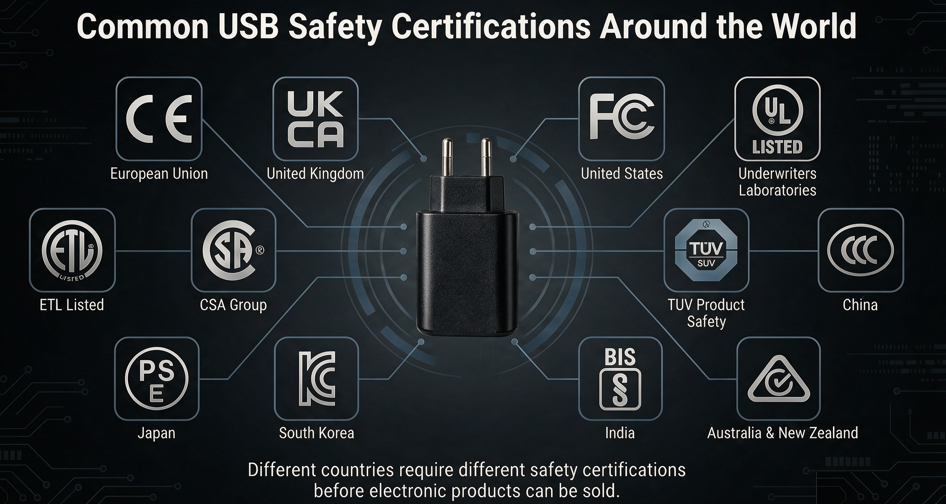
CE: EU mandatory market access safety certification for electronic products.
UKCA: UK mandatory electronic product certification after Brexit.
FCC: US mandatory electromagnetic compatibility certification.
UL/ETL/CSA: North American authoritative electrical safety certifications.
TÜV: German high-standard third-party safety certification, widely recognized globally.
PSE/KC/BIS/RCM: Mandatory electronic product certification for Japan, South Korea, India, Australia and New Zealand respectively.
CCC: China Compulsory Certification; core mandatory certification for domestic mainstream chargers and power banks in China.
Chapter 7 Environmental and Material Certification Terminology
RoHS: EU hazardous substance restriction standard, limit toxic heavy metals in digital accessories.
REACH: EU strict chemical control regulation.
WEEE: Waste electronic product recycling environmental regulation.
Halogen-Free: Environment-friendly flame retardant material, no toxic flue gas when burning.
Conflict Minerals: International supply chain compliance standard, has no relation to user use safety.
Recyclable Materials: Environment-friendly recyclable raw materials for digital product shells.
Chapter 8 EMC and Performance Test Terminology
EMC (Electromagnetic Compatibility): Products will not interfere with surrounding electrical equipment, and resist external electromagnetic interference.
EMI (Electromagnetic Interference): Electromagnetic wave noise generated by electronic equipment.
EMS (Electromagnetic Susceptibility): The anti-interference ability of electronic products.
Conducted/Radiated Emission: Two types of electromagnetic noise transmission forms.
Hi-Pot Test / Leakage Current / Burn-in Test / Drop Test / Plug Cycle Test: Routine factory safety and durability detection items for USB electronic products.
Chapter 9 Common USB Safety Misconceptions
- Higher charging power means higher danger: False. Product safety depends on certification and workmanship, not charging power.
- Uncertified products are unsafe: Not absolute, but uncertified products have no official safety guarantee, not recommended for purchase.
- Certified products are genuine qualified products: False, counterfeit products often forge certification marks.
- Fast charging damages battery easily: False. Formal certified fast charging has complete protection, barely affects battery life.
- Third-party chargers are unsafe: False. Third-party products with formal certification are as safe as original brand chargers.
- Why counterfeit certification marks exist: Manufacturers cut production costs, avoid expensive official testing and certification.
Chapter 10 How to Identify and Select Safe USB Products
Check product printed parameter labels and reject three-no products; verify certification authenticity through official institution platforms; check official product specification sheets; confirm USB-IF certification for high-end fast charging accessories.
Select 3C, TÜV certified regular chargers; E-Marker equipped high-power data cables; 3C certified brand power banks. Prioritize certified products rather than low-priced unknown brand accessories in daily purchase.