
1. Introduction: Definition and Value of Fast Charging
When using smartphones, tablets, TWS earbuds and other digital devices, we often face the trouble of low battery. Standard slow charging takes 3 to 4 hours to fully charge a device, which cannot fit modern fast-paced lifestyles. Under this background, fast charging technology has been widely popularized.
Simply put, fast charging is a technology that greatly shortens battery charging time by raising charging power within a safe range. Its core difference from standard charging is straightforward: standard charging stores energy slowly with low power, while fast charging inputs more electricity in a short time with higher controllable power.
As smart devices consume more power and batteries gain larger capacity, fast charging has become a standard configuration for digital products. Its biggest advantage is time-saving; a dozen minutes of fragmented charging can support all-day daily use. This article will explain the full working mechanism of fast charging in plain language, from basic battery principles to system operation and public misconceptions.
2. Basic Principle: How Lithium Battery Charging Works
Almost all consumer digital devices use lithium-ion batteries. Fast charging is only an optimized upgrade of the standard lithium battery charging process. We need to master the basic charging logic first.
2.1 Basic Structure of Lithium Batteries
A lithium battery has four core components: positive electrode, negative electrode, electrolyte and separator. You can regard the battery as a water storage tank: lithium ions are water flow, electrolyte is the water pipeline, and the positive and negative electrodes are two ends of the tank.
During charging, lithium ions move from the positive electrode to the negative electrode and store energy; during discharging (using your phone), lithium ions flow back to the positive electrode to release energy. To put it simply: charging stores lithium ions at the negative electrode, and discharging consumes stored lithium ion energy.
2.2 Three Stages of Standard Battery Charging
All lithium batteries follow a three-phase charging process, applicable to both fast and slow charging:
- Constant Current (CC) Stage: Output stable fixed current to charge the battery, and the battery voltage rises gradually;
- Constant Voltage (CV) Stage: When the battery reaches the safe voltage limit, keep the voltage constant and gradually reduce the charging current;
- Trickle Charging Stage: Charge the last small portion of power with tiny weak current to avoid battery overheating and overcharging damage.
2.3 Core Formula of Charging Speed
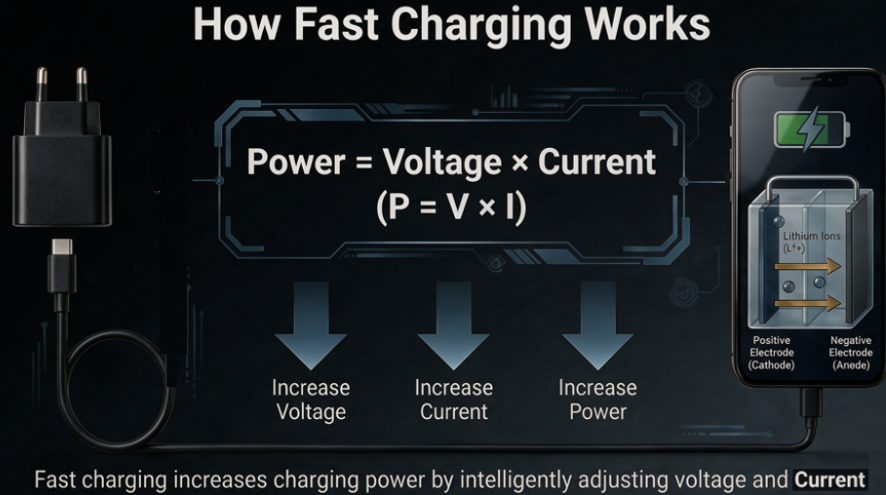
Charging speed is determined by one basic physical formula: Power (P) = Voltage (U) × Current (I).
Popular interpretation: Voltage equals water pressure, current equals water pipe thickness, and power equals total water volume flowing into the tank per unit time. Faster charging fundamentally means improving total charging power to input more electricity in unit time — this is the bottom logic of all fast charging technologies.
3. Three Core Implementation Schemes of Fast Charging
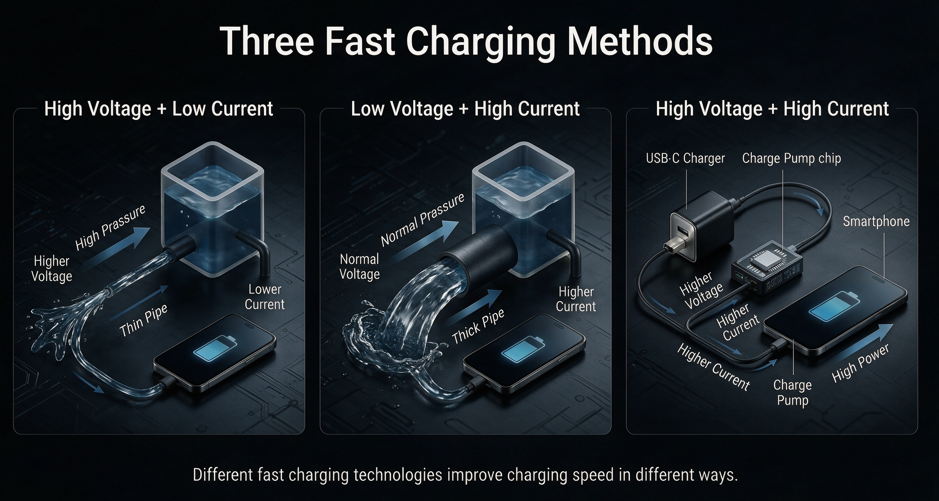
All mainstream fast charging technologies fall into three categories based on the power formula, with respective advantages and disadvantages:
3.1 High Voltage & Low Current Fast Charging
Working principle: Keep charging current unchanged and only increase voltage (raise water pressure with fixed pipe diameter).
Advantages: Compatible with ordinary data cables; small-size chargers. Disadvantages: Extra voltage converts into heat on mobile phones, causing obvious heating during charging. Representative technology: Qualcomm Quick Charge (QC).
3.2 Low Voltage & High Current Fast Charging
Working principle: Maintain low safe voltage and only increase charging current (thicken water pipeline with standard water pressure).
Advantages: Low equipment heat and low energy loss. Disadvantages: Strict requirements for data cables and interfaces; only dedicated cables activate full-speed fast charging. Representative technology: OPPO VOOC, Huawei SCP Super Charge.
3.3 High Voltage & High Current Hybrid Fast Charging
Working principle: Raise voltage and current simultaneously to achieve ultra-high charging power, the mainstream solution for 100W+ super fast charging on flagship phones.
This solution relies heavily on charge pump technology: an intelligent energy converter that steps down voltage and amplifies current, greatly reducing heat generation and energy loss. Most modern high-power super fast charging adopts this hybrid scheme.
4. Four Core Components of a Complete Fast Charging System
Fast charging cannot work with a single device; four hardware modules cooperate to realize high-speed charging:
4.1 Power Supply Terminal: Charging Adapter
The charger converts household alternating current (AC) into direct current (DC) for batteries. Fast charging adapters add two core functions: intelligent device identification and automatic voltage/current adjustment.
New materials such as Gallium Nitride (GaN) and Silicon Carbide (SiC) are widely used in new fast chargers to reduce charger size, lower heat and support higher power output.
4.2 Transmission Terminal: Charging Data Cable
Data cables undertake electric energy transmission. Thicker wires and high-quality materials support larger current. High-power fast charging cables are built with an E-Marker chip, which tells chargers and phones the maximum bearing power of the cable and activates fast charging authorization.
4.3 Control Terminal: PMIC and Protocol Chip
It is the brain of the whole fast charging system. The power management chip regulates voltage, current and charging phases; the protocol chip completes handshake communication between the phone and charger. Fast charging will not turn on until both devices confirm mutual compatibility.
4.4 Energy Storage Terminal: Battery and BMS System
Fast-charging compatible batteries adopt optimized internal structure to bear high-current fast energy storage. The Battery Management System (BMS) acts as a safety supervisor, monitoring battery voltage, temperature and power in real time; it reduces charging power or suspends charging once potential risks are detected.
5. Principles of Mainstream Commercial Fast Charging Protocols
Fast charging protocols are divided into two categories for easy understanding: universal public protocols and brand-exclusive private protocols.
5.1 Universal Public Protocol: USB PD
The global universal fast charging standard, supported by iPhone, laptops and most Android devices. The charger and device communicate through cable CC pins to negotiate the optimal charging power. It has the best cross-brand compatibility; the latest PD 3.1 standard supports up to 240W ultra-high power charging.
5.2 High Voltage Protocol Representative: Qualcomm QC
Early mainstream Android fast charging, which improves speed by grading up voltage. It has good compatibility with third-party chargers, with obvious heat generation during charging.
5.3 Low Voltage Direct Charging Representative: VOOC & Huawei SCP
Brand private protocols adopting direct charging mode: bypass the internal step-down circuit of mobile phones and transmit electric energy directly to batteries. Some devices apply dual-cell battery design to charge two batteries synchronously, realizing faster speed and lower heat. Full-speed charging only works with official matched chargers and cables.
5.4 Charge Pump Super Fast Charging
The core technology of 100W+ high-power charging. It realizes energy conversion via capacitors, with energy conversion efficiency over 95% and far better heat control than traditional fast charging. It is the core configuration of current flagship phone super fast charging.
6. The Complete Working Process of Fast Charging
- Physical Connection: Connect the phone and charger via data cable, plug into household power supply;
- Protocol Handshake and Power Negotiation: Start default 5V low-speed charging first; the phone and charger communicate automatically to confirm the maximum compatible charging power;
- Full-Power Fast Charging Phase: 0%-80% battery level, activate high-power fast charging; the system monitors temperature and battery status in real time;
- Power Reduction and Constant Voltage Phase: At about 80% battery level, the system reduces charging power automatically and switches to constant voltage mode to protect battery life;
- Trickle Charging and Charging Termination: Supplement the last power with tiny current; the BMS system cuts off power input automatically when fully charged.
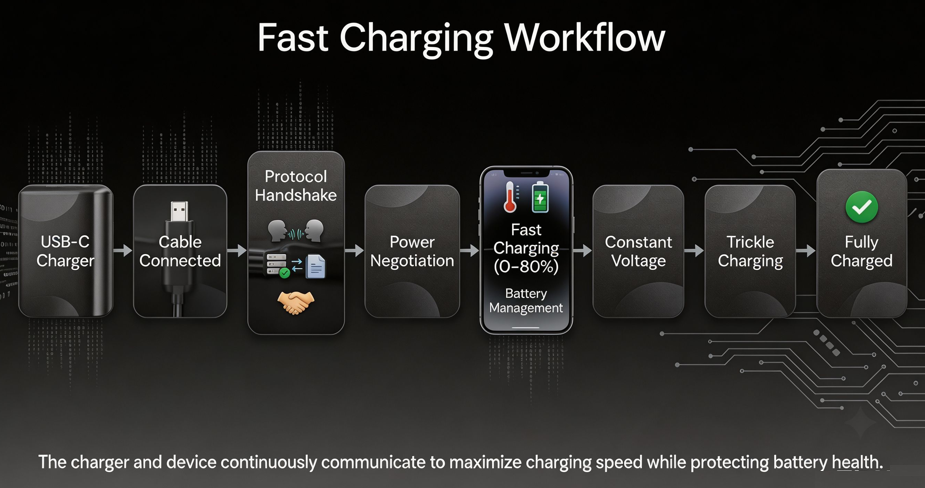
This explains why all phones charge rapidly for the first 80% and slow down obviously for the last 20%: this is a built-in battery protection strategy.
7. Multi-Level Safety Protection Mechanism of Fast Charging
Many users worry about fast charging safety; formal fast charging devices are equipped with complete automatic safety protection systems:
- Input terminal protection: Power off automatically in case of over voltage, over current and short circuit;
- Temperature protection: Reduce power or suspend charging when the charger, cable, chip or battery overheats;
- Battery-specific protection: Prevent battery overcharge, overdischarge and balance internal cell status;
- Algorithm-level protection: Limit fast charging under ultra-high or ultra-low ambient temperature; compensate charging power for aging batteries.
8. Key Factors Affecting Actual Fast Charging Speed
Fast charging cannot always run at full speed; the following factors limit actual charging speed in daily use:
- Protocol Matching: Private fast charging requires official matched accessories; third-party chargers only support slow charging;
- Hardware Specification: Charger rated power, cable current bearing limit and battery hardware upper limit determine the peak charging speed;
- Ambient Temperature: Phones limit fast charging automatically in cold winter and high-temperature hot summer;
- Device Status: Using the phone while charging and serious battery aging will greatly reduce charging speed;
- System Control Strategy: Mobile OS adjusts charging speed and temperature threshold according to user scenarios.
9. Correction of Common Fast Charging Misconceptions
Misconception 1: Fast charging seriously damages battery life
Fact: False. Formal manufacturers equip fast charging with complete battery protection algorithms; high-power charging only runs at 0%-80% battery level. The main factors damaging lithium batteries are long-term full battery storage, high-temperature operation and running batteries dead. Standard fast charging has negligible impact on battery lifespan.
Misconception 2: Higher wattage chargers mean faster charging
Fact: False. The peak charging speed is determined by the phone and battery hardware limit. High-power chargers will automatically adapt to the device’s upper power limit. A 120W charger cannot charge a 67W fast charging phone faster, nor will it damage the device.
Misconception 3: Mixing different brand chargers will burn out phones
Fact: False. All modern fast charging devices have handshake negotiation mechanisms; chargers will not output high voltage/current compulsively. Cross-brand matching only disables full-speed fast charging and turns on slow charging, with no risk of hardware damage.
Misconception 4: Overnight charging damages batteries via overcharging
Fact: False. The phone system cuts off charging input automatically once fully charged. No continuous electric input will cause overcharging; overnight charging only produces tiny standby power loss.
10. Conclusion
In conclusion, the core logic of fast charging is simple:improve charging power through hardware and software coordination, and shorten lithium battery charging time under multi-layer safety protection. The whole system relies on coordinated operation of chargers, data cables, control chips and BMS battery systems.
In the future, fast charging technology will develop towards lower heat generation, higher energy efficiency and popular wireless fast charging. With new battery material innovation, fast charging will become safer with lower battery loss, completely solving the long charging pain point of smart electronic devices.