
Chapter 1 Overview: Why Are USB-IF Standards Constantly Updating?
What is USB-IF?
USB-IF stands for USB Implementers Forum. Founded in 1994, it is a non-profit industry organization initiated by multiple technology companies. Simply put, it is the “headquarters” that sets all USB standards—what USB interfaces look like, how fast they can transfer data, and how much power they can deliver—all of these rules are established and maintained by USB-IF.
Why are standards being updated so frequently now?
There are two main reasons. First, technology itself is advancing—from the original USB 1.0 to today’s USB4 2.0, transfer speeds have skyrocketed from 1.5 megabits per second to 80 gigabits per second. Second, multiple countries around the world are legally mandating USB-C interfaces—the EU, Saudi Arabia, South Korea, and other regions have successively introduced regulations requiring electronic products to use USB-C charging ports. This means USB-IF certification is no longer just a “nice-to-have” but a “passport” to enter these markets.
What does this article cover?
This article outlines the most important USB-IF standard updates between 2024 and 2026—including improvements in data transfer speeds, breakthroughs in charging power, refinements to interface specifications, simplification of naming rules, and mandatory compliance requirements in various countries—to help ordinary consumers and manufacturers understand what these changes mean.
Chapter 2 Major Speed Upgrades: USB4 2.0 is Here
How fast is USB4 2.0?
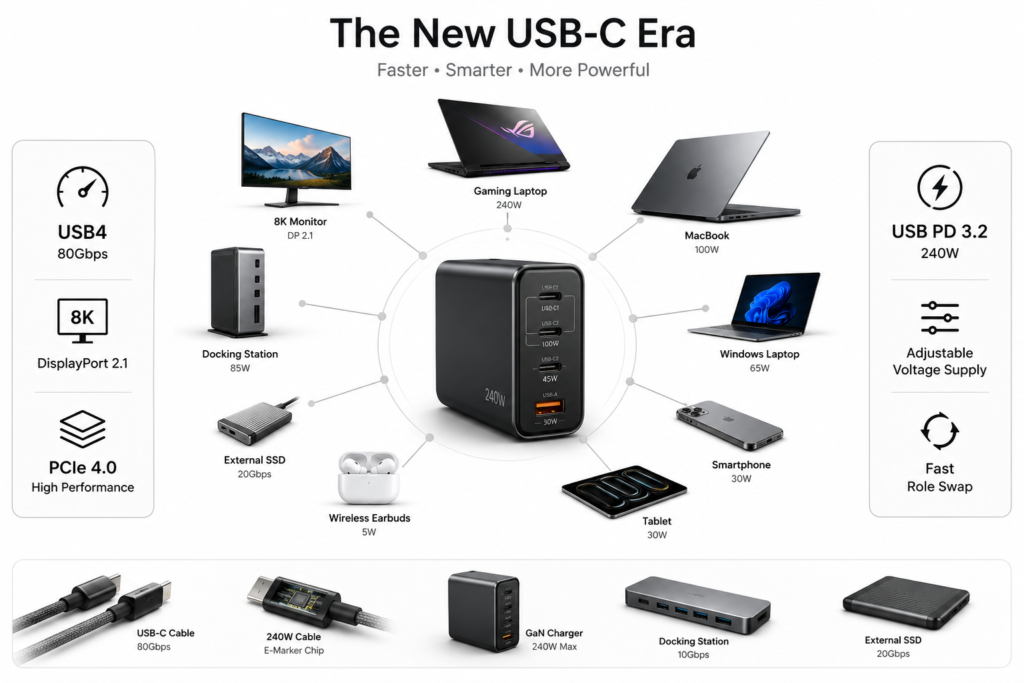
In October 2022, USB-IF officially released the USB4 Version 2.0 standard. Its biggest highlight is that data transfer speeds can reach up to 80 gigabits per second (80Gbps) . What does that mean? Transferring a 100GB 4K movie would theoretically take just over ten seconds.
Even more impressive, it has an “asymmetric mode”—one direction can run at 120Gbps while the other runs at 40Gbps. This mode is particularly well-suited for connecting displays or external graphics cards, where data primarily flows from the computer outward.
USB4 2.0 also uses a new PAM3 signal encoding technology, supports DisplayPort 2.1 video output (capable of driving 8K displays), and supports PCIe 4.0 (for external high-speed storage and graphics cards). And it uses only one interface type—USB-C.
Who is using it?
Chip manufacturers are working on products that support USB4 2.0. Computers and accessories with USB4 2.0 are on their way, but widespread adoption will take some time.
Stricter testing
Starting in 2025, USB4 2.0 products must pass stricter tests, including new signal integrity testing at 80Gbps speeds. These tests check whether signals remain stable and reliable during high-speed data transfer.
Chapter 3 Charging Power Breakthrough: From 100W to 240W
USB PD 3.1: Charging power more than doubled
USB PD (Power Delivery) is the USB charging protocol standard. The biggest change in PD 3.1, released in 2021, is raising the maximum charging power from 100W to 240W (48V/5A).
How much difference is there between 100W and 240W? 100W is roughly enough to charge a thin-and-light laptop, while 240W can power high-performance gaming laptops, workstations, and even some power tools. PD 3.1 adds three new voltage levels—28V, 36V, and 48V—to achieve this.
USB PD 3.2: Smarter charging
In 2024, USB-IF released the PD 3.2 standard. While the maximum power remains the same (240W), it introduces a very important feature called “Adjustable Voltage Supply” .
Older chargers could only output a few fixed voltages (like 5V, 9V, 15V, 20V). PD 3.2’s Adjustable Voltage Supply mode can finely adjust voltage in 0.1V (100mV) increments between 9V and 20V.
This is great for battery life—devices can request exactly the voltage they need rather than accepting a fixed setting. The new rules clearly state: charging products with power exceeding 27W must support this feature.
Starting in March 2026, all newly certified fast-charging products must be tested to the PD 3.2 standard, and the older PD 3.1 standard will no longer accept new certification applications.
Fast Role Swap
Additionally, a test called “Fast Role Swap” (FRS) has become mandatory. It ensures that when the charging direction suddenly changes—for example, when you unplug a power bank that was charging your laptop and switch to charging your phone—the device won’t black out or restart.
Chapter 4 New Specifications for Type-C Connectors and Cables
Type-C R2.4: A “cost-saving channel” for small appliances
On October 28, 2024, USB-IF released Type-C Specification R2.4. The most important update is the clear definition of a certification path for “charging-only interfaces” .
A standard full-featured Type-C interface has 24 pins and can transfer data, video, and power. A “charging-only interface” retains only 14 core pins, removing all pins used for data transfer. This means small appliances like fans, lamps, and electric shavers—devices that only need charging—can use a simplified, lower-cost Type-C interface while still complying with USB-IF standards.
R2.4 also includes right-angle plugs in the certification scope for the first time and optimizes the test methods for contact current ratings. For high-speed USB4 Gen3 and Gen4 cables, the insertion loss test has also added a new 12.8GHz frequency point.
Type-C R2.5: Released in April 2026
In April 2026, USB-IF released Type-C Specification R2.5. This is a further technical refinement of R2.4.
Cables must display power ratings
New rules require that all USB-C cables supporting high-power charging (over 60W) must have a built-in E-Marker chip—a tiny chip that records how much current and power the cable can handle. Additionally, cables must permanently display their power rating (60W or 240W) on the cable body. If you want to buy a cable that can charge a gaming laptop, just look at the marking on the cable.
Chapter 5 Naming Rules Overhaul: No More “Secret Codes”
Goodbye to “USB 3.2 Gen 2×2”
USB naming has long been criticized—terms like “USB 3.2 Gen 1,” “USB 3.2 Gen 2,” and “USB 3.2 Gen 2×2” made it impossible for ordinary consumers to tell which was faster.
USB-IF has finally decided to reform. The new rules are extremely simple: name products directly by their transfer speed.
| Old Name | New Name |
|---|---|
| USB 3.2 Gen 1 | USB 5Gbps |
| USB 3.2 Gen 2 | USB 10Gbps |
| USB 3.2 Gen 2×2 | USB 20Gbps |
| USB4 | USB 40Gbps |
| USB4 Version 2.0 | USB 80Gbps |
The “SuperSpeed USB” brand name has also been retired. USB 2.0 and USB 1.0 naming remains unchanged.
What do the new logos look like?
New logos display both speed and power information. For example, a docking station that supports 80Gbps data transfer and 240W charging would be labeled “USB 80Gbps / 240W”. Clear at a glance—no more guessing.
Logo compliance is mandatory
Starting in 2026, USB4 Version 2.0 products can only use speed-based logos like “USB 80Gbps” in marketing and packaging—they can no longer use version numbers as selling points. Logo compliance has become a mandatory test item. Products with non-compliant packaging or body labeling will not be accepted by labs.
Chapter 6 Regional Mandatory Compliance: Certification from “Optional” to “Required”
EU: USB-C becomes law
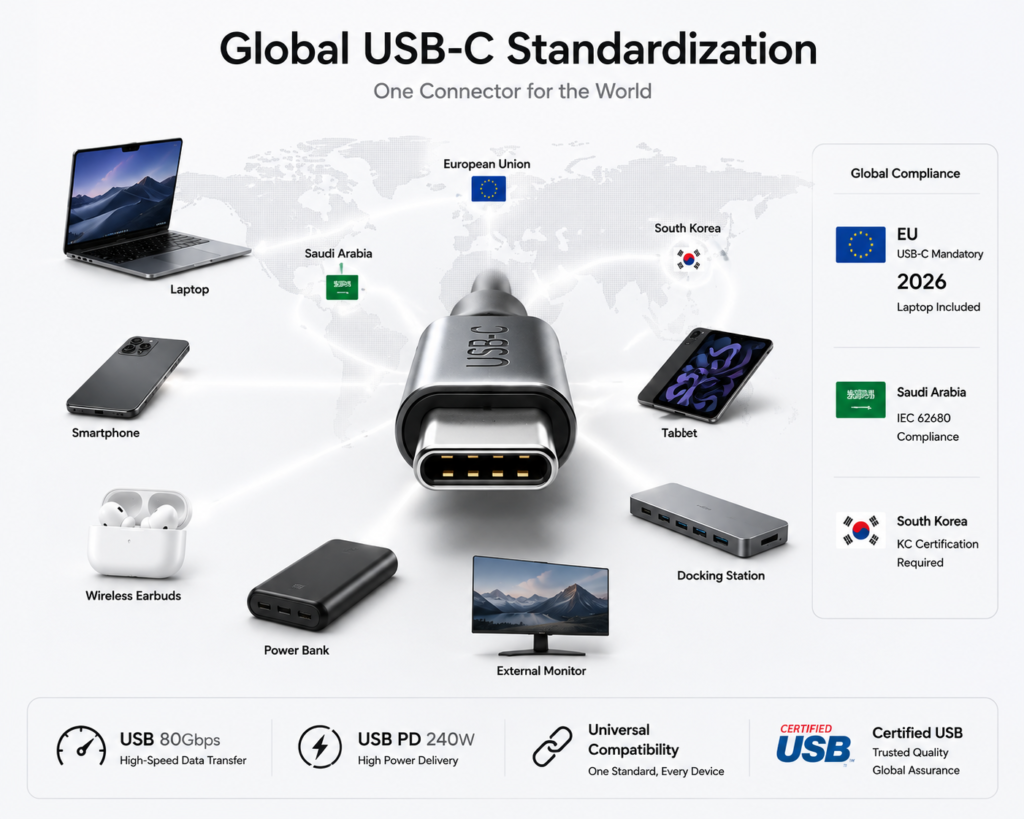
In 2022, the EU passed the Common Charger Directive. Since December 28, 2024, 15 categories of portable devices—including phones, tablets, and earphones—sold in the EU must have USB-C charging ports.
The critical date is April 28, 2026—from this day forward, all laptops sold in the EU must also be equipped with compliant USB-C charging interfaces. Non-compliant older laptops must be removed from sale.
This means that whether you buy a laptop from Apple, Lenovo, Dell, or ASUS, any one bought in the EU can be charged with the same USB-C charger.
Saudi Arabia and South Korea are following suit
Saudi Arabia requires products to comply with SASO IEC 62680 standards. Phase 1 started on January 1, 2026, covering phones, tablets, and other devices. Phase 2 starts on April 1, 2026, bringing laptops under the regulation. All regulated products must obtain product conformity certificates through the SABER platform.
South Korea requires RRA SDoC certification. Originally scheduled for February 2025, it has been postponed to November 5, 2026. After enforcement, devices must apply for KC certification, and USB-C interfaces must undergo separate SDoC certification.
Two certification paths
USB-IF certification now has two paths:
- Full USB-IF Certification: Tests all items (electrical, protocol, interoperability, etc.). Upon passing, products receive a TID number and can use the “Certified USB” logo. Suitable for products targeting global markets and premium brand positioning.
- IEC 626800 Compliance Program: Tests only the core items required by regulations. Lower cost, shorter timeline, but cannot use the “Certified USB” logo. Suitable for products that only need to meet the EU’s minimum legal requirements.
Chapter 7 What Manufacturers Need to Know: 2026 Certification Essentials
Which standards must be used?
For USB-IF certification in 2026, you must use the correct standard versions:
| Product Type | Required Standard | Notes |
|---|---|---|
| Type-C interfaces/cables | Type-C Spec R2.4 or R2.5 | Older 2.3 and below no longer accepted |
| Fast-charging products | PD R3.2 V1.1 | Fully replaces PD 3.1 starting March 2026 |
| High-speed transfer products | USB4 Compliance Specification | Covers 40Gbps and 80Gbps |
| EU market | IEC 62680 series | EU mandatory market access requirement |
Most common test failures
The most common certification failures in 2026 are: Adjustable Voltage Supply testing, Fast Role Swap testing, and Shared Capacity testing for multi-port chargers. Manufacturers of fast-charging products, multi-port power supplies, and high-speed transfer products must pay special attention.
Certification costs and timeline
Becoming a USB-IF full member is a prerequisite for certification. Full membership costs approximately $5,000 USD per year. Members receive a free Vendor ID (VID) and permanent, unlimited USB logo usage rights.
If you don’t want to become a full member, there is a temporary option: pay $6,000 USD for a VID plus $3,500 USD for a two-year logo license, totaling $9,500 USD.
Certification costs for high-end products like USB4 2.0 (including testing fees) typically exceed 100,000 RMB. The testing cycle is usually 4 to 6 weeks.
Compliance Workshop
USB-IF holds regular Compliance Workshops to help manufacturers with product development and interoperability testing. Workshop #140 was held in April in Burlingame, California, and #141 will be held August 4-7 in Portland, Oregon. Full members can attend for free.
Chapter 8 Industry Impact and Ecosystem Value
Impact on different manufacturers
- End-product manufacturers (laptops, phones, tablets): Must complete product interface and charging protocol upgrades to meet 2026 standards and regional regulatory requirements.
- Accessory manufacturers (chargers, cables, docking stations): Need to update product designs to ensure cables have permanent power rating markings and chargers support AVS adjustable voltage.
- Chip manufacturers: Need to launch next-generation chips supporting USB4 2.0 and PD 3.2.
- Testing labs: Need to upgrade test equipment to support new items like signal integrity testing at 80Gbps speeds.
Compliance paths for export-oriented manufacturers
For manufacturers looking to enter the EU market, the IEC 62680 Compliance Program is a fast track—shorter testing cycles and lower costs, but products cannot use the “Certified USB” logo. For those targeting global markets and brand premiums, full USB-IF certification remains essential.
Ecosystem value
These standard updates bring tangible benefits: better interoperability between different brands—your phone charger can charge your laptop, and your laptop charger can charge your headphones. Unsafe, non-standard charging accessories will have a harder time entering the market. Consumers no longer have to be confused by cryptic names like “USB 3.2 Gen 2×2”.
Chapter 9 Future Directions
Higher bandwidth
USB4 2.0’s 80Gbps won’t be the end. As 8K video, VR/AR, AI computing, and other applications develop, the demand for data transfer speeds will only increase.
Higher power
The 240W EPR extended power range is just the beginning. Higher-power devices may be powered via USB-C in the future, further unifying charging interfaces across various electronic devices.
Global regulatory coordination
With the EU, Saudi Arabia, South Korea, and other regions introducing mandatory USB-C regulations, the global trend toward interface unification is irreversible. More countries and regions are likely to follow.
Green energy and efficiency
New standards are also continuously strengthening requirements for low power consumption and energy efficiency, making devices more efficient and less wasteful when charging and transferring data.
Chapter 10 Summary
From 2024 to 2026, USB-IF standards have undergone a comprehensive upgrade:
- Faster speeds: USB4 2.0 pushes transfer speeds to 80Gbps, making 8K video and external graphics cards effortless
- Stronger charging: PD 3.1 raises power from 100W to 240W—even gaming laptops can now charge via USB-C; PD 3.2 makes charging smarter and better for battery health
- More standardized interfaces: Type-C R2.4 opens a “cost-saving channel” for small appliances, while R2.5 further refines the standards
- Simpler naming: No more memorizing “USB 3.2 Gen 2×2″—just look at the speed
- Stricter compliance: The EU has written USB-C into law—starting April 28, 2026, all laptops must charge via USB-C
For ordinary consumers, these changes mean: no more guessing when buying chargers and cables—just look at the speed and power ratings; phones, tablets, and laptops can share one cable and one charger; charging is faster and safer.
For manufacturers, getting the standard versions right, ensuring logo compliance, and watching regional regulatory deadlines—getting these three things right is the key to entering global markets smoothly.