
1. Introduction
Have you ever wondered how your phone charges just by placing it on a pad? As wireless charging becomes more common—from phones and watches to cars—you’ll encounter plenty of technical terms. This guide explains the most important ones in plain, everyday language.
This dictionary references the IEC 63563-2:2025 standard and the Wireless Power Consortium’s Qi Specification version 2.0. These standards cover everything from basic introductions and terminology to complex technical details like power delivery, communication protocols, and security. Whether you’re curious about how it works or shopping for a wireless charger, this guide is for you.
2. How Wireless Charging Works
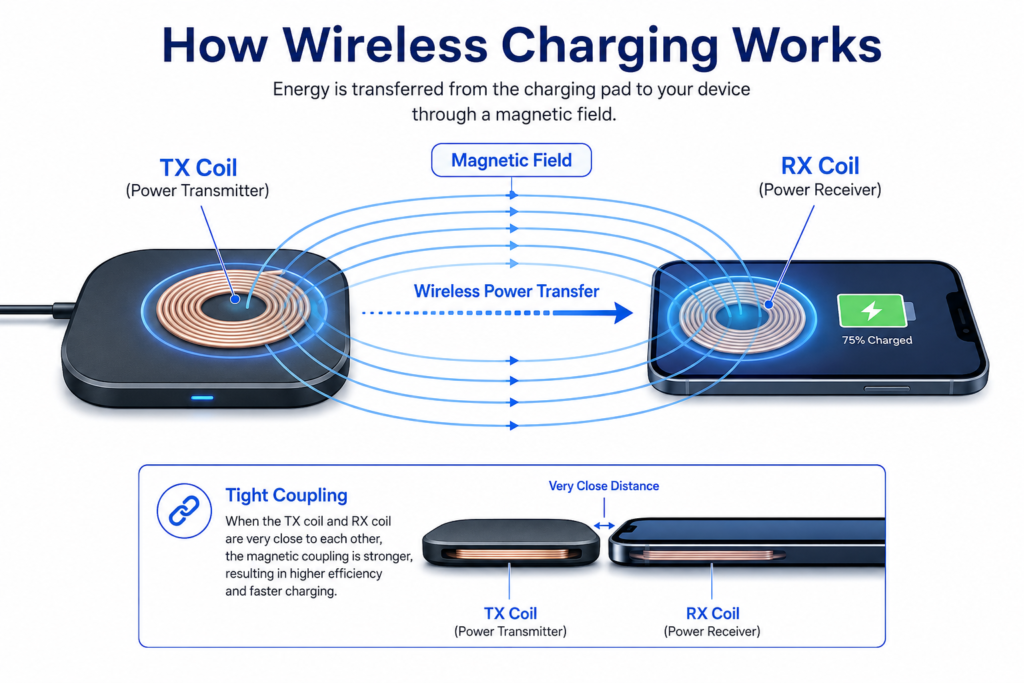
Inductive Wireless Charging — This is the most common type of wireless charging—the kind used in phones. The principle is simple: the charger has a coil (the transmitter coil) and your phone has another coil (the receiver coil). When the charger is powered on, its coil creates a changing magnetic field. The coil in your phone, when placed nearby, picks up this magnetic field and generates electricity to charge the battery. The catch? Your phone must be placed very close to the charger—just a few millimeters away.
Tight Coupling — The transmitter and receiver coils are placed very close together, so the magnetic field “locks” tightly between them. This gives high charging efficiency. A phone on a charging pad is a classic example of tight coupling.
Transmitter Coil (TX Coil) & Receiver Coil (RX Coil) — These are the core components of wireless charging. The transmitter coil in the charger sends out energy, and the receiver coil in your device captures it.
Magnetic Resonance Wireless Charging — This works similarly to inductive charging but with a twist: the transmitter and receiver coils are tuned to the same “frequency” (think of it as the same vibration rhythm). When they match, energy can be transferred efficiently even over longer distances. The advantages? Longer range (a few centimeters to tens of centimeters) and less fuss about exact positioning.
Loose Coupling — The opposite of tight coupling. The coils don’t need to be right next to each other—they can be slightly misaligned or even a bit farther apart. Magnetic resonance is a loose coupling technology.
Resonant Frequency — The key to magnetic resonance charging. The transmitter and receiver coils are tuned to the same frequency (for example, 6.78 MHz, an internationally used band). It’s like two tuning forks tuned to the same note—strike one, and the other vibrates too. That’s how energy travels.
RF Wireless Charging / Over-the-Air Charging — This uses radio waves to transmit energy, like a radio picking up a signal. It can work over distances of a few meters, but currently delivers only low power, mainly for small, low-energy devices.
Capacitive Coupling Charging — This transfers energy through an electric field rather than a magnetic field. It’s a less common technology with limited applications.
Ultrasonic Wireless Charging — Uses sound waves (beyond human hearing range) to transfer energy. It’s a cutting-edge technology still under development.
3. Standards & Certification: What to Look for When Buying
Qi Standard — Qi (pronounced “chee,” meaning “life energy”) is the world’s most popular wireless charging standard. Developed by the Wireless Power Consortium (WPC), over 11,000 products from more than 300 companies are Qi-certified. In simple terms, if your phone and charger both support Qi, they’ll work together—no matter the brand.
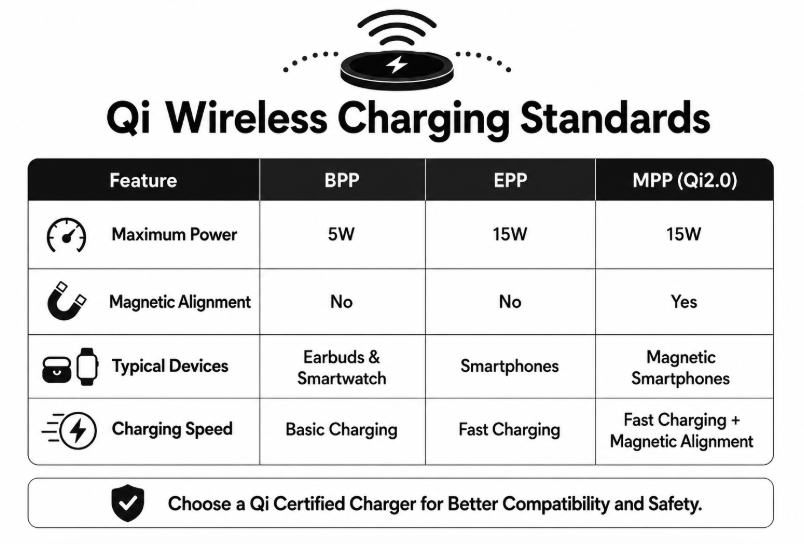
Qi 2.0 — The next-generation Qi standard released in 2023. It adds magnetic alignment—both the charger and device have magnets that automatically snap into the perfect position. Qi 2.0 supports up to 15W of charging power, and over 1.5 billion Qi 2.0 devices are already available.
BPP (Baseline Power Profile) — The “basic” level of Qi, delivering up to 5W of power. Suitable for small devices like earbuds and smartwatches.
EPP (Extended Power Profile) — The “upgraded” level of Qi, delivering up to 15W of power. Ideal for phones that need faster charging.
MPP (Magnetic Power Profile) — A new profile introduced with Qi 2.0. It delivers 15W like EPP but adds magnetic alignment features. Products with magnetic wireless charging typically use MPP.
WPC (Wireless Power Consortium) — The organization that develops the Qi standard, dedicated to standardizing and promoting wireless charging technology.
Qi Certification — Products must pass rigorous tests (including safety and compatibility) to earn Qi certification. Certified products can display the Qi logo, meaning they’re safe, reliable, and compatible with other Qi devices.
AirFuel Alliance — Another major wireless charging standards organization, promoting different technologies like magnetic resonance and RF charging.
4. Hardware: What’s Inside a Wireless Charger
Power Transmitter (PT) — The wireless charger itself—the device that sends out power.
Power Receiver (PR) — The part inside your phone, watch, or other device that receives power.
Active Area — The part of the charging pad where charging actually works. If your phone is misaligned, it may fall outside the active area and won’t charge.
Magnetic Shielding Sheet — A special material placed behind the coil. It guides the magnetic field toward the receiver and prevents it from leaking backward, which could interfere with the charger’s internal circuits or heat up nearby metal objects.
Rectifier Bridge — The receiver coil picks up alternating current (AC), but phone batteries need direct current (DC). The rectifier bridge converts AC to DC.
Wireless Charging Main Control Chip — The “brain” of the wireless charger, handling device identification, power control, safety monitoring, and more.
Resonant Capacitor — Works with the coil to tune the circuit to a specific frequency (the resonant frequency we discussed earlier), making energy transfer more efficient.
5. Performance Metrics: How to Judge a Charger
Rated Power — The maximum stable power output of a charger, measured in watts (W). Higher power means faster charging.
Charging Efficiency — The ratio of power received by the device to power input to the charger. For example, if the charger draws 10W and the phone receives 8W, the efficiency is 80%. Wireless charging typically ranges from 70% to 90%. Higher efficiency means less wasted energy and less heat.
Air Gap — The distance between the charger surface and the back of your device. Phone cases count toward this gap, so thick cases can reduce charging performance.
Coupling Coefficient (k) — A measure of how tightly the magnetic fields of the transmitter and receiver coils are “locked” together, ranging from 0 to 1. Higher values mean better coupling and higher efficiency.
Operating Frequency — The electromagnetic frequency used during wireless charging. Qi standards typically use 100-205 kHz, while magnetic resonance uses 6.78 MHz.
Quality Factor (Q) — A measure of coil “quality.” Higher Q means better energy storage and lower losses.
Skin Effect — High-frequency current tends to flow on the surface of a wire rather than evenly throughout. That’s why wireless charging coils use “Litz wire”—made of many thin strands twisted together—to reduce this effect and minimize losses.
Alignment Tolerance — The maximum distance your phone can be off-center from the charging coil and still charge effectively. Beyond this range, charging slows down or stops.
Multi-Device Charging — One charger powering multiple devices at the same time. Magnetic resonance technology naturally supports this because its energy field is wider.
6. Safety: Is Wireless Charging Safe?
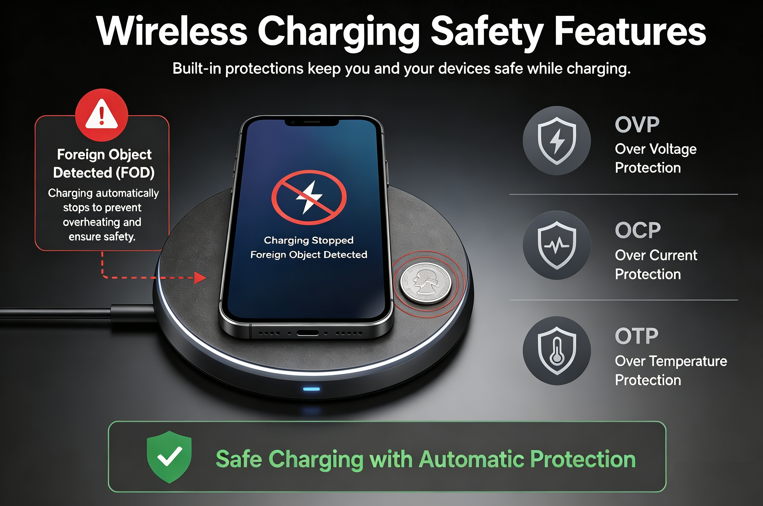
FOD (Foreign Object Detection) — One of the most important safety features in wireless charging. If a metal object (like a coin or key) is on the charging pad, the charger could heat it up, potentially causing burns or fires. FOD detects this situation—if metal is detected, the charger shuts down or refuses to start.
Power Loss Method FOD — Compares power output from the transmitter with power received by the device. If there’s a big discrepancy, something unknown is consuming energy (likely a metal object heating up), and the charger automatically shuts off.
Q-Value Method FOD — Detects foreign objects by measuring changes in the coil’s Q value. Metal objects alter the Q value when they come near the coil, triggering protective measures.
Over-Voltage Protection (OVP) — Automatically cuts output if voltage gets too high, protecting devices from damage.
Over-Current Protection (OCP) — Limits power if current gets too high, preventing overheating or damage.
Over-Temperature Protection (OTP) — Reduces power or stops charging if temperatures get too high, preventing fires.
SAR (Specific Absorption Rate) — A measure of how much electromagnetic radiation the human body absorbs. Wireless charging devices must meet safety limits and won’t harm you.
EMC (Electromagnetic Compatibility) — Measures whether a device interferes with other electronics and whether it’s vulnerable to interference from them. All compliant wireless charging products must pass EMC testing.
7. Communication & Control: How Charger and Device “Talk”
Analog Ping — The charger sends out a weak detection signal to “check” if a device has been placed on it. Think of it as knocking on a door and asking, “Anyone there?”
Digital Ping — If the analog ping gets a response, the charger sends a digital signal to identify the device and determine how much power it needs.
Load Modulation — The device sends information back to the charger by changing the “load” on its coil. This is how Qi-compatible devices “talk” to the charger.
Power Transfer Contract — The “agreement” between charger and device: how much power to deliver, when to stop, and so on.
Closed-Loop Power Control — The device continuously tells the charger “how much power I need right now,” and the charger adjusts its output accordingly for fast, safe charging.
8. Common Products & Features
Charging Pad — The most common type of wireless charger. Flat on a desk—just place your phone on top.
Charging Stand — An upright charger stand. Your phone leans against it, so you can watch videos or check messages while it charges.
In-Car Wireless Charger — Built into a car’s center console or armrest, meeting automotive-grade standards. Just drop your phone in and it charges while you drive.
Multi-Device Charger — Charges multiple devices at once—phone, earbuds, smartwatch, all together.
MagSafe — Apple’s magnetic wireless charging system. Magnets in both the charger and phone snap into perfect alignment automatically, supporting 15W charging.
Reverse Wireless Charging — Your phone becomes a charger, powering other Qi-compatible devices (like earbuds or another phone). Great for emergencies—for example, if a friend’s phone dies, you can give them a quick boost.
Fast Wireless Charging — Wireless charging at 10W or higher, much faster than standard wireless charging. Different manufacturers may have their own proprietary fast-charging protocols.
9. Emerging Technologies
Over-the-Air Charging — Charges devices from several meters away, typically using RF or ultrasound.
Spatial Wireless Charging — The entire room becomes a charging zone—devices charge automatically wherever they’re placed.
Electric Vehicle Wireless Charging — Park your EV over a charging pad and it charges automatically. Even dynamic charging (while driving) is being developed.
Implantable Medical Device Wireless Charging — Wirelessly powering devices like pacemakers inside the body, eliminating the need for surgery to replace batteries.
Wi-Fi Backscatter Charging — Harvests energy from existing Wi-Fi signals to power ultra-low-power devices.
10. Common Abbreviations
| Abbreviation | Full Name | Meaning |
|---|---|---|
| WPC | Wireless Power Consortium | Wireless Power Consortium |
| TX | Transmitter | Transmitter (charger) |
| RX | Receiver | Receiver (device being charged) |
| FOD | Foreign Object Detection | Foreign Object Detection |
| BPP | Baseline Power Profile | Baseline Power Profile (5W) |
| EPP | Extended Power Profile | Extended Power Profile (15W) |
| MPP | Magnetic Power Profile | Magnetic Power Profile (Qi 2.0) |
| SAR | Specific Absorption Rate | Specific Absorption Rate |
| EMC | Electromagnetic Compatibility | Electromagnetic Compatibility |
| OVP | Over-Voltage Protection | Over-Voltage Protection |
| OCP | Over-Current Protection | Over-Current Protection |
| OTP | Over-Temperature Protection | Over-Temperature Protection |