
If you are shopping for a wireless charger, you will most likely see power ratings like 15W and 25W on product pages. Many people’s first reaction is that the bigger the number, the faster the charging, so buying the higher-powered one is definitely the right choice. But when they actually get it home, they find that it is either not much different from their old 15W charger, or their phone does not support it at all, leaving them wondering where their money went.
In fact, the gap between 15W and 25W wireless charging is far from just a 10W difference on paper — it is related to your phone model, charger specifications, and even the thickness of your phone case. This article explains everything from basic principles to selection logic for different scenarios. After reading it, you will know exactly which one to buy.
First, Clarify: Comparison Scope and Prerequisites for 25W to Take Effect
First, let’s define the scope of our discussion to avoid later misunderstandings: we only discuss consumer-grade mobile phone wireless charging; smart watches, earbuds, electric vehicles and other categories are not within the comparison scope. We also only cover compliant products — that is, products with Qi/Qi2 certification (universal wireless charging compatibility standard), MagSafe certification (Apple’s magnetic wireless charging standard), or brand official/certified proprietary protocols. Uncertified no-name low-cost products, no matter how high their claimed power is, are not within the scope of discussion.
Another special reminder: 25W wireless charging and 25W wired charging are not the same concept. Wireless charging transmits power through magnetic fields, which inherently has energy loss. Combined with mobile phone thermal management limits, wireless charging is usually slower than wired charging at the same rated power. Do not compare wireless charging speed to wired speed. This article also does not discuss extreme tests of proprietary ultra-high-power wireless fast charging of 50 or 60 watts, but only focuses on the 15W and 25W levels that most people commonly buy, to solve practical problems in daily purchase.
Three Easily Confused Power Concepts
Before talking about the gap, we must first understand three power concepts that merchants often use as selling points, otherwise it is easy to be misled:
The first is input power, which is the power that the charging head delivers to the wireless charging base. This number is usually higher than the actual power received by the phone, because the base’s own power consumption and transmission loss will take up a portion. Some merchants label input power as output power, making the number look large, but in reality the phone cannot get the corresponding power at all.
The second is rated output power, which is the most prominent 15W and 25W on the product page. This is the highest wireless output level the wireless charger can reach, equivalent to its “theoretical upper limit”.
The third is actual power received by the phone, which is the power that actually enters the phone’s battery. This is the key factor that determines charging speed. It changes in real time with the phone’s battery level, temperature, coil alignment, and background load, and is not a fixed value.
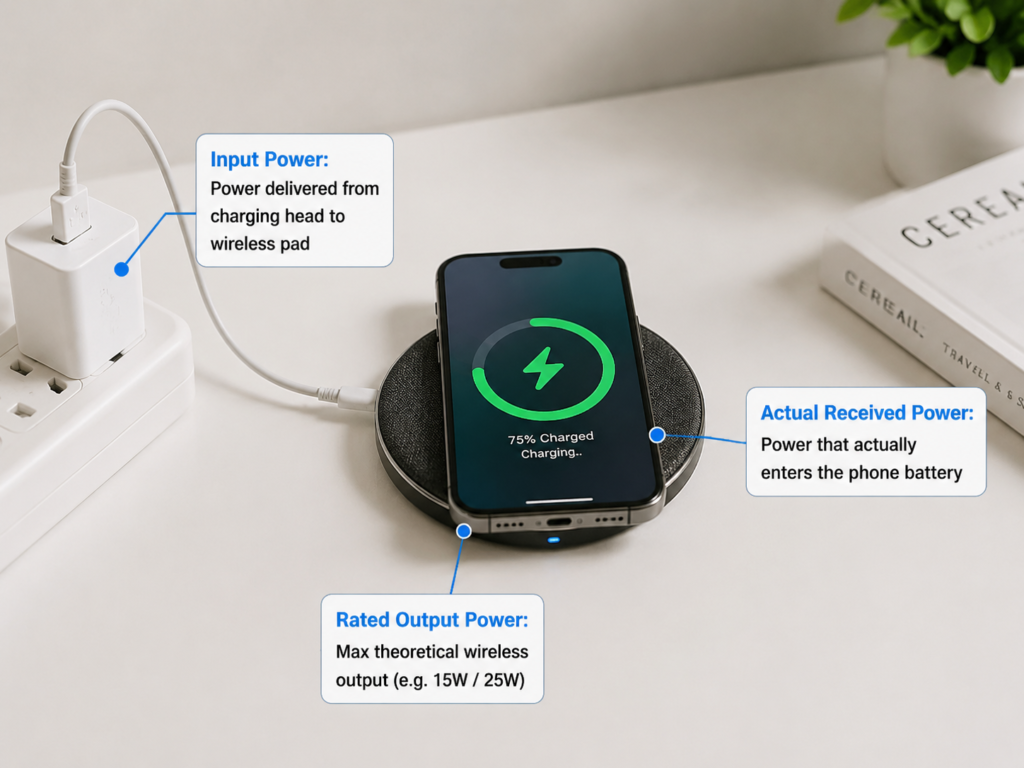
It should be clarified here: the perceived charging speed mainly depends on the average power throughout the charging process, not the peak power that lasts for a few minutes. The 25W advertised by many merchants may only be maintained for a few minutes under conditions of low battery, suitable temperature, and the phone being left idle. Most of the time it runs at a lower power, and the actual perceived difference from 15W is not large.
6 Necessary Conditions for 25W to Run at Full Capacity
For a 25W wireless charger to reach its rated high power level, all of the following 6 conditions must be met at the same time. Missing any one may cause it to drop to 15W or even lower:
- Phone upper limit meets the requirement: The phone itself clearly supports a wireless charging level of around 25W or higher. Otherwise, no matter how high-power the base is, it cannot break through the phone’s hardware limitations.
- Protocol matching: The wireless charger supports the corresponding protocol of the phone, such as new specifications like 25W MagSafe, Qi2 25W (Qi2.2), or brand proprietary protocols. Most ordinary Qi2 products are still at the 15W level. Do not assume that Qi2 means 25W by default.
- Power supply accessories meet the standard: The charging head and cable meet the input requirements of the wireless charger, which may be USB-C PD (USB Power Delivery), PPS (Programmable Power Supply, a more flexible fast charging protocol), or a brand-specified adapter. The specific requirements are subject to the product description; you cannot just use any old charging head.
- Precise coil alignment: The coil positions of the phone and the wireless charger are perfectly aligned. A magnetic structure can greatly improve alignment stability and reduce the trouble of repeated adjustments.
- Environment and case compliance: The ambient temperature is moderate, the phone case is not too thick, and there are no metal foreign objects, card holders or other obstructions between the two.
- Suitable phone state: The phone is at low to medium battery level, locked and idle or in a low-load state, and has not triggered obvious temperature-controlled speed reduction.
The core conclusion is clear: 25W wireless charging only has obvious advantages in short-term charging scenarios of “phone support, protocol matching, low battery, normal temperature, accurate alignment, and low load”. 15W has stronger versatility, lower cost, and less heat pressure, making it more suitable for most people’s desktop drop-in charging, overnight charging, and mixed use of multiple devices. When purchasing, do not just look at the wattage. The correct order is: first check the upper limit of your phone’s wireless charging, then verify the protocol and certification of the wireless charger, and finally confirm the adapter requirements. Only when all three match should you consider power.
Plain Language Introduction: The Speed Logic of Wireless Charging
The principle of wireless charging is not complicated: the wireless charging base and the back of the phone each have a coil. When the two coils are close, the base coil generates a magnetic field, and the phone coil converts the received magnetic field into electrical energy to charge the battery. This process is professionally called “magnetic field coupling”. You just need to know that power is transmitted through the air between the two coils.
Since it is transmitted through the air, there must be energy loss, and most of the wasted part is converted into heat. Therefore, the more aligned the two coils are, the closer they are, and the fewer obstructions in between, the higher the efficiency and the less heat. If placed crookedly, the phone case is too thick, or there is a metal sheet or card holder in between, not only will the efficiency decrease, but in severe cases the wireless charger will trigger foreign object detection and stop charging directly to avoid safety risks.
Actual Speed is Determined by the “Bucket Effect”
Precisely because of the air-transmitted power method, the speed of wireless charging is never determined by a single component, but is a typical “bucket effect” — the shortest plank determines the final charging speed.
This short plank may be the phone itself: if the phone only supports up to 15W wireless charging, even if you buy a 25W or 50W wireless charger, it will only run at 15W or even lower. The phone will actively limit the power and will not force it to accept higher power.
It may also be a protocol mismatch: for example, a 25W wireless charger with a brand’s proprietary protocol used on another brand’s phone, the two sides cannot negotiate a common high-power level, and eventually can only drop to the universal 15W, 10W or even 5W basic level.
Insufficient charging head power, too thick phone case, and too high ambient temperature may all become the short plank that lowers the speed.
Charging is Not at Constant Power Throughout the Process
Another point many people don’t know: the power of wireless charging is not consistent from start to finish, but changes dynamically with the battery level.
Generally speaking, the charging power is highest when the phone’s battery level is below 20%, which is the golden period of fast charging. When the battery level reaches 50% or 60%, the power will gradually decrease. Above 80%, the power will drop particularly significantly — because at this time the battery is nearly full, the phone will slow down the speed, charging while adjusting, to both protect battery life and control temperature.
This is why the speed gap between 25W and 15W is absolutely not calculated as 25 divided by 15 equals 1.66 times, let alone twice as fast. The high power of 25W can only be maintained for a short period of time when the battery is low. Later, both will slow down, and the gap will be very small. The speed you can really feel is actually the time taken for the commonly used charging range from 20% to 80%, and the average power throughout the process, not the peak that lasts a few minutes.
4 Most Common Misconceptions for Beginners
Having said that, we can clarify a few of the most common misconceptions people have, to avoid being tricked in the future:
First misconception: 25W must be twice as fast as 15W. The peak duration is very short. High battery level, high temperature, and background running programs will cause speed reduction. The actual speed gap is far from twice as large. In many cases, it may only be a difference of ten or twenty minutes, and even almost no difference in some scenarios.
Second misconception: A 25W wireless charger will damage phones that do not support it. As long as it is a formally certified product, it will first “negotiate” with the phone to find the highest power supported by both. If the phone does not support high power, it will automatically drop to a lower level, and will not force high power into it. The real risks are uncertified inferior products, metal foreign objects caught in between, and abnormal heating, which have nothing to do with the power itself.
Third misconception: Wireless 25W equals wired 25W. To emphasize again, wireless charging has transmission loss and stricter thermal management limits. With the same rated 25W, the speed and stability of wireless charging are definitely not as good as wired charging. If you pursue extreme fast charging speed, wired is still a more reliable choice.
Fourth misconception: Magnetic charging means higher power. The function of magnetism is only to help you align the coils precisely, without having to repeatedly move the position to find the charging point. It does not increase power by itself. Whether it can reach 25W still depends on whether the phone supports it, and whether the wireless charger has the corresponding protocol and certification.
Core Comparison: 5 Key Differences Between 15W and 25W
When comparing 15W and 25W, you should try to use the same phone that clearly supports 25W wireless charging, 15W/25W wireless chargers of the same brand or same certification system, and unify the adapter, room temperature (about 25℃), phone case (bare phone or official thin case), locked and idle state, coil alignment and other conditions. Recommended observation indicators include 20%-80% charging time, 0-100% full charge time, body temperature, speed reduction frequency, and average power throughout the process.
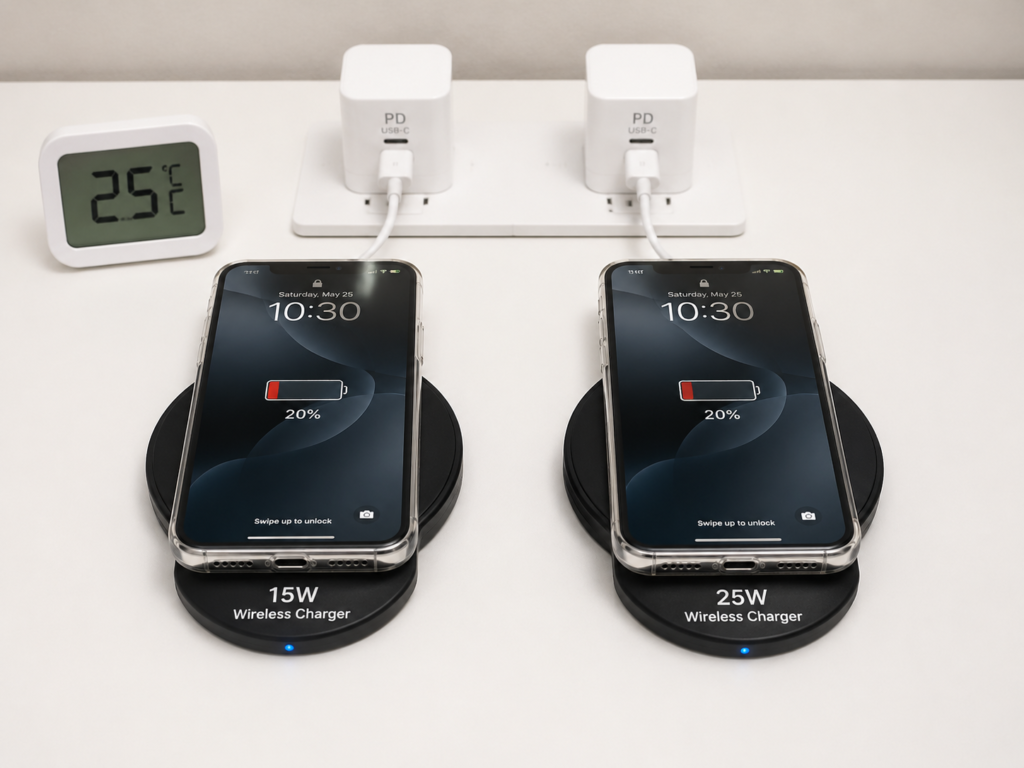
It should be noted that different brands of mobile phones have great differences in battery capacity, temperature control strategies, and charging curves, so it is not advisable to directly apply data from a single model. The following are general rules.
Dimension 1: Charging Speed
Under ideal conditions, the advantage of 25W is mainly concentrated in the low to medium battery charging range, such as 10% to 50%, or 20% to 80%. At this time, its high power can be maintained for a relatively long time, and it is indeed faster than 15W. But if it is a full charge from 0 to 100%, the gap will be much smaller, because above 80%, both 15W and 25W will drop to very low power to charge slowly, and the speed in the second half is about the same.
And as long as one condition is not met, this gap will shrink or even disappear completely. For example, if your phone only supports 15W, or the protocol does not match, or the charging head is not good enough, or the weather is too hot, or you have a thick case, or you use the phone while charging, or the battery level has exceeded 80%, then 25W may be no different from 15W. Even because of greater heat and faster speed reduction, it may be less stable than 15W.
When choosing a wireless charger, don’t just look at the peak wattage. Prioritize referring to third-party tested 20%-80% charging time, average power and temperature curves, which are closer to the actual user experience.
Dimension 2: Heat and Speed Reduction Stability
A 25W wireless charger has higher input energy, and more heat is generated during transmission, so the heat dissipation pressure is naturally greater. Therefore, it is more likely to trigger the phone’s temperature control protection, and the speed will drop when the temperature is high, so the stability is not as good as 15W.
The 15W has low power and low heat generation. In many cases, it does not even need an active cooling fan, and is very quiet. It is more suitable for long-term charging, such as when sleeping at night, or placed on an office desk for drop-in charging, without worrying too much about temperature issues.
Of course, if a 25W wireless charger has an active cooling fan, or a metal heat conduction structure, or a large-area heat dissipation base, the stability will be much better, which is much more reliable than those cheap high-power models without heat dissipation. However, it should be noted that the temperature control threshold is set by the phone manufacturer itself, and there is no unified standard. As long as the phone determines that the temperature is too high, it will actively reduce power, and in severe cases, it will pause charging.
Dimension 3: Compatibility and Protocol Requirements
15W is a relatively universal wireless fast charging level, but whether it can reach 15W still depends on the phone, the wireless charger’s certification level and protocol matching. Ordinary Qi devices may only have 5W, 7.5W, 10W or EPP (Extended Power Profile) levels; the mainstream magnetic level of Qi2 is commonly 15W, but it also depends on whether the phone supports the corresponding specification.
The protocol requirements for 25W are much higher: the mainstream of ordinary Qi2 certified products is still 15W level. To reach 25W, it needs to support Qi2 25W (Qi2.2), 25W MagSafe or brand proprietary protocols, and most rely on specific models. When used across brands, it often drops to 15W, 10W, 7.5W or even 5W.
Here is a reminder: Qi, Qi2 or MagSafe certification only means that it meets the corresponding safety standards and can work compatibly at the corresponding level, but it does not mean that it can reach the highest power rated by the wireless charger. For example, a 25W Qi2 wireless charger used on a phone that only supports 15W Qi2 can only reach 15W. The certification only ensures that this 15W is safe and stable, not that it can run at full 25W. Not to mention brand-proprietary high-power wireless chargers, usually only the brand’s designated models can run at full capacity. When used with other brands of phones, they will basically drop to the universal Qi level.
Dimension 4: Cost and Accessory Requirements
Among products of the same brand and same certification level, 25W ones are usually more expensive than 15W ones. The price difference also depends on additional configurations such as whether it has a fan, whether it has magnetism, whether it has a stand, and whether it comes with a charging head.
Moreover, 25W has higher requirements for the charging head. Old 5V/2A charging heads, low-power PD heads, and adapters with mismatched protocols cannot make the 25W wireless charger run at full speed, and you may have to spend more money to buy a new charging head. Apple 25W MagSafe usually requires a 25W MagSafe charger, paired with a USB-C adapter of about 30W class or the specification recommended in Apple’s instructions; the specific details are subject to the official accessory page. Some Android 25W wireless chargers may require a charging head with PPS protocol, or a brand-specified adapter.
As for the electricity bill for long-term use, the difference is actually minimal and can be completely ignored. The cost difference is mainly concentrated in the wireless charger itself, supporting adapters, certification premiums, and heat dissipation design.
Dimension 5: Usage Fault Tolerance
15W has low power, and has higher tolerance for placement position, phone case thickness, and ambient temperature. Even if it is placed a little crookedly, or with a slightly thicker case, or the weather is a little hotter, at most the speed is slightly slower, not much different.
And 25W is much more delicate. It is particularly dependent on precise alignment and good heat dissipation. As long as it is placed a little crookedly, the case is a little thicker, the temperature is a little higher, or there is a metal sheet, card holder or something in between, the speed will drop significantly, or even directly drop to 15W.
Now many magnetic wireless chargers, whether MagSafe or Qi2, can indeed help you align the coils and improve the success rate of alignment. But if it is a poor-quality magnetic case, or the magnetic ring is in the wrong position, or a magnetic case with a card holder, it may instead cause heat generation, or even trigger foreign object detection. Magnetism only improves the success rate of alignment; high power still requires protocol and certification matching.
For quick reference, here is a table of core dimension differences:
| Comparison Item | 15W Wireless Charger | 25W Wireless Charger |
|---|---|---|
| Speed Advantage | Sufficient for daily use; little perceived difference for overnight/desktop drop-in charging | Obvious advantage for short-term charging at low battery |
| Heat Pressure | Usually lower, good stability | Higher, dependent on heat dissipation design |
| Compatibility | Strong cross-brand versatility | Greatly limited by phone model, protocol, and accessories |
| Cost | Lower, wide range of options | Higher, often requires matching adapters or official accessories |
| Difficulty to Reach Rated Power | Relatively easy, high fault tolerance | High requirements for alignment, temperature, and certification |
| Suitable Scenarios | Overnight charging, desktop drop-in use, mixed use of multiple devices | Short-term fast charging during the day for supported models |
Scenario Variables: Changes in the Gap Under Different Scenarios
Under different usage scenarios, the actual gap between the two will change significantly. We will explain them separately according to the most common types of scenarios.
Low Battery Temporary Charging Scenario
If you want to judge whether 25W is valuable, focus on the low to medium battery range such as 10%-50% or 20%-80%, not just 0-100%. Typical scenarios include before going out, between meetings, during lunch breaks, returning to the workstation for a short time, etc.
The judgment standard is also very simple: if you often only have a 20-40 minute charging window, and your phone clearly supports 25W wireless charging, and the wireless charger protocol and adapter can match, then the actual value of 25W will be higher; if the charging time is usually more than 1 hour, the perceived gap between the two will be significantly reduced.
Overnight Charging Before Bed Scenario
In this case, 15W is completely sufficient. Even for a phone with a large battery, it will definitely be fully charged after seven or eight hours. Although 25W is faster in the early stage, it will stop when it is full later, and you can’t feel the difference at all. Moreover, many phones have a battery optimized charging function, which will learn your schedule and only fill the last bit when you are about to wake up. This makes the advantage of 25W even more useless. For overnight charging, you should pay more attention to safety functions such as quietness, low temperature, stability, and foreign object detection, rather than how high the power is.
Charging with Phone Case Scenario
If it is an ordinary thin silicone case, or an official magnetic case, the impact on charging is very small, and both 15W and 25W can work normally. But if it is a relatively thick case, such as a shockproof case or thickened silicone case, it will increase the distance between the two coils and reduce efficiency, and 25W will be more affected than 15W.
If it is a metal case, a case with metal patches, a card holder case, a stand case, or a magnetic case with the magnetic ring in the wrong position, the risk is even higher. Not only will the speed drop a lot, but it may also trigger foreign object detection, and even cause problems due to heat generation. If you usually use a thicker case, or a case with metal accessories, prioritize choosing an officially compatible case, or accessories certified by the same brand, and do not blindly pursue 25W.
Using While Charging Scenario
In this case, the phone’s own screen and processor are consuming power, which will generate a lot of heat. Coupled with the heat from wireless charging, the temperature can easily rise and trigger temperature-controlled speed reduction. 25W already generates more heat, and at this time it may drop even more than 15W, and the actual net charging speed may be about the same as 15W, or even worse.
Moreover, under high load, wireless charging is more about “slowing down power loss” or “slowly replenishing power”, and cannot charge fully stably and quickly. If you often use your phone while charging, in fact, wired fast charging will be more stable and more cost-effective than wireless 25W.
Summer Car Mount/High Temperature Environment
In summer, when the car is parked in the sun, the temperature inside the car is very high. Direct sunlight will heat up both the phone body and the charging base at the same time. Coupled with running navigation, connecting to Bluetooth, turning on hotspot, and keeping the screen on, in this case, even a 25W car wireless charger, as long as there is no active heat dissipation, the peak power can only be maintained for a few minutes, and will soon slow down due to too high temperature. The actual effect may be no different from 15W, or even less reliable than a stable 15W.
So when choosing a car wireless charger, prioritize checking whether the fixing position is stable, whether it can cool down with the help of the air outlet, whether the phone blocks the air conditioning wind, and whether it has foreign object detection, rather than just looking at the rated wattage. In high temperature environments, a stable 15W is much more practical than a falsely rated 25W.
Model Adaptation: Judge Actual Available Power by Phone Camp
The upper limit of wireless charging varies greatly among different phone camps. You can check your phone model to judge the actual available power.
iPhone Users
For iPhone 12 to 15 series, the official MagSafe wireless charging maximum is 15W. Most ordinary Qi wireless chargers can only reach 7.5W or even lower, while Qi2 certified products can also reach the 15W level on supported models.
For models like the iPhone 16 series that Apple officially clearly supports 25W MagSafe, when paired with a 25W MagSafe charger and a USB-C adapter of about 30W or higher, the maximum wireless charging power is about 25W. The specific details are subject to Apple’s official specifications and accessory instructions. The old 15W MagSafe charger you bought before, or ordinary 15W Qi2 accessories, will not automatically become 25W just because you changed to a new model. You must pay attention to this.
So the purchase suggestion is very clear: if you use iPhone 12 to 15 series, choose a 15W model with MagSafe or Qi2 certification, there is no need to waste money on 25W; if you use iPhone 16 or other models that Apple officially clearly supports 25W MagSafe, and you often need short-term charging during the day, then consider the 25W version of MagSafe.
Samsung Galaxy Users
Many people confuse Samsung’s 25W wired fast charging with wireless charging. In fact, the upper limit of wireless charging for most mainstream Samsung Galaxy flagship phones is around 15W, and 25W is more of a promotional term for wired fast charging. Moreover, Samsung’s wireless fast charging relies on its own Fast Wireless Charging protocol, and non-certified bases may drop to lower power.
For Samsung users, it is enough to prioritize choosing Samsung’s official 15W wireless charger, or one that is clearly compatible with Samsung’s wireless fast charging protocol. If you really pursue speed, using wired 25W or 45W directly will be much more reliable and cheaper than wireless.
Google Pixel Users
The upper limit of wireless charging varies greatly among different Pixel models, and you cannot draw a conclusion just by looking at the brand. For example, some Pixel models paired with the official Pixel Stand 2nd generation base can reach a higher wireless charging level than 15W, but if you use an ordinary Qi or Qi2 wireless charger, the power is usually lower than the maximum level of the official base, and may drop to 12W, 10W or even lower. The specific details depend on your model and accessories.
So Pixel users must first check your specific model and the power supported by the official base before buying. If you don’t use the official base, don’t blindly chase the 25W rating, because most likely you won’t be able to reach it.
Cross-Brand Universal Rules
Finally, a cross-brand universal rule that applies no matter what phone you use:
Qi or Qi2 certification only means that it can work safely and compatibly at the certified level, not that it can run at the full highest power rated by the wireless charger. The final wattage it can reach is negotiated by the phone, wireless charger, protocol, and adapter together, taking the highest value supported by both.
If you have several phones of different brands at home, such as iPhone, Samsung, and Pixel, choosing a 15W certified magnetic or Qi2 product is usually more practical than those proprietary protocol 25W ones. At least each device can reach a good speed without waste. When mixing multiple devices, prioritize looking at certification, heat dissipation, stand form and stability, and don’t simply pursue the 25W number.
Pitfall Avoidance Practice: Identify Real Power and Troubleshoot Slow Charging
When purchasing and using wireless charging, you need to pay attention to common marketing tricks and master slow charging troubleshooting methods to avoid pitfalls.
Common Power Marketing Tricks
First, let’s talk about several power marketing tricks commonly used by merchants. Be more vigilant when you encounter them:
The first is to promote input power as output power. The product page says 25W in big letters, but it is actually input power, and the actual wireless output may only be 15W or even lower. You can’t find it at all if you don’t read the parameter page carefully.
The second is to only mention peak power, without saying how long the peak can last, without test conditions, and without saying which models it is applicable to, just saying “25W super fast charging”. In fact, it may only reach 25W for a few seconds on a specific phone at extremely low battery, and most of the time it is below 15W.
The third is not explaining the matching adapter requirements. When you buy it home and plug it in with an old charging head, you find that the speed is about the same as the previous 10W. When you ask customer service, they say you need to buy their high-power charging head separately.
The fourth is having no certification at all, but claiming “full-brand high-power compatibility”. In fact, it can only run at the universal low level, and the so-called high power is just a gimmick.
The fifth is using vague words like “magnetic”, “fast charging”, “super fast charging”, without clarifying what protocol it is and whether it has certification, making you think it is high power, but in fact it is just a 5W slow charger with magnetism.
Compliance Certification and Safety Inspection
How to judge whether a wireless charger is reliable? First, look at certification and safety functions.
There are several common certifications: Qi or Qi2 certification, which is the certification of the Wireless Power Consortium, ensuring basic compatibility and safety; MagSafe certification, which is Apple’s certification, ensuring that it can reach the corresponding MagSafe power level on Apple devices; there are also brand official certifications, such as Samsung and Xiaomi’s official certifications, ensuring that it can run at full capacity of their proprietary protocol power.
In terms of safety functions, regular wireless chargers should have basic functions such as foreign object detection, temperature control protection, overvoltage and overcurrent protection, and short circuit protection. Products with formal certification basically have these.
Also pay attention to the choice of adapter: choose PD, PPS or brand-specified adapter according to the wireless charger instructions. Some brand proprietary wireless fast charging also requires brand-specified adapters or specified cables; don’t just look at the total wattage of the adapter, but also check whether PD/PPS, fixed voltage/current levels and brand requirements match. For example, some wireless chargers require a PD head with PPS protocol. If you use a PD head with only fixed voltage, even if the wattage is enough, it won’t run at full speed.
Formal certified products are all backward compatible and will not damage the phone. The real risks are those uncertified low-cost inferior products, as well as abnormal heating and foreign objects caught in between.
4 Check Points Before Purchase
Before buying, you can check against these four points, and you basically won’t fall into big pitfalls:
First, check your phone: what is the specific model, what is the official maximum supported wireless charging wattage, and whether there are requirements for dedicated accessories.
Second, check the wireless charger: what is its actual wireless output power, what certifications does it have, what protocols does it support, which models is it applicable to, don’t just look at the input power.
Third, check the power supply: how many watts of adapter does it need, what protocol is required, whether the package comes with cables and charging heads, and whether you need to buy them separately.
Fourth, check your usage scenario: do you use it on the desktop, or in the car, do you need heat dissipation, do you need magnetism, do you need a stand, do you need quietness. These functions sometimes affect the user experience more than power.
Simple Method to Judge Real Speed
If you have already bought it and want to know its real speed, don’t just look at the merchant’s promotional pictures. Test it according to these steps, and the result will be closer to your actual usage:
Step 1: First check the official wireless charging upper limit of your phone and recommended accessories to ensure that your phone itself supports the corresponding power.
Step 2: Use an official or certified wireless charger, paired with a charging head and cable that meet the requirements, to eliminate accessory problems.
Step 3: Drain the phone’s battery to between 20% and 50%, in a room temperature environment, leave it locked and idle, with a bare phone or thin case, align the coils, then measure the time taken from 20% to 80%, or measure how much power can be charged in 30 minutes.
Step 4: You can also look at third-party tested 20%-80% charging time, average power and temperature curves, which are much more reliable than the merchant’s peak promotion.
Here is a reminder: many people use a USB power meter to test, but what the power meter measures is the input power delivered by the charging head to the wireless charger, not the actual power received by the phone battery. High input power may just be due to large loss and more heat generation, not that the phone actually gets that much power. Don’t be misled by this.
5-Step Troubleshooting Sequence for Slow Charging
If you think your wireless charger is particularly slow, you can troubleshoot step by step in this order, and most problems can be found:
Step 1: First confirm whether your phone supports the corresponding wireless fast charging level. For example, if the phone only supports 15W, it definitely can’t reach 25W.
Step 2: Confirm whether your wireless charger supports the protocol or certification required by your phone. For example, if you use an iPhone, you have to choose one with MagSafe or Qi2 certification, otherwise it may only be 7.5W.
Step 3: Check whether your charging head and cable meet the requirements, whether the wattage is enough, whether the protocol is correct, and whether you are using inferior cables.
Step 4: Remove thick cases, metal patches, card holders, stands, magnetic patches and other things, re-align the coils, and see if the speed becomes faster.
Step 5: If it is still slow, check whether the ambient temperature is too high, or whether there are many high-power-consuming programs running in the background of the phone. Let the phone cool down a bit, leave it locked and idle, close background programs and try again.
Abnormal Situations That Require Immediate Stop of Use
Finally, let’s talk about several abnormal situations that must be stopped immediately, safety first:
If the wireless charger repeatedly disconnects, has a strange smell, the shell feels particularly hot to the touch, or is deformed, stop using it.
If the back of the phone or the battery position is abnormally bulging, also stop using it immediately and find official testing.
Products that have no certification information, are particularly low in price, and have obviously abnormal temperature control, simply don’t buy them.
Also, if there are metal foreign objects, bank cards, access control cards, magnetic sheets and other things between the phone and the wireless charger, be sure to remove them immediately. They will not only affect charging, but may also generate heat and burn the cards, and even have safety hazards.
Selection Decision: Rules for Judging Between 15W and 25W
To judge whether to choose 15W or 25W, you can follow the following simple rules.
3-Second Quick Judgment Method
First, let’s give you a 3-second quick judgment method, ask yourself three questions:
First question: Does your phone clearly support around 25W or higher wireless charging? If the answer is “no”, just choose the 15W certified model directly, no need to think more.
Second question: Do you often need short-term fast charging during the day? If the answer is “no”, then 15W is completely sufficient for you, and you can’t use the advantage of 25W at all.
Third question: Are you willing to buy the corresponding certified wireless charger and a suitable adapter for 25W? If the answer is “no”, then it is not recommended to chase 25W either. You won’t be able to run it at full capacity after buying, it’s a waste of money.
Only if the answers to all three questions are “yes”, then you consider buying 25W. Otherwise, 15W is a more cost-effective choice.
Situations Where 15W is Prioritized
If you meet any of the following situations, it is better to prioritize choosing 15W:
Your phone’s wireless charging upper limit is less than or equal to 15W;
You mainly use the wireless charger for overnight charging, or place it on your office desk for drop-in charging;
You have several devices of different brands at home, and value versatility;
You have a limited budget, or pursue quietness, and hope for lower heat generation;
You often use it in car scenarios, or often use the phone while charging;
You don’t want to spend extra money on high-power adapters or official dedicated accessories.
Situations Where 25W is Prioritized
If you meet the following situations, then you can consider choosing 25W:
Your phone officially clearly supports 25W and above wireless charging, and you can buy the corresponding certified accessories;
You often have the need for short-term charging during the day, and the speed difference from 20% to 80% is indeed of practical value to you;
You can accept a higher price, possible fan noise, larger volume, and stricter placement requirements;
You use the same brand’s ecosystem products, and are willing to match with official charging heads and accessories;
You have needs for desktop tidiness and magnetic stand form, and are willing to pay for a better experience.
Pre-Purchase Check List
Before purchasing, you can check against the following list to avoid omissions:
Your phone model and official maximum wireless charging power;
Whether the certification and protocol of the wireless charger match your phone;
Whether the power and protocol of the charging head meet the standard, and whether you need to buy it separately;
How thick is the phone case you usually use, and whether there are metal parts, magnetic sheets, card holders or stands;
Whether you have needs for additional functions such as heat dissipation, magnetism, stand, and car mounting;
Whether your budget can cover the cost of the wireless charger itself, cables, and possibly the adapter.
Summary
Finally, let’s summarize the core content. Just remember these three conclusions:
First, the core value of 25W wireless charging is short-term charging at low battery. It is not faster than 15W in all scenarios, and the gap is not large in many cases.
Second, 15W wireless charging is more universal, cheaper, and more stable, and is instead suitable for most people’s daily wireless charging needs.
Third, the real charging speed is determined by the phone’s power upper limit, the wireless charger’s protocol certification, the charging head, coil alignment, ambient temperature, and phone load together, not just by the rated wattage.
As for how to choose in the end, it’s actually very simple: if your phone doesn’t support 25W, directly choose the 15W certified model; if your phone supports 25W, but it is mainly for overnight charging, 15W is sufficient; if your phone supports 25W, and you often need short-term fast charging during the day, choose the official or certified 25W model; for mixed use of multi-brand devices, prioritize choosing universal 15W, Qi2 or MagSafe certified products; if it is high-temperature car use, or you often play with the phone while charging, don’t spend extra money for 25W, stability and heat dissipation are more important.
The core value of wireless charging is convenience. There is no need to blindly pursue high power numbers. The one that suits your usage scenario is the best choice.