
You plug your phone into a charger every single day, but have you ever wondered what actually happens inside that little plastic cube? It’s not just “magic electricity.” Technically, it is an AC-DC switching power supply (SMPS) — a tiny smart power system that converts dangerous wall voltage into safe, battery-friendly power — and even negotiates charging speed with your phone.
60-Second Quick Summary
- What a charger does: It turns high-voltage wall AC into low-voltage DC for your phone. Think of it as a power translator + safety guard.
- How fast charging works: Instead of pushing more current through the cable (which makes it hot), chargers raise the voltage. It’s like carrying more in each trip instead of making more trips.
- What GaN does: It’s a better, faster electronic switch. It doesn’t make charging faster by itself — it lets engineers build smaller, cooler, more efficient chargers.
Part 1: What Is a Charger, Anyway?
Think of it like a water pressure converter
Wall outlets provide high-voltage alternating current (AC) that flips direction 50–60 times per second. Your phone runs on low-voltage direct current (DC) that flows only one way.
A charger does two big jobs:
- Steps the voltage way down to something safe for a battery
- Turns alternating current (AC) into direct current (DC)
All modern phone and laptop chargers use a design called a switch-mode power supply (SMPS). It’s the reason a 65W laptop charger today is smaller than a 10W phone charger was 20 years ago.
Two Ways to “Turn Down” Power: Linear vs. Switching
Imagine you have a high-pressure garden hose and you want to water delicate plants. There are two ways to lower the pressure:
Linear charger — squeeze the hose
You partially kink the hose to slow the water down. All the extra pressure gets wasted as friction and heat.
- ✅ Super simple, perfectly smooth output, no buzz or noise
- ❌ Very inefficient, gets really hot, wastes energy
- Used for: low-power electronics and precision analog circuits where extremely low noise matters
Switching charger — flick the tap on and off super fast
Instead of squeezing, you flip the tap on and off hundreds of times per second. If it’s on half the time, you get about half the total water. Almost no energy is wasted because the valve is either fully open or fully closed.
- ✅ 85–95% efficient, tiny and light, works anywhere in the world
- ❌ Creates a tiny bit of electrical “hum” and ripple
- Used for: literally every phone, laptop, and gadget today
Why Chargers Don’t Shock You: The Isolation Barrier
Inside almost every consumer wall charger is a high-frequency transformer or equivalent isolation stage that transfers energy using magnetics — there’s no direct wire from the wall side to your phone side.
Think of it like two fans facing each other: one fan blows air, the other spins from the wind, but they never touch. That electrical separation is what keeps you safe from shock.
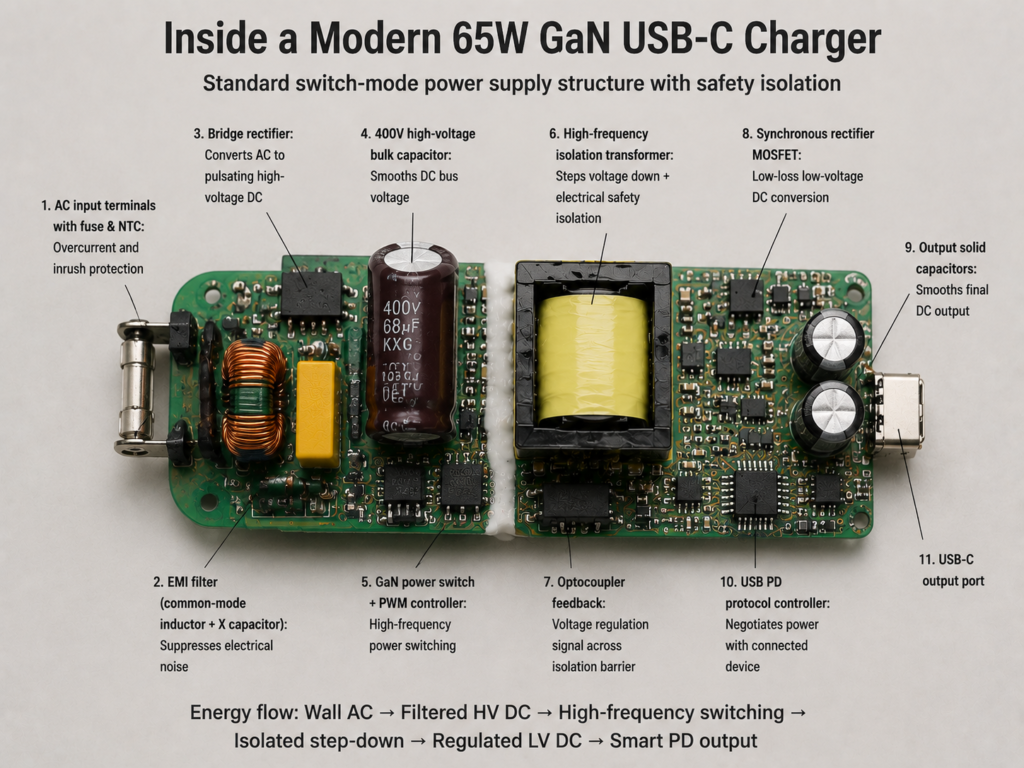
Part 2: Step-by-Step Tour Inside a Charger
Think of this as a power factory assembly line. Electricity goes in one end, gets processed through stations, and comes out clean and safe on the other end.
- EMI filter — the doorman / dust mask
Cleans up electrical static coming from the wall, and also stops the charger’s own internal switching noise from leaking back into your house wiring. - Bridge rectifier — the one-way turnstile
Wall electricity flips back and forth. This set of diodes forces it all to flow in the same direction, turning AC into pulsating DC. - High-voltage capacitor — the water storage tank
A big capacitor smooths out the pulsing DC into a steady high-voltage stream. Bigger tank = smoother power under heavy load. - PFC stage (on bigger chargers) — the rhythm keeper
Medium and large chargers add this to draw power smoothly in sync with the wall voltage, like pushing a swing in time. It’s better for the power grid and meets efficiency rules. Many small phone chargers below roughly 75W do not use a dedicated PFC stage. - Power switch — the ultra-fast faucet
A tiny transistor (MOSFET or GaN) flips on and off tens to hundreds of thousands of times per second, chopping the high-voltage DC into high-frequency pulses. Faster switching = smaller transformer = smaller charger. - High-frequency transformer — the voltage reducer + safety wall
The pulses drive one side of a tiny transformer. Energy is transferred through the magnetic field inside the transformer, while the input and output remain electrically isolated. The number of wire loops on each side sets how much the voltage drops. - Output rectifier — another one-way gate
Turns the low-voltage high-frequency AC back into DC. Better chargers use a “synchronous rectifier” MOSFET instead of a simple diode to cut waste and heat. - Output capacitors — the smoothing tank
Smooth out the pulsing DC into clean, steady power your phone can use. - Feedback system — the remote thermostat
A sensor watches the output voltage and sends an optical “message” back to the primary controller using light (an optocoupler). If voltage is too low, the switch stays on longer; if too high, it stays on less. - USB PD protocol chip — the negotiation desk
This smart chip talks to your device over the USB cable, asks how much power it wants, and tells the power supply to adjust voltage and current accordingly.
💡 Super simple recap: Wall power → cleaned up → turned into DC → chopped really fast → stepped down safely → turned back into clean DC → smart chip haggles power with your phone.
Part 3: How Battery Charging Actually Works
Filling a battery is like filling a glass of water
You don’t just crank the tap wide open until water spills everywhere. You start slow, fill fast in the middle, and taper off at the top.
The phone’s internal charging chip is in charge of this process. The wall charger supplies the voltage and current requested by the device, within the charger’s own limits.
- Pre-charge — the slow start
If the battery is totally dead, charging starts with a tiny trickle to “wake it up” gently. Hitting a fully dead battery with full current would damage it permanently. - Constant Current — the fast fill
Once the battery is awake, the system holds current steady and lets voltage slowly rise. This is where most of the charge goes in — about 70–80% of the battery fills up here. This is the “fast charging” phase. - Constant Voltage — the careful top-off
When voltage hits the battery’s safe limit (usually around 4.2V or 4.45V), voltage holds steady and current slowly shrinks. When current drops to almost nothing, the battery is full.
Part 4: Why Fast Charging Is Fast
It’s not about shoving more current — it’s about raising voltage
Think of electricity like delivery trucks on a highway (the cable).
- Current = number of trucks
- Voltage = how much cargo each truck carries
If you want to deliver more packages, you could add more trucks — but the highway gets congested and hot. That’s high-current charging.
Instead, you can load more cargo onto each truck. Same number of trucks, way more packages delivered, and no extra traffic or heat. That’s fast charging: raise the voltage, keep the current reasonable.
The Handshake: How Your Phone and Charger Agree on Speed
Before fast charging starts, the charger and device have a quick digital conversation over the USB-C cable:
- Phone plugs in
- Charger lists all the power levels it can safely provide
- Phone picks one it supports
- Charger confirms and ramps up the voltage
- Fast charging begins
If they don’t speak the same “language” (protocol), they fall back to basic slow 5V charging.
USB PD: The Universal Charging Language
USB Power Delivery is the global standard protocol for USB-C fast charging. It defines standard voltage levels and negotiation rules.
- Standard Power Range (SPR): 5V, 9V, 12V, 15V, 20V — up to 100W with a 5A cable
- Extended Power Range (EPR / PD 3.1): adds 28V, 36V, and 48V fixed voltage levels, enabling up to 240W with compatible cables and devices
- PPS mode: lets the phone request tiny, smooth voltage tweaks for cooler, more efficient charging
Cable matters too
A USB-C cable is not just a passive wire. Higher power levels require cables with identification electronics called an E-Marker chip. This chip tells the charger whether the cable can safely carry higher current. Without it, the PD system will limit power to protect the cable.
Part 5: What Is GaN, Exactly?
Better switch material = smaller charger
Imagine the power switch inside the charger is a door.
- Old silicon MOSFET = heavy wooden door. It works, but opening and closing it takes effort and makes noise (energy loss).
- GaN (Gallium Nitride) = lightweight carbon-fiber door. It opens and closes way faster, with almost no effort.
Because GaN wastes less energy every time it switches, engineers can crank the switching speed way up. A faster switch means a smaller transformer and smaller filter parts — which is why GaN chargers are so much tinier for the same wattage.
Important: GaN does not automatically make charging faster. It makes the charger smaller, cooler, and more efficient. Actual charging speed still depends on your phone and cable.
Part 6: Rules & Safety Standards
Reputable chargers are designed to comply with four main categories of regulations:
| Category | What it checks | Common standards |
|---|---|---|
| Safety | No shock, no fire, no hazards | IEC 62368-1:2023 / UL 62368-1 |
| Energy efficiency | Wastes as little power as possible, even on standby | DoE Level VI (US), CoC Tier 2 (EU) |
| Charging protocol | Plays nicely with all USB-C devices | USB PD 3.1, USB Type-C specification |
| Electrical noise | Doesn’t interfere with radios, Wi-Fi, etc. | FCC Part 15B (US), EN 55032 (EU) |
FAQ
Why do chargers get warm?
Even a really good charger wastes about 10% of power as heat — from the switch, the transformer, and the output rectifier. Higher wattage = more heat. A warm charger is totally normal. If it’s too hot to hold comfortably, that’s a problem.
Does a GaN charger charge my phone faster?
Not by itself. If both chargers are 65W, your phone will charge at the same speed. The GaN one will just be smaller and run slightly cooler. Charging speed is set by your phone, not the charger’s internal tech.
Will fast charging ruin my battery?
Properly designed, certified fast chargers don’t damage batteries any faster than normal charging. Your phone controls the whole process and slows down on its own to protect the battery. Heat and full-charge storage hurt battery life far more.
Can I use a 140W laptop charger on my phone?
Yes. The charger doesn’t force power into the device. Your phone asks for exactly what it wants and nothing more. A bigger charger just has extra headroom it won’t use. It won’t break your phone.
Why is my fast charger not charging fast?
Usually because one part of the charging chain does not support the same standard. Fast charging requires the charger, cable, and device to support compatible protocols. If any link is missing, you fall back to slower basic charging.
Why does my 100W charger only charge at 60W?
Usually because of the cable. Think of it like a highway: the charger and phone can handle 5 lanes, but the cable is only 3 lanes wide.
Basic USB-C cables are usually rated for 3A max — that’s 60W at 20V. To go higher (100W, 140W, 240W), you need a cable with a tiny E-Marker chip inside that says “I’m safe for 5A.” The PD system automatically limits power to protect weaker cables.
Does USB-C automatically mean fast charging?
No. USB-C is just the shape of the plug. Fast charging needs the charger, cable, and phone all to support a protocol like USB PD. Some basic USB-C ports only output basic 5V.
Is a bigger-wattage charger always better?
No. If your phone only takes 25W, a 100W charger won’t charge it any faster — it’ll just sit there mostly idle. Buy enough wattage for your devices, plus a little headroom, but don’t overbuy just for the number.
Final Summary
- A charger is a high-speed, isolated AC-to-DC power converter. Modern ones use switching technology because it’s small, light, and efficient.
- Batteries charge in three gentle stages — slow start, fast fill, careful top-off — controlled by your phone, not the wall brick.
- Fast charging works by raising voltage through a negotiated protocol, not just cranking up current. This delivers more power through the same cable without extra cable heat.
- GaN is a better switch material. It makes chargers smaller and more efficient, but doesn’t automatically make your phone charge faster.
- For best results: match the protocol, buy certified products, use a cable rated for the power you want, and don’t overpay for more watts than your devices can use.