
If you look at the charging cables, USB cords, power cords and Ethernet cables around your home, chances are most of them use a PVC outer jacket. As the most widely used cable jacket material in the industry, PVC is everywhere, yet most people know very little about it. This guide breaks down everything you need to know about PVC jacket cables — what they are, how they perform, where they work best, how to choose them, and common myths debunked.
1. What Is a PVC Jacket Cable?
1.1 What Is a Cable Jacket?
A cable jacket (also called a cable sheath) is the outermost layer of a cable — the part you touch and hold.
Many people confuse the outer jacket with the inner conductor insulation. They serve completely different purposes and sit in separate layers:
| Layer | Location | Core Function |
|---|---|---|
| Conductor Insulation | Wraps each individual internal wire | Separates wires to prevent short circuits; provides primary electrical insulation |
| Cable Jacket | The outermost layer, enclosing the entire cable | Provides external physical and environmental protection; adds mechanical strength; serves as secondary insulation |
A cable jacket is responsible for:
- Abrasion resistance: Protects against damage from daily pulling, rubbing and bending
- Moisture & dust resistance: Blocks water vapor and dust from reaching internal conductors and causing corrosion
- Oil resistance: Special PVC formulations can withstand light exposure to oils and greases
- Secondary electrical insulation: Adds an extra safety barrier beyond the core wire insulation
- Mechanical strength: Improves the cable’s overall tensile strength and bend durability
1.2 What Is PVC?
PVC stands for Polyvinyl Chloride, a highly common thermoplastic material. In simple terms, thermoplastics soften when heated and harden when cooled, making them ideal for high-volume manufacturing.
Pure PVC is naturally rigid and has poor heat resistance. In cable production, manufacturers blend PVC with additives like plasticizers, stabilizers and flame retardants to adjust its flexibility, temperature rating and fire performance for different applications.
PVC has dominated the cable industry for decades for one core reason: it delivers an unmatched balance of performance, availability and cost. Raw materials are abundant, production processes are mature, and it works well enough for the vast majority of everyday use cases.
1.3 Defining PVC Jacket Cables
A PVC jacket cable is simply a cable that uses PVC as its outermost protective layer.
A typical PVC jacket cable follows this structure, from inside to outside:
- Conductor: Usually copper or copper alloy, carries power or data signals
- Insulation: Wraps each conductor for electrical isolation
- Shielding (optional): Found on signal and high-speed cables to reduce electromagnetic interference
- PVC Jacket: The outer layer that provides overall protection
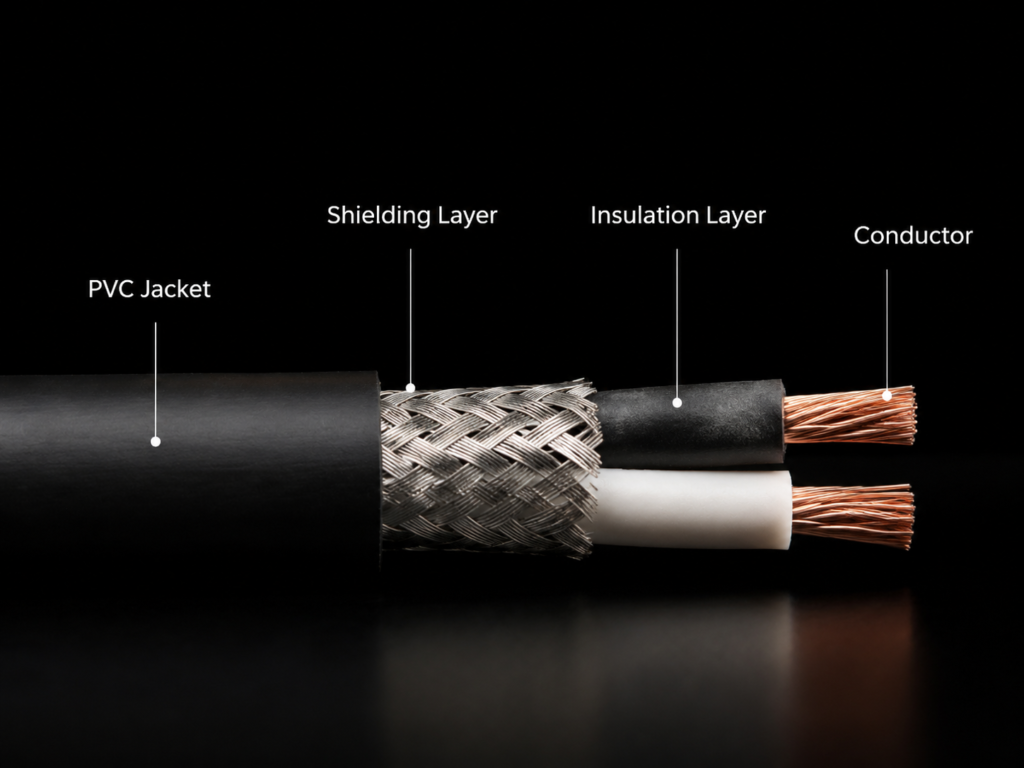
Compared to other jacket materials such as TPE, silicone or braided nylon, PVC cables occupy the value and general-purpose segment. They cover everything from budget charging cables to standard household power cords.
2. Key Benefits of PVC Cable Jackets
2.1 Low Cost & Excellent Value
PVC benefits from a highly mature global supply chain with stable, low raw material costs. Its extrusion manufacturing process is simple and efficient, keeping production expenses low.
This is why almost all stock cables included with consumer electronics, as well as most budget cables, use PVC jackets. It delivers reliable daily performance at a very accessible price point.
2.2 Easy to Manufacture & Customize
PVC extrusion is a well-established, highly consistent process that scales easily for mass production. It also accepts colorants extremely well, so it can be produced in virtually any color with a smooth, matte or textured finish to match any product design.
2.3 Good Abrasion Resistance for Daily Use
PVC offers decent surface toughness. It stands up well to normal rubbing, scraping, pulling and bending in home and office environments. For typical indoor use, it resists minor damage very effectively.
2.4 Inherent Flame Retardant Properties
PVC naturally contains chlorine, which gives it a baseline level of fire resistance. With added flame retardant additives, it can meet various industry flame ratings.
An important clarification: flame retardant does not mean fireproof. A compliant PVC jacket will typically self-extinguish once removed from the flame, so it does not spread fire easily. However, it will still burn when exposed to sustained flame or extreme heat, and may release irritating smoke when burning.
2.5 Reliable Electrical Insulation
PVC is a good electrical insulator. As an outer jacket, it provides a dependable secondary insulation barrier that fully meets safety requirements for low-voltage power and weak-signal cables — a major reason it is so common in consumer electronics.
3. Limitations of PVC Cable Jackets
For quick reference, here is a side-by-side summary of PVC jacket pros and cons:
| Advantages | Disadvantages |
|---|---|
| Low cost, excellent value | Average flexibility; stiffens in cold temperatures |
| Easy to manufacture and color | Limited high-temperature tolerance |
| Good everyday abrasion resistance | Poor UV resistance; not for long-term outdoor use |
| Self-extinguishing flame properties | Traditional formulations have environmental concerns |
| Stable electrical insulation | Prone to creasing with frequent bending |
Below is a closer look at its main weaknesses:
3.1 Average Flexibility & Poor Cold Performance
Standard PVC has a somewhat firm feel. It tends to hold creases after being bent, and develops “memory” if coiled for long periods — it will not lay flat easily.
In cold winter temperatures, PVC becomes noticeably stiffer and more brittle, and can crack if bent sharply. This is why charging cables feel much harder when used outside in cold weather.
3.2 Limited High-Temperature Resistance
Standard PVC jackets are rated for continuous use at roughly 60°C to 80°C (140°F to 176°F). Long-term exposure to higher temperatures accelerates aging, causing the jacket to harden, become brittle and crack, shortening the cable’s lifespan and creating safety risks.
For this reason, PVC is not suitable for industrial environments with sustained heat, or for long-term placement in hot, enclosed spaces like a car dashboard in direct sun.
3.3 Poor UV Resistance
Standard PVC formulations have weak ultraviolet resistance. Long-term exposure to direct sunlight causes rapid degradation: the jacket hardens, fades in color, and eventually cracks, losing its protective ability.
For outdoor use, you need specially formulated weather-resistant PVC or a different jacket material entirely.
3.4 Historical Environmental Concerns
Traditional PVC formulations used phthalate plasticizers, and improper incineration can release harmful fumes, leading to longstanding environmental criticism.
That said, modern compliant PVC has improved significantly. Phthalate-free formulations and low-smoke zero-halogen (LSZH) modified PVC are now widely used, and meet major global standards like RoHS and REACH. Regulations vary by country, but reputable products always comply with local mandatory standards.
4. Where Are PVC Jacket Cables Best Used?
PVC performs best in indoor, room-temperature environments with mild conditions. Here are its most common applications:
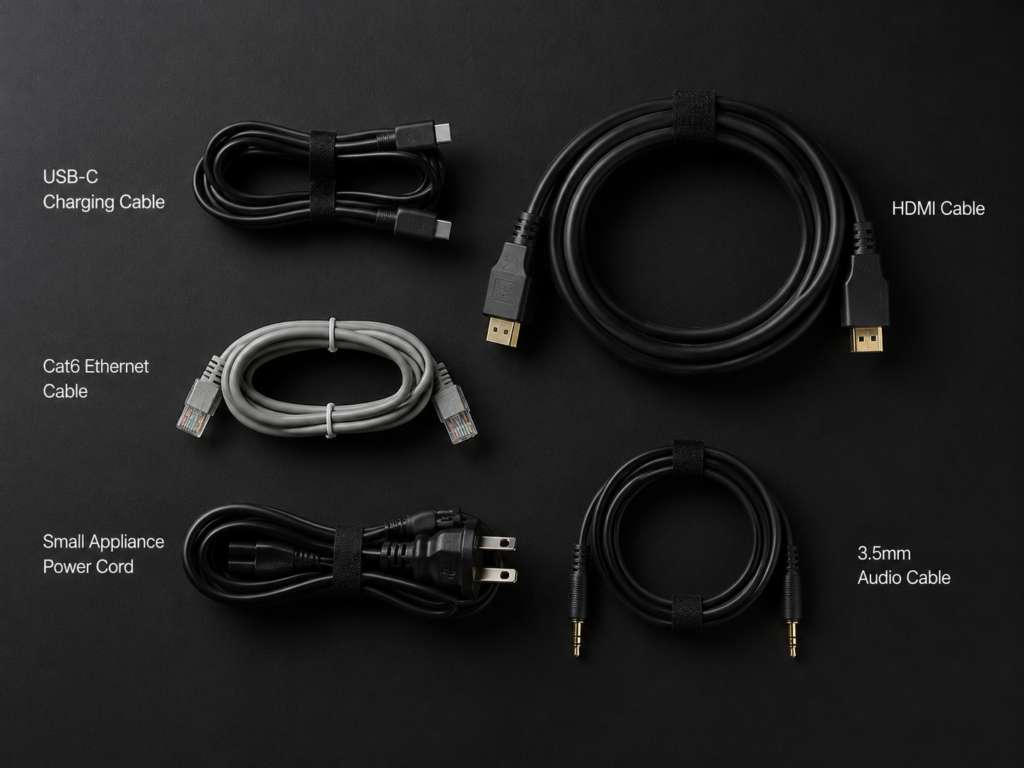
4.1 Phone Charging Cables
Whether USB-A, USB-C or Lightning, most stock and budget phone charging cables use PVC jackets. They work perfectly for everyday indoor charging.
4.2 Data Cables
USB data cables, printer cables, keyboard/mouse cords and external hard drive cables almost always use PVC jackets, striking a good balance between cost and basic protection.
4.3 Household Power Cords
Small appliance power cords, AC adapter output cables and household extension cords are classic use cases for PVC jackets. They offer reliable durability and safety for normal indoor conditions.
4.4 Audio & Video Cables
HDMI cables, VGA cables, RCA cables and 3.5mm audio cables almost all use PVC jackets in their standard versions, which work well for both fixed installations and regular use.
4.5 Network & Communication Cables
Standard home Ethernet cables, telephone wires and indoor low-voltage wiring commonly use PVC jackets — low cost and sufficient for long-term indoor service.
5. How to Tell If a Cable Has a PVC Jacket
You can usually identify a PVC jacket without cutting the cable open:
5.1 Check the Product Specifications
The most reliable method is to check the product page, packaging label or datasheet. Reputable products clearly list the jacket material — if you see “PVC” or “Polyvinyl Chloride”, it is a PVC jacket cable.
5.2 Look at the Appearance
- Typically has a smooth surface with a slight plastic sheen
- Available in bright, solid colors
- Usually has no outer braid — just a smooth, one-piece plastic exterior
5.3 Feel the Flexibility
- Feels firmer than TPE or silicone
- Bends slowly and tends to hold a crease rather than springing back
- Brand-new cables may have a faint plastic odor that fades quickly on genuine, compliant products
5.4 Check Certifications
Genuine PVC cables will list certifications like RoHS for environmental compliance, plus safety marks such as UL or CE for power cables.
6. How to Choose PVC Jacket Cables
When shopping for PVC cables, don’t fixate only on the “PVC” label — focus on your use case and build quality.
6.1 Match the Material to Your Environment
| Environment | PVC Jacket Recommended? | Notes |
|---|---|---|
| Indoor home / office | Highly recommended | Standard PVC works perfectly |
| Cold / freezing environments | Not recommended | Standard PVC becomes stiff and brittle |
| Outdoor / direct sunlight | Not recommended | Ages and cracks quickly; use weather-rated PVC only |
| High-heat industrial settings | Not recommended | Insufficient temperature rating; safety risk |
6.2 Consider How Often the Cable Will Be Bent
- Permanent installation, rarely moved: PVC is ideal — durable and cost-effective
- Occasional movement, normal plugging/unplugging: Standard PVC works great
- Frequent bending, daily carry, heavy use: TPE or braided jackets are usually a better choice, as PVC will crease and wear faster
6.3 Inspect Build Quality
- Check that the jacket has a uniform thickness and a smooth, even surface with no bubbles, scratches or rough edges
- Make sure the plug strain relief is solid and well-reinforced
- Avoid cables with a strong, harsh chemical smell — this is a sign of low-quality material
- Prefer products with recognized safety and environmental certifications
6.4 Don’t Judge Only by the Material Name
Not all PVC is created equal. High-quality, properly formulated eco-PVC from a reputable manufacturer will feel better and last much longer than cheap, low-grade PVC made from recycled scrap.
In many cases, a well-made PVC cable will outperform a cheaply made TPE or silicone cable. Don’t chase “premium materials” blindly — overall build quality and certifications matter more.
7. Common Myths About PVC Cables Debunked
7.1 Are all PVC cables stiff?
No.
Flexibility is entirely determined by the PVC formulation. By adjusting the type and amount of plasticizers, PVC can be made anywhere from very rigid to quite soft. Many high-quality flexible PVC cables feel nearly as soft as basic TPE. The reason most people associate PVC with stiffness is simply that many budget cables use a firmer, lower-cost formula.
7.2 Are PVC cables bad for the environment?
It depends.
Older, traditional PVC did have valid concerns around phthalates and incineration emissions. But modern eco-PVC that meets RoHS and REACH standards eliminates harmful plasticizers, and low-smoke zero-halogen formulations greatly reduce combustion hazards.
Always check for relevant environmental certifications rather than writing off all PVC as non-eco-friendly.
7.3 Can PVC cables handle fast charging?
Absolutely.
Fast charging capability depends on the internal conductor gauge, wire design, and (for high-power PD charging) the presence of an E-Marker chip — in short, what’s inside the cable. The jacket material only protects the outside and has no direct effect on charging speed.
A properly built PVC cable can easily support 100W+ fast charging.
7.4 Does a PVC jacket slow down data transfer?
No, not directly.
Data speed and signal integrity depend on the conductor material, shielding structure, impedance control and connector quality. The PVC jacket sits on the outside purely for physical protection. As long as the internal design is correct, the jacket will not affect transfer speeds.
7.5 Do PVC cables always have a shorter lifespan?
Not necessarily.
Cable lifespan depends on build quality, material grade and how and where you use it. A high-quality PVC cable used properly indoors can easily last 3–5 years or longer. Conversely, even a premium silicone cable will fail quickly if abused in extreme heat or oily environments.
Matching the right material to the right environment, plus reasonable care, is what determines real-world longevity.
8. Why PVC Remains the Most Common Cable Jacket Material
8.1 The Core Strengths of PVC
PVC remains the dominant cable jacket material not because it excels at any one thing, but because it is extremely well-rounded:
- Affordable and excellent value for money
- Extremely mature manufacturing with consistent quality
- Balanced performance that covers most everyday scenarios
- Universal adoption with a complete global supply chain
For normal daily use, PVC is the practical “good enough, works well, doesn’t cost much” choice.
8.2 Who Should Choose PVC Jackets?
- Everyday home users who mostly use cables indoors
- Office users with mostly stationary cables
- Budget-conscious consumer electronics users
- Anyone who does not need extreme environmental performance or extra-soft flexibility
8.3 Final Buying Advice
When shopping for cables, don’t automatically dismiss PVC, and don’t blindly chase “premium” materials either.
- Start with your use case: for normal indoor use, a good-quality PVC cable is all you need. For outdoor, cold or heavy-bending use, look at other materials.
- Overall design, build quality, safety certifications and brand reputation matter more than the jacket material name alone.
- Modern, compliant eco-PVC is perfectly safe and environmentally acceptable for everyday use — there is no need for unnecessary concern.