
Imagine you are trying to order coffee in a foreign country. You speak one language, the barista speaks another. If you both use the same language, everything is fast and smooth. If not, you struggle.
Charging your phone works the same way. Your phone and your charger need to speak a common “charging language.” There are two major languages in the world of fast charging: Quick Charge (QC) , created by Qualcomm, and USB Power Delivery (USB PD) , created by the USB‑IF organisation.
This article compares them directly. We will look at what each one is, how they have changed over time, how they control voltage and current, how much power they can deliver, what hardware they require, and their strengths and weaknesses.
1. What Are They? (Basic Definitions)
Quick Charge (QC) is a fast‑charging protocol developed by Qualcomm. It is a private (or semi‑open) technology. Originally, it only worked with Qualcomm’s own Snapdragon processors. Phone makers had to license it and include specific chips inside the phone. Think of it as a family secret code – only members of the family can understand it.
USB Power Delivery (USB PD) is a universal charging standard created by the USB‑IF, a group that includes Apple, Google, Microsoft, and many others. It is not owned by any single company. It works with any device that has a USB‑C port – phones, tablets, laptops, headphones, game consoles, and more. Think of it as the international language of charging – everyone can learn it, and everyone can use it.
Key difference: QC is a private dialect; PD is a global standard.
2. Evolution Over Time (Version History)
Both standards have gone through multiple versions. The tables below show how they have developed.
Quick Charge Versions
| Version | Release Year / Key Feature | Maximum Power |
|---|---|---|
| QC 1.0 | 2013 – 5V/2A or 5V/1.8A | ~10W |
| QC 2.0 | Fixed voltage steps: 5V, 9V, 12V (Class A) and 20V (Class B) | Up to 60W (20V×3A, Class B; most phones use Class A up to 36W) |
| QC 3.0 | Introduced INOV – 200mV step voltage adjustment, backward compatible with QC 2.0/1.0 | Still 60W |
| QC 4.0 | First to be compatible with USB PD – 5V/3A, 9V/3A | 27W |
| QC 4+ | Improved dual‑channel charging (splits current between two ICs to reduce heat), lower heat | 27W (9V×3A) |
| QC 5.0 | Announced July 27, 2020 – 100W+ | 100W+ (5 min to 50%) |
| QC 5+ | Announced Sept 9, 2025 – 140W (20V×7A) | 140W |
USB PD Versions
| Version | Release Year / Key Feature | Maximum Power |
|---|---|---|
| PD 1.0 | 2012 – basic power delivery | 60W |
| PD 2.0 | Added higher voltage profiles (5V, 9V, 15V, 20V) | 100W (20V×5A) |
| PD 3.0 | Added PPS (Programmable Power Supply) – 20mV steps | 100W |
| PD 3.1 | May 2021 – added EPR (Extended Power Range) with 28V, 36V, 48V | Up to 240W (48V×5A) |
Observation: QC started earlier but stayed at lower power for years. PD 2.0 already reached 100W in 2015, while QC only hit 100W with QC5 in 2020. QC 4.0 (2016) was the first QC version to be compatible with USB PD. QC5+ now reaches 140W, which is higher than standard PD 3.0 (100W) but lower than PD 3.1’s maximum 240W.
3. Voltage and Current Control – How They Adjust Power
Quick Charge changed its control method over time:
- QC 2.0 used fixed voltage levels – like climbing stairs with big steps (5V, 9V, 12V, 20V). The phone could only pick one of these fixed steps. Big jumps cause more heat.
- QC 3.0 introduced INOV (Intelligent Negotiation for Optimal Voltage). It allowed 200mV steps – like a gentle ramp instead of stairs. Smoother, but still not extremely fine.
- QC 5 / 5+ now uses USB PD‑PPS, which allows 20mV steps – much finer than 200mV. It also supports high current up to 7A (for QC5+).
USB PD has two modes:
- Fixed voltage profiles: 5V, 9V, 15V, 20V (and for PD 3.1: 28V, 36V, 48V). These are like preset gears.
- PPS mode (Programmable Power Supply): This is much more flexible. The charger and device can negotiate voltage in 20mV steps and current in 50mA steps. This is like a continuous dial – you can set exactly the right amount of power for the battery’s current state.
Comparison: Both QC5/5+ and PD 3.0/3.1 support 20mV stepping via PPS, but PD has had PPS since version 3.0 (2017), while QC only adopted it with QC5 (2020). PD also offers fixed higher‑voltage options (28V, 36V, 48V) for laptops and other large devices, which QC does not support.
4. Maximum Power – Who Can Deliver More?
| Standard | Maximum Power | How It Is Achieved |
|---|---|---|
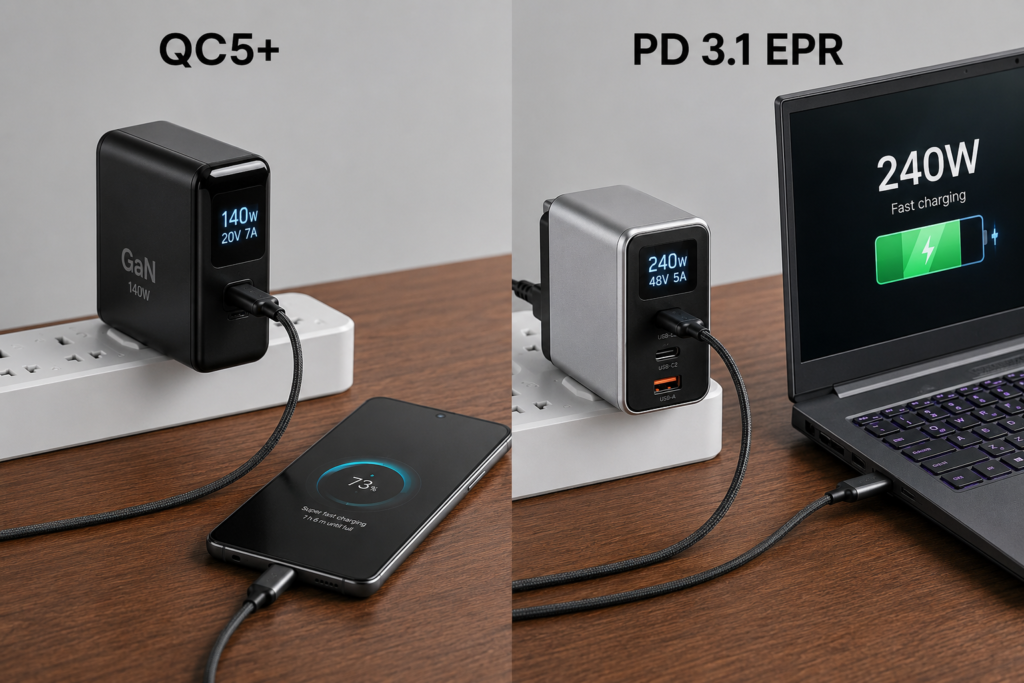
| Quick Charge (QC5+) | 140W | 20V × 7A |
| USB PD (PD 3.1 EPR) | 240W | 48V × 5A |
On paper, PD has a much higher ceiling (240W vs 140W). However, for smartphones, 140W is already extremely fast. The higher 240W is mainly designed for gaming laptops, workstations, and other high‑power devices. For phones, both are more than enough.
5. Compatibility Requirements – What Hardware Do You Need?
This is a crucial difference. Both standards have hidden requirements that determine whether you can actually reach their maximum speeds.
For Quick Charge (especially QC5 and QC5+):
- You need a Snapdragon processor (865, 865+, 888, or newer) – that is the software foundation.
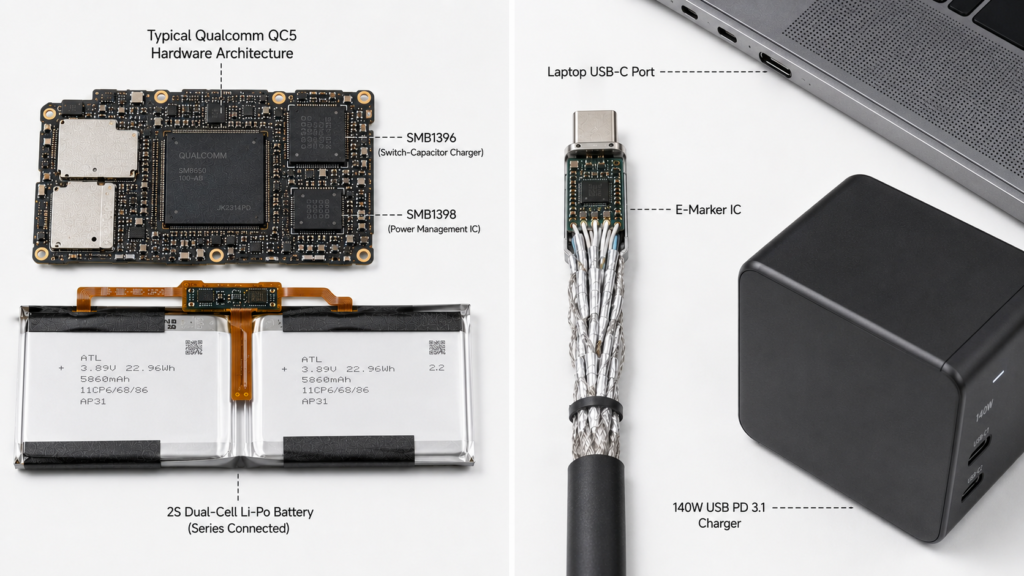
- But the processor alone is not enough. The phone must also include three additional hardware components:
- SMB1396 – a switch‑capacitor converter (splits voltage)
- SMB1398 – a power management IC (directs current)
- 2S dual‑cell battery – two batteries wired in series
- And you also need the right charger and cable:
- A charger that supports PD‑PPS and can deliver at least 100W (for QC5) or 140W (for QC5+).
- A USB‑C to USB‑C cable with an E‑Marker chip that supports 5A current.
Without these, the phone cannot accept 100W+ power, even if it has a Snapdragon chip. The chip gives you the “driver’s license” – but the SMB chips, dual battery, PPS charger, and 5A cable are the actual “engine” that produces the speed. If any piece is missing, the system will automatically limit power to a lower level – you will not see 100W+ speeds.
For USB PD (especially PD 3.1 EPR for 240W):
- The charger must support EPR (Extended Power Range) .
- The device (laptop, phone, etc.) must also support EPR – it is not just about the charger and cable.
- The cable must have an E‑Marker chip and explicitly declare EPR capability (for 48V / 5A).
If any of these three pieces is missing, the system will drop down to 100W or lower. For standard PD 3.0 (100W), the cable only needs to support 5A with E‑Marker, but the charger and device must also support the 20V/5A profile.
Comparison: QC5’s requirement is mostly inside the phone – you need specific chips and a dual battery, plus a compatible PPS charger and 5A cable. PD 3.1’s requirement is across the entire chain – charger, device, and cable all must be EPR‑certified. Both create barriers, but the type of barrier is different.
6. Strengths and Weaknesses – A Direct Comparison
Quick Charge
| Strengths | Weaknesses |
|---|---|
| Very high power specifically for phones (100W+) | High hardware barrier – not every Snapdragon phone can use 100W |
| QC5 works with standard PPS chargers – not locked to one brand | Still a “dialect” – devices outside Qualcomm cannot use it |
| Backward compatible with QC2.0, 3.0, 4+ in terms of protocol negotiation, but charging speed is limited by the charger’s capability | Power ceiling (140W) is lower than PD’s 240W |
USB PD
| Strengths | Weaknesses |
|---|---|
| Universal – works with almost every modern device | For 240W, all three pieces (charger, device, cable) must support EPR |
| Higher maximum power (240W) for future devices | Older PD devices may not support high power levels |
| PPS allows precise control – less heat, longer battery life | Some early PD lacked PPS |
| Open standard – no licensing fees |
7. Summary Comparison Table
| Feature | Quick Charge (QC) | USB Power Delivery (PD) |
|---|---|---|
| Owner | Qualcomm (private) | USB‑IF (open standard) |
| Main use | Snapdragon phones | All devices with USB‑C |
| Latest version | QC5+ (140W) | PD 3.1 (240W) |
| Voltage control | Fixed steps → 200mV → 20mV PPS | Fixed profiles + 20mV PPS |
| Current limit | Up to 7A (QC5+) | 5A maximum (all PD versions) |
| Hidden requirement | SMB1396 + SMB1398 + dual‑cell battery + PPS charger + 5A E‑Marker cable | Full EPR chain for 240W (charger + device + cable) |
| Backward compatibility | Yes, with QC2.0/3.0/4+ | Yes, but power may be limited |
| Third‑party charger support | Yes (PPS chargers) | Yes (all PD‑compliant chargers) |
| Max power for phones | 100W – 140W | Up to 100W (PD 3.0) – 240W (EPR, rare for phones) |
Final Thought
Quick Charge and USB PD were once very different. QC was a closed system, while PD was open. Today, QC5 has adopted PD‑PPS as its core technology, so they are more similar than ever. The main differences lie in:
- Ownership and ecosystem: QC is tied to Qualcomm and specific phone hardware; PD is universal.
- Power ceiling: PD goes higher (240W) but requires full EPR compliance.
- Hardware requirements: QC needs special chips inside the phone, plus a PPS charger and 5A cable; PD needs special cables and chargers for its top tier, and the device itself must also support EPR.
Both are capable of very fast charging. For a pure technical comparison, PD offers broader compatibility and higher ultimate power, while QC offers specialised optimisation for Snapdragon phones.