
1. Introduction: Have You Met These Charging Frustrations?
Have you ever run into these charging headaches?
You pack multiple chargers for your phone and tablet before a trip, bulky and taking up too much space in your bag. You borrow a friend’s fast charger for your phone, only to find the battery barely gains power after a long wait — it never actually triggers fast charging. At home, every electronic device comes with its own branded charger, leaving a drawer full of unused charging adapters: too wasteful to throw away, yet useless to keep around.
Why does this happen? Is there a solution that lets chargers from different brands work with fast charging across devices? The answer is UFCS, the universal fast charging standard developed independently by China.
2. What Exactly Is UFCS?
2.1 Basic Definition
UFCS stands for Universal Fast Charging Specification. In everyday terms, it is widely known as the “integrated fast charging protocol”. Simply put, it is a unified industry standard for fast charging, developed independently by China.
2.2 Who Developed This Standard?
UFCS is not created by a single company — it is a joint effort of the entire industry chain.
Led by the China Academy of Information and Communications Technology (CAICT), the standard was co-initiated by four major Chinese smartphone brands: Huawei, OPPO, vivo and Honor. It also brings together partners across the industrial chain, including chipmakers and charger manufacturers. The standard was officially released by the Telecommunication Terminal Industry Association and the China Communications Standards Association.
2.3 In One Simple Sentence
If each brand’s proprietary fast charging protocol is a local dialect, then UFCS is the common language for fast charging. As long as both the charger and the phone support this “common language”, they can “understand” each other no matter what brand they are, and deliver fast charging across brands.
3. Why Do We Need UFCS?
3.1 The Fragmented Fast Charging Market
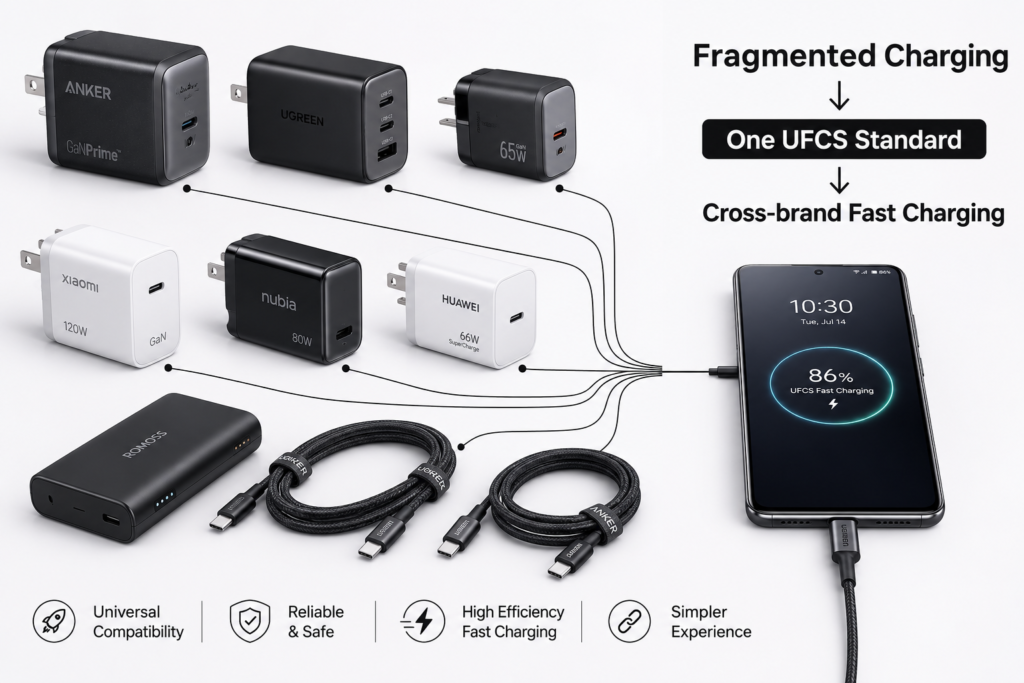
Before UFCS arrived, the Chinese fast charging market was full of competing standards that did not work with each other.
Huawei has SCP, OPPO has VOOC, vivo has FlashCharge, Xiaomi has its own HyperCharge — almost every major brand has its own exclusive fast charging protocol, like a secret code only its own devices can recognize.
This created an awkward situation: when charging across brands, most devices could only run the most basic 5V/2A normal charging at around 10W, far from real fast charging. Only the “original charger” from the same brand could deliver full-speed fast charging.
3.2 Real Problems Caused by Fragmentation
This fragmented state brings many practical troubles:
- Higher cost for users: Every time you switch to a different phone brand, you have to buy a new set of original chargers, wasting extra money.
- More e-waste: Large numbers of unused chargers are discarded, causing serious resource waste and environmental pressure.
- Wasted industry effort: Companies repeatedly invest in developing similar fast charging technologies, instead of working together to advance the overall technology.
3.3 The Drive for a Unified Standard
Beyond internal industry pain points, external factors also pushed for a unified fast charging standard.
The EU’s policy to unify the Type-C port set a good reference for the industry. Having an independent unified fast charging standard also helps the Chinese industry gain technical voice and avoid patent risks. In addition, a unified standard reduces e-waste, which aligns with the national strategy of green, low-carbon and energy-saving development.
4. How Does UFCS Work?
4.1 Core Logic: Handshake Negotiation First, Then Stable Fast Charging
The core logic of UFCS is to provide the entire industry with a unified “negotiation language”, solving the fundamental problem of “language barriers” between devices of different brands.
In the era without a unified standard, each brand’s fast charging protocol was like a unique local dialect: a Huawei charger only “spoke Huawei’s language”, while an OPPO phone only understood OPPO’s language. When the two met, neither could receive the other’s fast charging instructions. In the end, they could only use the most basic “common language” supported by all devices — the 5V/2A normal charging mode, which is naturally very slow.
UFCS is like the universal common language for the fast charging industry. As long as both the charger and the phone master this unified language, they can smoothly complete the full negotiation process. The whole process is fully automatic and finished in milliseconds, completely unnoticeable to users, and is divided into four specific steps:
- Self-introduction at the moment of connection: The instant the data cable is plugged in, the charger and the phone first send basic identity signals to each other, informing the other party of all charging protocols they support, equivalent to sharing their “language list” first.
- Protocol matching and confirmation: Both parties quickly check their respective protocol lists and find the commonly supported UFCS standard. If both support UFCS, they automatically switch to this unified communication channel. If either party does not support it, they will fall back to other mutually compatible protocols, or the most basic normal charging mode, and will not damage the device throughout the process.
- Two-way negotiation of power levels: After confirming the use of UFCS, the phone tells the charger the maximum voltage, current and power it can withstand, and the charger also feeds back all power levels it can stably output. After two-way matching, the two sides select the highest power level that both can operate safely and stably, neither wasting the charger’s performance nor exceeding the phone’s capacity.
- Officially start fast charging with real-time communication: After the negotiation is completed, the charger will output power stably according to the agreed level. The two sides keep communicating throughout the charging process, dynamically adjusting the power at any time according to the phone’s battery level, body temperature and cable status, balancing speed and safety.
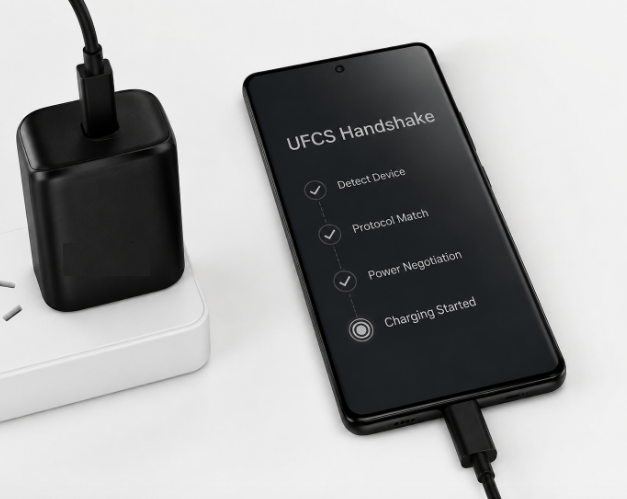
In short, UFCS does not force all devices to use the same hardware. Instead, it sets a unified set of communication rules for all devices, so that products of different brands can accurately match each other’s capabilities without changing core hardware, and achieve cross-brand fast charging.
4.2 No Special Cable Needed, Strong Compatibility
Many people ask: do I need a special data cable for UFCS fast charging? The answer is no.
UFCS works with the Type-C, USB-A and even older Micro-USB cables we use every day — no extra cable replacement required. It also supports fine-grained voltage and current adjustment, balancing charging speed and safety. Its power coverage is wide too: it works for everything from low-wattage phones to kilowatt-level electric vehicles.
4.3 Full Safety Protection
A unified standard does not mean sacrificing safety. UFCS has multiple built-in safety mechanisms:
It can detect cable impedance in real time to identify low-quality, unqualified data cables and avoid safety risks. It supports encrypted authentication to block counterfeit charging devices. It also has multiple layers of protection against over-voltage, over-current and overheating, keeping the charging process safe all the way through.
5. UFCS 1.0 vs 2.0: What’s New in the Upgrade?
5.1 UFCS 1.0 (Released in 2021)
Released in 2021, UFCS 1.0 laid the basic technical framework for integrated fast charging, turning cross-brand fast charging from a concept into reality. However, version 1.0 required device authentication to achieve high-power fast charging, which made it harder to popularize widely. As the standard rolled out, the first batch of certified products gradually became available to consumers.
5.2 UFCS 2.0 (Released in 2025) — Core Upgrades
Released in 2025, UFCS 2.0 is a major milestone for integrated fast charging, with very practical core upgrades:
- 40W authentication-free interoperability: As long as both devices support UFCS 2.0, they will run 40W fast charging directly when plugged in, with no extra authentication process — truly “plug in and fast charge”.
- Reverse charging support: Phones can also act as a power source, delivering reverse fast charging to small devices like earbuds and smartwatches.
- Dynamic power adjustment: It automatically adjusts charging speed based on the phone’s battery level, and slows down automatically when the battery is nearly full, to better protect battery lifespan. At the same time, four major Chinese smartphone brands signed a patent cross-licensing letter of intent, taking another big step toward a fully connected fast charging ecosystem.
6. What Real Benefits Does UFCS Bring?
6.1 For Consumers: Cheaper and Easier
- One charger for everything: A Huawei phone can fast charge with an OPPO charger, a vivo phone can fast charge with a Honor adapter — no more worrying about “is this the original charger?”.
- Lower cost: You don’t need to buy an original charger for every brand. One high-quality charger can work with most devices at home.
- Easier to travel: Just bring one charger when you go out. Shared power banks and public charging facilities can also deliver fast charging speed.
- Safer charging: The unified standard has passed strict industry-wide certification, making it more standardized and safer than scattered proprietary protocols.
6.2 For the Environment and Society: Greener and More Convenient
A unified fast charging standard can drastically reduce the number of unused chargers and cut e-waste, in line with the concept of green and low-carbon development. Meanwhile, public charging facilities can adopt a unified standard, covering more public scenarios such as airports, high-speed railway stations and hotels, making fast charging accessible to everyone.
6.3 For Industry Development: Ending Waste, Going Global
After ending years of fragmented internal competition, companies in the industrial chain can focus on technological upgrading and promote the overall progress of fast charging technology. More importantly, as a standard developed independently by China, UFCS is gradually going global, enhancing the global voice of China’s fast charging industry.
7. Where Can UFCS Be Used?
7.1 Consumer Electronics: The Main Scenario Today
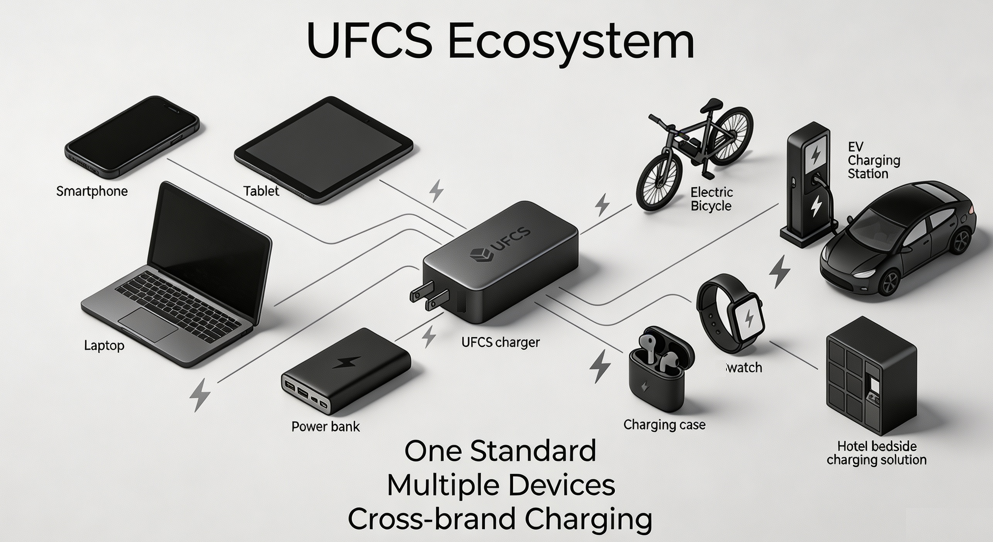
Currently, the most common application of UFCS is in consumer electronics, including smartphones, tablets and laptops we use every day, as well as various IoT devices like wireless earbuds and smartwatches, plus accessories like power banks and chargers.
7.2 Public Service Scenarios: Fast Charging Everywhere
In public spaces, the value of UFCS is even more obvious. Public charging panels in airports, high-speed railway stations and hotels, in-car shared chargers in ride-hailing cars and taxis, and shared power banks on every street — all can use the UFCS standard to deliver fast charging to phones of different brands.
7.3 Future Expansion Directions
Beyond consumer electronics, UFCS will extend to more fields in the future. Electric bicycles, home small appliances, even industrial equipment and new energy vehicles and other high-power charging scenarios will all become application directions for integrated fast charging.
8. How Popular Is UFCS Right Now?
8.1 Supported Brands
Among smartphone brands, new models from major Chinese brands including Huawei, Honor, OPPO, vivo and Xiaomi basically support the UFCS standard. In the charger sector, many third-party GaN charger brands have launched UFCS-certified products. Upstream power management chipmakers have also completed technical adaptation long ago.
8.2 Certification Data
As of October 2025, there are over 245 UFCS-certified products, covering multiple categories such as smartphones, chargers and power banks. The ecosystem is growing rapidly.
8.3 International Recognition
In 2025, UFCS was officially included in the ITU-T international standard, becoming a best practice solution for global fast charging. This means the fast charging standard independently developed by China has been officially recognized by the international community and is entering the global market.
9. Frequently Asked Questions
9.1 How do I know if my phone supports UFCS?
The easiest way is to check the product specifications, product detail page or packaging of your phone. If it has the UFCS logo, it supports the standard. Currently, new flagship and mid-range models from major Chinese brands basically come with UFCS integrated fast charging.
9.2 What is the relationship between UFCS and PD fast charging?
PD is an international universal fast charging standard launched by the USB-IF organization, while UFCS is an integrated fast charging standard launched by China. They are not opposites — they can coexist. Many chargers support multiple protocols including PD and UFCS to work with more devices. Compared with PD, UFCS is more adapted to the fast charging technical features of Chinese manufacturers, and delivers a better cross-brand interoperability experience.
9.3 What happens if I use a non-UFCS charger on a UFCS phone?
There is no need to worry about device damage at all. In this case, the phone and charger will automatically fall back to other fast charging protocols that both support, or the most basic normal charging mode. It will only slow down the charging speed, and will not damage the device.
9.4 Do iPhones support UFCS?
Currently, UFCS is mainly supported by Chinese brand Android phones. Apple devices still mainly use the PD fast charging protocol and do not support UFCS for now.
10. Summary
UFCS integrated fast charging is China’s solution to the long-standing pain point of fast charging incompatibility. From the framework building of version 1.0 to the authentication-free full-speed interoperability of version 2.0, this standard is step by step solving the charging troubles that have bothered consumers for years.
In the future, UFCS will expand from smartphones and consumer electronics to more devices and more scenarios, becoming a universal charging standard covering all product categories. Unified fast charging is an inevitable trend of industry development, and in the end, every ordinary consumer will benefit from the unified standard.