
If you’ve ever noticed lights dim when they’re far from the breaker box, or wondered why a long extension cord makes your phone charge slower, you’ve seen voltage drop in action. It works exactly like water pressure dropping in a long garden hose: the farther electricity travels, and the more you push through the wire, the more gets “lost” along the way as heat.
60-Second Quick Summary
- What it is: Voltage drop is lost voltage caused by wire resistance. It depends on three things: how much current you’re using, how far the wire runs, and how thick the wire is.
- Rule of thumb: For home wiring, keep drop under 3% on any single circuit, and under 5% total from the main panel to the farthest outlet. This is a widely accepted industry best practice.
- Biggest traps: Always count both outgoing and return wires. Never use solid copper sizing charts for cheap copper-clad aluminum (CCA) wires — they have way more resistance.
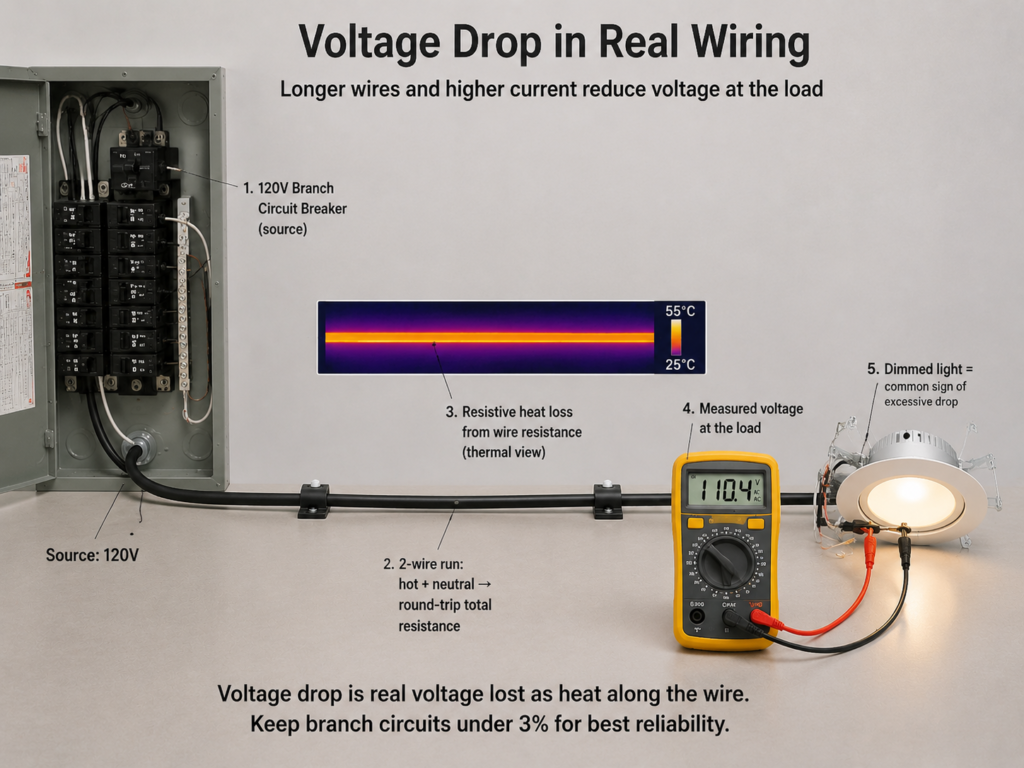
Part 1: The Basics (With Simple Analogies)
1.1 What Exactly Is Voltage Drop?
Think of your electrical circuit like a garden hose connected to a spigot:
- Voltage = water pressure at the spigot
- Current (amps) = how much water is flowing through the hose
- Wire resistance = friction from the inside of the hose
The longer the hose and the more water you push through it, the weaker the pressure is at the nozzle. That weaker pressure is voltage drop.
Small amounts are totally normal. Too much causes dim lights, overheated wires, and electronics that run poorly or fail early.
1.2 Why Does This Matter?
- Devices work right: Everything from lights to chargers is designed for a specific voltage range.
- Safety & reliability: Following standard limits avoids overheating and premature wear.
- Save money: Pick the right wire size — not too thin (unsafe) and not unnecessarily thick (waste of money).
1.3 Key Terms in Plain English
- AWG (American Wire Gauge): The standard wire size rating. Think hose diameter: smaller numbers = thicker wire = less resistance = less drop. 12 AWG is thicker than 14 AWG.
- Round-trip length: Electricity doesn’t just go one way. It flows out through the hot wire and back through the neutral. Total wire length is double the one-way distance — like driving to a store and back home.
- IACS: Just the industry benchmark for “pure copper conductivity.” Regular copper wires all fall right around this standard.
Part 2: How to Calculate Voltage Drop
2.1 The Core Idea
At its simplest: Voltage Drop = Current × Total Wire Resistance
This is just the hose rule restated: more water flow + more friction = more pressure loss.
We use this simplified approach for most home and small commercial projects. For very long, high-power industrial runs, engineers add extra factors for AC effects — but you usually don’t need that for household work.
2.2 Single-Phase / DC (Most Home Wiring: 120V / 240V)
Formula: Vd = 2 × I × L × R ÷ 1000
What each letter means:
- 2 = the round-trip factor (there and back again)
- I = how many amps your device draws
- L = one-way length of the run, in feet
- R = wire resistance per 1000 feet (from the AWG chart below)
Drop percentage: Vd% = (Vd ÷ system voltage) × 100
⚠️ #1 beginner mistake: Forgetting the “×2” for round trip. Skip it and you’ll underestimate drop by half — which can lead to undersized, unsafe wires.
2.3 Balanced Three-Phase (Commercial / Industrial)
For 3-phase equipment:
Formula: Vd = 1.732 × I × L × R ÷ 1000
The 1.732 comes from 3-phase math (it’s roughly √3). Drop percentage is calculated against the line-to-line voltage.
Part 3: Charts, Corrections & Mistakes to Avoid
3.1 AWG Copper Resistance Cheat Sheet
Room temperature (20°C), 100% IACS pure copper
| AWG Size | Resistance (Ω / 1000 ft) |
|---|---|
| 14 AWG | 2.525 |
| 12 AWG | 1.588 |
| 10 AWG | 0.999 |
| 8 AWG | 0.628 |
| 6 AWG | 0.395 |
Quick notes:
- Solid and regular stranded copper of the same AWG perform almost identically.
- Tinned copper and oxygen-free copper are basically the same as regular copper for drop calculations.
- CCA warning: Copper-clad aluminum has about 1.5–1.6× more resistance than solid copper. Think of it like a hose that looks thick on the outside, but most of the inside is plugged up. Never use this chart directly for CCA — multiply resistance by ~1.55 first.
3.2 Why Hot Wires Have More Drop
Copper gets more resistive when it heats up — like how thick syrup flows slower when it’s cold, or air feels heavier on a hot day. A fully loaded wire runs much hotter than room temperature.
Quick rule of thumb for copper:
- Room temperature (20°C): baseline = 1.0
- 75°C (typical loaded wire temperature): multiply resistance by ~1.22
Most professional electricians design using 75°C values, because that’s the typical rating for panel terminals.
3.3 What’s an “Okay” Amount of Drop?
The NEC (National Electrical Code) doesn’t have strict enforceable rules for voltage drop, but there’s a widely followed industry best practice:
- 3% maximum for any single branch circuit
- 5% maximum total from the main service to the farthest outlet
Think of this like speed limits for wiring: you won’t automatically get a ticket for going a little over, but staying under keeps things safe, efficient, and reliable.
3.4 Quick Sizing Chart (120V, 3% max, 75°C, solid copper)
Approximate one-way lengths for quick planning
| AWG | 10 A | 15 A | 20 A |
|---|---|---|---|
| 14 AWG | ~58 ft | ~39 ft | ~29 ft |
| 12 AWG | ~93 ft | ~62 ft | ~46 ft |
| 10 AWG | ~148 ft | ~98 ft | ~74 ft |
| 8 AWG | ~235 ft | ~157 ft | ~118 ft |
Tip: At 240V with the same 3% rule, you can roughly double these lengths.
3.5 The 4 Most Common Mistakes
- Forgetting the round-trip ×2 — the #1 beginner error.
- Ignoring temperature — room-temperature math gives you an overly optimistic number.
- Using copper charts for CCA — CCA has way more resistance.
- Only looking at wire ampacity — a wire’s safe current rating isn’t the same as its voltage drop performance.
FAQ
Is the 3% drop rule a strict code requirement?
No. It’s a widely recommended best practice, not a mandatory enforceable law. Most professionals follow it anyway because it keeps systems running reliably and efficiently.
Why do you double the length for single-phase circuits?
Because current flows out on the hot wire and back on the neutral. Both wires add resistance — it’s a round trip, not a one-way street.
Can I use this chart for copper-clad aluminum (CCA)?
No. CCA has about 50–60% more resistance than solid copper. You’ll get a wrong (too low) number if you use copper values directly.
Does wire temperature really matter that much?
Yes. A fully loaded 75°C wire has about 22% more resistance than room-temperature wire. Skipping this makes your design look better on paper than it will work in real life.
Can I ignore drop for short extension cords?
For short cords powering small devices, it’s usually negligible. For long cords running high-power tools or chargers, it’s worth checking.
Final Summary
- Voltage drop is just lost voltage from electricity pushing through wire resistance — exactly like pressure loss in a long hose.
- For home projects, always count the round-trip length, use 75°C temperature values as a realistic baseline, and aim for 3% or less on branch circuits.
- Never treat CCA the same as solid copper. It’s lighter and cheaper, but has much higher resistance.
- When in doubt, go one wire size thicker. The extra cost is small compared to the reliability gain.