
1. Introduction: Are Gold Connectors Always Better Than Silver Ones?
1.1 The Common Confusion When Shopping for Cables
When shopping for charging cables, HDMI cords, or audio cables, most people notice connectors come in two common finishes: gold and silver. Brands often advertise “gold-plated connectors” as a premium feature, and these products usually cost more. It’s easy to assume gold equals high quality, silver means budget grade — and that gold plating is always better.
1.2 Understanding Connector Plating Matters More Than Chasing “Gold”
In reality, the color you see is just the outer metal plating. Gold and nickel plating each have their own strengths and best use cases. Gold is not automatically superior to nickel in every situation. Learning the real differences between the two will help you pick the right product for your needs, so you don’t waste money on marketing hype.
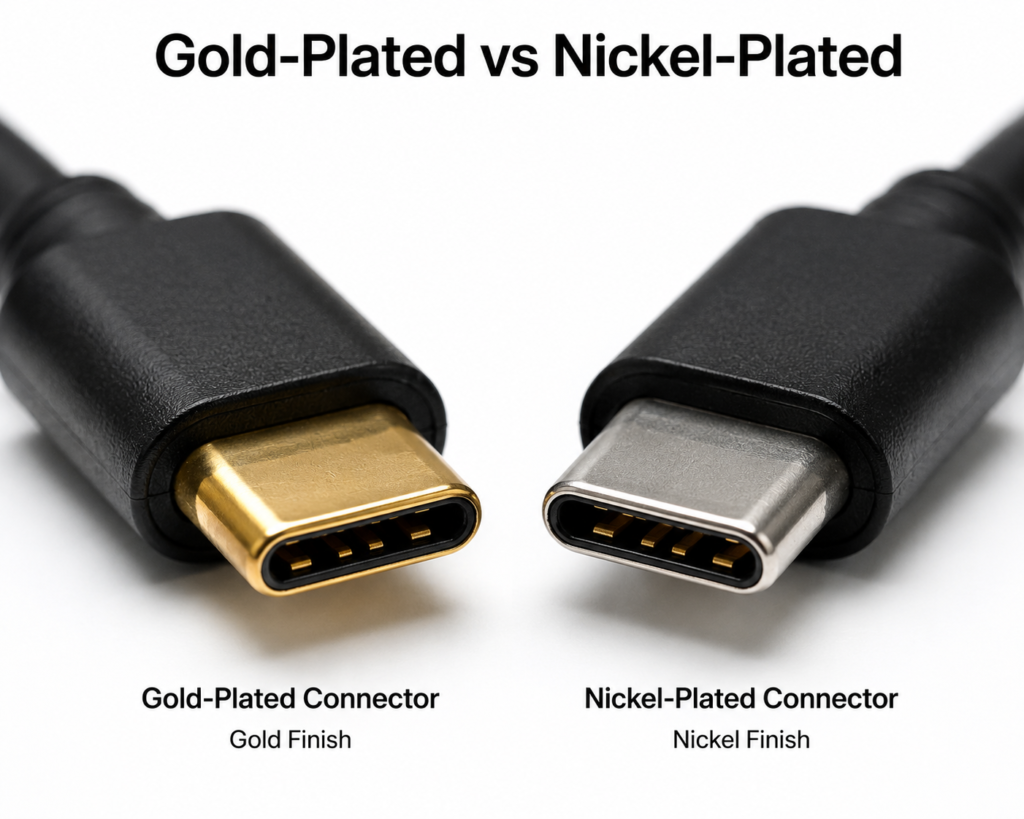
2. Basics: What Is Connector Plating For, Anyway?
2.1 Why Connectors Need Surface Plating
The whole point of a connector is to carry power and signals reliably. Most connectors are made of copper or copper alloys, which conduct electricity well but tarnish and corrode easily when exposed to air. Over time, oxidation leads to poor contact, slow charging, or dropped signals. Plating acts like a protective jacket for the connector: it shields the base metal from corrosion and improves how well the two contact surfaces connect.
2.2 The Basics of Base Metal and Plating Structure
Nearly all connectors use copper as the base material because it balances conductivity and cost. Plating is never applied directly to copper. Instead, a thin layer of nickel is almost always used as an undercoat first, then the final top layer — either gold or more nickel — is added on top. The nickel underlayer adds hardness and prevents the base copper and top plating from mixing together.
3. What Are the Two Types of Connectors?
3.1 Gold-Plated Connectors: Structure, Types and Key Traits
A gold-plated connector has a thin layer of gold deposited on top of the nickel undercoat. There are two common types: hard gold (a gold alloy), which is more scratch-resistant and used for connectors that are plugged in often; and soft gold (higher purity), which conducts better and is used for permanent or low-plug precision equipment.
Its core advantages are excellent conductivity and near-total resistance to tarnish, but gold is very expensive, so the plating is always extremely thin.
3.2 Nickel-Plated Connectors: Process, Types and Key Traits
A nickel-plated connector uses nickel as the final outer layer. It comes in bright nickel and matte nickel finishes, with a silvery, slightly warm metallic look.
Its core advantages are high hardness, great wear resistance, and low cost. It also offers decent rust protection, though it can develop a thin oxide film over time in humid conditions.
4. Side-by-Side Performance Comparison
To make the differences easy to see, here’s a quick performance comparison table:
| Performance Category | Gold-Plated Connectors | Nickel-Plated Connectors |
|---|---|---|
| Conductivity & Contact Resistance | Excellent — very low and stable resistance | Good — slightly higher resistance that rises with oxidation |
| Oxidation & Corrosion Resistance | Excellent — virtually no tarnish under normal use | Good — stable in dry air, forms oxide layer in humidity |
| Wear Resistance & Plug Lifespan | Fair — soft gold wears through easily on thin-plated parts | Excellent — high hardness stands up to repeated plugging |
| Signal Transmission Stability | Excellent — consistent for high-frequency / low-level signals | Fair — oxide buildup can degrade weak signals |
| Harsh Environment Tolerance | Excellent — holds up well in high humidity and salt spray | Moderate — performance degrades faster in harsh conditions |
4.1 Conductivity and Contact Resistance
Gold conducts electricity much better than nickel, and since it doesn’t oxidize, its contact resistance stays low and consistent over time. Think of it like water flowing through a smooth pipe: there’s very little friction. With oxidized nickel, it’s more like water flowing through a pipe with rough buildup inside — the resistance goes up.
4.2 Oxidation and Corrosion Resistance
Gold is chemically very stable. It won’t tarnish, darken, or rust for years, even when exposed to sweat and moisture. Nickel stays fine in dry air, but with long-term exposure to humidity or sulfur in the air, it will slowly darken and form a thin oxide layer on the surface.
4.3 Wear Resistance and Plug Lifespan
Pure gold is relatively soft. On budget cables with thin gold plating, the top layer can wear off quickly with frequent plugging and unplugging, exposing the nickel underneath. Nickel, on the other hand, is much harder and more scratch-resistant, so it holds up better under heavy daily use.
4.4 Signal Transmission Stability
For very weak signals or high-speed, high-frequency data, even tiny changes in contact resistance can affect transmission quality. Gold-plated connectors maintain consistent resistance, so they deliver more reliable performance for high-speed data, 4K/8K video, and low-level audio. Nickel works fine for normal speeds but is less consistent in extreme use cases.
4.5 Tolerance for Humid, Salty and Harsh Environments
In coastal areas or humid, rainy seasons, metal parts corrode and tarnish much faster. Gold plating has a clear advantage here — it keeps working reliably for much longer. Nickel-plated connectors are more likely to develop oxidation and contact problems in these conditions.
5. Real-World Impact on Everyday Use
5.1 Effect on Charging Speed and Fast Charging
For regular phone charging and standard fast charging, there is virtually no noticeable difference in speed between a good nickel-plated and a good gold-plated connector. Even for 100W+ fast charging, as long as the connector is clean and makes solid contact, the gap is too small for most people to detect.
5.2 Effect on Data and Video Transmission Speed
For everyday file transfers and 1080p video, you won’t feel any difference between the two. But for 8K video, high-speed USB data, and other high-bandwidth, high-frequency uses, gold-plated connectors offer more stable performance and fewer dropouts or transfer errors.
5.3 Effect on Audio Sound Quality
Many audio cables market gold plating as a way to improve sound quality, but for the vast majority of listeners, you simply cannot hear a difference from connector plating alone. The stability benefit of gold only matters in professional recording or high-end HiFi systems that are extremely sensitive to tiny signal changes.
6. Cost, Lifespan and Common Uses
6.1 Material and Manufacturing Cost Differences
Gold is a precious metal, and its material cost is thousands of times higher than nickel. Even an extremely thin layer of gold adds significantly to production costs. Combined with a more complex plating process, genuine gold-plated cables almost always cost more than nickel-plated equivalents.
6.2 Real-World Lifespan in Different Scenarios
- Fixed, rarely plugged connections: Gold-plated connectors last longer, since they don’t wear out and don’t oxidize.
- Daily, frequent plugging and unplugging: Good nickel-plated connectors last longer, because they resist wear better than thin gold plating.
- Humid or outdoor environments: Gold-plated connectors have a clear lifespan advantage.
6.3 Common Applications for Each Plating Type
- Gold-plated connectors: Premium data cables, high-speed HDMI/DisplayPort cords, professional audio gear, precision instruments, industrial test equipment, aerospace and military hardware.
- Nickel-plated connectors: Budget charging cables, everyday consumer electronics, power connectors, basic home appliances, high-volume low-cost products.
7. Common Myths and How to Tell Real Gold Plating
7.1 Common Misconceptions About Connector Plating
- Myth: Gold plating is always better than nickel. They are built for different jobs. For frequent plugging, nickel can actually be more durable.
- Myth: A gold color means real gold plating. Many cheap cables use a gold-colored alloy finish that looks like gold but performs no better than nickel.
- Myth: Thicker plating is always better. Too much gold plating can actually chip and wear off more easily. A proper, specified thickness is what matters.
7.2 How to Spot Genuine Gold-Plated Connectors
- Check the specs: Legitimate products will list “gold plating” and often a thickness rating. If it only says “gold-colored connectors,” it’s probably not real gold.
- Check the price: Real gold plating adds cost. If a super-cheap cable claims “thick gold plating,” it’s almost certainly marketing fluff.
- Check wear: Real gold plating wears away to reveal the silvery nickel underlayer. Fake gold finishes usually wear to a similar color.
7.3 How to Avoid Marketing Gimmicks
Don’t pay extra just for the word “gold-plated.” Start with your actual use case. If you just need to charge your phone every day, there’s no reason to pay more for gold plating. It only makes sense for high-end gear or harsh environments.
8. Buying Guide: Choose the Right One for You
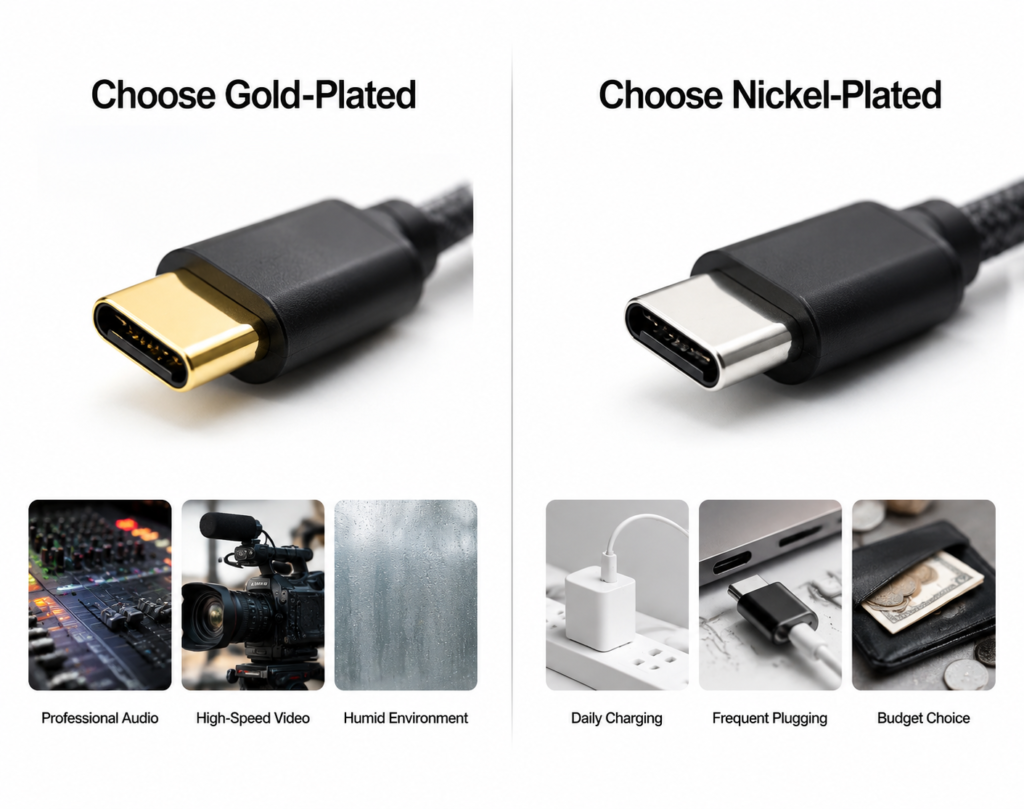
Here’s a quick reference table to help you decide based on how you’ll use it:
| Use Case | Recommended Plating | Why |
|---|---|---|
| Everyday phone charging, basic data cables | Nickel | More than enough, great value, wear-resistant |
| High-speed USB, 8K HDMI/DisplayPort video | Gold | More stable signal, fewer transmission errors |
| Regular headphones and speaker cables | Nickel | No audible difference for most people; better value |
| Professional HiFi and recording gear | Gold | More stable contact for low-level signals |
| Coastal, humid, or outdoor use | Gold | Better corrosion and tarnish resistance |
| Heavy daily plugging and unplugging | Nickel | Harder surface, longer wear life |
8.1 For Casual Everyday Use
If you just need to charge your phone or tablet and transfer files occasionally, a good nickel-plated cable is all you need. It’s durable, affordable, and will work fine for years of normal use.
8.2 For High-Speed Data and AV Gear
If you’re using a high-end monitor, gaming console, or professional camera that needs fast data or high-resolution video, go with genuine gold-plated connectors. They reduce signal loss and keep transmission more reliable.
8.3 For Frequent Plugging or Special Environments
For test equipment, shared charging stations, or anything that gets plugged in dozens of times a day, nickel-plated connectors will hold up better. For use in damp basements, near the coast, or outdoors, gold plating is the better choice for corrosion resistance.
9. Final Summary
9.1 Each Has Its Strengths — Neither Is Universally Better
Gold-plated connectors excel at conductivity, oxidation resistance, and corrosion resistance. They shine in situations where signal stability is critical or conditions are harsh. Nickel-plated connectors are harder, more affordable, and more wear-resistant, making them perfect for daily plugging and budget-friendly builds. There is no universal winner — just different tools for different jobs.
9.2 Choose Based on Your Real Needs, Not Hype
When shopping for cables, don’t get caught up in the idea that “gold is premium.” Think about how you’ll actually use the cable, your budget, and your environment. The best choice is the one that fits your needs — not the one with the fanciest marketing feature.