
If you’ve shopped for phone charging cables, earphone cords, or portable device wires lately, you’ve probably seen the term “TPE jacket” pop up in product descriptions. TPE cables feel soft and flexible, and they hold up better to repeated bending than basic plastic cords—but most people don’t really know what TPE is, how it compares to PVC or silicone, or what to look for when buying one. This guide breaks down everything you need to know in plain language.
1. What Is a TPE Jacket Cable?
1.1 What Is a Cable Jacket?
A cable jacket is the outermost protective layer of a cable—the part you touch and hold. Its main job is to shield the inner conductors, insulation, and shielding layers from physical damage like pulling, scraping, and moisture.
The jacket material directly defines how flexible a cable feels, how long it lasts, how comfortable it is to hold, and how well it holds up to different temperatures and environments.
1.2 What Is TPE (Thermoplastic Elastomer)?
TPE stands for Thermoplastic Elastomer, a class of polymer materials that combines the processing advantages of plastic with the elasticity of rubber.
In simple terms: when heated, TPE melts and can be molded like plastic; when cooled, it regains a rubber-like stretch and flexibility. This combination makes it easy to manufacture at scale while delivering a premium, rubber-like feel—one reason it has become the go-to jacket material for consumer electronics cables.
1.3 Why Are More Cables Using TPE Jackets?
Compared to traditional PVC jackets, TPE delivers a better user experience while meeting stricter global environmental standards. Its key benefits include:
- Soft, flexible build that’s easy to coil and store
- Smooth, skin-friendly surface that feels comfortable in hand
- Better bend resistance that holds up to daily use
- Recyclable material in most compliant formulations
- No plasticizers required, making it easier to meet global environmental rules
2. How Are TPE Cable Jackets Made?
2.1 Core Material Properties
TPE is not a single substance—it’s a blend of a “rubber phase” and a “plastic phase.” By adjusting the ratio of these phases and adding specialized additives, manufacturers can fine-tune hardness, abrasion resistance, temperature tolerance, and other properties to fit everything from delicate earphone wires to rugged equipment cables.
2.2 The Cable Manufacturing Process
TPE jackets are applied using a process called extrusion. The basic steps are:
- Material blending: TPE base resin is mixed with flame retardants, UV stabilizers, and other additives according to the product formula
- Extrusion: The blended material is heated until molten, then pushed through a die to form a uniform layer around the cable core
- Cooling & setting: The coated cable passes through water or air cooling to solidify the TPE jacket
- Quality inspection: Operators check outer diameter, insulation performance, and surface finish before the finished cable is spooled
2.3 Why TPE Can Be Made So Soft
TPE naturally has high elasticity similar to rubber. Its hardness—measured on the Shore scale—can be adjusted across a wide range through formulation.
For consumer electronics cables, manufacturers typically use a lower-hardness TPE to create a soft, flexible feel with minimal bending resistance. For higher-strength applications, they can increase hardness for better wear resistance and structural support. This versatility is a big reason TPE is used across so many product categories.
3. Key Advantages of TPE Cable Jackets
3.1 Excellent Flexibility
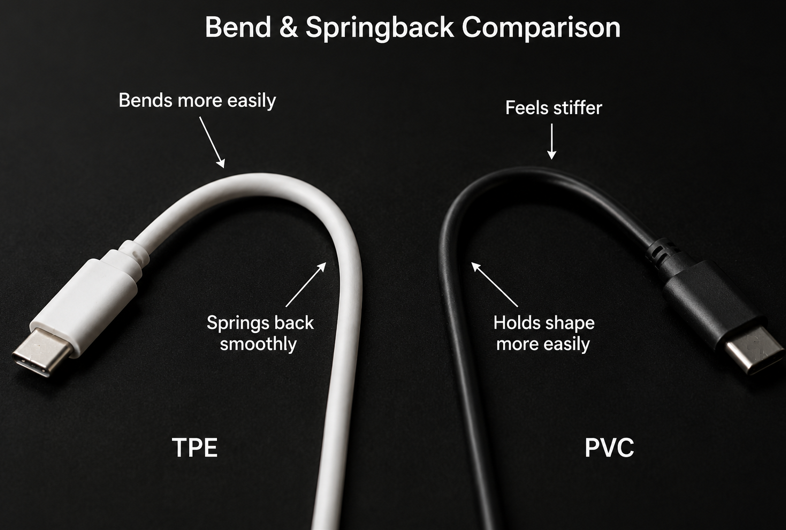
TPE cables bend easily and coil neatly without springing back open like stiff plastic cords. They’re much easier to tuck into a bag or pocket, and they don’t develop permanent kinks as easily after repeated bending.
3.2 Comfortable, Premium Feel
High-quality TPE has a smooth, slightly rubbery texture that’s pleasant to hold and doesn’t feel slippery or cheap. This is why many premium charging cables and earphones use TPE—small improvements in touch add up during daily use.
3.3 Good Shape Recovery
After being bent or twisted, TPE springs back to its original shape relatively quickly. By contrast, basic PVC cables often develop permanent bends over time, and can eventually crack along those creases.
3.4 Decent Abrasion Resistance
TPE holds up well to everyday wear: rubbing against a desk, jostling around in a pocket with keys, and other normal use. It doesn’t scuff or peel easily, making it a good fit for cables that get moved around a lot.
3.5 Strong Bend Fatigue Resistance
For charging cables and earphones that get bent, plugged, and unplugged every day, bend life matters a lot. A well-made TPE cable can typically withstand tens of thousands of bend cycles without jacket damage or exposed internal wires—lasting significantly longer than basic PVC alternatives.
3.6 Strong Environmental Profile
Properly formulated TPE doesn’t require phthalate plasticizers, so it easily meets major global environmental regulations including EU RoHS, REACH, and California Proposition 65. Its thermoplastic nature also means it can be recycled and reprocessed, unlike non-recyclable jacket materials.
4. Limitations of TPE Cable Jackets
TPE is not a one-size-fits-all solution. It has clear performance limits you should know before buying:
4.1 Limited High-Temperature Resistance
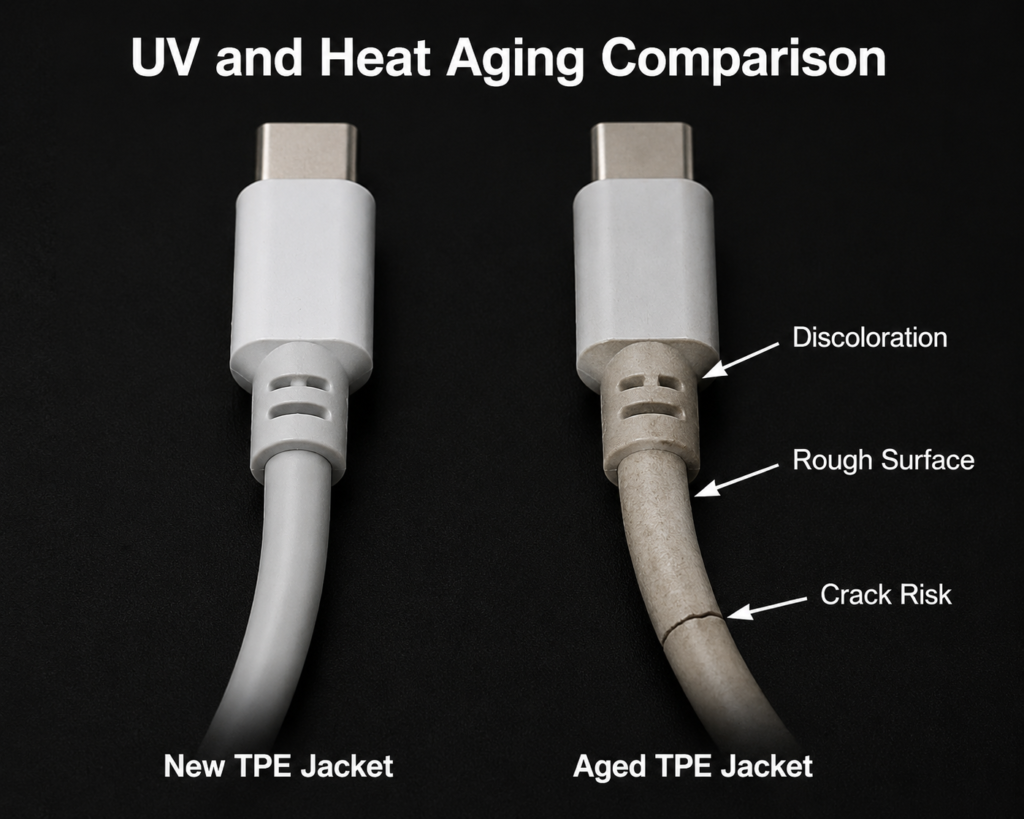
Standard TPE is generally rated for continuous use up to around 80°C. Long-term exposure to high heat—such as near hot electronics or inside a closed car in summer—can soften the material, speed up aging, and cause deformation. It is not suitable for high-temperature industrial environments.
4.2 Moderate Cut Resistance
Because TPE is relatively soft, sharp objects can cut or nick it fairly easily. For heavy industrial or construction settings where cables may contact sharp edges, TPE is rarely the first choice for jacket material.
4.3 Degrades Under Long-Term Sun Exposure
Standard TPE has only moderate UV resistance. Left outdoors in direct sunlight for extended periods, it will gradually harden, become brittle, and crack. For permanent outdoor use, you need a specially formulated weather-resistant TPE.
4.4 Low-Quality Versions Can Turn Sticky
Cheap, poorly formulated TPE may leach additives to the surface over time, resulting in a sticky, dust-attracting jacket. Reputable brands use stabilized formulations to avoid this issue in normal use.
5. TPE vs. Other Common Cable Jacket Materials
PVC, TPE, and silicone are the three most common jacket materials for consumer electronics cables. Here’s how they compare.
5.1 TPE vs. PVC
- Feel & flexibility: TPE is noticeably softer with a rubbery texture; PVC is stiffer and smoother, and gets even harder in cold weather
- Low-temperature performance: TPE stays flexible in cold conditions; PVC becomes rigid and brittle when cold, and can crack when bent
- Environmental profile: Standard PVC relies on plasticizers, with risk of phthalate exposure; TPE is plasticizer-free and more easily meets modern eco standards
- Cost: PVC is cheaper, common in free bundled cables; TPE costs more and is used in mid-range to premium products
5.2 TPE vs. Silicone
- Softness: Silicone is generally softer and more squishy; TPE is flexible but with more structural firmness
- Temperature tolerance: Silicone handles much higher and lower temperatures than TPE; TPE works well for normal room-temperature daily use
- Durability: TPE is more abrasion-resistant than standard silicone; silicone picks up dust more easily and can scratch more readily
- Cost: Silicone is more expensive to manufacture; TPE offers better value and is the mainstream choice for mid-tier cables
5.3 Quick Comparison Table
| Feature | TPE | PVC | Silicone |
|---|---|---|---|
| Softness | Good | Fair | Excellent |
| Bend resistance | Good | Fair | Good |
| High heat tolerance | Fair | Fair | Excellent |
| Environmental profile | Excellent | Fair | Good |
| Abrasion resistance | Good | Fair | Fair |
| Price point | Moderate | Low | High |
| Best for | Charging cables, earphones, consumer electronics | Budget bundled cables, home wiring | Premium cables, high-temperature use |
6. Common Cables That Use TPE Jackets
Thanks to its balanced performance, TPE is most popular in everyday consumer electronics. Common applications include:
6.1 USB Charging & Data Cables
USB-A, USB-C, and Lightning charging and data cables are the biggest use case for TPE jackets. These cables are bent and plugged in daily, so they need both a soft feel and strong bend fatigue resistance—exactly what TPE delivers.
6.2 Earphone & Audio Cables
Wired earphones and audio cords almost always use TPE. The flexible material is more comfortable to wear, reduces cable microphonics (rustling noise), and coils up neatly for storage.
6.3 Portable Digital Device Cables
Camera cables, handheld gaming console chargers, smart watch charging cords, and other portable electronics often use TPE jackets for a good balance of portability and everyday durability.
7. How to Tell If a Cable Has a TPE Jacket
You can make a reasonable guess from feel and behavior, but you can never be 100% sure just by touching. Here’s how to check:
- Check the official product specs: The most reliable method. Reputable brands list jacket material on packaging, product pages, and spec sheets.
- Test flexibility and springback: TPE cables usually bend easily and bounce back smoothly, without the stiff, rigid feel of PVC.
- Feel the surface: TPE has a subtle rubbery smoothness—not slippery-hard like PVC, and not soft-sticky like silicone.
Note: Feel alone is not proof. Some cheap cables use extra softeners to mimic TPE’s texture, but perform much worse in real use. Always rely on the manufacturer’s published specifications when possible.
8. Who Should Choose TPE Jacket Cables?
8.1 People Who Carry Cables On the Go
If you travel, commute, or regularly toss cables in a bag, TPE’s flexibility makes it much easier to store. It coils compactly and doesn’t spring open like stiff plastic cords.
8.2 People Who Bend Cables Frequently
Phone, tablet, and laptop charging cables get bent and plugged in every day. TPE’s better bend resistance means your cable will last longer before failing near the connector.
8.3 People Who Care About Feel & Comfort
If you dislike the cheap, hard plastic feel of basic cables, TPE’s smooth, flexible texture makes daily use noticeably more pleasant.
8.4 People Who Value Safety & Sustainability
Compliant TPE cables are free of harmful plasticizers, meet major global environmental standards, and are recyclable—making them a more eco-conscious choice.
9. What to Look for When Buying TPE Cables
The jacket material is only one part of a good cable. Don’t stop at “TPE”—also check these factors:
9.1 Build Quality & Internal Design
A great cable needs more than a good jacket. Conductor quality, shielding structure, and strain relief at the connectors all matter. Even the best TPE jacket won’t save a cable with weak, unreinforced connectors.
9.2 Relevant Certifications
Look for products with proper certifications matching their intended use and region:
- USB cables: USB-IF certification for reliable protocol compatibility
- Safety: UL (United States), CE (European Economic Area), CCC (China)
- Environmental: Compliance with EU RoHS, REACH, and California Proposition 65
9.3 Match to Your Actual Needs
Pick a cable that fits what you actually use it for:
- Charging: Make sure the cable supports the power rating of your charger and device
- Data transfer: Confirm the cable’s speed rating if you plan to transfer files
- Environment: Choose weather-resistant TPE for outdoor use, or oil-resistant formulations for greasy environments
10. Final Verdict: Are TPE Jacket Cables Worth It?
10.1 What TPE Does Best
TPE is an extremely well-balanced cable jacket material. It’s soft, comfortable, bend-resistant, eco-friendly, and reasonably priced. For everyday consumer electronics use—phone charging, data transfer, audio cables—it delivers one of the best combinations of user experience and value.
10.2 Where It Falls Short
Its limits are clear: it doesn’t handle extreme heat, prolonged UV exposure, or heavy industrial abuse well. For those scenarios, other materials are a better fit.
10.3 Final Buying Advice
- For everyday charging cables, data cables, and earphones, a reputable TPE jacket cable is one of the best all-around choices you can make.
- For permanent outdoor use, high-heat environments, or heavy industrial applications, choose a jacket material designed for those conditions, such as silicone or specialized rubber.
- Don’t assume every “TPE” cable is high quality. Stick to reputable brands with proper certifications—cheap knockoffs may cut corners on formulation and won’t deliver the same durability or safety.