
1. Introduction: The Hidden Efficiency Secret Inside Power Supplies
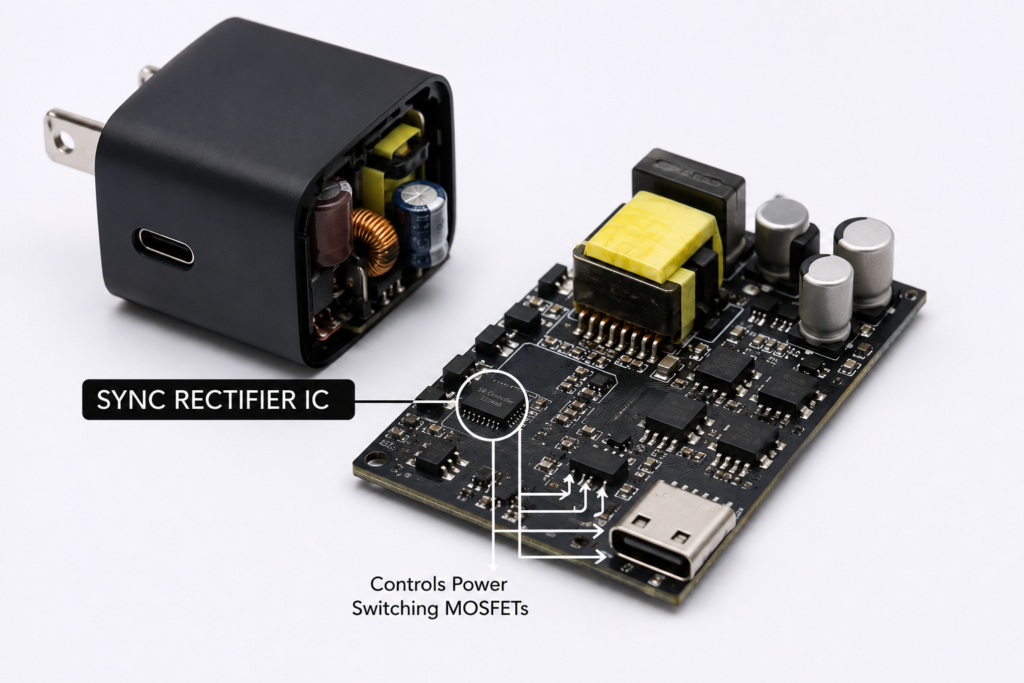
Everyday devices like phone chargers, laptop adapters, and server systems all rely on power conversion circuits. Many people have noticed chargers getting hot during use, or high-power devices draining energy quickly — a large part of this issue comes from energy loss in the rectification stage of the power supply.
Traditional rectification uses diodes to let current flow in only one direction, but diodes have a fixed forward voltage drop. The higher the current, the more power is wasted as heat. This not only wastes electricity but also limits how small power supplies can be made.
Synchronous rectification technology was created to solve this problem. It replaces traditional diodes with much lower-loss electronic switches, significantly improving power conversion efficiency and reducing heat. It is one of the core technologies in modern high-efficiency power supplies, and the synchronous rectification controller IC is the “smart brain” behind this technology.
2. Understanding Synchronous Rectification Controller ICs
Basic Definition and Function
A synchronous rectification controller IC is a type of power management chip dedicated to managing rectification switches. Its core job is to precisely control when power switches turn on and off, ensuring current flows only in the intended direction while minimizing energy waste. Simply put, it acts like a “smart gatekeeper” for the rectification path, opening and closing the gate at exactly the right time to keep current flowing smoothly with minimal loss.
Role and Position in Power Systems
In a complete switching power supply system, the synchronous rectification controller sits at the output-side rectification stage. It works together with the front-end PWM controller, power switches, and back-end protocol chips to convert high-voltage alternating current (AC) into low-voltage direct current (DC). Its performance directly determines the power supply’s conversion efficiency, heat generation, and standby power consumption, making it a key component for overall power supply quality.
Core Internal Modules
A typical synchronous rectification controller IC includes several core parts: a detection module that monitors voltage and current changes, a gate drive module that controls the power switch, a timing control module that adjusts switch timing, and a protection module that handles abnormal conditions. These modules work together to deliver precise, safe rectification control.
3. How Synchronous Rectification Works
The Basic Purpose of Rectification
The electricity from the power grid is alternating current (AC), which changes direction constantly. But electronic devices like phones and computers require direct current (DC) with a fixed direction to operate. Rectification converts AC to DC — it is like building a one-way road for electric current, only allowing it to travel in a single direction.
How Traditional Diode Rectification Works
Traditional rectification uses diodes as “one-way gates”. They automatically conduct when current flows forward and block current when it flows backward, with no extra control needed. However, diodes create a fixed voltage drop of 0.3V to 0.7V when conducting, like a speed bump on the gate. Every time current passes through, some energy is lost. The higher the current, the more energy is lost and released as heat.
How MOSFETs Enable High-Efficiency Rectification
Synchronous rectification replaces diodes with MOSFETs (Metal-Oxide-Semiconductor Field-Effect Transistors). A MOSFET acts like an actively controlled flat gate with very low resistance when open — usually just a few milliohms or less. The voltage drop and energy loss when current flows through are far smaller than with a diode. In low-voltage, high-current scenarios, its loss can be dozens of times lower than a diode.
How the Controller Precisely Manages Switch Timing
A MOSFET cannot decide when to turn on or off by itself — it needs the controller to direct it. The controller monitors the voltage across the MOSFET in real time to judge the direction and magnitude of the current. It turns the MOSFET on when current flows forward, and shuts it off right before current would flow backward, staying perfectly in sync with the main power switch. This is where the name “synchronous rectification” comes from.
| Comparison Category | Traditional Diode Rectification | Synchronous Rectification |
|---|---|---|
| Conversion Efficiency | 70%–85%, drops significantly at high current | 85%–95%, major advantage in high-current scenarios |
| Heat Generation | High conduction loss, noticeable heat | Low conduction loss, minimal heat |
| Component Cost | Fewer parts, lower cost | More components, slightly higher cost |
| Design Complexity | Simple structure, no extra control needed | Requires precise timing control, more complex design |
| Typical Use Cases | Low-power, low-cost power supplies | Medium to high-power supplies prioritizing efficiency and small size |
4. Key Technologies Inside the Controller IC
Smart Dead-Time Control
Dead time is a short “all-off gap” between the switching of two complementary transistors, like the yellow light at an intersection. It prevents both switches from conducting at the same time, which would short out the power supply. Smart dead-time control automatically adjusts this gap based on real operating conditions, avoiding short-circuit risks while minimizing wasted time to maximize efficiency.
Reverse Current Prevention and Light-Load Efficiency Optimization
At very light loads or during standby, current can sometimes flow backward toward the input — called “reverse current” — which wastes power and can damage circuits. Synchronous rectification controllers use early shutoff and threshold detection technologies to effectively prevent reverse current. They also automatically switch to low-power modes at light loads to reduce standby consumption and improve efficiency across low-load conditions.
High-Speed Gate Drive Technology
The gate is the control terminal of a MOSFET. Fast charging and discharging of the gate is required for the MOSFET to switch quickly. High-speed gate drive technology improves switching speed, reduces energy loss during switching, and allows the chip to work with higher-frequency power supply designs. For example, modern GaN fast chargers require high-speed synchronous rectification controllers to reach their full potential.
Full-Scenario Safety Protection
Like all power ICs, synchronous rectification controllers include complete protection features: over-voltage protection, over-current protection, over-temperature protection, and under-voltage lockout. When abnormal conditions such as excessive voltage, too much current, or overheating occur, the chip automatically stops working to protect itself and downstream devices — acting as a “safety guard” for the circuit.
Adaptive Multi-Mode Compatibility
Switching power supplies operate in different modes depending on load level, such as continuous conduction mode (CCM), discontinuous conduction mode (DCM), and quasi-resonant (QR) mode. Good synchronous rectification chips automatically identify the current operating mode and adjust their control strategy accordingly, maintaining high conversion efficiency under heavy load, light load, and standby conditions to suit different usage scenarios.
5. Chip Categories and Main Product Solutions
Common Classification Methods
- By integration level: Controllers with external MOSFETs, and integrated power MOSFET chips. The former only handles control and requires external switches, offering flexibility for high-power scenarios. The latter combines control circuitry and the power switch in one chip, requiring few external components for simpler design — ideal for medium and small-power fast chargers.
- By drive method: Self-driven and externally driven types. Self-driven chips get their drive signal directly from the transformer winding for a simpler circuit. Externally driven chips use independent control signals for higher precision and work with more complex topologies.
- By compatible power topology: Chips designed specifically for flyback converters, LLC resonant converters, forward converters, and other architectures, each matched to different power supply frameworks.
Major International Manufacturers and Product Lines
Leading global synchronous rectification chip makers include Texas Instruments (TI), Infineon, onsemi, MPS, and STMicroelectronics (ST). Popular product lines such as TI’s UCC series, Infineon’s IR series, MPS’s MP6908 series, and ST’s SRK series are widely used in the market and well-regarded for industrial power supplies and high-end adapters.
Domestic Chinese Chip Manufacturers and Typical Solutions
Domestic Chinese synchronous rectification chips have developed rapidly in recent years, with performance quickly catching up to international standards. Representative companies include Southchip, Silergy, Xinmao Microelectronics, and Dongke Semiconductor. Domestic chips are extremely widely used in consumer electronics fast charging — many domestic 65W and 100W GaN chargers use domestic synchronous rectification solutions. Some models can directly replace international equivalents, offering clear cost-performance advantages.
6. Key Parameters and Selection Guide
Explanation of Core Performance Parameters
| Parameter Name | Plain-Language Meaning | What It Affects |
|---|---|---|
| Operating Voltage Range | The voltage range where the chip works normally | Compatible power levels and output voltages |
| Gate Drive Capability | How strongly the chip can push the power switch | Which MOSFETs it can work with, and switching speed |
| Supported Switching Frequency | The fastest switching speed the chip can handle | Compatibility with high/low frequency designs, and power supply size |
| Quiescent Current | How much power the chip uses while idle | Standby power consumption of the power supply |
| On/Off Propagation Delay | How fast the chip reacts | Timing precision, which directly impacts rectification efficiency |
Selection Principles for Different Scenarios
There is no universal “best” chip — only the most suitable one. For low-power phone fast chargers, prioritize highly integrated chips with simple external circuits to reduce design cost. For high-power servers and industrial power supplies, prioritize industrial-grade chips with high reliability and complete protection. For GaN high-frequency fast chargers, choose models with fast switching speed and low delay.
Common Selection Mistakes and Notes
Many people assume higher specifications are always better, but unnecessarily high-frequency or high-drive chips add cost and can cause unwanted noise issues. Selection should be based on actual power requirements, power topology, and budget. Also, be sure the chip package size fits the product’s physical size requirements.
7. Typical Application Scenarios
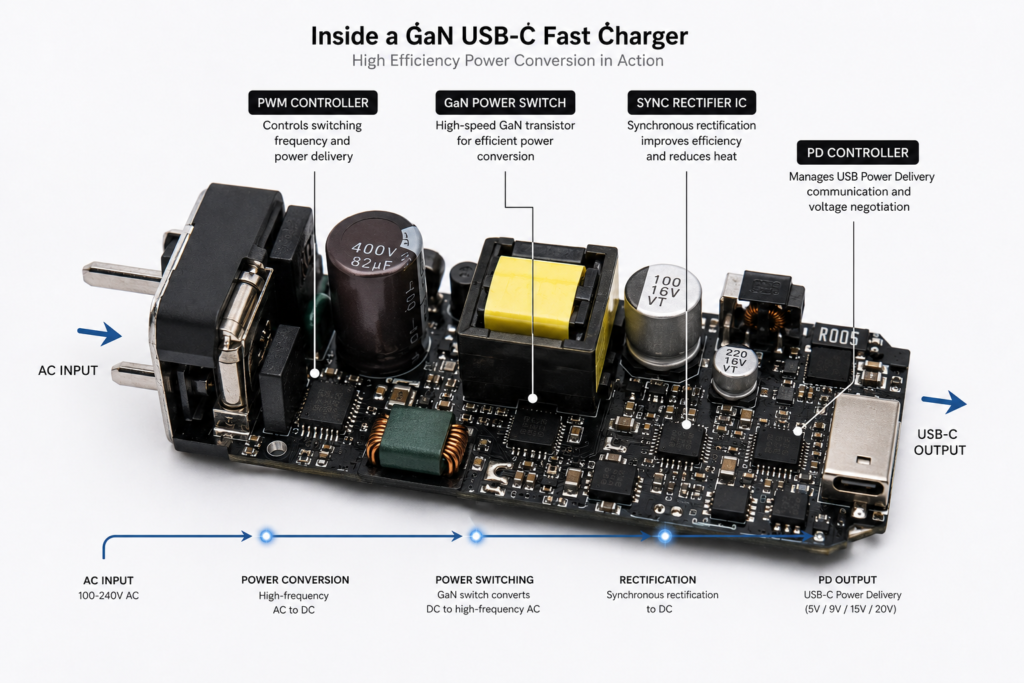
Consumer Electronics: USB PD Fast Chargers and GaN Chargers
This is the most widespread application for synchronous rectification chips. Nearly all modern 20W to 240W USB PD fast chargers — especially GaN chargers — use synchronous rectification. It pushes charger efficiency above 90%, significantly reduces heat, and works with high-frequency designs to shrink charger size, making high-power chargers compact and portable.
Office Equipment: Laptops and Desktop Power Adapters
Laptop power adapters typically start at 65W, with some gaming laptops exceeding 200W. Synchronous rectification greatly reduces adapter heat, improves energy efficiency, and helps meet energy efficiency standards like ENERGY STAR. Today’s slim, compact laptop adapters all rely on synchronous rectification technology.
Industrial & Infrastructure: Servers, Data Centers and Telecom Power
Server and data center power supplies run nonstop year-round, so electricity and cooling costs are major expenses. Synchronous rectification improves efficiency, cuts power waste and cooling demands, and meets high efficiency standards like 80 PLUS Titanium and Platinum. 5G base stations and telecom power systems also widely use synchronous rectification chips for better reliability and energy efficiency.
Transportation & Energy: On-Board Power and Energy Storage Systems
On-board chargers and DC conversion modules in electric vehicles, as well as power systems in energy storage stations, have strict requirements for efficiency and reliability. Synchronous rectification greatly reduces loss in high-current scenarios, lowers cooling needs, and extends overall system lifespan — making it an important technology choice for new energy power systems.
8. Common Issues in Design and Application
Core Factors Affecting Rectification Efficiency
Real-world rectification efficiency is not determined by the controller chip alone. The on-resistance of the power MOSFET, parasitic parameters from PCB layout, and dead-time settings all affect final efficiency. MOSFET selection and PCB layout have the biggest impact — poor design can even erase the efficiency benefits of synchronous rectification.
Typical Faults and Their Causes
Common issues include: low efficiency at light loads and high standby power, usually caused by reverse current or poorly tuned light-load modes; excessive temperature rise, often from mismatched MOSFET selection or incorrect drive timing; and accidental turn-on or short-circuit damage, frequently due to insufficient dead time or poor noise immunity design.
Basic Optimization and Troubleshooting Approach
To optimize efficiency, first select a suitable MOSFET — prioritize low on-resistance and matched switching speed. Second, optimize PCB layout by shortening power loops and reducing parasitic inductance. During tuning, you can fine-tune dead time and turn-off thresholds based on actual waveforms to maximize conduction time while maintaining safety, improving overall efficiency.
9. Technology Development Trends
Higher Integration and Minimal External Components
Integration is a key trend for synchronous rectification chips. More and more chips integrate the power MOSFET, drive circuit, and detection circuit into a single package, requiring very few external components to work. This not only simplifies design but also reduces size and overall cost — perfect for size-sensitive applications like consumer fast chargers.
Co-Evolution with Wide-Bandgap Semiconductors
The spread of wide-bandgap devices like GaN and SiC is pushing power supplies to higher switching frequencies. Synchronous rectification chips are continuously improving switching speed and control precision to match the high-frequency characteristics of wide-bandgap devices, unlocking the full potential of high-frequency power supplies and further boosting power density for smaller, lighter products.
Upgrade to Digital and Intelligent Control
Traditional analog control is evolving toward digital, intelligent control. Digitally controlled synchronous rectification chips use algorithms for more precise adaptive dead-time adjustment and full-load-range efficiency optimization. They also support flexible parameter configuration to fit more customized scenarios, with smart power supplies becoming increasingly common in the future.
Expansion to Higher Power and More Scenarios
With new standards like USB PD 240W, plus growing demand from new energy and data centers, synchronous rectification chips are expanding to higher power levels. At the same time, automotive-grade and industrial-grade high-reliability chips are developing quickly, with synchronous rectification spreading from consumer electronics into more industrial and energy applications.
10. Summary
Core Significance of Synchronous Rectification Controller ICs
Synchronous rectification controller ICs are among the core components of modern high-efficiency power supplies. Through precise intelligent control, they reduce the loss of traditional diode rectification to extremely low levels. A single small chip can improve power supply efficiency by several to more than ten percentage points — and when scaled up across billions of devices, saves enormous amounts of electricity worldwide.
Role in Advancing the High-Efficiency Power Industry
From portable GaN fast chargers to reliable server power supplies and on-board power in electric vehicles, synchronous rectification technology is driving the entire power industry toward higher efficiency, higher power density, and lower heat generation. It is a key enabler for smaller consumer electronics, and an important technical foundation for energy and cost savings in data centers and new energy sectors.