
1. Introduction: The Overlooked Cable “Bodyguard”
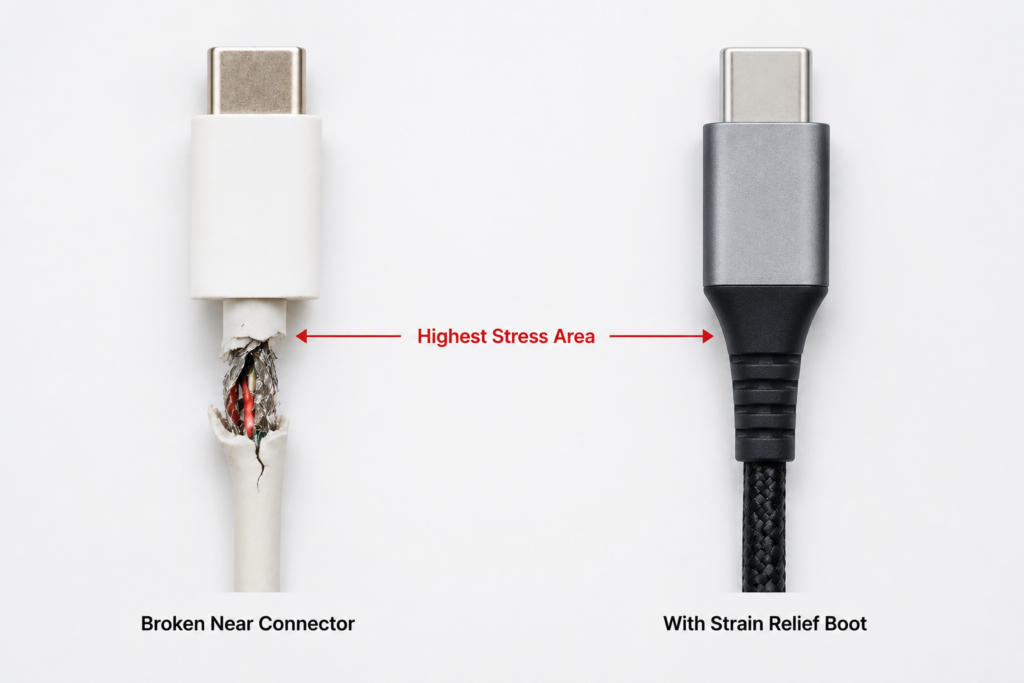
We’ve all been there: your phone charger or data cable looks fine along most of its length, but the area right next to the connector starts cracking, fraying, or yellowing after a few months. Eventually, the internal wires break, and the cable stops working entirely. Many people blame heavy use, but few notice the short, tapered section right where the cable meets the plug — this is the strain relief boot, the core of a cable’s strain relief design.
Put simply, a strain relief boot is the transition structure between the cable jacket and the connector housing. Its primary job is to absorb and distribute the forces from bending, pulling, and twisting, protecting the fragile junction where internal wires meet the connector pins. It may look small and unassuming, but this tiny feature is one of the biggest factors in how long your cables will last.
2. Why Cables Always Break Near the Connector
Have you ever wondered why cables almost never break in the middle, but always fail right at the plug? It comes down to basic physics and material behavior.
Bending Fatigue from Repeated Flexing
Every time you plug, unplug, or coil up a cable, the area near the connector gets bent the most. Much like bending a paperclip back and forth until it snaps, the copper conductors and plastic insulation inside the cable grow brittle over thousands of flex cycles. Eventually, the material fatigues, cracks form, and the internal wires break.
Tensile Stress from Pulling
Most people yank cables out by the cord instead of gripping the plug, or accidentally snag the cable on furniture. When this happens, all the pulling force concentrates at the base of the connector. The flexible cable can stretch slightly to absorb force, but the rigid connector cannot — so the joint takes all the stress, which can loosen solder joints, pull crimps apart, or snap copper strands.
Internal Damage from Torsional Stress
Twisting cables into tight coils, or repeatedly rotating the cord during use, puts torsional force on the connector end. Internal conductors, shielding, and insulation layers handle twist differently, so repeated torsion causes internal abrasion, misalignment, and broken strands over time — often leading to intermittent connection issues before total failure.
Accelerated Wear from Material Aging & Environment
Sunlight, heat, cold, oils, and humidity all break down cable jacket materials over time, making them stiffer, more brittle, and less elastic. Aged material cracks much more easily when bent. Since the connector area already handles the most stress, aging hits this zone hardest and speeds up failure.
Stiffness Mismatch: The Root Cause of Stress Concentration
All of these issues stem from one core problem: an abrupt change in stiffness. The connector housing is hard plastic or metal that barely flexes, while the cable body is soft and bends freely. At the point where they meet, stiffness drops suddenly. When you bend the cable, all the deformation and force piles up right at that boundary — like gluing a piece of cardboard to a piece of cloth; the crease will always form exactly at the seam. This high-force zone is the cable’s weakest point.
3. Common Types of Strain Relief Boots
To fight stress concentration, manufacturers use several different strain relief designs, each with its own strengths and ideal use cases.
| Strain Relief Type | Key Characteristics | Main Benefits | Common Applications |
|---|---|---|---|
| Tapered Conical Boot | Smooth, uniform taper from plug to cable diameter | Simple design, even stress distribution, low tooling cost | Basic charging cables, household power cords, entry-level data cables |
| Corrugated / Multi-Section Boot | Ridged, segmented, or wavy outer surface | More flexible bending, absorbs more deformation, longer flex life | Frequently plugged data cables, portable device cords, high-flex use cases |
| Overmolded One-Piece Boot | Molded directly onto the connector as a single seamless piece | Superior bond strength, better sealing, resists water and dust | Fast-charging cables, outdoor-use cords, premium high-durability products |
| Detachable Strain Relief | Separate rubber sleeves, spring coils, or heat shrink added after assembly | Universal fit, replaceable if damaged, low-cost upgrade | Old cable repair, industrial equipment maintenance, DIY modifications |
4. How Strain Relief Boots Protect Your Cables
Strain relief boots look simple, but they use basic mechanical principles to eliminate stress concentration at the connector root.
Spreading Concentrated Stress to Avoid Overload
Think of a strain relief boot as a shock absorber between the hard plug and the soft cable. Force that would normally concentrate entirely at the seam gets spread out across the full length of the boot. It’s like pressing with a fingertip versus the palm of your hand — the same total force, but much lower pressure on any single spot.
Enforcing a Safe Minimum Bend Radius
Every cable has a safe minimum bend radius; bend it tighter than that, and you damage internal wires and shielding. A strain relief boot adds controlled stiffness that limits how sharply the cable can bend right at the connector. It prevents sharp, damaging kinks and keeps curvature within a safe range.
Smoothing the Stiffness Transition
A well-designed boot doesn’t jump from hard to soft all at once — it grades stiffness gradually along its length. When stiffness changes slowly, bending force spreads evenly down the boot instead of piling up at one point. This removes the single weak spot that causes most cable breaks.
Securing the Cable Root and Protecting Connections
Strain relief boots clamp tightly around the cable jacket, anchoring the cord firmly to the connector housing. When you pull or twist the cable, the force goes into the boot and the outer jacket — not the delicate solder joints or crimp connections inside. This stops internal connections from pulling loose.
5. Common Materials for Strain Relief Boots
How well a strain relief works depends heavily on what it’s made of. Each material has a different feel, durability, and price point, and works best for certain uses.
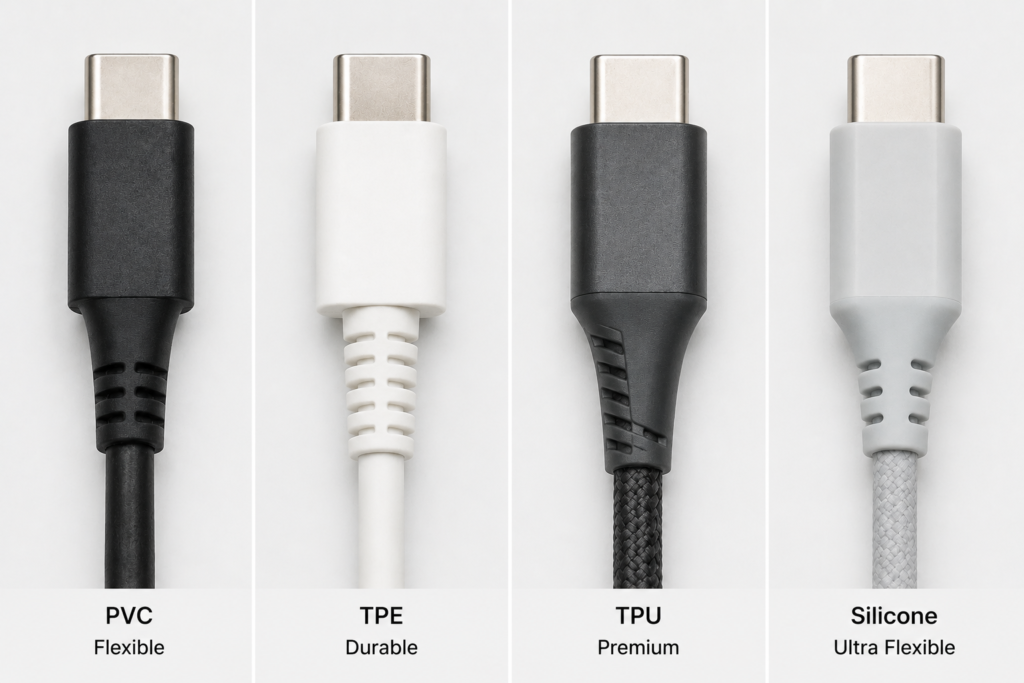
| Material | Feel & Flexibility | Durability Profile | Price Tier | Typical Products |
|---|---|---|---|---|
| PVC | Fairly stiff, moderate elasticity, gets harder in cold | Average wear resistance, prone to cracking after repeated bending | Budget | Free bundled cables, low-cost generic chargers |
| TPE | Soft, smooth, rubbery feel with good elasticity | Excellent flex fatigue resistance, resists cracking well | Mid-range | Most name-brand data cables, standard consumer charging cords |
| TPU | Tough, springy, and highly abrasion-resistant | Very strong tear and pull resistance, long service life | Mid-High | Fast-charging cables, outdoor cords, heavy-duty consumer products |
| Silicone | Extremely soft, skin-friendly, flexible across temperatures | Great weather resistance, stays flexible in cold, ages slowly | Premium | High-end data cables, medical device cords, extreme-environment use |
6. Key Factors That Determine Strain Relief Performance
Two strain relief boots might look similar, but one can last years while the other cracks in months. These design parameters make all the difference.
Boot Length
Longer isn’t always better, but too short is almost always worse. A boot needs enough length to spread stress effectively, but excessive length adds cost and makes the plug clumsier to handle. For most consumer cables, a length of 10–30 mm strikes a good balance.
Taper and Gradient Design
The smoother and more gradual the taper, the better the stress distribution. If the boot has sharp steps or sudden diameter changes, those spots become new stress concentration points — and defeat the whole purpose.
Material Hardness
Too hard, and the boot itself won’t bend. The flex point just moves to the end of the boot, and the cable still breaks. Too soft, and it can’t provide enough support to limit bending or spread force. The ideal hardness balances flexibility and structural support, usually measured on the Shore A scale.
Fit to Cable Diameter
The inside of the boot must fit snugly around the cable jacket. If it’s loose, the cable slides around inside, and force goes straight to the connector junction. If it’s too tight, it crushes the cable and causes damage of its own.
Internal Reinforcement Layers
Many cables add internal strengthening — like Kevlar fibers, cotton yarn, or PP tension members — right under the strain relief area. Working together with the outer boot, these internal layers boost pull and flex resistance, acting like an internal skeleton for the cable.
7. Strain Relief Design for Different Cable Types
Different cables see different kinds of use and stress, so their strain relief designs are tuned for specific jobs.
Phone Chargers & Data Cables
These get plugged and unplugged constantly, stuffed in pockets and bags, and bent frequently. Their strain reliefs prioritize flex fatigue life and a comfortable feel, usually made of TPE in tapered or corrugated designs. High-power fast-charge cables also add extra tensile strength to match their thicker, heavier conductors.
HDMI / DisplayPort Video Cables
High-speed video cables have many internal signal pairs and complex shielding — even one broken strand can cause screen flicker or signal dropouts. Their strain relief boots are usually stiffer and thicker, focused on enforcing a safe minimum bend radius to protect delicate internal signal paths and shielding layers.
Ethernet Cables & Household Power Cords
These cables bend less often, but may see significant pulling and twisting forces. Their strain relief designs tend to be simple and robust, focused on tensile strength and secure anchoring, while also meeting flame-retardant and electrical safety requirements.
Industrial & Medical Specialty Cables
Industrial cables need to resist oil, extreme temperatures, and heavy abrasion. Medical cables must withstand repeated disinfection and stay highly flexible. These specialty cables use application-specific materials and custom boot designs, with far higher durability than standard consumer products.
8. Buying & Using Cables: Common Strain Relief Myths
With a basic understanding of strain relief, you can pick better cables and make them last much longer with simple habits.
How to Spot a Good Strain Relief At a Glance
You don’t need lab equipment to judge quality — just check three things: First, look for a smooth, gradual transition with no sharp steps or hard corners. Second, squeeze it: it should be moderately firm, bend easily, and spring back quickly. Third, check the seams: the boot should join tightly to both the plug and the cable, with no gaps or wobble.
Common Misconceptions About Strain Relief
There are a lot of wrong beliefs about what makes a good strain relief. Many people think harder is stronger — but overly stiff boots just move the break point further down the cable. Others assume longer is always better, but excess length does nothing useful and makes plugs awkward. A thick boot also isn’t automatically better; a hollow, low-quality thick boot performs worse than a solid, well-made thinner one. Finally, remember: strain relief extends life dramatically, but it can’t make a cable indestructible. Rough handling will still break any cable eventually.
Simple Habits to Make Your Cables Last Longer
Three easy rules will double the life of almost any cable: Always pull by the plug body, never yank by the cord. When coiling cables, make loose loops — never twist them tight or fold them into sharp angles. Keep cables away from direct sun, heaters, and hot surfaces to slow down material aging.
9. Testing & Industry Standards for Strain Relief
Reputable brands test their strain relief designs against standardized procedures to ensure reliability, and products must meet industry safety and performance rules.
Flex Life & Swing Testing
The most important test is the swing bend test: the connector is held fixed, a weight is hung from the cable end, and the cable is bent back and forth at a set angle until it fails. The number of cycles is recorded. Basic consumer cables typically survive thousands to tens of thousands of bends, while premium cables can reach tens or even hundreds of thousands of cycles.
Tensile & Torsion Testing
Pull tests apply a set force to the cable root to verify the boot doesn’t slip and internal wires don’t break. Torsion tests twist the cable repeatedly to check twist resistance. These tests simulate real-world pulling and twisting, making sure cables survive normal use.
Environmental Aging & Temperature Cycling
Cables are exposed to high heat, cold, and humidity for extended periods, then re-tested for flex and pull strength to see how aging affects performance. Outdoor and industrial cables add extra tests for oil resistance, UV exposure, and salt spray to ensure reliability in harsh conditions.
Overview of Relevant Industry Standards
Global standards like IEC (International Electrotechnical Commission), UL (Underwriters Laboratories), and national GB standards in China all define minimum performance requirements and test methods for cable strain relief. Compliance with these standards is the baseline for a safe, reliable product.
10. Summary & Future Trends
Key Takeaways About Strain Relief Design
The strain relief boot is the most overlooked feature on a cable — and one of the most important for durability. By using a graduated structure to spread force and smooth out the stiffness jump, it solves the root cause of connector-end cable failure. A great strain relief requires the right combination of smart geometry, well-chosen material, and precise sizing.
The Future of Strain Relief Technology
As new materials and manufacturing methods emerge, strain relief design keeps improving. In the future, we’ll see more advanced flexible elastomers with longer service life, and multi-material composite boots that combine rigid support with soft flexibility. Bio-inspired gradient structures will also become more common, making stress distribution even more efficient. Meanwhile, new use cases — from high-power USB-C charging and high-speed data cables to industrial robotics and automotive wiring — will drive more specialized, purpose-built strain relief solutions, making cables tougher and more reliable than ever.