
Many people have run into the same frustrating issues: one HDMI cable causes constant screen flicker on your TV, while another works perfectly; a data cable drops connection mid-file transfer; an audio cable picks up a buzzing hum when placed near a charger. Most of these problems trace back to electromagnetic interference, and the cable’s shielding structure is the key solution.
Shielded cables generally fall into two categories: single-layer shielding and double-layer shielding. What’s the real difference between them, and how do you choose the right one for your needs? This guide breaks down the differences in plain terms to help you shop with confidence.
1. Why Do Cables Need Shielding?
1.1 What Is Electromagnetic Interference (EMI)?
We are surrounded by invisible electromagnetic waves, just like we’re surrounded by background noise. Power cords, electric motors, Wi-Fi routers, Bluetooth devices, and industrial equipment all radiate electromagnetic energy. When these waves reach a signal cable, they “mix in” with the intended signal and cause electromagnetic interference, or EMI.
The effects of EMI are easy to notice:
- Data packet loss, corrupted file transfers, and inconsistent transfer speeds
- Glitchy video, screen artifacts, and frequent blackouts or dropouts
- Buzzing, humming, or static in audio signals
- Unstable device connections that disconnect and reconnect randomly
1.2 The Core Purpose of Shielding
Think of a shield as a tight-fitting “metal jacket” for the signal wires inside a cable. It works in two directions:
- Blocks incoming interference: Stops outside electromagnetic waves from penetrating the cable and disrupting the signal
- Contains outgoing radiation: Prevents high-speed signals inside the cable from radiating outward and interfering with nearby electronics
Ultimately, shielding improves transmission reliability and helps devices meet standard electromagnetic compatibility (EMC) requirements.
2. Single-Layer Shielding: Basic EMI Protection
2.1 Structure and Common Types
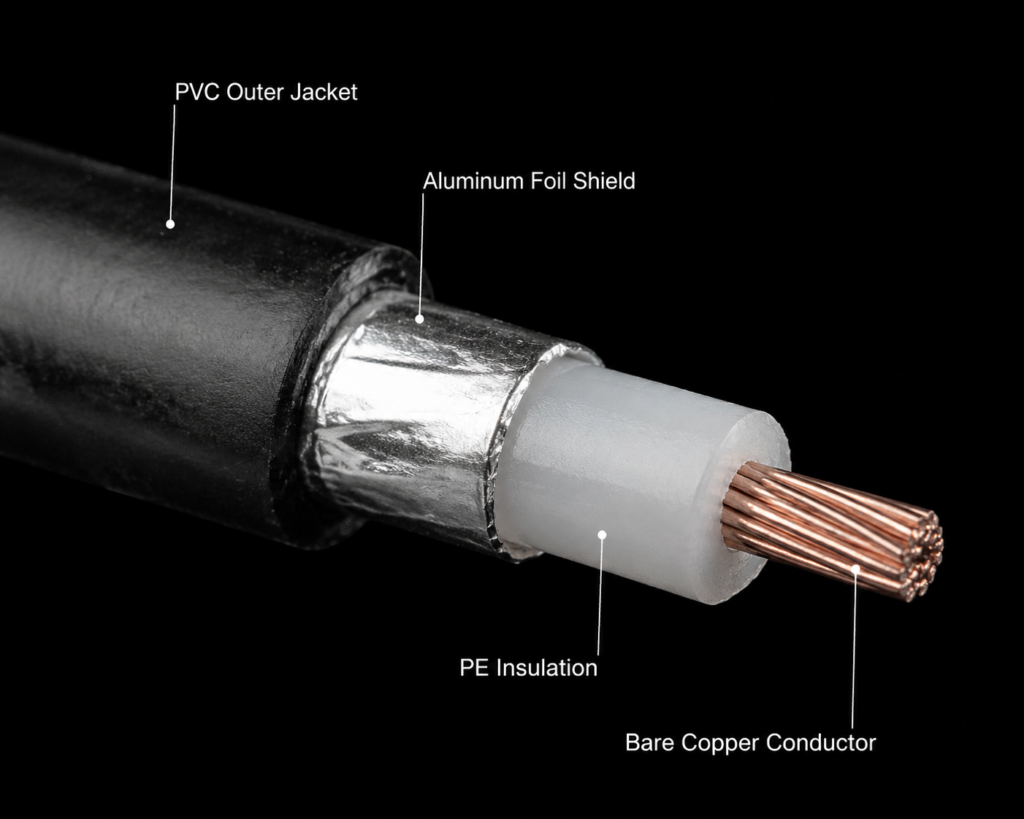
Single-layer shielding uses exactly one layer of shielding material wrapped around the internal signal conductors. The two most common types are:
- Foil shielding: A thin aluminum foil wraps fully around the wires, providing nearly 100% coverage. It excels at blocking high-frequency interference but is relatively brittle.
- Braided shielding: Fine copper wires are woven into a mesh around the conductors. It is more flexible and durable, and performs better against low-frequency interference.
2.2 Key Characteristics
- Simple structure and low manufacturing complexity, resulting in a lower price point
- More flexible and lightweight, making it easy to bend and store
- Slimmer overall diameter, so it takes up less space during installation or cable management
2.3 Advantages and Limitations
- Advantages: Great value for money, flexible and easy to use, sufficient for most everyday tasks
- Limitations: Moderate overall shielding performance, weaker protection at high frequencies, and insufficient reliability in high-interference environments
2.4 Typical Use Cases
- Standard USB charging cables and basic audio/video cables
- Short-distance device connections at home or in the office
- Everyday environments with few high-power devices and low electromagnetic noise
3. Double-Layer Shielding: Advanced EMI Protection
3.1 Structure and Common Configurations
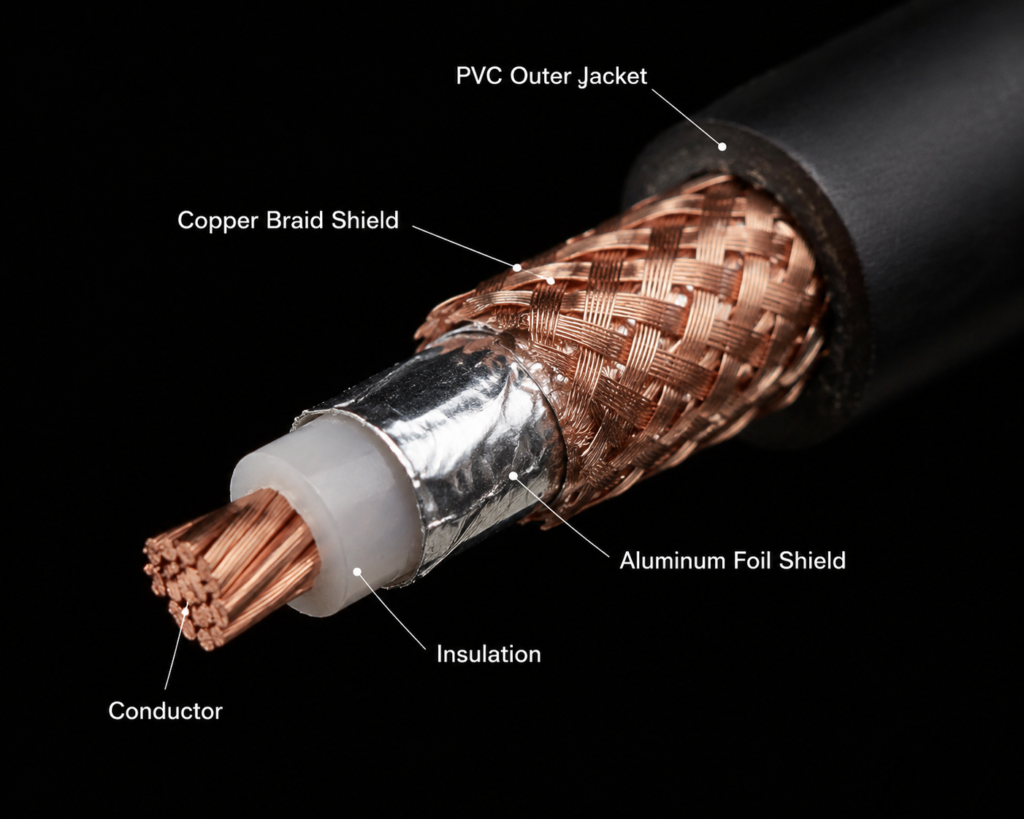
Double-layer shielding adds a second independent shield layer on top of the first, combining their strengths for better overall protection. The most common and most effective combination is foil + braided shielding. Other less common variants include double-foil and double-braided designs.
3.2 How the Two Layers Work Together
The two layers are not just stacked on top of each other — they complement each other’s weaknesses for better performance than either alone:
- Inner foil layer: Delivers near-100% coverage and specializes in blocking high-frequency EMI
- Outer braided layer: Reinforces low-frequency protection and adds mechanical strength, improving pull and flex durability
- Together, they reduce both incoming interference and outgoing signal leakage for dramatically better two-way protection
3.3 Key Characteristics
- Significantly better shielding performance across all frequencies, and much higher reliability in noisy environments
- Higher material and manufacturing costs, reflected in a higher retail price
- Thicker overall diameter and heavier weight, with slightly reduced flexibility compared to single-layer designs
3.4 Advantages and Limitations
- Advantages: Superior interference resistance, more stable signal quality, and suitability for demanding environments
- Limitations: Higher cost, stiffer cable body, and slightly more difficulty routing in tight spaces
3.5 Typical Use Cases
- High-speed data cables such as USB 3.2, USB4, and Thunderbolt cables
- High-performance audio/video cables such as HDMI 2.1 and DisplayPort 2.1
- Cabling for industrial automation, medical equipment, and test & measurement instruments
- High-interference locations near motors or variable frequency drives, as well as automotive and dense data center installations
4. Single vs. Double Shielding: Side-by-Side Comparison
The table below summarizes the key differences at a glance:
| Comparison Category | Single-Layer Shielding | Double-Layer Shielding |
|---|---|---|
| Shielding Performance | Sufficient for low/mid frequencies, weak at high frequencies | Excellent across all frequencies, reliable in high-interference areas |
| Signal Stability | Reliable for short, low-speed links; prone to issues at high speed and long distance | Much more stable for high-speed and long-distance runs |
| Physical Feel | Flexible, lightweight, slim diameter | Stiffer, slightly heavier, thicker overall |
| Flex & Durability | Very flexible and easy to coil and store | Higher mechanical strength, but reduced flexibility |
| Cost | Lower, budget-friendly price range | Higher, typically mid-range to premium pricing |
| Best For | Home, office, and general-purpose connections | High-speed data, pro A/V, industrial and high-interference environments |
In short: single-layer shielding is the best value for casual daily use, while double-layer shielding is the more reliable choice for high-performance and demanding environments.
5. Cable Category Guide: Which Cables Use Single-Layer vs. Double-Layer Shielding?
Double-layer shielding is not required for every cable. Different speeds and use cases call for different shielding designs, and most basic everyday cables only use a single shield layer.
5.1 Common Single-Layer Shielded Cables
These cables have modest speed requirements and operate in simple environments, where single-layer shielding is fully sufficient. They are the most common shielded cables in daily use:
- Standard USB 2.0 data cables and smartphone charging cables
- Entry-level 1080p HDMI cables, basic AUX audio cables, and headphone cords
- Cat5e Ethernet cables and standard office printer cables
- Low-speed sensor signal cables and low-voltage control cables
5.2 Common Double-Layer Shielded Cables
Cables with higher signal integrity and speed requirements, or those used in harsher environments, almost always use double-layer shielding:
- High-speed data cables: USB 3.2 / USB4 cables and the full Thunderbolt cable family
- High-resolution A/V cables: HDMI 2.0/2.1 cables and high-bandwidth DisplayPort cables
- Professional equipment cables: Industrial control cables, medical device cables, and test instrumentation cables
6. 5 Common Myths About Cable Shielding
6.1 Myth 1: More shield layers always mean better performance
Reality: Shielding performance depends on the entire system — proper grounding, shielded connectors, and coverage percentage matter more than sheer layer count. If grounding is faulty, even three layers of shielding will do very little. Adding extra layers also makes cables stiffer and more expensive with diminishing returns.
6.2 Myth 2: Double-shielded cables are faster
Reality: A cable’s maximum speed is determined by its interface standard, wire gauge, and chipset design. Shielding does not increase the rated speed of the cable. Instead, it reduces errors, dropouts, and speed dips caused by interference, making real-world performance more consistent.
6.3 Myth 3: A shielded cable is completely immune to interference
Reality: No shielding design can block 100% of interference. Performance depends on coverage, grounding, connector shielding, and layer count. Even a double-shielded cable can fail if its connectors have no shielding, creating a gap in protection.
6.4 Myth 4: Foil shielding is always worse than braided shielding
Reality: Neither is universally better — they excel at different things. Foil offers full coverage and superior high-frequency protection, while braid is more robust and better at low frequencies and mechanical durability. The two work best when combined.
6.5 Myth 5: Double-shielded cables are always more durable
Reality: Durability depends mostly on the outer jacket material, conductor construction, and flex-life design. Shield layer count has no direct link to how long a cable will last. Many single-shielded cables are extremely durable thanks to thick, abrasion-resistant jackets.
Summary
There is no universally “better” option between single-layer and double-layer shielding — only the right option for your use case.
For casual daily use, single-layer shielding delivers the best balance of flexibility, value, and performance. For high-speed transfers, professional audio/video, or noisy environments, double-layer shielding is the more reliable choice.
When shopping for cables, don’t fixate only on the number of shield layers. Consider your actual use case, and look at conductor quality, shield coverage, build quality, and brand reputation to find the cable that works best for you.