
If you’ve shopped for speaker wire, Ethernet cables, or home wiring, you’ve almost certainly seen the term “OFC” or “oxygen-free copper” promoted as a premium upgrade. It is one of the most widely advertised features in consumer cables — and also one of the most misunderstood. For some industrial applications, it is a genuine engineering necessity. For everyday household use, it is often little more than a price premium with no measurable benefit.
This guide is built for tiered reading. Start with the 60-second summary for key takeaways, stay in the beginner sections if you only need buying advice, and dive into the engineering section if you want full material specifications and standards details.
60-Second Quick Summary
- What it is: Oxygen-Free Copper (OFC) is a high-purity, low-oxygen grade of copper produced through special melting and casting processes. It is a purity grade of copper, not an entirely new conductor material.
- Real core value: Its most important advantage is resistance to hydrogen embrittlement and improved long-term reliability in harsh environments. It is specified for high-temperature, vacuum, and long-life infrastructure applications.
- Best and worst uses: Worth the premium for industrial, aerospace, and precision RF systems. For home wiring, consumer audio, and ordinary network cables, the real-world performance gain is extremely small and usually not worth the extra cost.
Part 1: Absolute Beginner Basics
1.1 What Is Oxygen-Free Copper (OFC)?
Oxygen-free copper is a refined grade of copper made by melting and casting copper in a vacuum or inert gas atmosphere to minimize trapped oxygen and impurities.
In simple terms: It is still pure copper — just a cleaner, more carefully refined version with far less oxygen trapped inside the metal.
It is not a different material like copper-clad aluminum or silver-plated copper. It is a higher purity grade of the same base metal, produced to reduce internal defects and improve performance under extreme conditions.
1.2 Why Was Oxygen-Free Copper Invented?
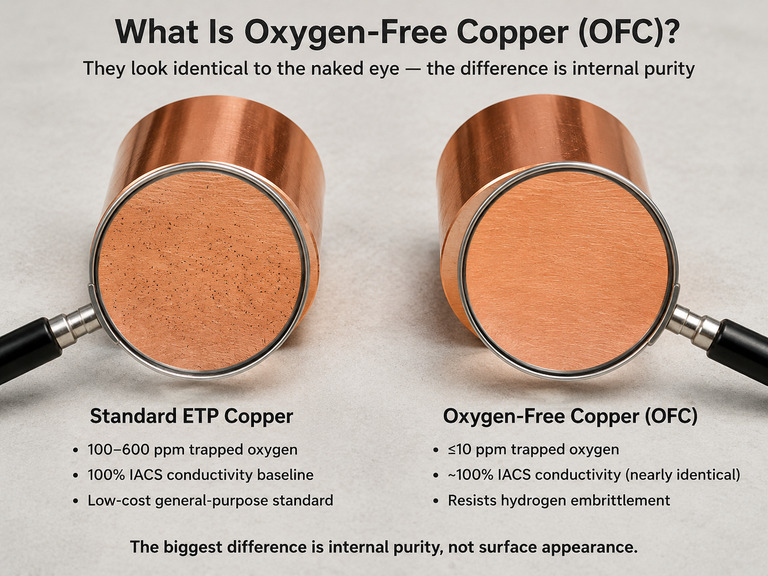
To understand why OFC exists, think of copper like a loaf of bread. Standard electrolytic tough pitch (ETP) copper has tiny, invisible pockets of oxygen scattered through it, like air bubbles in bread.
Standard ETP copper
- ✅ Cheap and widely available
- ✅ Works perfectly for most everyday wiring
- ❌ Contains 100–600 ppm of trapped oxygen
- ❌ Can become brittle and crack when heated in hydrogen-rich environments
- ❌ Contains more oxide inclusions that can matter in ultra-high-reliability systems
Oxygen-free copper
- ✅ Very low oxygen content (typically ≤10 ppm)
- ✅ Resists hydrogen embrittlement at high temperatures
- ✅ Fewer internal oxide defects for more consistent performance
- ❌ Significantly more expensive to manufacture
- ❌ Provides almost no measurable benefit in normal room-temperature use
OFC was developed to solve a very specific engineering problem: copper failing by hydrogen embrittlement in high-temperature and vacuum environments. It was not invented to make consumer audio sound better or home wiring run cooler.
1.3 Core Characteristics
- Excellent resistance to hydrogen embrittlement
Its extremely low oxygen content prevents internal cracking when the conductor is heated in hydrogen-containing atmospheres. This is its single most irreplaceable advantage. - Higher purity and cleaner structure
Fewer impurities and internal oxide inclusions improve long-term stability under harsh service conditions. - Noticeably higher cost
The specialized refining process adds significant material cost compared to standard ETP copper.
1.4 OFC vs. Standard ETP Copper: What Actually Changes?
- Standard ETP copper (C11000): Low cost, higher oxygen content, fully adequate for mains-frequency power and general-purpose wiring. It is the default choice for the vast majority of cables sold worldwide.
- Oxygen-free copper (C10200): Higher cost, very low oxygen content, strong hydrogen embrittlement resistance, better long-term stability in harsh environments. It is a premium upgrade that only delivers measurable value in specific demanding applications.
Part 2: How It Works & Where It Actually Matters
2.1 DC & Power Frequency Performance
For ordinary DC and 50/60 Hz household power, the electrical difference between OFC and standard copper is almost too small to measure.
- The DC conductivity difference between C10200 OFC and standard ETP copper is roughly 0.5% or less.
- For home wiring and appliance power cords, the difference in heat, voltage drop, and energy loss is undetectable in normal use.
- Stepping up one wire gauge — for example from 14 AWG to 12 AWG — reduces resistance far more than upgrading from ETP copper to OFC at the same gauge.
2.2 Hydrogen Embrittlement: The Real Reason OFC Exists
This is the one advantage that is undisputed, non-negotiable, and genuinely worth paying for in the right applications.
Think of the tiny oxygen pockets inside standard copper like water droplets trapped inside a pipe. When you heat the copper in a hydrogen atmosphere, the hydrogen reacts with the trapped oxygen to form water vapor. The vapor expands, creates internal micro-cracks, and eventually makes the conductor brittle enough to break. This is called hydrogen embrittlement.
Because OFC has almost no trapped oxygen, there is almost nothing inside for hydrogen to react with. It can survive high-temperature soldering, vacuum equipment, and hydrogen-rich environments that would cause standard copper to crack and fail.
This property is formally tested under ASTM B577, and it is the primary industrial reason to specify OFC.
2.3 Long-Term Reliability & High-Frequency Performance
- Long service life: Fewer internal oxide inclusions can extend service life in buried, submarine, and hard-to-access installations where maintenance is expensive.
- High-frequency and precision signals: For RF, microwave, and precision measurement applications, lower impurity levels improve manufacturing consistency and repeatability. Even so, the electrical improvement is usually smaller than the gain from changing conductor geometry or adding silver plating.
- Ultra-fine wire manufacturing: Higher purity reduces breakage rates when drawing extremely fine wire for semiconductor packaging and miniature electronics.
Part 3: Quick Decision: Do You Actually Need OFC?
Ask yourself these three questions in order. If you answer No to the first two and Yes to the third, standard copper is almost certainly fine.
- Will the wire operate in high-temperature, vacuum, or hydrogen-rich conditions? → If yes, OFC is often required.
- Is it for precision RF, metrology, or ultra-high-reliability infrastructure? → If yes, OFC may be justified.
- Is it for home wiring, consumer audio, ordinary Ethernet, or regular power cords? → If yes, standard copper delivers all the performance you need, and the OFC premium is usually not worth paying.
Part 4: Where OFC Delivers Real Value & Where It Doesn’t
✅ Where OFC Is Actually Worth the Premium
- High-temperature and vacuum industrial equipment
Vacuum electronic switches, furnace sensor leads, hydrogen-brazed components, and internal wiring for semiconductor manufacturing tools. - Precision RF and test & measurement
High-end coaxial cables, microwave components, laboratory test leads, and calibration standards where signal consistency and measurement accuracy are critical. - Long-life critical infrastructure
Submarine communications cables, underground direct-burial cables, and data center backbone wiring where minimizing lifetime maintenance cost is the priority. - Aerospace and defense
Specialty cables built to military specifications, where extreme temperature cycling, vibration, and long service life are required. - Ultra-fine precision electronics
Semiconductor packaging leads and miniature wire harnesses, where high purity improves manufacturing yield and reliability.
❌ Where OFC Is Usually Just Marketing Hype
Many consumer products advertise “OFC” as a premium feature because it sounds impressive and supports a higher price. In reality, other factors almost always have a much larger effect on real-world performance.
- Residential electrical wiring
The NEC and most building codes accept standard ETP copper. The conductivity difference is well under 1%, which has no measurable effect on power bills, heat, or safety. Claims that OFC home wiring “saves 10% electricity” are inconsistent with basic electrical theory. - Consumer-grade audio cables
Controlled blind listening tests generally do not find a statistically significant audible difference between OFC and equivalently constructed standard copper cables in typical home audio systems. Marketing claims about “4N, 5N, 6N high-purity copper” are often self-declared purity numbers, not standardized material grades. - Ordinary commercial Ethernet cables
Genuine solid copper Ethernet cable already uses high-purity copper. “OFC” is a basic requirement for a compliant product, not a premium upgrade. Cable geometry, twist accuracy, shielding, and installation quality determine real-world speed and stability far more than copper purity. - Regular appliance power cords
For short, low-current power cords for computers, TVs, and household appliances, OFC provides no measurable performance benefit. Standard UL-listed copper cords are perfectly safe and adequate.
Marketing Claims vs. Reality
- Claim: OFC saves electricity → Reality: No measurable benefit in typical building wiring.
- Claim: OFC improves sound quality → Reality: Generally inaudible in consumer-grade systems.
- Claim: OFC is much stronger → Reality: Mechanical strength is essentially the same as standard copper.
- Claim: OFC lasts much longer → Reality: The advantage is significant only in harsh industrial environments.
- Claim: OFC prevents hydrogen embrittlement → Reality: True. This is the core industrial benefit.
- Claim: Aerospace always uses OFC → Reality: It is used when the design or applicable standard requires it.
Part 5: Engineering Deep Dive
If you are a casual shopper choosing cables for home use, you can skip this section and go straight to the FAQ. The material below is intended for engineers, specifiers, and industrial buyers.
5.1 Standard OFC Grades (ASTM B170)
ASTM B170 defines the standard grades of oxygen-free electrolytic copper. Oxygen-free copper is formally defined as copper with an oxygen content not exceeding 0.0010% (10 ppm).
- Grade 1 (UNS C10100 / OFE)
- Copper + silver ≥ 99.99%, oxygen ≤ 5 ppm, individual impurities ≤ 1 ppm each
- Electrical conductivity ≥ 101% IACS — the highest conductivity grade of commercially produced industrial copper
- Used for vacuum electronics, semiconductors, aerospace, and ultra-high-reliability applications
- Grade 2 (UNS C10200 / OF)
- Copper ≥ 99.95%, oxygen ≤ 10 ppm, no residual phosphorus deoxidizer
- Electrical conductivity ≥ 100% IACS — the standard industrial OFC grade
- The most common grade specified for high-performance cables and general industrial use
- C11000 Electrolytic Tough Pitch (ETP) — baseline reference
- Copper ≥ 99.90%, oxygen 100–600 ppm
- Defined as the 100% IACS conductivity reference
- The standard conductor material for the vast majority of general-purpose cables
5.2 Specialized Crystal-Structure Variants
- LC-OFC (Linear Crystal / Long Crystal OFC): Produced through thermal processing to enlarge grain size and reduce transverse grain boundaries. It is a commercial processing concept, not a standardized ASTM material grade.
- OCC (Ohno Continuous Cast) single-crystal copper: Produced by a proprietary continuous casting method to eliminate transverse grain boundaries within a single length. It is a specialized manufacturing process, not a standard industry conductor classification.
5.3 Selection, Verification & Avoiding Hype
When to Specify OFC
- Justified: High-temperature / vacuum / hydrogen environments, precision RF and metrology, long-life critical infrastructure, military and aerospace
- Not justified: Residential wiring, consumer audio, ordinary Ethernet, regular appliance power cords
How to Verify Genuine OFC
- Look for standard references: Products citing ASTM B170, ASTM B49, or IEC 60228 are more credible than products that only say “OFC”.
- Check the UNS alloy number: Products explicitly labeled C10100 or C10200 are more trustworthy than generic “oxygen-free copper” claims.
- Look for UL listings: UL 758 and UL 44 listed products have documented conductor material controls.
- Verify DC resistance: If resistance at a given AWG is far outside the standard value, the product is likely not solid copper at all, regardless of OFC labeling.
Better-Value Alternatives
- If you need oxidation resistance: Choose tinned copper. It provides more direct protection against moisture and corrosion at a lower cost than OFC.
- If you need better high-frequency performance: Choose silver-plated copper. It reduces high-frequency loss far more than any purity upgrade to solid copper.
- If you need general-purpose power and signal: Standard ETP copper to NEC/UL specifications offers the best value by a wide margin.
Side-by-Side Comparison: Standard Copper vs OFC vs Tinned Copper vs Silver-Plated Copper
| Property | Standard ETP Copper | Oxygen-Free Copper | Tinned Copper | Silver-Plated Copper |
|---|---|---|---|---|
| DC conductivity | ★★★★★ | ★★★★★ | ★★★★☆ | ★★★★★ |
| High-frequency performance | ★★★☆☆ | ★★★☆☆ | ★★☆☆☆ | ★★★★★ |
| Hydrogen embrittlement resistance | ★★☆☆☆ | ★★★★★ | ★★☆☆☆ | ★★★☆☆ |
| Corrosion / moisture resistance | ★★☆☆☆ | ★★☆☆☆ | ★★★★★ | ★★★☆☆ |
| Long-term harsh-environment reliability | ★★★☆☆ | ★★★★☆ | ★★★★☆ | ★★★★★ |
| Cost (lower = better) | ★★★★★ | ★★★☆☆ | ★★★★☆ | ★★☆☆☆ |
FAQ
Is oxygen-free copper completely free of oxygen?
No. OFC is low-oxygen copper, not zero-oxygen copper. Industrial-grade C10200 has a maximum of 10 ppm oxygen — roughly 1/10 to 1/60 the oxygen content of standard ETP copper.
Is higher purity copper always better?
No. Once purity reaches about 99.95%, further purification brings diminishing returns. Going from 99.95% to 99.99% improves conductivity by only about 0.5% while more than doubling material cost.
Does oxygen-free copper never oxidize?
It does oxidize. The surface oxidation rate of OFC is not dramatically different from standard copper. Its main advantage is fewer internal oxide inclusions and resistance to hydrogen embrittlement — not immunity to surface tarnish.
Does an OFC label mean the cable is high quality?
Not necessarily. OFC only describes the refining grade of the copper. It says nothing about conductor geometry, insulation quality, shielding, or build quality. A poorly built cable can still be marketed as OFC.
Why does almost every cable advertise OFC?
Partly because it is an easy-to-understand marketing term that sounds premium. It is also often used as a quick shorthand for “solid copper, not CCA,” since many budget counterfeit cables replace solid copper with copper-clad aluminum.
Does OFC really improve audio quality?
There is no robust, widely replicated evidence that OFC produces an audible difference in typical consumer audio systems when compared to equivalently constructed standard copper cables. In a well-designed system, the difference falls below the threshold of human hearing.
Why isn’t every cable made with oxygen-free copper?
Because OFC costs significantly more, and for the vast majority of ordinary civilian applications, the performance benefit is negligible. Standard ETP copper already fully meets requirements for safety and performance. OFC only makes economic sense in specific demanding environments.
Is OFC a standardized material?
Yes. Oxygen-free electrolytic copper is formally defined in ASTM B170, with additional conductor product standards such as ASTM B49 and IEC 60228. Finished cables may also fall under UL 758, UL 44, MIL-W-16878, and NEC requirements. Whether OFC is required always depends on the applicable standard and design intent.
Final Summary
- Oxygen-free copper is a high-purity, low-oxygen grade of copper. It is a material refinement, not an entirely new conductor technology.
- Its single most important and irreplaceable advantage is resistance to hydrogen embrittlement at high temperatures. This makes it essential for vacuum, high-temperature, and hydrogen-process industrial equipment.
- For DC power and mains-frequency wiring, the electrical difference between OFC and standard copper is less than 1% — far too small to notice in everyday use.
- In consumer audio, ordinary Ethernet, and residential wiring, OFC is predominantly a marketing feature. Other design choices such as wire gauge, shielding, and build quality have a much larger impact on real-world performance.
- OFC solves a real engineering problem — but only where that problem actually exists. For industrial, aerospace, and precision RF applications, it is a legitimate and well-justified choice. For most household and consumer use cases, standard copper to recognized safety standards remains the best value.