
Have you ever plugged your phone in to charge before bed, then woken up second-guessing whether you’ve damaged the battery? Or had your e-bike cut out mid-ride, convinced the battery was dead for good — only to realize it was just a built-in safety feature doing its job?
We interact with rechargeable batteries every day: smartphones, laptops, portable power banks, e-bikes, portable power stations — nearly all our portable devices run on lithium-based batteries. Yet very few of us actually understand what “overcharge protection” and “over-discharge protection” really do. Many people fall into one of two camps: they’re overly anxious, thinking a 100% charge means overcharging or a dead device means dangerous over-discharge; or they’re completely careless, assuming protection features mean they can abuse their batteries however they want.
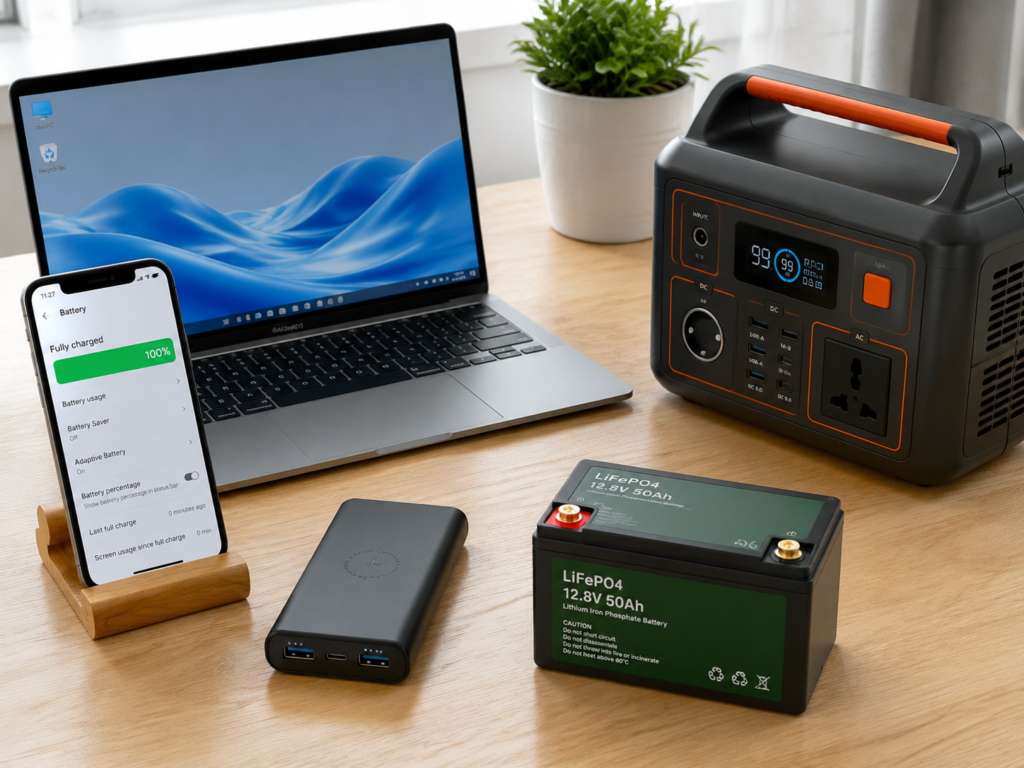
This guide starts with the most basic definitions and works up to practical skills: how to tell if your battery’s protection is working properly, how to read voltage specs in product manuals, and how to troubleshoot common small issues. We’ll avoid overly technical jargon wherever possible, so even total beginners can follow along.
2. Why Overcharge and Over-Discharge Damage Batteries
Many people know overcharge and over-discharge are bad, but don’t know how severe the harm is, or when actual problems occur. Damage comes in grades — crossing a threshold does not instantly break a battery, and risk level depends on multiple factors.
2.1 Overcharge Harm Levels and Thresholds
Overcharge damage ranges from mild to severe, and there is no absolute “0.1V over = failure” rule. Risk depends on cell chemistry, overvoltage magnitude, duration, ambient temperature, charging current, battery age, and protection design.
- Mild abnormality: For example, slightly inaccurate charge cutoff, or leaving a fully charged battery in a hot environment for a long time (like leaving a fully charged phone in a sunbaked car in summer). This usually does not cause immediate safety issues, but accelerates capacity fade and internal resistance rise, shortening battery life.
- Moderate abnormality: If a cell stays above its recommended voltage limit for an extended period, gas will build up internally, causing bulging, leaks, casing deformation, or a charger that never stops charging / overheats. At this point the battery has noticeable damage and should not be used further.
- Severe abnormality: If protection fails completely, combined with high heat, high current, or physical damage to the battery, thermal runaway can occur — internal temperature and pressure rise uncontrollably, which can lead to smoking, fire, or even explosion in extreme cases.
2.2 Over-Discharge Harm Levels and Thresholds
Compared to overcharge, over-discharge has lower immediate safety risk, but is a far more common cause of lifespan degradation. Severity is highly tied to how long the battery stays in a low-voltage state — recharging immediately after hitting low power is vastly different from leaving it dead for months.
- Mild over-discharge: Voltage drops below the recommended lower limit for a short time, like accidentally letting your phone die once then recharging it right away. Most batteries will recover normally, but it still causes a small amount of lifespan loss — think of it like pulling an all-nighter: it won’t make you sick immediately, but it’s not great for you long-term.
- Moderate over-discharge: If a battery stays at low power for days or weeks, internal resistance will rise noticeably, capacity will drop permanently, and battery level readings will become inaccurate (e.g., a full charge dies very quickly with light use).
- Severe over-discharge: If cell voltage drops too low and the battery is left unused for months, it may enter a locked protection state that regular chargers can’t wake up — often called a “starved” battery. In more severe cases, copper dissolution can occur: copper from the negative electrode dissolves into the electrolyte, which can cause internal short circuits. Never try to forcefully activate a severely over-discharged battery on your own.
2.3 Risk-Multiplying Factors
Often a single overcharge or over-discharge event won’t cause major problems, but combined with other factors, risk increases exponentially:
- High temperature: A sunbaked car interior, a windowsill in direct sun, charging under a blanket, or charging in an enclosed space all significantly increase overcharge risk and speed up degradation. High heat is the number one enemy of batteries.
- Low temperature: Charging standard lithium-ion batteries below 0°C (32°F), even if the voltage looks normal, can cause lithium plating — lithium atoms form metallic lithium crystals on the negative electrode surface. These crystals can pierce the battery’s internal separator, causing irreversible damage or even short circuits. Only specialized low-temperature batteries can be charged below freezing, and only strictly according to the product manual.
- High load: When an e-bike climbs a steep hill, a power tool stalls, or a power bank outputs at maximum wattage, the battery has to deliver very high current instantly. Voltage drops temporarily due to internal resistance (called voltage sag), which can trigger over-discharge protection earlier than expected.
- Battery aging: Batteries that are several years old have higher internal resistance and lower capacity, so voltage drops more sharply under load. They’re more prone to early shutdown, overheating, or jumping battery level readings.
- Physical damage: Bulging, punctured, crushed, dropped, or water-damaged batteries may have damaged internal structures, and protection mechanisms may not be able to stop internal short circuits. Never use a physically damaged battery.
3. How to Read Protection Voltages, Recovery Voltages, and Other Specs
Many people get confused by the pile of voltage terms in product manuals or battery spec sheets. Once you learn a few core concepts and a simple step-by-step method, it’s easy to parse.
3.1 Common Single-Cell Battery Parameter Reference
First, here’s a basic reference range to build your intuition, with a critical caveat: These are general reference values only, NOT a guide for repair or modification. Always follow the official cell datasheet, protection board specs, or device manual. Parameters can vary significantly between manufacturers and applications.
| Battery Type | Single-Cell Nominal Voltage | Typical Full Charge Cutoff Voltage | Typical Discharge Cutoff Voltage Range | Common Applications |
|---|---|---|---|---|
| Standard lithium-ion / NMC (ternary lithium) and most 3.6V/3.7V LiPo cells | 3.6V / 3.7V | 4.2V (high-voltage variants can reach 4.35V) | 2.5V ~ 3.0V | Smartphones, laptops, power banks, small digital devices |
| Lithium iron phosphate (LFP) | 3.2V | ~3.65V | 2.0V ~ 2.8V | E-bikes, energy storage systems, some power tools |
| Lead-acid (per cell) | ~2.0V | Highly dependent on temperature and charging mode | Determined by full-pack controller under-voltage setting | Car batteries, older UPS systems, low-speed mobility scooters |
Note: “Lithium-polymer” describes a battery’s electrolyte form or soft-pack casing, not its chemistry. Actual voltage thresholds depend on the specific cathode material — don’t assume all LiPo batteries use NMC chemistry and apply NMC parameters blindly.
As a rough reference for beginner understanding:
- For common 3.6V/3.7V lithium-ion/NMC cells, overcharge protection voltage is usually slightly higher than the normal full charge cutoff; over-discharge protection voltage is near or slightly below the discharge cutoff, depending on product design.
- For LFP cells, overcharge protection voltage is usually slightly higher than the 3.65V full charge cutoff; the gap between discharge cutoff and over-discharge protection is wider, with noticeable differences between power-type (e.g., e-bikes) and energy-storage-type applications.
Again: Lead-acid batteries have very different protection logic from lithium batteries. Never mix chargers, protection boards, or threshold standards between chemistries.
3.2 Four Easily Confused Voltage Concepts
Four voltage terms appear most often in manuals, and they mean very different things — don’t mix them up:
- Nominal voltage: A reference voltage used for naming and rough estimation, not a fixed operating voltage. For example, a 3.7V lithium battery is 4.2V when full and around 3V when empty. The nominal voltage is just a convenient average, like “average height” for people — not everyone is exactly that tall.
- Full charge cutoff voltage: The target upper limit for normal charging management. When this voltage is reached, charging should switch to constant voltage mode and eventually stop. This is the “normal upper limit” for daily use.
- Discharge cutoff voltage: The recommended lower limit to stop discharging in normal use. It’s usually higher than the actual dangerous threshold, making it the “normal lower limit” for daily use.
- Overcharge/over-discharge protection voltage: The last-resort threshold that triggers hardware protection in abnormal situations. It’s a “red line” you should never hit regularly, and definitely not a target for daily use.
3.3 Protection Recovery Voltage and Hysteresis Design
Many people notice a quirk: after over-discharge protection triggers, the battery doesn’t resume discharging as soon as voltage rises back to the over-discharge threshold — it has to rise to a higher voltage first. Similarly, after overcharge protection triggers, it doesn’t reset as soon as voltage drops to the overcharge threshold — it has to drop lower first. This is called hysteresis design, and the voltage required to reset protection is called the recovery voltage.
Why is this designed this way? It’s the same logic as your home air conditioner: if you set it to cool at 26°C (79°F), it doesn’t turn on the second the temperature hits 26°C, or turn off the second it hits 25°C (77°F). It uses a range — for example, turns on at 27°C (81°F) and off at 25°C — to avoid frequent cycling that wears out components. Battery protection hysteresis works the same way: if protection triggered and reset at the exact same voltage, small fluctuations would cause the power switch to flip on and off repeatedly, ruining the user experience, wearing out switching components faster, and even causing overheating or power surges.
In short: Overcharge recovery voltage is lower than overcharge protection voltage, and over-discharge recovery voltage is higher than over-discharge protection voltage. The gap between them is the hysteresis, and its job is to prevent the protection from toggling back and forth constantly.
3.4 Temperature, Current, and Protection Interactions
Overcharge and over-discharge protection don’t only rely on voltage — temperature and current are also part of the system:
- High temperature protection: Most lithium battery devices will reduce charging power, pause charging, or shut down entirely if the battery gets too hot, to avoid risk.
- Low temperature protection: Battery discharge capacity drops in cold weather, and charging restrictions are even stricter. Standard lithium-ion batteries should not be charged below 0°C (32°F), and definitely not fast-charged.
- Overcurrent and short circuit protection: These trigger based on current magnitude and duration, not voltage like overcharge/over-discharge protection. They’re a separate category of safety features.
- Voltage sag: When outputting high current, battery voltage drops temporarily. This effect is more pronounced in aged batteries. That’s why your phone might suddenly shut down during a graphics-heavy game even if it showed 30% battery left — it’s not a broken protection system, it’s high current causing voltage to drop instantly to the protection threshold.
3.5 Practical Method for Regular Users to Read Specs
If you want to understand the protection parameters of your device, follow these five steps — no specialized engineering knowledge required:
- Confirm the battery chemistry. Is it NMC, LFP, or lead-acid? Different chemistries have completely different thresholds, so never mix them up.
- Confirm whether the listed voltage is per-cell voltage or full pack voltage. For full packs, you’ll need to know the number of cells in series to convert to per-cell voltage for comparison.
- Distinguish the four core voltages: charge cutoff, discharge cutoff, overcharge protection, and over-discharge protection. Don’t confuse normal cutoff voltages with protection thresholds.
- Check the operating temperature range, especially the charging temperature range. Many people overlook this, but it’s extremely important.
- If you can’t find clear parameters, choose reputable brand products that meet relevant safety standards: For lithium batteries, IEC 62133 is a widely accepted international safety standard; UL series standards are common in North America; UN 38.3 is a standard for transport safety. CE is a conformity mark for the EU, but whether it covers battery safety depends on the product category, test reports, and declaration scope — don’t assume a CE mark alone means full battery safety compliance.
4. Common Myths Debunked
There are tons of rumors and misunderstandings about overcharge and over-discharge. Here are the eight most common ones, cleared up once and for all.
Myth 1: Charging your phone overnight will definitely cause overcharging
Clarification: With a reputable brand phone, a certified charger, and normal ventilation, charging overnight usually won’t trigger actual overcharge protection. Devices have multiple layers of charging control, and once full, they stop charging or use a tiny trickle current to top up. That said, long-term plugged-in charging (especially in hot environments) accelerates calendar aging of the battery, so it’s not the best daily habit — but you don’t need to panic about it catching fire.
Myth 2: Letting your phone die completely has no effect on the battery
Clarification: While automatic shutdown isn’t true over-discharge, it’s right near the protection boundary. Frequently draining the battery to shutdown increases the number of deep cycles and raises the risk of over-discharge. For daily use, it’s best to recharge when you hit around 20% remaining — at the very least, don’t leave dead batteries sitting unused for long periods.
Myth 3: A protection board means you can charge and discharge however you want
Clarification: A protection board is a last line of defense for abnormal situations, not a lifespan optimization tool, and definitely not foolproof. High heat, cold, high current, long-term full charge, or long-term empty charge will still damage the battery. Think of it like a car’s airbag: having one doesn’t mean you can drive recklessly.
Myth 4: Battery bulging is always caused by over-discharge
Clarification: Battery bulging is most often linked to overcharging, high heat, aging, manufacturing defects, or internal side reactions. Over-discharge more commonly causes failure to charge, capacity loss, and higher internal resistance — bulging is rarely caused by over-discharge alone. The exact cause requires professional testing to confirm.
Myth 5: All rechargeable batteries have the same protection standards
Clarification: NMC, LFP, lead-acid, and NiMH batteries have very different voltage platforms, chemical properties, and protection logic. Never mix chargers, protection boards, or controllers between chemistries — for example, using a lead-acid charger to charge a lithium battery is extremely dangerous.
Myth 6: Battery percentage is accurate, so only 0% is dangerous
Clarification: Battery percentage is an algorithmic estimate, heavily affected by temperature, load, battery age, and calibration. It’s not a precise value. When your device shows 0%, there’s usually still a safety buffer left. But if you leave the battery dead for a long time, self-discharge will slowly bring it down to the actual over-discharge threshold — so never store dead batteries long-term.
Myth 7: Higher-wattage chargers are more likely to cause overcharging
Clarification: Certified fast-charging devices negotiate voltage and current via charging protocols, and the device only draws the power it supports. For example, if your phone supports 20W fast charging, using a 100W PD charger will still only deliver 20W to the phone. The real risks come from cheap, uncertified chargers, protocol glitches, poor ventilation, or faulty batteries.
Myth 8: Leaving the charger plugged in after full charge will definitely cause overcharging
Clarification: Reputable devices will stop charging, reduce power, or top up intermittently once full, so they won’t keep charging at high current and won’t easily overcharge. That said, long-term plugged-in full charge does increase calendar aging, especially in hot environments, so unplugging after full charge is better for lifespan — but you don’t need to fear immediate danger if you forget.
5. Troubleshooting and Everyday Tips to Avoid Issues
5.1 Common Causes of Protection Failure
Protection mechanisms aren’t indestructible. These situations commonly cause protection to fail:
- No-name, low-quality products: Many cheap off-brand batteries and power banks have no proper protection board, or use low-quality protection ICs, switching components, or temperature sensors that don’t actually work.
- Mismatched accessories: Chargers or cables with mismatched voltage, interface protocols, power, or polarity can exceed the device’s limits and cause protection failure.
- Battery and protection component aging: Aged cells have higher internal resistance, lower capacity, and worse voltage sag, which can cause protection to trigger more often. If the protection board’s components also age, sampling lines fail, or battery management system (BMS) parameters drift, protection judgment can become inaccurate or even fail entirely.
- Physical damage: Water-damaged, dropped, crushed, or punctured batteries may have damaged protection circuits or internal cell structures, so protection mechanisms can’t work properly.
- Unauthorized modifications: Replacing cells yourself, shorting the protection board, randomly rewriting BMS parameters, or mixing cells of different capacities/chemistries all drastically increase safety risk and are strongly discouraged.
5.2 Correct Steps to Take When Protection Triggers
If you encounter protection triggering or suspect an abnormality, follow these steps — don’t act blindly:
- Suspected overcharge or overheating: Unplug the charger immediately, move the device to a well-ventilated, cool area away from flammable materials, and let it cool naturally. Do not continue charging, and do not use ice packs or put it in the fridge to cool down.
- Suspected over-discharge: First try charging with the original or a certified low-power charger, and observe for 10–30 minutes to see if normal charging and power-on resume. If there’s still no response, or if the battery gets hot, smells strange, or bulges, stop using it immediately.
- If the battery is bulging, leaking, has a sharp chemical smell, is smoking, or gets hot after water exposure: Never charge it, never squeeze it, never take it apart, and never throw it in a regular trash can. Contact the brand’s customer support, or dispose of it according to local hazardous waste regulations.
- Strictly prohibited actions: Do not short the protection board, do not force-charge with a bench power supply blindly, do not puncture a bulging battery, and do not put a faulty battery back into a device.
5.3 Everyday Use Tips to Avoid Problems
You can drastically reduce risk and extend battery life with a few simple habits:
- Buying tips: Choose reputable brands with clear parameter labeling, explicit overcharge/over-discharge protection claims, and relevant safety certifications. Don’t buy cheap, unbranded products to save a few dollars.
- Charging habits: Prioritize original or certified chargers and cables. Avoid high-load activities (like playing graphics-heavy games or running demanding software) while charging, to prevent the battery from overheating.
- Battery level habits: You don’t need to deliberately charge to 100% or drain to 0% every day. Keeping the battery between 20% and 80% is best for lifespan. Occasional full charges or deep drains are fine — no need to stress about it.
- Long-term storage: If you won’t use a battery for a long time, store it at around 40–60% charge in a cool, dry place. Check the charge level every 3–6 months and top it up if needed, to avoid deep over-discharge from self-discharge.
- Temperature notes: Avoid charging standard lithium-ion batteries below 0°C (32°F), and avoid charging, discharging, or storing batteries in environments above 45°C (113°F).
- For e-bikes and portable power stations: Always check the manual’s storage charge requirements and top-up schedule before long-term storage. The BMS itself draws standby power, which can slowly drain the battery over time and lead to deep over-discharge if left unchecked.
5.4 Real Limitations of Protection Mechanisms
It’s important to be objective: protection systems aren’t perfect. They have clear limits:
They can’t cover every extreme failure scenario. For example, internal cell short circuits, punctures, severe crushing, or a faulty charger that outputs uncontrolled high voltage may cause damage faster than protection can react, or protection may not work at all. Protection components themselves can age, break, or drift out of spec — they’re not forever reliable. For multi-cell battery packs, if individual cells are mismatched, just checking the total voltage won’t catch issues: the total voltage might be normal, but one cell could already be overcharged or over-discharged.
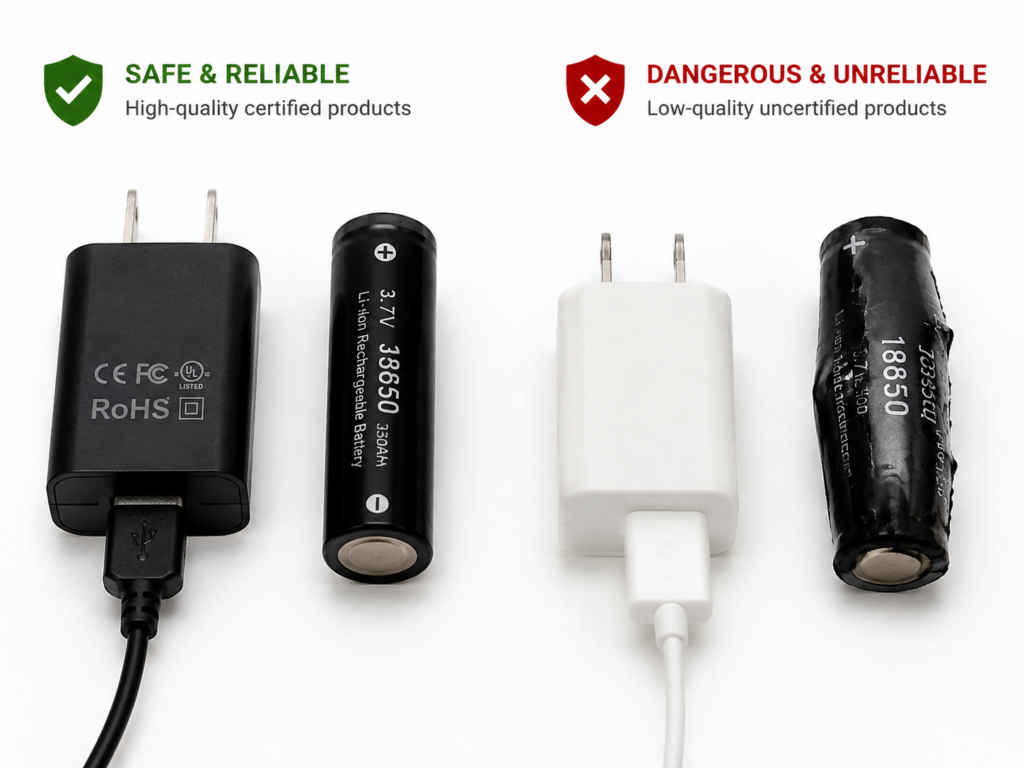
The bottom line: Protection only reduces the probability of accidents — it doesn’t make improper use safe. Building good usage habits is the most reliable strategy.
6. Key Skills You’ll Gain From This Guide
By now, you should have a comprehensive understanding of overcharge and over-discharge protection. You don’t need to take apart batteries or tweak parameters — mastering these few points is enough to use batteries safely every day:
- You can tell the difference between full charge, overcharge, low battery, and over-discharge. You can also read basic specs in manuals like cutoff voltage, protection voltage, recovery voltage, and operating temperature range, and you don’t confuse the 100%/0% display with actual safety limits.
- You can recognize normal protection behavior on phones, laptops, power banks, e-bikes, and portable power stations, and don’t mistake normal speed limits, charge stop, or hibernation for device malfunctions.
- You can do basic safety checks by feeling the temperature, checking the exterior, and observing charge/discharge behavior, to spot early signs of abnormal risk.
- When you encounter common issues like failure to charge, sudden shutdown, charging overheating, or battery bulging, you know how to handle it correctly: when to monitor, when to stop using the device immediately, and when to contact support or dispose of the battery properly.
- You can build reasonable habits for buying, charging, discharging, and long-term storage. You don’t panic over an occasional full charge or low battery, and you don’t abuse batteries just because protection exists. You can use your devices with peace of mind while extending battery life.
Batteries are here to make our lives easier. Understanding the basics of how their protection works will help you worry less and get more use out of every battery you own.