
If you often buy chargers on cross-border e-commerce platforms, you must have seen promotions like “UL94 V-0 flame-retardant enclosure” and “fireproof material”. Many people think flame retardant means “non-flammable”, and even test safety by lighting the enclosure with a lighter — in fact, this is not only dangerous, but also completely inaccurate. Today we will thoroughly explain the flame retardant materials in chargers: what exactly they do, what UL94 V-0 means, how to judge whether a product is truly reliable, and how to choose for different usage scenarios.
First, Understand: What Exactly Do Flame Retardant Materials in Chargers Do
Plain Language Definition: Flame Retardant Does Not Mean “Non-Flammable”, But “Harder to Ignite, Slower to Burn, and Self-Extinguishing”
Let’s start with the most easily misunderstood point: flame retardant materials are not materials that “can never be ignited”. They are plastics, adhesives, insulating parts, and PCB substrates that have flame retardants, flame-retardant fillers added, or themselves use flame-retardant resin systems. Their core function is to reduce the risk of accident escalation in scenarios such as small sparks, local high temperatures, and electrical faults.
Specifically, they can achieve four effects: harder to be ignited; faster self-extinguishing after leaving the fire source; slowing down the speed of flame spread; reducing the probability that molten dripping plastic ignites surrounding items.
It must be clear that their positioning is: flame retardant materials are passive damage reduction lines of defense after a fault occurs. They cannot replace overcurrent protection, over-temperature protection, short-circuit protection, insulation design, and heat dissipation design — they are the last buffer, not a universal safety umbrella.
Which Parts of Chargers Use Flame Retardant Materials
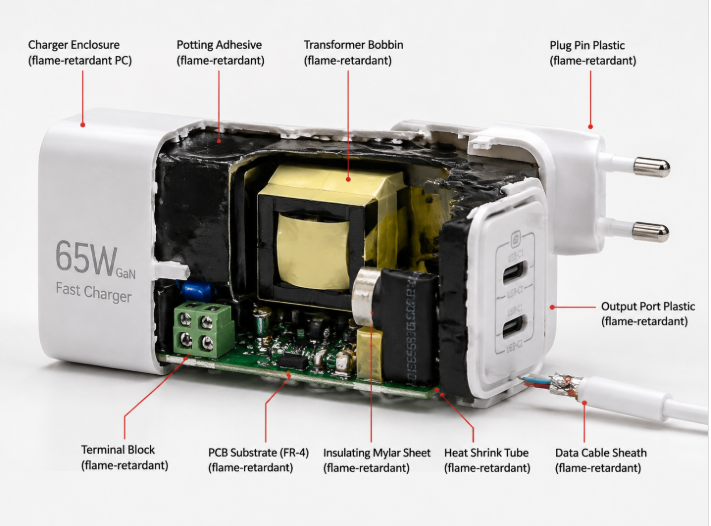
Some parts are directly visible to you: such as the charger enclosure, plastic around the plug pins, data cable sheaths, and plastic parts near the output ports.
There are also many parts you cannot see but are crucial to safety: transformer bobbins, terminal blocks, internal buckles and brackets, PCB substrate materials, insulating sheets / heat shrink tubes / Mylar sheets, potting adhesives, fixing adhesives, conformal coatings, etc.
We also need to draw clear boundaries here to avoid misunderstanding:
- Flame retardant materials for chargers are not the same as battery fire protection: they control flame spread within the charger itself, and do not address issues with the device-side battery;
- They cannot resolve faults in wall sockets, power strips, or conversion plugs themselves;
- Nor can they withstand external large fires, or sustained combustion environments when completely wrapped in cloth or paper.
Why Ordinary Users Should Also Know a Little About It
Nowadays, fast charging power is getting higher and higher. 65W, 100W, and 140W multi-port PD chargers are very common. With high internal power density, the requirements for heat resistance and flame retardancy of materials are also stricter. Although gallium nitride (GaN) fast chargers have high efficiency, their small size leads to more concentrated local heat, requiring the cooperation of heat dissipation, structure, and materials to ensure safety.
More critically, chargers often appear in high-risk locations: bedside, sofa gaps, carpets, next to paper piles, or when traveling with multiple stacked conversion plugs. In addition, on overseas cross-border e-commerce platforms, products with fake certifications, no brands, falsely labeled power, and vague material descriptions are not uncommon. Knowing a little about flame retardant knowledge can help you avoid many safety pitfalls.
Beginner’s Correction: 4 Most Commonly Confused Concepts
Many people’s misunderstandings about flame retardancy come from confusing different safety indicators:
- Flame retardant ≠ non-flammable: If burned continuously with a strong fire source, flame-retardant plastic will eventually burn. It can only withstand common fault scenarios such as small sparks and local high temperatures.
- Flame retardant ≠ high temperature resistant: High temperature resistance focuses on whether the material will soften or deform when heated; flame retardancy focuses on whether it will ignite when exposed to fire, whether it can self-extinguish, and whether it will spread. The two are completely different things. For example, some materials soften at 80°C but can self-extinguish quickly when burned; some materials do not deform at 120°C but ignite at the slightest touch of fire.
- Flame retardant ≠ insulating: The function of insulation is to prevent electric leakage and breakdown, while flame retardancy is to prevent flame spread. Both are safety indicators, but their assessment directions are completely different.
- Flame retardant ≠ “fireproof”: “Fireproof” is basically a marketing term. To be truly reliable, it must be supported by specific test standards, ratings, thickness, applicable parts, and certification documents. Empty talk of “fireproof” has no meaning at all.
Why Chargers Particularly Need Flame Retardant Design
Chargers Are Heat-Generating Devices Themselves
Even low-power slow chargers generate heat when internal components such as rectifiers, transformers, and switching transistors work, but the thermal stress is relatively small. Multi-port fast chargers and laptop PD chargers have high power, and the temperature rise during full-load operation will be very obvious.
Although small GaN chargers have higher efficiency and lower loss, due to their small size and high power density, internal thermal design and flame retardant materials are even more important. Compliant products will pass a series of tests such as temperature rise, abnormal operation, short circuit, and overload, while inferior products often only pursue the promotional point of “small size, high power” and completely ignore safety redundancy.
Common Causes of Fire
Charger fires are usually not caused by a single reason. Common incentives can be divided into three categories:
- Internal faults: short circuits, component aging, capacitor failure, cold solder joints, creepage caused by dust and moisture (i.e., electric leakage and arcing along the plastic surface between live parts), circuit protection failure, etc.
- External faults: loose sockets, poor pin contact, stacked use of multiple conversion plugs, overloaded power strips, etc.
- Improper use: covered by quilts, paper, or clothing, preventing heat dissipation; long-term full-load operation; placed in a car exposed to direct sunlight; long-term use in humid, oily, or dusty environments.
What May Happen When Flame Retardancy Is Insufficient
If flame retardant materials do not meet the standards, the accident will develop much faster: in the early stage, it may only be yellowing, softening, and deformation of the enclosure, with a burnt smell or slight smoking; then internal arcs or high-temperature points will burn through the enclosure, and flames will spread quickly along plastic parts or wires; even more dangerous is molten dripping plastic, which may ignite desktops, carpets, bedding, and paper, causing secondary fires.
It must be emphasized again: the value of flame retardancy is to slow down the speed of accident escalation, giving you time to react and deal with it, not to guarantee that accidents will never happen.
The Position of Flame Retardancy in the Overall Safety System
Charger safety is a complete system, and flame retardancy is only one part of it:
- Active protection circuits are the first line of defense, cutting off or limiting energy under abnormal conditions, such as overcurrent, overvoltage, short-circuit, over-temperature, and over-power protection;
- Structural design is responsible for isolating hazardous energy, such as sufficient creepage distance, electrical clearance (the air distance between live parts to prevent air breakdown), insulating sheets, fire-resistant enclosures, and heat dissipation channels;
- Flame retardant materials are the last passive line of defense, preventing flames from spreading quickly outside the charger in case a fire actually starts.
Therefore, when purchasing, you must not only look at the selling point of “flame-retardant enclosure”, but also comprehensively consider certification, brand, power labeling, protection functions, and usage scenarios.
Plain Language Principle: How Flame Retardant Materials “Extinguish Fires”
To understand the principle of flame retardancy, you must first know the three necessary conditions for combustion: combustible material, oxygen, and sufficient heat. Without any one of them, combustion cannot continue. Most plastics used in chargers are organic polymer materials, which are themselves combustible. The function of flame retardant formulations is to interrupt the combustion chain from different angles.
Principle 1: Oxygen Isolation and Char Formation — “Covering the Material Surface with a Protective Shell”
Some materials with flame retardant formulations will form a dense carbonized layer on the surface when heated, or foam and expand into a thick char layer, covering the material surface like a pot lid, which not only isolates oxygen but also blocks heat from transferring to the inside. Intumescent flame retardant systems and some phosphorus-nitrogen flame retardant systems work on this principle.
It should be noted here: this layer of char is formed only during combustion, not that the surface of the daily-use enclosure has a layer of “flame retardant coating” that can be wiped off.
Principle 2: Endothermic Cooling — “Absorbing” Heat
Some inorganic flame-retardant fillers, such as aluminum hydroxide and magnesium hydroxide, absorb a lot of heat when they decompose when heated, and at the same time release non-flammable gases such as water vapor, which is equivalent to installing a “cooling air conditioner” for the material, lowering the temperature below the threshold required for combustion.
The advantage of this principle is low smoke and low corrosivity during combustion; the disadvantage is that a large amount needs to be added to work, which may make the material brittle and heavier, increase processing difficulty, and may also affect the appearance.
Principle 3: Gas Phase Inhibition — Breaking the Chain of Flame Reactions
Combustion is essentially a free radical chain reaction, which requires continuous participation of active free radicals to sustain. Some flame retardants will release active components in the flame, “eating up” these free radicals that maintain combustion, breaking the reaction chain, and the flame will naturally go out.
The halogenated flame retardants that people often hear about mainly work on this principle. Their advantages are high efficiency, low addition amount, little impact on the processing performance of materials, and relatively controllable cost; but the disadvantage is that they may produce relatively thick smoke and corrosive gases during combustion, and some specific halogenated substances are restricted by regulations such as RoHS (Restriction of Hazardous Substances Directive, an EU directive restricting hazardous substances in electrical and electronic equipment) and REACH (Registration, Evaluation, Authorization and Restriction of Chemicals, an EU chemical management regulation).
It is also necessary to correct a common misconception here: not all halogen-containing flame retardant materials are non-compliant. The key depends on the specific substances used, whether the formulation complies with local regulations, and whether it has passed relevant certifications. You cannot simply judge good or bad solely based on “halogenated / halogen-free”.
Principle 4: Diluting Combustible Gases — Reducing Combustible Concentration
Some flame retardants will release non-flammable or flame-resistant gases such as nitrogen, water vapor, and carbon dioxide when heated, diluting the concentration of combustible gases generated by material decomposition to below the concentration that can sustain combustion, thereby preventing flame spread.
This principle is generally not used alone, and is usually combined with principles such as char formation, heat absorption, and gas phase inhibition to form a composite flame retardant system.
Different Parts Have Different Flame Retardant Priorities
Different positions in chargers have different working environments, and the requirements for flame retardancy also have their own focuses:
- Enclosure: In addition to flame retardancy and self-extinguishing properties, it must also balance impact resistance, heat deformation resistance, appearance, and dimensional stability;
- Near plug pin bases and terminals: Because they are close to live parts and heat sources, more emphasis is placed on heat resistance, arc resistance, glow wire resistance, dimensional stability, and insulation performance;
- PCB board: The focus is on reducing the speed of flame spread along the board, while ensuring stable electrical performance;
- Adhesives and coatings: They must balance insulation, moisture resistance, fixation, thermal conductivity or flame retardancy, and also consider performance retention after long-term aging.
Flame Retardant Systems: How to Choose Between Halogenated and Halogen-Free
Many people struggle with “halogenated or halogen-free” when buying chargers. In fact, there is no absolute good or bad for flame retardant systems, only the difference between whether they meet usage needs and regulatory requirements.
Halogenated Flame Retardant Systems
The most common are brominated flame retardants combined with synergists such as antimony trioxide, which is one of the longest-applied and most technically mature flame retardant systems.
Its advantages are obvious: high flame retardant efficiency, relatively small addition amount to meet requirements, little impact on the processing performance and mechanical properties of materials, and relatively controllable cost. The disadvantage is that the smoke emission during combustion is relatively large, and corrosive gases may be produced. Some specific brominated flame retardants are restricted by EU regulations such as RoHS and REACH.
As the saying goes: not all halogenated products are non-compliant. As long as the substances used are allowed by regulations and have passed local safety and environmental certifications, they are qualified products.
Halogen-Free Flame Retardant Systems
There are many types of halogen-free flame retardant systems, common ones include phosphorus-based, nitrogen-based, phosphorus-nitrogen compounded, intumescent flame retardants, and inorganic fillers.
Its advantage is that it is usually more in line with the trend of low smoke, low corrosion, and environmental friendliness; but the disadvantage is also realistic: higher cost, and many halogen-free formulations will affect the fluidity, impact strength, and hydrolysis resistance of materials, and the appearance texture may not be as good as that of halogenated systems.
For ordinary consumers, “halogen-free” is a bonus point, but it must not replace safety certification and specific flame retardant ratings — a halogen-free material with a flame retardant rating of only V-2 is not necessarily safer than a halogenated material with V-0.
Phosphorus-Nitrogen Flame Retardants and Intumescent Flame Retardants
Phosphorus-nitrogen flame retardants and intumescent flame retardants are very common types in halogen-free systems. They mainly work through char formation, expansion and oxygen isolation, and dilution of combustible gases, and are commonly used in flame-retardant modified plastics such as PC, PC/ABS, PA, and PBT.
Its advantage is that the comprehensive environmental performance is relatively good, with low smoke and low corrosivity during combustion; the difficulty is that formulation balancing is difficult, and it is necessary to simultaneously balance flame retardant effect, material mechanical properties, long-term stability, and processability, which requires high technical requirements for manufacturers.
Inorganic Flame Retardant Fillers
The most common representatives are aluminum hydroxide and magnesium hydroxide, which mainly rely on endothermic decomposition and release of water vapor to cool and retard flame. The principle has been explained earlier.
The advantages of this type of filler are environmental protection, low smoke, and low toxicity; the disadvantage is that the addition amount is usually very large, often accounting for more than half of the material’s weight, which will make the material brittle and heavier, and reduce processing fluidity. Therefore, they are generally used in occasions where the requirements for mechanical properties are not too high, or used in combination with other flame retardant systems.
There Is No “Universal Best” Flame Retardant Formulation
Many people think that the higher the flame retardant rating and the more expensive the material, the better, but that’s not the case. Under the same flame retardant rating, different materials may have completely different drop resistance, heat resistance, smoke emission, cost, and appearance.
When selecting materials for chargers, many factors such as flame retardancy, insulation, strength, heat resistance, processing, environmental protection, cost, and supply stability must be considered at the same time. It is a result of multi-faceted balance, not just looking at the flame retardant rating as the only indicator.
Physical Correspondence: What Are the Common Flame Retardant Materials in Chargers
After talking about the principles and systems, let’s take a look at what flame retardant materials are used in different parts of actual chargers, as well as their respective characteristics.
Common Flame Retardant Plastics for Enclosures
The enclosure is the most familiar part to everyone. There are three main types of commonly used flame-retardant plastics, with obvious differences in characteristics and applicable scenarios:
| Enclosure Material | Main Advantages | Common Limitations | Typical Application Scenarios |
|---|---|---|---|
| Flame-retardant ABS | Low cost, easy processing and molding, good appearance and texture | Heat resistance and impact resistance are usually weaker than PC | Low-power chargers, entry-level products |
| Flame-retardant PC | Strong impact resistance, good heat resistance, dimensional stability | High cost, sensitive to stress cracking, high processing requirements | High-power fast chargers, GaN chargers, high-end products |
| Flame-retardant PC/ABS alloy | Combines the toughness of PC with the processing and appearance advantages of ABS, with moderate cost | Heat resistance and impact resistance are slightly lower than pure flame-retardant PC | Mid-to-high-end consumer electronics chargers |
There is a very important boundary here: ordinary ABS, PC, PC/ABS plastics are completely different from “flame-retardant grade” ones. You cannot assume that an enclosure made of PC material is flame-retardant — you must check the specific material grade, UL94 rating, test thickness, and certification documents.
Common Materials for Internal Structural Parts
Because internal structural parts are close to heating and live parts, they have higher requirements for heat resistance and electrical performance of materials. Commonly used ones include:
- Flame-retardant PBT: Commonly used in plug pin bases, transformer bobbins, and around terminals. Its advantages are dimensional stability, good heat resistance, and excellent electrical performance;
- Flame-retardant PA (nylon): Commonly used in internal buckles, brackets, and terminal blocks. It has high strength and good toughness, but has relatively strong hygroscopicity, so performance changes after moisture absorption must be considered during use;
- High-performance materials such as flame-retardant PPS and LCP: Used in small parts requiring high temperature and high dimensional stability. They have excellent performance but high cost, and are generally only used in high-end small-volume chargers.
There is a simple judgment logic: the closer the plastic parts are to high-temperature or high-energy areas such as plug pins, switching devices, transformers, and terminals, the higher the requirements for heat resistance, flame retardancy, and electrical performance.
PCB and Insulating Materials
- FR-4 epoxy fiberglass board: It is the most common PCB substrate, usually with a certain flame retardant rating, but the specific level depends on the board grade and supplier. You cannot assume that all FR-4 are V-0;
- Insulating sheets, Mylar sheets, mica sheets: Mainly used for high-low voltage isolation and local heat-resistant isolation to prevent electrical breakdown, many also have flame retardant properties;
- Heat shrink tubes, sleeves: Used to protect solder joints, wires, and pins to prevent short circuits, and also to prevent the spread of local flames.
Adhesive and Coating Materials
Many adhesives and coatings inside chargers also have flame retardant functions:
- Fixing adhesive: Used to fix heavy components such as large capacitors, inductors, and transformers, reducing vibration and solder joint stress. Some products have flame retardant properties;
- Potting adhesive: Can play the role of insulation, moisture resistance, thermal conductivity, and flame retardancy, but will affect maintenance and heat dissipation paths. Generally used in products with high protection requirements;
- Conformal paint/coating: The main function is moisture resistance, dust resistance, and corrosion resistance. Some models have flame retardant properties.
Ordinary consumers basically cannot directly confirm the flame retardant rating of adhesives, so there is no need to worry about this part. Just focus on the overall product certification and brand reliability.
Do Not Directly Judge Material Rating by Feel
Many people like to judge the flame retardant rating by touch and sight: they think that if the enclosure is hard, thick, black, and glossy, it is V-0; if it has a pungent odor, many burrs, and poor seams, it is unqualified.
In fact, these are all inaccurate: hard, thick, black, glossy plastic can completely be non-flame-retardant; while odor, burrs, and seams are more related to processing technology, and cannot be directly equated with flame retardant rating. Of course, if there is a pungent odor, loose plug pins, or cracked seams, it is indeed a risk signal, but conversely, no odor and good workmanship do not mean that flame retardancy must meet the standards.
The only things that can truly judge the flame retardant rating are material grades, test reports, certification certificates, or public parameters of reliable brands.
How to Read Flame Retardant Ratings: The Relationship Between UL94 V-0, Glow Wire, and Whole-Machine Certification
The most common flame retardant promotion you see when buying chargers is “UL94 V-0”, but many people don’t know what it means at all, and even think that having V-0 means absolute safety. In this part, we will clarify the relationship between flame retardant ratings and certification.
What is UL94
UL94 is a test standard for the burning performance of plastic materials formulated by UL LLC (Underwriters Laboratories) of the United States, and is one of the most commonly used evaluation standards for flame retardant materials in the electrical and electronic industry.
It should be particularly noted that UL94 tests the combustion performance of material samples of standard size under specified conditions, not that the whole machine using this material will never catch fire. The fire resistance of the whole machine is also related to many factors such as structural design, thickness distribution, openings, seams, and flame retardant properties of other components.
The common ratings of UL94 from low to high can be roughly understood as: HB (horizontal burning, the lowest rating) < V-2 < V-1 < V-0. In some scenarios, there are stricter ratings such as 5VA and 5VB. For charger enclosures, V-0 is already a relatively common high requirement.
Plain Language Explanation of UL94 V-0
UL94 V-0 belongs to the vertical burning test. Simply put: a plastic sample of specified thickness is fixed vertically, ignited with a standard Bunsen burner flame for 10 seconds then removed, and the burning time of the sample is recorded; after the sample is extinguished, ignite it for another 10 seconds, and record the burning time again.
To reach the V-0 rating, many conditions must be met: after each removal of the fire source, the afterflame time of the sample cannot exceed the specified value; the total afterflame time of two ignitions cannot exceed the specified value; there must be no burning drips falling down to ignite cotton placed 30 cm below; the afterglow time (the time the material remains red and glowing after the flame is extinguished) also cannot exceed the specified duration.
There is a very critical boundary here: V-0 must be tied to test thickness, material grade, and color/formulation range. A single phrase “V-0 material” is meaningless.
Why “Thickness” Is Important
Many people don’t know that for the same flame-retardant material, different thicknesses may result in very different flame retardant ratings. For example, a certain flame-retardant PC can reach V-0 at a thickness of 1.5mm, but when changed to 0.8mm thickness, it may only reach V-1 or even V-2.
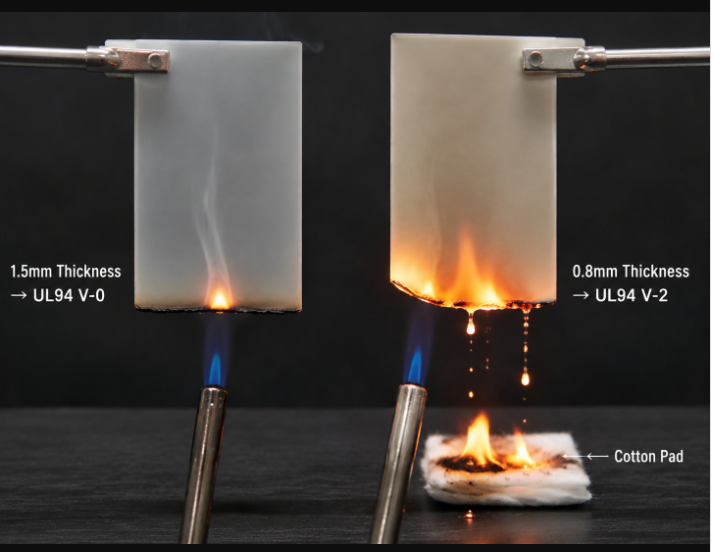
Moreover, the actual charger enclosure is not of uniform thickness. There are rib positions, openings, seams, and buckle positions. The actual fire resistance performance of these weak points will be worse than that of standard samples. If the e-commerce page only writes “UL94 V-0” but does not write the test thickness, applicable parts, and material grade, then the information completeness of this promotion is seriously insufficient.
What is the Glow Wire Test
In addition to UL94 vertical burning, you may also hear about the “glow wire test”. This test is different from the scenario of UL94: it simulates the performance when a local heat source generated by high-temperature metal wires, heating terminals, or electrical faults comes into contact with plastic materials.
During the test, a glowing metal wire heated to a specified temperature is pressed vertically on the plastic sample, and it is observed whether the sample will ignite, how long it takes to extinguish after ignition, and whether there are burning drips that ignite the cotton below.
Plastic parts near plug pins, near terminals, and supporting live parts pay more attention to glow wire performance than ordinary enclosures, because they are more likely to be exposed to local high temperatures or arcs. The common basis for the glow wire test is the IEC 60695 series of standards, and different product standards will specify different test temperatures and judgment conditions.
Differences Between Temperature Resistance, HDT, RTI, CTI and Flame Retardancy
Many product promotions also feature indicators such as HDT, RTI, and CTI. They are all related to safety, but they are not the same as flame retardancy. Don’t confuse them:
- HDT (Heat Deflection Temperature): Refers to the temperature at which a material deforms to a certain extent under a specific load when heated. It reflects the material’s ability to resist thermal deformation and has nothing to do with flame retardancy;
- RTI (Relative Temperature Index): Refers to the maximum temperature at which a material can maintain certain electrical/mechanical properties after long-term aging in a high-temperature environment. It reflects long-term heat aging resistance;
- CTI (Comparative Tracking Index): Refers to the ability of a material surface to resist tracking under the action of contamination and voltage. The higher the value, the less likely the surface is to leak electricity and arc due to dirt or moisture;
- Ball pressure test: Evaluates the deformation of plastics under the combined action of high temperature and pressure. For example, if the plastic around the plug pins deforms too much at high temperatures, the pins may loosen or shift, causing danger.
These indicators are all part of safety assessment, but they cannot replace each other: a high V-0 rating does not mean high HDT, nor does it mean that insulation performance must be good.
The Relationship Between Whole-Machine Certification and Material Flame Retardancy
UL94 is only a material-level test. Whether a charger is safe also depends on the safety standards and regulations of the whole machine.
Common whole-machine safety standards/certification systems include: IEC/UL 62368-1 (the current mainstream safety standard for audio/video and information technology equipment, replacing the old 60950 and 60065), UL, ETL, CSA, TÜV, CB system, etc.
It should be particularly reminded here that CE in Europe is a manufacturer’s self-declaration system, not a third-party certification. There are many cases of fake CE, misused CE, and incomplete documents on the market. You cannot assume that a product is safe just because you see the CE mark.
Compliant whole machines will comprehensively evaluate many items: electric shock protection, temperature rise, abnormal operation, short circuit, overload, mechanical strength, insulation distance, fire-resistant enclosure, material flame retardancy, etc. So the conclusion is clear: Having formal whole-machine safety certification is usually much more reliable than solely promoting “flame-retardant enclosure”.
Practical Guide for Ordinary Users: How to Judge Whether a Charger’s Flame Retardancy Is Reliable
After talking about so much professional knowledge, when ordinary users buy chargers, how should they judge whether the flame retardancy is reliable? In fact, you don’t need to remember so many materials and standards, just follow the priority.
First Priority: Check the Safety Certification for the Target Market
This is the most reliable and worry-free judgment method:
- North American market: Prioritize certifications such as UL, ETL, and CSA, and check whether the product model and certification number are consistent;
- European/UK market: CE and UKCA marks need to be judged in combination with brand, sales channel, and compliance documents, not just the marks;
- Markets such as Australia/New Zealand, Japan, and South Korea: Check local mandatory or recognized certification marks, such as SAA for Australia/New Zealand, PSE for Japan, and KC for South Korea.
The query path is also very simple: you can check the brand’s official website, the public database of the certification body, product manuals, packaging, and the body nameplate. If you encounter a product with no brand, no model, blurred certification marks, mismatched models, or contradictory input and output parameters, just pass it directly.
Second Priority: Check the Labeling of Materials and Flame Retardant Ratings
If the product has formal certification, then look at its material labeling:
- More credible wording: “Flame-retardant PC enclosure, UL94 V-0, test thickness 1.5mm, enclosure part uses XX grade material”. The more specific the information, the more credible it is;
- Insufficient information wording: “Fireproof material”, “fireproof enclosure”, “high-grade flame-retardant material”, “high-temperature resistant enclosure” — these are basically meaningless and have no reference value.
For high-power fast chargers above 65W, prioritize products that clearly state flame-retardant enclosures, over-temperature protection, and temperature rise control.
Third Priority: Check Brand and Channel
Prioritize brands that have been sold in the target market for a long time, have perfect after-sales service, and have a recall mechanism. The cost of fraud for these brands is high, and their quality control and compliance are usually more guaranteed.
Try to avoid unbranded chargers whose price is far lower than mainstream products of the same power — the cost is there. Products that are sold particularly cheaply will most likely cut corners on materials, certification, and protection circuits.
When purchasing cross-border, especially check whether the plug specifications, voltage range, and certification are applicable to your region. Do not buy products that only adapt to plugs of other countries and do not have local certification.
Appearance and Feel Can Only Assist in Eliminating High-Risk Products
Appearance and feel can be used to initially eliminate high-risk products, but cannot be used to prove that flame retardancy meets the standards:
- Relatively reliable workmanship features: tight seams, no obvious burrs, firm plug pins, clear markings, no odor on the enclosure;
- High-risk features: thin and soft enclosure, wobbly plug pins, blurred printing, cracked seams, strong pungent odor, abnormally light weight.
Remember: Do not take “thick, heavy, black, hard” as evidence of V-0. These have no inevitable connection with the flame retardant rating.
Never Do Home Burning Tests
Many people think “I’ll light it with a lighter to see if it can self-extinguish, then I’ll know if it’s flame-retardant”. This is absolutely not recommended:
- Burning plastic at home will produce harmful smoke, and there is also a risk of fire and burns;
- UL94 testing has very strict conditions: sample size, thickness, flame height, ignition time, ambient temperature and humidity, position and state of the cotton below — all have clear regulations. Home testing cannot meet these conditions at all, and the results are completely inaccurate;
- Igniting the whole machine is even more dangerous. When internal capacitors, adhesives, PCBs, and wires burn, they will release a large amount of irritating or toxic smoke.
The correct approach is to judge through certification, brand, material descriptions, and official databases, not to burn it yourself.
Common Misconceptions: These Understandings of Flame Retardancy Are Wrong
There are many widely circulated wrong understandings about charger flame retardancy. Here we will correct them uniformly.
Misconception 1: The Higher the Flame Retardant Rating, the Better
For ordinary charger enclosures, V-0 is already a common high requirement. If pursuing higher 5VA and 5VB ratings, it will often bring problems such as increased cost, brittle materials, increased processing difficulty, and difficulty in achieving good appearance.
Safety is a systematic project, not just looking at the flame retardant rating as the only indicator. It must also be comprehensively judged in combination with whole-machine design, temperature rise, insulation, protection circuits, etc.
Misconception 2: The Thicker the Enclosure, the Safer It Is
Thickness does affect the performance of some flame retardant tests, but it is not that the thicker the better. Too thick an enclosure will affect internal heat dissipation, and also increase volume and weight. A reasonable design is to find a balance between flame retardancy, heat dissipation, strength, size, and cost.
Misconception 3: Metal Enclosures Are Definitely Safer Than Plastic Ones
Many people think that metal does not burn, so chargers with metal enclosures must be safer. In fact, metal itself does not burn, but it is conductive, requiring stricter insulation, grounding, or isolation design. If the insulation design is not in place, it will instead bring the risk of electric shock.
Conversely, if a plastic enclosure uses compliant flame-retardant materials and has passed formal whole-machine certification, its safety can also be very good.
Misconception 4: GaN Chargers Are Small in Size, So They Must Be More Dangerous
GaN devices have higher efficiency than traditional silicon devices and lower loss, so theoretically they generate less heat. But because GaN chargers are usually smaller in size and have higher power density, the requirements for thermal design, materials, layout, and protection strategies are also higher.
The safety of compliant GaN chargers is guaranteed by the overall design. You cannot judge that they are more dangerous just because of their small size.
Misconception 5: Having CE Means It Must Be Safe
As mentioned earlier, CE is mostly a manufacturer’s self-declaration, not mandatory third-party certification. There are very common cases of fake CE, misused CE, and incomplete documents on the market. When buying chargers in Europe, you still need to judge in combination with brand, channel, model, compliance documents, and user feedback.
Misconception 6: Burning It Yourself Can Determine V-0
UL94 testing requires standard samples, standard flames, standard environment, and professional judgment. The conditions of home burning tests are completely unqualified, which is very prone to misjudgment and will also produce harmful smoke. Never try it.
What Situations Will Weaken Flame Retardant Protection
Even qualified flame retardant materials will have reduced or even failed flame retardant performance when encountering these situations:
- Innately unqualified materials: Reducing flame retardants, using low-quality recycled materials, and falsely labeling ratings — this is the most common problem with low-priced unbranded products;
- Enclosure damage: Cracks from drops, holes, cracked seams, which directly expose internal live or high-temperature parts, and the flame-retardant enclosure loses its function;
- Chemical erosion: Long-term contact with alcohol, acetone, banana oil, strong cleaners, and oil may cause plastic stress cracking or material aging, affecting flame retardant performance;
- Long-term high temperature: Using in a car exposed to direct sunlight, next to radiators, or under quilts will accelerate the aging of plastics and adhesives, reducing flame retardant and mechanical properties;
- Natural aging: For chargers that have been used for many years, the plastic will gradually become brittle, crack, and deform. If these situations occur, or there are burn marks or odors, it is time to replace them.
Scenarios Where Flame Retardant Materials Are “Not Sufficient”
Flame retardant materials are not omnipotent. When encountering these situations, their effect will be very limited:
- Severe short circuits form sustained arcs with very high energy;
- The charger is completely covered by paper, cloth, or bedding, so heat cannot dissipate and the temperature continues to rise;
- Poor contact of sockets or conversion plugs causes continuous heating, and heat is continuously transferred into the charger;
- The internal protection circuit completely fails, continuously supplying energy to the faulty part;
- An external large fire continuously burns the charger, which has far exceeded the scenarios tested for the material.
Scenario-Based Purchasing: How to Choose for Different Usage Needs
Different usage scenarios have different focuses on charger flame retardancy and safety requirements. You can choose according to your own needs.
General Purchasing Priorities
No matter what the scenario, you can choose according to this priority:
- Has formal safety certification for the target market, with verifiable model;
- Reliable brand, formal channel, with after-sales and recall capabilities;
- Clearly labeled with information such as flame-retardant enclosure, UL94 V-0, over-temperature protection, short-circuit protection, etc.;
- For high-power fast chargers, prioritize attention to heat dissipation design, enclosure material, certification, and actual power labeling.
Use in Bedroom/Bedside
The bedroom is a high-risk scenario, because people react slowly when sleeping, and the consequences are more serious if something goes wrong. Prioritize chargers with formal certification, low temperature rise, clear use of flame-retardant materials, and over-temperature protection.
When using, do not place the charger next to pillows, quilts, sofa gaps, or paper. When sleeping, try to avoid using unidentified high-power chargers for long-term full-load charging.
Use in Children’s Room
For chargers in children’s rooms, prioritize brand products. The enclosure structure must be firm, and plug pins, enclosures, and ports must not be loose, to avoid danger caused by children touching or pulling. At the same time, avoid using uncertified conversion plugs, cheap power strips, and damaged cables.
Use in Car or High-Temperature Environments
When the car is exposed to the sun, the internal temperature may reach above 60°C, which will accelerate the aging of plastics and adhesives. Car chargers should choose products with clear heat resistance, flame retardancy, and certification. Do not leave ordinary household chargers in the car exposed to the sun for a long time.
Travel and Overseas Use
When traveling, prioritize formal travel chargers adapted to local plug specifications and voltage ranges. Try not to use the multi-layer stacked combination of “wall socket + conversion plug + power strip + multi-port charger”. The more layers, the higher the risk of poor contact and heating. If you find that the plug is loose, has poor contact, or is obviously hot, stop using it immediately.
Multi-Port Fast Charging / Laptop PD Fast Charging
For multi-port fast chargers or laptop PD chargers above 65W, more attention should be paid to certification, temperature rise control, enclosure flame retardancy, and over-temperature protection. When multiple ports are fully loaded at the same time, the internal temperature rise will be higher than that of a single port. Do not use them while covered. If you often need high-load use, you can prioritize products with larger power margin. For example, if you usually need 65W, choose a 100W one, so you don’t have to keep it working at full load all the time.
Humid or Dusty Environments
It is not recommended to use ordinary chargers for a long time in humid places such as bathrooms and kitchens. Humidity will increase the risk of creepage, corrosion, and short circuit. If you must use them, choose products with clear applicable environments, complete certifications, and moisture-proof designs.
Daily Use and Replacement Judgment
After choosing the right charger, you also need to use it correctly and replace it in time to ensure safety.
Correct Usage Methods
- Keep ventilation, do not cover the charger with quilts, clothes, or paper;
- Do not leave the charger clamped in sofa gaps, mattress edges, or paper piles for a long time;
- Use charging cables with matching power and reliable quality, do not use damaged cables;
- When charging with multiple ports at the same time, touch the enclosure. If it is abnormally hot (for example, over 60°C, you can only hold it for a few seconds), stop using it;
- Clean with a dry cloth. Do not soak the enclosure with strong solvents or a large amount of alcohol to avoid corroding the plastic.
Signals That Require Immediate Stop of Use
If the charger has these conditions, unplug it immediately and stop using it:
- Enclosure deformation, bulging, cracking, or burn marks;
- Burnt smell, smoke, or crackling sounds during charging;
- Loose plug pins, obvious wobble after inserting into the socket;
- Unstable output, repeated charging interruptions, or abnormal heating;
- Has been exposed to water, cracked from drops, or crushed by heavy objects.
When Is It Recommended to Replace
If these situations occur, it is recommended to replace the charger directly:
- High-power chargers whose brand, certification, and source cannot be confirmed;
- Used for many years, with aging signs such as brittle enclosure, cracking, yellowing, odor, loose plug pins, etc.;
- Old chargers that are often used under high load with obvious temperature rise;
- When the matching travel conversion plug, power strip, or cable has poor contact, they should also be checked and replaced together.
Advanced Verification: What to Check If You Want to Learn More
If you want to further confirm the flame retardant and safety performance of the product, you can start from these aspects. This part of the content is suitable for semi-professional readers who have higher requirements for details.
Check UL Yellow Card or Material Data
If the manufacturer has announced the material grade, you can go to the UL official website to check the corresponding Yellow Card, focusing on these information: material grade, supplier, UL94 rating, test thickness, color restrictions.
It should be noted that for the same material, different colors, different thicknesses, and different glass fiber reinforcement ratios may result in different flame retardant ratings. If it only writes “V-0 plastic” but has no material grade and thickness, the credibility is very limited.
Check Whole-Machine Certification Database
According to the model, certification number, and manufacturer name on the product nameplate, query in the corresponding certification body database. For example, UL certification can be checked on the UL official website, and ETL certification can be checked on the Intertek official website.
When querying, pay attention to: whether the sales model on the e-commerce page is consistent with the model on the certification; whether the certification certificate covers the corresponding input voltage, output power, plug type, and sales region.
What to Focus on When Reading Test Reports
If you can get the test report, you don’t need to read all of it. Focus on these parts:
- Material testing: UL94 rating, test thickness, sample bar conditions, color, humidity conditioning conditions;
- Whole-machine testing: temperature rise, abnormal operation, short circuit, overload, insulation withstand voltage, creepage distance, electrical clearance;
- Local component testing: glow wire, ball pressure, CTI, heat aging resistance.
Supply Chain Risk Points
When purchasing, also pay attention to several common supply chain risks:
- Excessively high proportion of recycled materials will affect flame retardant stability and mechanical strength;
- Insufficient addition of flame retardants, resulting in inconsistency between the nominal rating and actual performance;
- After changing material suppliers or colors, flame retardant verification is not redone, and the rating may become invalid;
- Low-priced unbranded products are most prone to problems such as material replacement and certification mismatch.
Final Summary
Understanding charger flame retardant materials is not to make you a material expert, but to avoid risks and choose more reliable products. You don’t need to remember all the material names and test standards, just grasp a few core points:
First, flame retardant does not mean non-flammable. It is a passive damage reduction line of defense after a fault occurs, whose function is to slow down the expansion of the accident. It cannot replace circuit protection and correct use.
Second, do not be fooled by marketing terms such as “fireproof” and “high-grade flame retardant”. To be truly reliable, there must be specific test standards, ratings, thickness, and certification support.
Third, to judge whether a product is reliable, the priority is: formal whole-machine certification > reliable brand and channel > clear material and flame retardant labeling. Appearance and feel can only be used for preliminary risk elimination, not as evidence.
Fourth, charger safety is a system, not relying solely on the flame-retardant enclosure. It also needs to be combined with protection circuits, structural design, and correct usage habits.
Whether it’s for daily home use, travel, or for children, as long as you grasp these points, you can avoid the vast majority of safety hazards.