
If you live or travel abroad, you’ve most likely encountered this situation: the charger you carry with you gets lost or breaks. Buying an original one is not only expensive, but may also be out of stock in some small areas; buying a third-party one costs several times less, but you worry it’s unsafe, harms the battery, or even damages your device.
Many people’s understanding of chargers still stays at “it works as long as it plugs in”, but in reality, the gap between different chargers may be much bigger than you think, from charging speed and battery life to safety risks.
This article will start from the most basic common sense, all the way to advanced parameter identification and troubleshooting, to help you understand the real differences between genuine original chargers and formal third-party chargers, so you don’t have to struggle with which one to choose.
I. First Clarify the Comparison Objects: Don’t Compare Knockoff Products with Genuine Products
When many people discuss “original vs. third-party”, they often compare knockoff products with genuine ones, and the conclusion will naturally be biased. Before the formal comparison, let’s clarify the boundaries of the comparison.
1. What Is a Genuine Original Charger
A genuine original charger refers to a product produced by the device’s original manufacturer, or produced by an officially authorized OEM and sold through official channels. It includes both chargers bundled with the device and officially sold separate accessories of the same specification.
It should be noted that counterfeit, refurbished, disassembled bulk, and unlicensed white-label products, even if their appearance is highly similar to the original, are not considered genuine original products. To judge whether it is a genuine original product, there are four core points: whether the purchase channel is officially authorized, whether the model is consistent with the official label, whether the packaging and serial information are complete, and whether the after-sales path is clear and traceable.
2. Third-Party Chargers Fall into Two Categories
Third-party chargers are defined as chargers not produced by the device brand but capable of powering devices of multiple brands. In practice, they are divided into two categories:
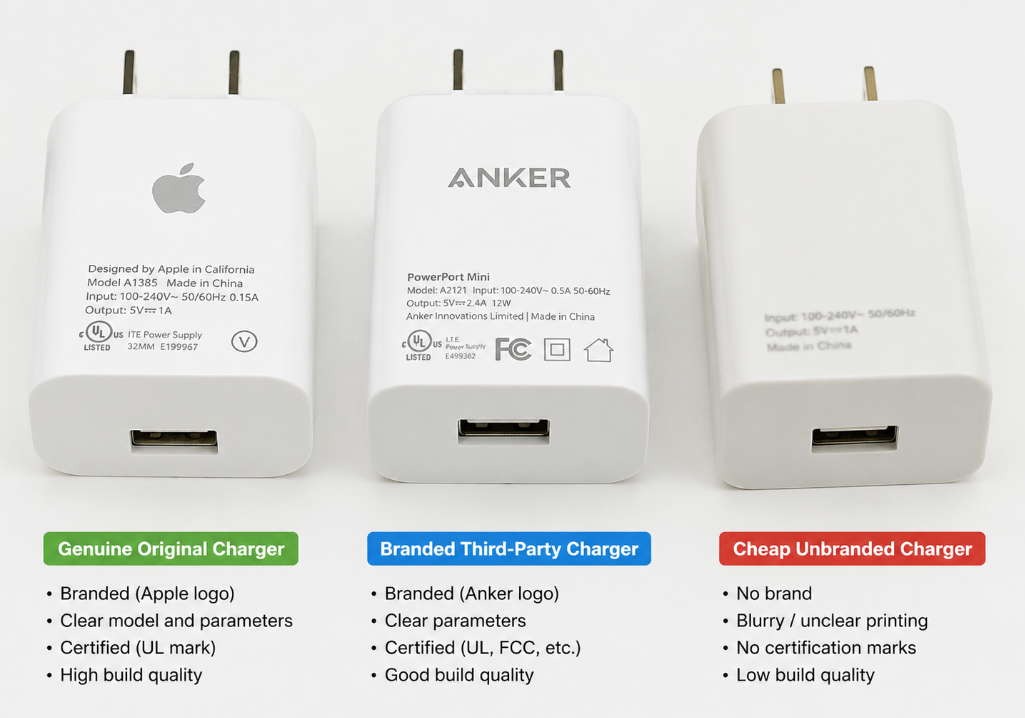
One category is formal third-party chargers: they have clear brands, clear parameter labels, required safety compliance certifications, clear after-sales policies and stable sales channels. For example, compliant products from brands such as Anker, Belkin, UGREEN, Baseus, etc., are the objects that can be compared with original chargers on a fair level.
The other category is unbranded/no-name third-party chargers: they have no brand, no certification, no clear parameters, and even have falsely marked parameters. Such products themselves do not meet basic compliance requirements and should not be included in the fair comparison of “original vs. third-party”.
3. Comparison Scope and Fair Criteria of This Article
To make the conclusions more objective, the comparison in this article has clear boundaries:
- Only wall-plug wired chargers are discussed, excluding wireless chargers, car chargers, power banks, outdoor power supplies, industrial power supplies and other power supply products;
- The comparison benchmark is genuine original vs. formal certified third-party, excluding non-compliant products such as counterfeits, three-no (no brand, no certification, no clear parameters) products, knockoffs, and disassembled bulk products;
- All conclusions about charging speed and battery health impact are valid by default under the unified conditions of the same device, same power level, same qualified cable, same ambient temperature, and same battery level range.
II. Must-Know for Beginners: Why You Can’t Just Judge a Charger by “Whether It Plugs In”
Many people’s first criterion for choosing a charger is “as long as the interface can plug in”, but when they actually use it, they find that it either charges slowly, gets hot, or even doesn’t work. Let’s start with the most basic common sense to help you understand how chargers work and what problems you may have if you choose the wrong one.
What Are the Consequences of Choosing the Wrong Charger
The problems of choosing the wrong charger can be minor or severe: minor ones are just slow charging, failure to trigger fast charging, occasional disconnection, obvious heating of the charger or cable; moderate ones will cause continuous high temperature of the device, accelerated battery aging, poor interface contact, intermittent charging that affects use; if it is a low-quality product, there may also be serious safety hazards.
For users who live abroad or shop cross-border, the probability of encountering pitfalls is even higher: different countries have different plug shapes, voltage specifications, and certification systems have their own requirements. Coupled with the mixture of fake goods on overseas platforms and the high cost of cross-border after-sales rights protection when problems arise, it is easy to spend money but not get a reliable product.
What Does a Charger Actually Do?
Actually, the working logic of a charger is not complicated: the wall socket outputs high-voltage alternating current (AC), but digital products such as mobile phones, tablets, and laptops use low-voltage direct current (DC) internally. The core function of a charger is to convert high-voltage AC into low-voltage DC that the device can use.
Fast charging is not “forcing electricity into the device”, but the charger, charging cable, and device first negotiate through a set of rules called “fast charging protocol” to find a power level supported by both parties, and then start charging. Here’s a reassurance for beginners: A qualified charger only provides its upper power limit, and the actual amount of electricity drawn is determined by the device’s battery management system and temperature control strategy. As long as the charger is compliant, the protocol matches, and the cable is qualified, it will not actively “burn out” the device.
Charging Experience Is Determined by Three Factors Together
Many people think that slow charging means the charger is bad, but that’s not the case. The charging experience is the result of the combined action of three components:
- Charger itself: determines the maximum output power, supported fast charging protocols, protection circuit and heat generation control, which is the upper limit of charging capability.
- Charging cable: determines the current capacity, identification capability and interface stability. Substandard cables will directly limit the speed or even cause abnormal heating, which is equivalent to “no matter how wide the highway is, if the bridge is narrow, you can’t go fast”.
- Device side: has its own maximum charging power, temperature control rules and battery protection mechanisms, which is the final determining factor of actual charging speed – if the device only supports 20W, using a 100W charger won’t make it charge faster.
4 Basic Concepts You Must Understand First
Several terms will be mentioned frequently in the following comparisons. Remember their meanings first, and the subsequent content will be easy to understand:
- Power (W): The calculation formula is voltage (V) × current (A), which represents the theoretical power supply upper limit of the charger. The higher the power, the higher the upper limit, but it does not mean that the actual charging is necessarily faster.
- Fast charging protocol: The “common language” for devices and chargers to communicate charging specifications. Common ones include USB PD, PPS, QC and proprietary protocols of various brands. Without a commonly supported protocol, only slow charging is possible.
- Safety certification: A mark that the product meets the basic safety and electromagnetic compatibility requirements of the sales region, which is the bottom line of compliance. It does not mean faster charging or higher quality ranking.
- Temperature-controlled speed reduction: A protection mechanism that automatically reduces power when the device or charger temperature is too high. It is a normal design and not necessarily a product failure.
First Correct 5 Most Common Misconceptions
Many people have deviations in their understanding of chargers. Let’s first correct the 5 most common misconceptions to avoid pitfalls later:
- The higher the power, the faster the charging? Wrong. The actual charging speed depends on the device’s power upper limit, whether the protocol matches, cable specifications and ambient temperature. Using a 100W charger for a phone that only supports 20W will only charge at a maximum of 20W, no faster.
- Third-party chargers must damage the battery? Wrong. Formal, compliant third-party chargers with matching protocols will not cause additional damage to the battery. We will explain the specific reasons in detail when we talk about battery health later.
- Original chargers are always the fastest? Wrong. Some devices come with original chargers with very low power. For example, many phones used to come with 10W chargers, but the phone itself supports 65W fast charging. In this case, choosing a high-power third-party charger that supports the corresponding protocol is faster.
- USB-C port equals fast charging? Wrong. USB-C is just the shape of the interface, and does not mean it necessarily supports fast charging protocols such as PD and PPS. Some low-cost USB-C chargers only support 5V slow charging, and you can only charge slowly when plugged in.
- Being able to plug in equals compatibility? Wrong. Being able to plug in only means basic power supply is possible, it does not mean safe full-speed fast charging, and may even cause abnormal heating and repeated disconnection due to protocol mismatch.
III. Item-by-Item Comparison of Core Dimensions
First, here is an overview table for quick reference, and we will explain the details and applicable conditions of each dimension in detail later.
| Comparison Dimension | Genuine Original Charger | Formal Compliant Third-Party Charger |
|---|---|---|
| Safety and Reliability | High quality control consistency, sufficient adaptation verification, clear responsibility | Compliant products have sufficient safety baseline, high-end models have workmanship close to original |
| Charging Speed | Best match with own proprietary protocol, stable triggering | Minimal speed difference when protocols match, imperceptible in daily use |
| Impact on Battery Health | More stable temperature control and protocol, negligible difference | Qualified matching products cause no additional harm to the battery |
| Size and Function | Mostly single-port basic models, high-end models also use GaN | Richer multi-port, GaN, travel functions, high portability |
| Durability | Good batch stability, predictable long-term experience | High-end models are close to original, low-end models have insufficient stability |
| Price and After-Sales | High unit price, clear official after-sales path | More features for the same budget, after-sales varies by brand |
Safety and Reliability
Before talking about safety, we need to set a premise: only genuine original and formal compliant third-party products are meaningful for comparison. Comparing three-no products with original ones in terms of safety is inherently unfair. Under the premise of the same power level, meeting the compliance requirements of the sales region and reliable sources, both types of products can usually meet the basic safety bottom line; but compliance does not mean zero risk. Batch defects, product aging, moisture or dropping, poor socket contact, long-term full-load use and other situations may still bring safety hazards.
The advantage of original chargers is better quality control consistency, more sufficient adaptation verification with their own devices, easier definition of after-sales responsibility when problems occur, and usually better long-term batch stability.
Mature brands of formal third-party chargers generally pass safety certifications of multiple markets. Many high-end models have protection circuits, component materials, and heat dissipation designs that are no worse than original ones, and their safety level can be close to original.
In fact, the core determining factor of safety is not the label of “original” or “third-party”, but circuit design, component materials, protection mechanisms, heat dissipation design, whether there is compliance certification, and good production consistency. The real high-risk ones are non-compliant products with no certification, falsely marked power, too light weight, abnormally low price, and unknown origin. These are the main sources of safety hazards.
Charging Speed and Protocol Compatibility
For the same device, same battery level range, same qualified cable, and same temperature, the difference in charging speed is almost only related to two things: “whether the protocol matches” and “whether the power is sufficient”.
The advantage of original chargers is the highest protocol matching degree with their own devices, especially for models using proprietary fast charging protocols – for example, some models with high-power proprietary fast charging protocols require original or officially authorized chargers and cables to trigger full speed; ordinary third-party chargers supporting PD/PPS/QC may drop to tens of watts or even lower power, depending on the protocol levels opened by the model and cable specifications.
But if the device uses general protocols such as USB PD, PPS, QC, as long as the third-party charger supports the corresponding protocol and power, the actual charging speed gap with the original is very small, almost imperceptible in daily use.
Here are two points that are easy to fall into pitfalls: first, the USB-C interface is just a form, and does not mean it necessarily supports fast charging protocols such as PD. When the protocol does not match, only slow charging is possible; second, when multi-port chargers are plugged with multiple devices at the same time, the power will be redistributed. You can’t just look at the advertised “total power”. For details, please refer to the multi-port distribution description in the nameplate section later.
In addition, original chargers are not omnipotent – for example, using an Apple original charger to charge a Samsung phone may not be able to fast charge if the protocol does not match.
Impact on Battery Health
Under the premise of the same power, same temperature, same charging habits, and both are qualified products, the difference in impact on battery life between genuine original and formal third-party products is extremely small, almost imperceptible in daily use.
The real factors affecting battery life, sorted by importance: high temperature environment > long-term stay at high battery level > using with high load while charging > unstable voltage and current of low-quality chargers > long-term high-power fast charging frequency.
The value of original chargers lies in more stable protocols and temperature control strategies. Users who don’t want to study parameters will definitely not go wrong with original ones. But as long as formal third-party chargers have matching protocols, appropriate power, and normal temperature control, they will not damage the battery because they are “non-original”. What really accelerates battery aging is uncertified low-quality products – abnormal heating during charging, repeated disconnection, unstable voltage output, these are the battery killers.
So instead of struggling with the brand label, it’s better to pay more attention to not charging in high temperature, not playing large games while charging, and not putting the device in a closed high-temperature place. These have a much greater impact on the battery.
Size, Portability and Functions
If the differences in safety and speed are hard for ordinary people to perceive, size and function are where third-party products can most easily stand out.
Many high-end third-party products use Gallium Nitride (GaN, a new type of semiconductor material that can make chargers smaller and have higher power density) solutions, which are much smaller than traditional original chargers and have strong portability. Of course, some high-end original chargers of some brands have also started to use GaN, and the size gap is narrowing.
In terms of functions, third-party products are more common with 2-port, 3-port or even 4-port designs. One charger can power mobile phones, tablets, earphones, and thin-and-light laptops at the same time, without needing to bring multiple chargers. Many third-party products also support foldable prongs, replaceable plugs, and 100-240V wide voltage, which are especially suitable for people who travel frequently for business or leisure.
However, note that when multiple ports are used at the same time, power will be redistributed. The specific rules need to be confirmed against the distribution table on the charger nameplate to avoid the main device not reaching fast charging speed.
Durability and Long-Term Stability
Durability does not depend on the brand label, but on materials, workmanship and usage habits, and products of different grades vary greatly. The advantage of original chargers is that the batch consistency of the shell, prongs, and interface is relatively stable, and the long-term use experience is predictable. Under the premise of dry environment, good socket contact, no excessive pulling of cables, and no long-term full load, genuine original and high-quality third-party chargers can usually be used stably for many years.
For high-end models of formal third-party chargers, the interface life, shell strength, and temperature control performance can also be close to or even reach the level of original ones, but low-end models are not necessarily – they may have loose interfaces, deformed prongs, increased heating, and falsely marked power after half a year to a year of use.
To judge whether a charger is durable, you can look at brand reputation, warranty duration, long-term user reviews, professional disassembly reviews, as well as whether there is complete certification information and whether there are a lot of abnormal heating feedback. In addition, service life is also related to usage habits: frequent plugging and unplugging, use in humid environments, too loose sockets, long-term full load, and simultaneous high load on multiple ports will shorten the charger’s life.
Price, After-Sales and Total Cost of Ownership
Price is the direct reason why many people choose third-party products, but when calculating cost, you can’t just look at the unit price, but also look at functions and long-term use risks. Original chargers are usually 1.5-3 times more expensive than formal third-party chargers of the same specification, with large differences between different brands. Taking the common official selling price and daily price of mainstream e-commerce in the US market as an example, the official price of Apple’s 20W original charger is about $19, and the same power formal third-party is about $10–15; some mainstream brand 65W official adapters are commonly in the range of about $40–60, with large pricing differences between different brands, and some brands are higher or lower; the same power formal third-party may be lower during promotions, but high-end multi-port GaN models may also be close to or even exceed the price of original single-port ones. Taxes, promotional activities, and channel policies in different regions will significantly affect the final price. When purchasing, please refer to the real-time price of local formal channels.
The advantage of original chargers is that the official after-sales path is clear, and the responsibility definition is direct when problems occur. As long as it is a genuine product and non-human damage within the warranty period, it can be replaced.
The advantage of third-party products is that you can buy higher power, more interfaces, GaN small size or travel-friendly features for the same budget. Calculating the total cost of ownership, there is little difference for single-device users; but for multi-device users, using a high-quality multi-port third-party charger is usually more cost-effective than buying multiple original ones.
Here we need to explain the warranty boundary: compliant third-party chargers will not cause the device to lose warranty because they are “non-original” per se, but if the device damage is determined to be caused by the charger, there may be after-sales disputes. In this case, the after-sales of formal brands will be more guaranteed. In addition, the price of high-end multi-port GaN third-party chargers may be close to or even exceed that of original single-port ones, so it cannot be generalized that “third-party is cheaper”.
IV. Choose by Scenario: When to Choose Original, When to Choose Third-Party
After talking about the comparison of all dimensions, you may still struggle with “which one should I buy”. In fact, you don’t have to stare at the label to choose, just pick according to your own usage scenarios and needs.
1. Scenarios More Suitable for Choosing Original Chargers
If you meet the following situations, prioritizing genuine original chargers will be more worry-free:
- You don’t want to study parameters such as protocols, power, and cables at all, and just want it to work stably when plugged in. The adaptation between original chargers and their own devices has been fully verified, so you don’t have to worry about matching issues, and it will charge normally when plugged in.
- Your device relies on high-power proprietary fast charging. For example, some Chinese Android flagships with 100W+ fast charging require original or officially authorized chargers and cables to trigger full speed, and ordinary third-party ones may only reach 20-30W, with an obvious speed gap.
- The device is expensive and still under warranty, and you don’t want to have after-sales disputes due to accessories. Using original chargers can reduce after-sales responsibility disputes; compliant third-party products usually do not cause the device to lose warranty because of their “non-original” status, but if the damage is determined to be related to accessories, you may still need to provide evidence and communicate.
- Powering professional equipment such as medical equipment, professional photography equipment, and professional audio equipment. Such equipment has high requirements for power supply stability, and the loss is large once problems occur. The responsibility chain and adaptability of original chargers are more guaranteed.
- The area you live in has many counterfeits and chaotic third-party channels, and you can’t distinguish between genuine and fake. If the local market is flooded with counterfeit products and it’s hard to buy genuine products from formal third-party brands, buying original ones directly through official channels is more stable, avoiding spending money on fakes.
- As a long-term main charging solution for flagship phones, tablets, and laptops, and you have sufficient budget. For long-term high-frequency use, the batch stability and long-term performance of original chargers are more predictable, and you don’t need to replace them frequently.
2. Scenarios More Suitable for Choosing Formal Third-Party Chargers
If your situation meets the following, formal certified third-party chargers will be a more cost-effective choice, provided that you must choose products with brands, certifications, and formal channels:
- You have multiple devices at the same time, such as mobile phones, tablets, earphones, watches, thin-and-light laptops, etc. One multi-port third-party charger can cover the charging needs of all devices, without needing to plug multiple chargers on the desk, or bring a bunch of chargers when going out.
- Your device clearly supports general fast charging protocols such as USB PD, PPS, QC, and does not rely on proprietary fast charging. In this case, as long as the power and protocol of the third-party charger match, the actual charging speed is almost the same as the original, and it is completely imperceptible in daily use.
- You travel frequently for business or leisure and need a highly portable charger. Many third-party GaN chargers are small in size, have foldable prongs, support 100-240V wide voltage, and even have replaceable plugs, which are much more convenient than bulky original chargers.
- The original charger is lost or broken, and the cost of official replacement is too high. For example, the original adapter for some laptops costs several hundred yuan, and a formal third-party one of the same power may only cost half or even less. As long as the protocol matches, it can be used normally.
- You have a limited budget but don’t want to buy low-quality products. As long as you choose formal brands with safety certifications and clear after-sales, third-party products have much higher cost performance than original ones, and you don’t have to pay double the price for the brand label.
- You have devices of multiple brands and hope one charger can cover all of them. For example, if you use an Apple phone, an Android tablet, and a Windows thin-and-light laptop at the same time, choosing a multi-port third-party charger that supports multiple protocols is much more convenient and cost-effective than buying original ones for each device.
3. How to Choose for Special Scenarios
There are some common specific scenarios, you can directly refer to the following suggestions:
- Old slow-charging devices: If your device only supports 5W/10W slow charging, choosing a formal compliant third-party one is enough. The speed is almost the same as the original, there is no need to spend a high price on the original, and there is no need to buy a high-power one, which is a waste of money.
- Long-time charging at night: Modern devices and qualified chargers usually reduce current or charge intermittently after being fully charged. There is no need to worry too much about occasional overnight charging; but long-term stay at full charge, high temperature caused by being covered by quilts/pillows, or using low-quality chargers may still increase the risk of battery aging and safety hazards. What you really need to pay attention to is not to cover the device in a closed high-temperature place, and not to use low-quality chargers.
- Thin-and-light laptop charging: First check the PD input power required by your laptop’s official specifications, such as common 45W, 65W, 100W, 140W, then choose a charger and cable of the corresponding power. If the power is insufficient, it may only charge slowly, or even drain while using.
- Gaming handhelds/tablets: First check the officially recommended power and protocol. If you use a multi-port charger, pay attention to whether the power allocated to the handheld or tablet is sufficient when other devices are plugged in at the same time, to avoid draining while charging during play.
- Home backup charger: Choosing a formal third-party one is fine, you don’t need to buy multiple original ones, but you must not be greedy for cheap and buy unbranded low-price ones. Backup chargers also need to be safe and compliant.
- Overseas travel: Be sure to confirm that the charger supports 100-240V wide voltage, also check whether the plug shape meets the standard of the destination, whether there is a compliance certification of the destination. In addition, choose a good quality travel adapter, because low-quality travel adapters will also bring safety hazards.
4. These Products Should Never Be Bought
Whether you choose original or third-party, you must avoid the following types of products, no matter how cheap they are:
- “Three-no” chargers with no brand, no certification, no clear parameters, which can’t even guarantee the most basic safety bottom line.
- “Original bulk”, “disassembled original”, “factory leftover” products with prices significantly lower than the normal market level. The authenticity, source and usage status of such products are difficult to verify, and there may be risks such as counterfeiting, refurbishment, aging from disassembly, and no after-sales. They are not suitable as main chargers.
- Products that claim “universally compatible with all fast charging” and “full-speed fast charging for all phones” but do not list the specific supported protocols and power levels are basically falsely advertised.
- Products with rough shells, loose prongs, blurry printing, and abnormally light weight. Note: weight can only be used as an auxiliary judgment, not as sole evidence. Some small-volume GaN chargers are inherently light, so it should be considered together with other conditions.
- Cross-border low-price products with no after-sales, no formal purchase vouchers, and models that cannot be found on the brand’s official website. You can’t find anyone to protect your rights when problems occur.
V. Advanced Tips: Understanding Parameters, Certifications and Cables
If you want to judge whether a charger is good and suitable for your device by yourself, these practical tips can help you go from beginner to semi-proficient.
How to Read the Charger Nameplate
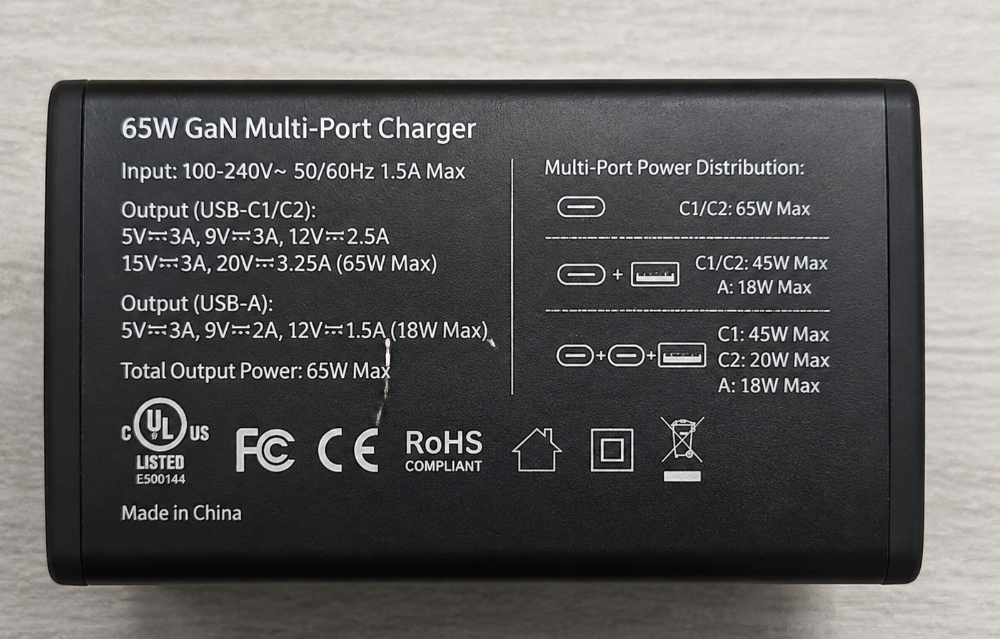
Every formal charger has a nameplate printed with parameters, and the information is actually not hard to understand:
- Input: If it says 100-240V~ 50/60Hz, it is wide voltage and basically universal worldwide; if it only says 120V or 230V, it can only be used in specific regions.
- Output: It will list different voltage and current levels, such as 5V/3A, 9V/2.22A, 12V/1.67A, representing different specifications that the charger can output.
- Power calculation: Voltage × current = power. For example, 9V × 2.22A ≈ 20W, you can calculate the power of each level by yourself.
- Single-port maximum power: The highest output when using a certain port alone, this is the most useful parameter for you.
- Total power: The total power of all ports when multiple ports are used at the same time, it does not mean that each port can reach the total power.
- Multi-port distribution table: The nameplate or manual of multi-port chargers will write the power distribution of different port combinations, such as C1+C2=45W+20W, be sure to focus on this.
The Role of Common Safety Certifications
Different countries and regions have different compliance certifications. You only need to confirm that the product has the certification of the sales region. Note: Certification is the safety bottom line, not a performance ranking. Having certification does not mean faster charging, nor does it mean that all devices can charge at full speed.
- Chinese Mainland: CCC mandatory certification.
- United States: Related electronic products sold in the market usually need to meet FCC electromagnetic compatibility/radio frequency compliance requirements; but FCC is not equal to electrical safety certification. For electrical safety, more attention should be paid to UL, ETL listing or locally recognized safety marks.
- European Union: CE compliance mark, representing compliance with relevant EU directive requirements. CE is not a quality ranking, nor does it mean that the product is tested unit by unit by a third-party laboratory. It is a mark under the manufacturer’s compliance declaration system.
- United Kingdom: UKCA is the UK market compliance mark.
- Japan: PSE is the mark related to electrical appliance safety.
- South Korea: KC is a common certification in the South Korean market.
- Australia/New Zealand: RCM is a common compliance mark.
- India: BIS is a common certification requirement for some electronic and electrical products.
- USB-IF: Certification from the USB Association, which is a bonus item for protocol and compatibility, but not required for all qualified products.
How to Judge Whether the Fast Charging Protocol Matches
To know whether a charger can fast charge your device, just check in four steps:
- Check the official parameters of the device to confirm the maximum charging power, interface type, and supported fast charging protocols.
- Check the output protocol of the charger to confirm that it supports the protocol required by the device and has sufficient power.
- Check the charging cable specifications to confirm that it can carry the corresponding current and power, otherwise the speed will be limited.
- If it is a multi-port charger, also check the multi-port power distribution to confirm that the main device can still get sufficient power when multiple devices are used at the same time.
Here are some common examples:
- For recent iPhones, fast charging mainly depends on USB PD charger + qualified USB-C to Lightning or USB-C cable (iPhone 15 and later have C port).
- For some Samsung models to trigger higher power fast charging, PD PPS support is usually required.
- Many high-power fast charging of Chinese Android phones rely on original or authorized accessories and proprietary protocols, and ordinary third-party ones cannot reach full speed.
- Laptops generally require 45W, 65W, 100W or higher PD input. Insufficient power may result in slow charging or even draining while using.
How to Choose Cables So They Don’t Hold You Back
Many people can’t charge fast, the problem is actually the cable. The key points for choosing cables with different interfaces are different:
- Lightning cables: For Apple Lightning interface devices, prioritize MFi certified or official/reliable brand cables, otherwise fast charging may not be triggered or even the device cannot be used.
- USB-C cables (within 60W): In ordinary PD charging scenarios, common 3A specification USB-C cables can basically cover, but if it is a phone’s proprietary high-power fast charging, original or officially authorized cables may still be required, and you can’t just look at the general current specification.
- USB-C cables (over 60W): For scenarios requiring 5A high current (such as common 65W, 100W, 140W PD charging), prioritize USB-C cables with E-Marker chips, otherwise full speed may not be achieved.
- USB-C cables (240W high power): 240W is a high power level of the USB PD 3.1 EPR specification. All three: device, charger, and cable must support it at the same time to meet the standard. Confirm the specifications separately when purchasing.
Also note: data cables are not equal to charging cables. Some cables can only charge at low power or transmit at low speed, you can’t just look at the interface shape. If the cable has interface heating, looseness, damaged outer sheath, or disconnection after bending, be sure to replace it immediately.
How to Identify Counterfeit Original Chargers
Fake original chargers are very common on cross-border platforms. Here are some practical identification methods:
- The most reliable method: Only buy from brand official websites, official flagship stores, and authorized retailers. Don’t be greedy for cheap and buy from unknown small shops.
- Packaging inspection: Model, serial information, font, printing, barcode, certification mark should be clear and consistent. Blurry ones have high risk.
- Appearance inspection: Prongs are tight, seams are uniform, no burrs, looseness, or peculiar smell.
- Weight assistance: Under the same power, fake products are often lighter due to shrunken components, but weight can only be used as an auxiliary judgment, not as sole evidence.
- Price judgment: “Original” products with prices significantly lower than the official price are highly suspicious. Don’t take chances, unless you can verify the authenticity through official channels.
- High-risk channels: “Disassembled original”, “bulk original”, “foreign trade leftover” have high risks and are not recommended as main chargers.
Steps to Choose a Reliable Third-Party Charger
Follow these seven steps to choose a third-party charger, and you basically won’t fall into pitfalls:
- First eliminate all products with no brand, no certification, no clear parameters.
- Confirm that the product has compliance certification of the sales region, and prioritize products whose models can be found on the brand’s official website.
- Match the maximum power and protocol of the device. Sufficient power is enough, there is no need to blindly buy models far exceeding the device’s upper limit, which is a waste of money.
- Confirm whether the cable needs to be purchased separately – especially for laptops, tablets, and high-power phones, many chargers do not come with cables or the included cables have insufficient specifications.
- Be sure to look at the multi-port power distribution table, don’t just look at the largest “total power” number on the promotional page.
- Choose brands with stable reputation, clear warranty, and sold through formal channels. Don’t buy brands you’ve never heard of.
- Do a low-risk test after receiving the product. Use it for a while and observe whether there is peculiar smell, abnormal noise, abnormal heating, or disconnection. If there is no problem, use it normally.
VI. Common Misconceptions and Troubleshooting
When using chargers daily, many small problems don’t require rushing to buy a new one. You can find the cause by troubleshooting first. This section summarizes the most common misconceptions and hands-on troubleshooting methods that beginners can follow.
1. Clarification of High-Frequency Misconceptions
In addition to the basic misconceptions mentioned earlier, there are several common misconceptions related to daily use and fault judgment that need to be corrected:
- Original chargers never break? Wrong. Original chargers can also have problems due to aging, water ingress, dropping, long-term full load, cable pulling, etc. Counterfeit original chargers have higher risks.
- High-power chargers will burn small devices? Usually not. As long as it is a compliant product, the device will draw power as needed. Both parties negotiate power through the protocol first, there will be no “forced electricity” situation. A high-power charger for a low-power device is actually more relaxed.
- Having the words “fast charging” means it’s fast? Wrong. Only when the protocol, power level, cable, and device all match can full-speed fast charging be achieved. Missing any one may slow it down.
- Charging all night will definitely damage the battery? Not accurate. Modern devices and qualified chargers have full-charge current reduction and optimized charging mechanisms. There’s no need to panic about occasional overnight charging; but long-term stay at full charge, high temperature caused by being covered by bedding, and using low-quality chargers will still increase the risk of battery aging and safety hazards.
- The more expensive the charger, the better? Not necessarily. Expensive high-end models may have more interfaces, smaller size, and longer warranty, but if you only charge a single phone, a basic compliant product is sufficient, and there’s no need to pay for features you can’t use.
2. Troubleshooting Steps for Slow Charging
When encountering slow charging, troubleshoot in order from easy to difficult, and most problems can be quickly located:
- Step 1: Replace with a qualified charging cable. The cable is the most prone to problems – insufficient specifications, broken internal core wires, oxidized interfaces, and poor contact will all lead to speed limitation. Replacing the cable is the lowest cost and fastest effective troubleshooting method.
- Step 2: Confirm the single-port maximum power of the charger. Don’t just look at the “total power” on the promotional page. The total power of a multi-port charger is the sum of all ports, and a single port may not reach the power you need.
- Step 3: Unplug other devices for multi-port chargers and test. When multiple ports are used at the same time, power is redistributed. If other devices take up power, the main device may not reach full speed. Single-port testing can eliminate this factor.
- Step 4: Pause high-load operations on the device. When playing large games, using navigation, video calling, or turning on hotspot, the device itself consumes power quickly, and will also trigger temperature-controlled speed reduction due to heat, which looks like slow charging. Turn off high-load apps and observe again.
- Step 5: Check the environment and device temperature. After being exposed to the sun in summer, placed in a quilt, or when the device itself is hot, temperature-controlled speed reduction will be triggered. This is a normal protection mechanism. Move the device to a ventilated and cool place to recover.
- Step 6: Check whether the fast charging protocol matches. For example, some Samsung models require PPS protocol, Apple requires PD protocol. If the protocol does not match, only slow charging is possible. Confirm that the charger supports the protocol required by the device.
- Step 7: Check the system battery settings. Many phones have functions such as optimized charging, battery protection, and charging upper limit (such as stopping at 80%). When enabled, they will limit charging speed or battery level, which is a normal setting, not a fault.
3. How to Judge Abnormal Heating
It is normal for a charger to heat up during charging, but you need to distinguish between normal heating and dangerous heating. You can judge by hand feel levels:
- Warm hand level (normal): Feels warm, not hot. Especially in the first half of high-power fast charging, heating will be more obvious. This is normal energy conversion loss, don’t worry.
- Obviously hot but no peculiar smell (observable): You can hold it but feel hot, no burning smell or abnormal noise. First unplug high-load devices, change a socket, change a cable, move the charger to a ventilated and cool place. If the heating returns to normal after cooling down, there is no problem.
- Too hot to hold for long (stop using immediately): You can’t hold it for more than a few seconds after picking it up. Unplug the power immediately. It may be a charger quality problem, overload, or internal fault. Don’t continue testing.
- Abnormal symptoms (stop using immediately): If there is burning smell, abnormal noise, sparking, shell deformation, blackened/loose prongs, or deformed interface, unplug immediately no matter what the situation is. Never use it again to avoid safety accidents.
4. Troubleshooting Path for Repeated Charging Disconnection
When charging is intermittent, charging and stopping for a while, troubleshoot in this order:
- Change the cable first, then change the socket. The most common cause is poor cable contact or loose socket. First eliminate these two simplest problems. Many times, changing the cable will fix it.
- Test using a single port alone. If it is a multi-port charger, it may be disconnection caused by repeated gear shifting during power distribution. If single-port use is normal, it is a multi-port power distribution problem, not product damage.
- Test with another device. If the disconnection stops after changing the device, the problem is with the original device – it may be that the device’s interface is dirty, the system has a bug, or the battery management system triggers protection, not the charger’s problem.
- Check the interface status. Check whether the device’s charging port and cable interface have traces of dust, oxidation, or water ingress. Dust can be gently cleaned with a clean soft brush. If there is water ingress, dry it thoroughly before use.
- Stop using if disconnection occurs on multiple devices. If you change several devices and still have repeated disconnection, it is most likely that the charger or cable is faulty. Don’t continue to use it, replace it with a compliant product in time.
VII. Quick Decision Checklist
For your quick verification, three practical checklists are organized, which you can refer to when buying and using.
Pre-Purchase Verification Checklist
- What is the maximum charging power supported by my device?
- What interface is my device, USB-C or Lightning?
- What fast charging protocols does my device support, PD, PPS, QC or proprietary protocol?
- Do I need a single-port or multi-port charger?
- Do I need features like travel portability, foldable prongs, wide voltage?
- Does the product have compliance safety certification for my region?
- Can the single-port power and multi-port distribution meet my needs?
- Do I need to buy the cable separately, and are the specifications sufficient?
- Is the purchase channel formal, and is the after-sales policy clear?
Post-Receipt Safety Inspection Checklist
- Is the appearance damaged, are the prongs tight, is the interface loose?
- Are the parameters, model, and certification marks on the nameplate consistent with the promotion?
- Is there any peculiar smell, abnormal noise, or sparking during the first use?
- Is the heating within an acceptable range, is it too hot to hold?
- Can the device be stably recognized, and is the charging speed roughly in line with expectations?
- Is there frequent disconnection when multiple ports are used at the same time?
Immediate Stop Signals During Use
- The charger or cable is too hot to hold.
- There is burning smell, abnormal noise, or sparking.
- The shell is deformed, bulging, or cracked.
- Prongs are blackened, loose, or deformed.
- The device has frequent disconnection accompanied by abnormal heating.
- The cable’s outer sheath is damaged, the interface is deformed, or the metal part is exposed.
Final Summary
Finally, here is a one-sentence decision conclusion: If you don’t want to study parameters, your device relies on proprietary fast charging, and you value the warranty responsibility chain, choose genuine original; if you have multiple devices, travel frequently, your device supports general protocols, and you pursue multi-port and cost-effectiveness, choose formal certified third-party; under any circumstances, do not buy three-no, counterfeit, or low-price products of unknown origin.
After reading this article, you can already make most charger purchase and fault judgments independently:
- Look at the device first: Before choosing a charger, first check your device’s maximum charging power, interface type and supported fast charging protocols, then match the product of corresponding specifications. There is no need to blindly pursue high power far exceeding the device’s upper limit.
- Then look at the charger parameters: Prioritize paying attention to single-port maximum power and multi-port power distribution table, don’t just look at the largest “total power” number on the promotional page.
- Safety first: Prioritize choosing brands with compliance certification of the sales region, sold through formal channels, and with clear after-sales. Avoid unbranded three-no products, “original bulk” products of unknown origin, and abnormally low-price products.
- Troubleshoot in order: When encountering slow charging, abnormal heating, or repeated disconnection, troubleshoot in the order of “replace qualified cable → check single-port power → verify protocol matching → check environment/device temperature → check system battery settings”, most problems can be quickly located.
Choosing a charger really doesn’t require struggling with the label of “original or third-party”. The core is just two points: the product must be formal and compliant, and it must match your needs. Always remember: Don’t buy unbranded, uncertified, low-price products of unknown origin just to save a few tens of dollars, which may bring battery damage or even safety risks, which is not worth the loss.