
1. Introduction: The Development Background of Huawei Fast Charging Technology
In the era of widely adopted smartphones, “charging anxiety” has become a daily hassle for most users. From the early 5V/1A slow charging to today’s super fast charging with tens or even hundreds of watts, charging technology has been evolving continuously toward the goals of being faster, safer, and more user-friendly.
As a technology leader among domestic smartphone brands, Huawei has carved out a clear independent path in fast charging: from the early FCP high-voltage fast charging to the later industry-leading SCP SuperCharge. The two generations of protocols connect sequentially, gradually achieving comprehensive upgrades in charging speed, thermal control and user experience, and have become one of the core competitive advantages of Huawei smartphones.
2. Huawei FCP (Fast Charge Protocol) Fast Charging Technology
2.1 Definition and Birth Background of FCP
Short for Fast Charge Protocol, FCP is Huawei’s first-generation proprietary fast charging protocol, officially released in 2015 alongside the Huawei Mate 8. At a time when most phones had a charging power of less than 10W, the 18W FCP greatly shortened charging time and marked Huawei’s first step toward high-power fast charging.
2.2 FCP 9V/2A High-Voltage Fast Charging Solution and Working Principle
FCP adopts a “high-voltage low-current” technical route, with a core specification of 9V/2A and a maximum charging power of 18W.
Simply put, it increases charging power by raising the output voltage of the charger while keeping the current unchanged. The charger outputs 9V high-voltage electricity, which is then converted into a voltage acceptable to the battery through a step-down circuit inside the phone before being charged into the battery. This approach is similar to Qualcomm’s QC2.0 in the same period and was the mainstream solution for early fast charging in the industry.
2.3 Communication Mechanism, Advantages and Technical Limitations of FCP
FCP has a relatively simple communication mechanism: the charger and the phone complete protocol handshaking through the USB interface, and switch to the high-voltage fast charging mode once an FCP-compatible device is detected.
Its most prominent advantage is the low requirement for data cables. Ordinary USB cables can trigger fast charging, so users do not need to replace cables additionally, resulting in a very low accessory threshold.
However, the high-voltage low-current solution also has inherent limitations: the step-down conversion of voltage inside the phone will cause extra energy loss and generate heat, making the phone warmer during charging. As users’ demand for higher charging power continues to grow, the route of simply increasing voltage gradually hit a bottleneck, which directly gave birth to the next-generation SCP fast charging technology.
3. Huawei SCP (SuperCharge Protocol) Super Fast Charging Technology
3.1 Development History and Power Evolution of SCP
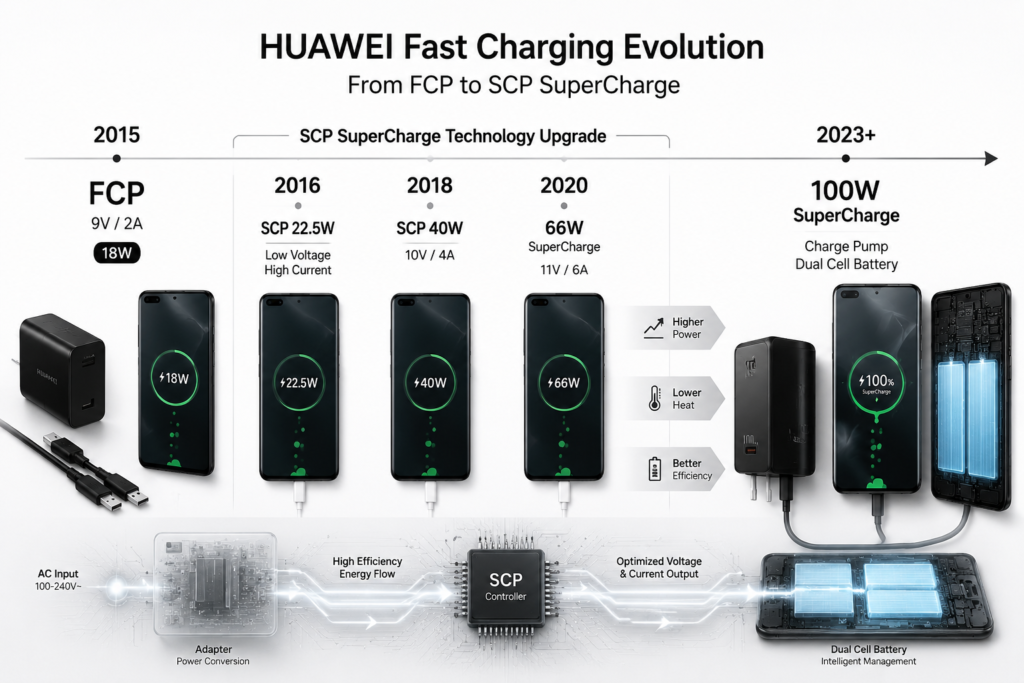
Short for SuperCharge Protocol, SCP is Huawei’s second-generation fast charging technology. It debuted in 2016 with the Huawei Mate 9, marking Huawei’s official entry into the “SuperCharge” era.
From its first generation to the present, SCP has gone through multiple rounds of power upgrades, covering all categories from flagship to mid-range models. The specific evolution of each generation of SCP is sorted out in the table below:
| SCP Generation | Typical Power | Voltage & Current Specification | Representative Model | Release Year |
|---|---|---|---|---|
| SCP 1.0 | 22.5W | 5V/4.5A / 4.5V/5A | Huawei Mate 9 | 2016 |
| SCP 2.0 | 40W | 10V/4A | Huawei Mate 20 Pro | 2018 |
| 66W SuperCharge | 66W | 11V/6A | Huawei Mate 40 Pro | 2020 |
| 100W SuperCharge | 100W | 20V/5A | 2022 and later flagship models | 2022 |
3.2 Working Principle of SCP Low-Voltage High-Current Direct Charging
Completely different from FCP’s technical approach, SCP follows the “low-voltage high-current” route. Its core is to make the charger output a low voltage closer to the battery voltage, and increase the current to boost power.
The biggest feature of this solution is the greatly reduced step-down loss inside the phone: the voltage output by the charger can directly charge the battery after simple conversion, with less energy waste and significantly less heat generated during charging, truly realizing the experience of “fast charging even when the screen is on”.
3.3 Charge Pump, Dual-Cell Battery and High-Efficiency Fast Charging Architecture
As power continues to increase, Huawei has added two key technologies to the SCP system to ensure efficiency:
The first is charge pump technology. It acts as a high-efficiency “voltage converter” that can complete voltage conversion with nearly 98% efficiency, with much less loss than traditional step-down circuits, making it the core support for high-power fast charging.
The second is dual-cell design. Simply put, a large battery is split into two small batteries connected in series. The voltage output by the charger can be split to charge both batteries at the same time, achieving higher charging power without increasing the voltage of a single battery, while ensuring battery safety.
3.4 Intelligent Control and Safety Protection Mechanism of SCP
The higher the charging power, the more important safety is. SCP has built a full-link safety protection system: multiple sensors on the charger, cable and phone monitor voltage, current and temperature in real time. Combined with an intelligent thermal control algorithm, it will automatically adjust charging power or even temporarily pause fast charging once excessive temperature or abnormal voltage is detected.
In addition, Huawei has added a battery health management function. By optimizing the charging curve, it slows down battery aging while maintaining fast charging, balancing charging speed and service life.
4. Core Technical Comparison Between FCP and SCP
To help you intuitively understand the core differences between FCP and SCP, we have sorted out the comparison of key indicators in the table below:
| Comparison Item | FCP Fast Charging | SCP Super Fast Charging |
|---|---|---|
| Technical Route | High-voltage low-current | Low-voltage high-current |
| Typical Max Power | 18W | Up to 100W and above |
| Cable Requirement | Ordinary USB cable | 5A/6A dedicated high-current cable |
| Heat Generation | Relatively high (more internal conversion loss) | Low (high-efficiency charge pump conversion) |
| Conversion Efficiency | Average | High (about 98% charge pump efficiency) |
| Bright-screen Charging Performance | General | Excellent |
4.1 Architectural Difference: High-Voltage Low-Current vs Low-Voltage High-Current
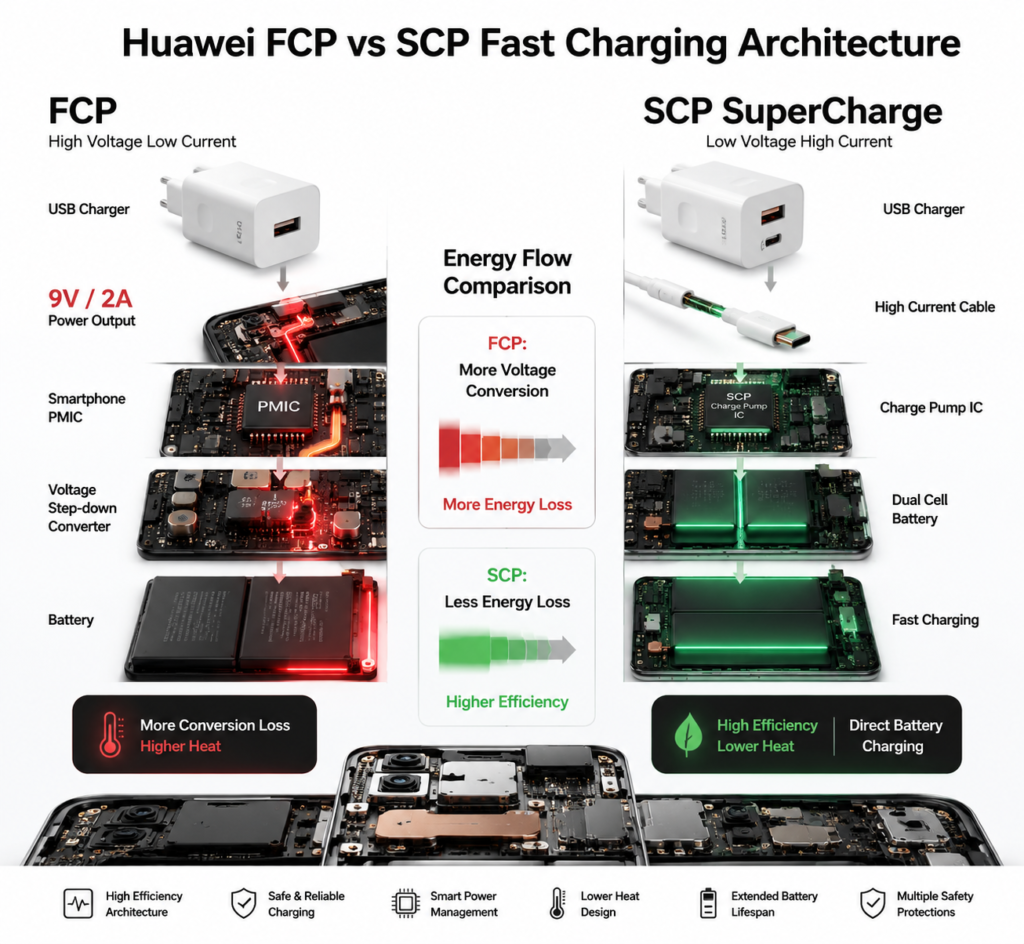
FCP relies on high voltage to increase power, requiring significant step-down conversion inside the phone; SCP relies on high current to increase power, with less conversion pressure on the phone side. The most essential difference between the two lies in the location and amount of energy loss.
4.2 Comparison of Charging Efficiency, Heat Generation and Power Performance
- Charging efficiency: SCP’s charge pump solution has much higher conversion efficiency than FCP’s traditional step-down solution, so more electricity can be actually charged into the battery
- Heat performance: FCP causes more obvious body heat during charging; SCP has much better overall thermal control due to lower loss, and its advantage is especially prominent during screen-on charging
- Power ceiling: FCP stops at 18W, while SCP can achieve 100W or even higher charging power through technological iterations
4.3 Requirements for Cables, Chargers and Compatibility
- Cable requirements: FCP works with ordinary USB cables; SCP requires dedicated 5A/6A high-current data cables due to the larger current, and some cables are also equipped with exclusive identification chips
- Compatibility: SCP chargers are backward compatible with FCP devices. When charging older Huawei phones, they will automatically switch to FCP mode, so there is no need to replace the charger.
5. Hardware Architecture of Huawei Fast Charging System
5.1 Charger and Protocol Identification System
The charger is the starting point of fast charging. In addition to the basic switching power supply circuit, Huawei fast chargers integrate an exclusive protocol identification chip. When a phone is connected, the chip quickly identifies the fast charging protocol supported by the device and matches the corresponding voltage and current levels to ensure both fast and safe charging.
5.2 Phone-Side Power Management and Charge Pump Technology
The Power Management Integrated Circuit inside the phone is the “command center” of fast charging, responsible for managing the entire charging process. In high-power SCP models, a dedicated charge pump chip undertakes the core voltage conversion work, replacing the traditional step-down circuit and achieving high-efficiency, low-heat energy transmission.
5.3 Dual-Cell Battery and High-Current Charging Design
The battery end is also specially optimized for fast charging: the dual-cell structure splits the charging pressure, and with a specially designed tab structure, it reduces internal resistance heating when high current passes through. At the same time, it is matched with professional heat dissipation materials to quickly dissipate the heat generated by charging, ensuring the stability of long-time fast charging.
6. Huawei Fast Charging Ecosystem and Future Development
6.1 Relationship Between SCP/FCP and Protocols Such as USB PD
USB Power Delivery (USB PD) is the current universal fast charging standard. Huawei’s recent phones and chargers also add support for the USB PD protocol. Simply put, Huawei’s proprietary fast charging (SCP/FCP) can achieve full-speed fast charging with the highest power, while the PD protocol ensures basic compatibility with devices of other brands, laptops and other products, balancing exclusive experience and versatility.
6.2 Huawei SuperCharge Certification and Accessory System
To ensure fast charging experience and safety, Huawei has launched the SuperCharge certification system. Only chargers and data cables that pass the certification can trigger full-speed SCP fast charging. Uncertified third-party accessories usually only support normal charging or low-power fast charging, which is the main reason why many users feel that “fast charging is not fast” after buying third-party chargers.
6.3 Development Trend: From Proprietary Fast Charging to Unified Fast Charging Standard
In the past, fast charging protocols of different brands were not compatible with each other, and users had to replace a full set of accessories when switching brands, resulting in high usage cost and inconvenience. Today, China has launched the Universal Fast Charging Standard (UFCS), and Huawei is an important participant in this standard. In the future, fast charging will gradually move toward “unified compatibility”, and chargers of different brands can trigger fast charging with each other, bringing a more hassle-free user experience.
7. Summary: The Technical Value of Huawei SCP/FCP Fast Charging
7.1 Summary of Technological Evolution from FCP to SCP
From FCP to SCP, Huawei has completed the leap from “following the industry mainstream route” to “developing an independent technical route”. FCP solved the problem of popularizing fast charging from scratch, while SCP has achieved experience upgrading from good to excellent. With the solution of low-voltage high-current plus charge pump, it has broken the thermal bottleneck of high-power fast charging.
7.2 Core Advantages of Huawei SuperCharge
The core advantage of Huawei SCP fast charging lies in the balance of speed, heat generation and safety. It does not simply pursue the paper power figure, but pays more attention to the thermal performance in actual use, screen-on charging experience and full-link safety protection, making fast charging not only fast, but also durable and reliable.
7.3 Future Direction of Smartphone Fast Charging Technology
In the future, smartphone fast charging will continue to develop toward higher efficiency, better compatibility and longer battery life on the basis of high power. With the popularization of unified fast charging and the application of new materials such as Gallium Nitride (GaN), fast charging will become more universal and compact, while better protecting battery health, truly alleviating users’ charging anxiety.