
When buying a charger, you have most likely come across terms like “gallium nitride fast charging”, “silicon carbide black technology”, and “third-generation semiconductor”. Merchants always claim that new materials make chargers smaller, faster, and cooler, but prices can range from tens to hundreds of yuan—are these really just an “intelligence tax”?
Many people assume by default that silicon carbide is more advanced than gallium nitride, or that any charger using new materials will definitely charge faster—these are all misconceptions. What you should really care about is never the name of the material, but whether the charger can fit in your carry-on bag, whether it gets unreasonably hot during charging, whether it can charge your phone/laptop at full speed, and whether it is safe for long-term use.
This article will thoroughly explain the differences between gallium nitride (GaN) and silicon carbide (SiC), covering everything from phone and laptop chargers to desktop chargers, car chargers, portable power stations, and even electric vehicle charging, to help you understand what to choose for different scenarios and avoid marketing pitfalls.
Beginner Basics: What Do GaN and SiC Actually Do in Chargers
To understand the difference in user experience between the two, we first need to figure out what actually happens inside a charger, and what roles GaN and SiC play in it.
Basic Operating Principle of Chargers
The wall sockets in your home output high-voltage alternating current (for example, 220V in mainland China, 110V in North America), but your phone and laptop require low-voltage direct current. The job of a charger is to convert this high-voltage alternating current into low-voltage direct current that devices can use, through rectification, switching conversion, voltage transformation, filtering, plus fast charging protocol negotiation.
GaN and SiC are two materials mainly used in the power conversion section of chargers—that is, the core link responsible for high-speed switching and voltage adjustment, such as high-frequency switching transistors, power factor correction (PFC, which is mainly used to improve power factor, reduce reactive power and harmonic impacts on the power grid, and may also help the whole machine optimize efficiency under specific loads, but this does not mean users will definitely save a noticeable amount of electricity), or high-voltage rectification parts. Simply put, they are the core components in chargers responsible for “controlling power switches”, which directly affect the efficiency, size, and heat generation of the charger.
What Are “Core Switching Devices”
You can think of power switching devices as a high-speed electronic valve that opens and closes: when current needs to pass through, the valve opens; when voltage needs to be adjusted, the valve opens and closes rapidly, controlling the output voltage level through the proportion of time it is open versus closed.
The performance of this valve is very important:
- The faster the switching speed, the smaller the magnetic components such as transformers and inductors in the charger can be made (because the higher the frequency, the smaller the required magnetic core volume), so the overall size and weight of the charger can be reduced;
- The smaller the “resistance” when the valve is open, the less heat is wasted when current passes through, that is, the lower the conduction loss;
- The less loss generated at the moment of switching, the less overall heat is generated, and the higher the efficiency.
But note: material is only part of what affects switching performance; the final overall device experience also depends on circuit design, heat dissipation, capacitors, transformers, protection strategies, and even the quality of the protocol chip. It’s just like being given the best engine—if the transmission and body design are poor, the overall vehicle performance won’t be good either.
Plain-Language Features of Gallium Nitride (GaN)
The biggest advantage of gallium nitride is its fast switching speed, which is especially suitable for high-frequency operation, so it is easiest to make chargers small and light with it.
The lipstick-sized 65W chargers and wallet-fitting 100W multi-port chargers you can buy now basically use gallium nitride devices. For ordinary users, the most intuitive feeling is: at the same power, gallium nitride chargers are usually smaller and lighter, making them very convenient to carry on business trips and commutes.
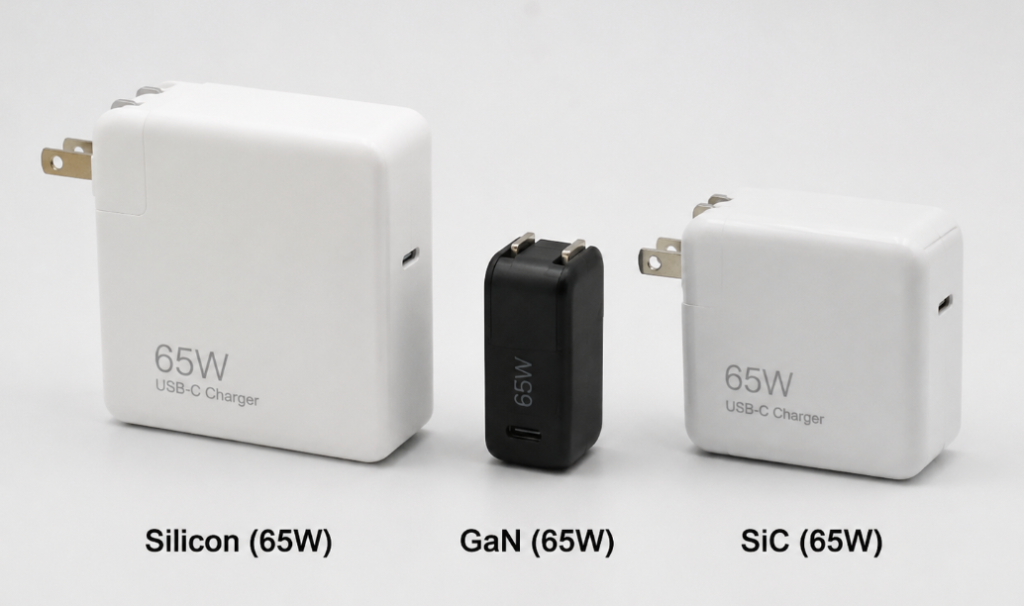
But it also has limits: gallium nitride does not equal “no heat generation”. If you pursue an extremely small size, stack the power very high, and don’t do a good job with heat dissipation, the casing will still get hot at full load. After all, the power is fixed—the smaller the size, the harder it is for heat to dissipate.
Plain-Language Features of Silicon Carbide (SiC)
The core advantage of silicon carbide is its high voltage resistance and high temperature resistance, making it suitable for high-power and long-term high-load operation.
It has a higher voltage withstand rating and more stable performance at high temperatures, so it is more commonly used in scenarios that require long-term high-voltage and high-power operation, such as electric vehicle on-board chargers (OBC, the component in electric vehicles that converts alternating current to direct current to charge the battery, equivalent to the built-in “charger” of the electric vehicle), public DC fast charging piles, inverter/charging modules of portable power stations, and industrial power supplies. In these scenarios, silicon carbide can bring higher efficiency, better thermal stability, and more reliable long-term use.
But for USB-C chargers for mobile phones, tablets, and most thin and light laptops, the advantages of silicon carbide are actually difficult to fully leverage—the input is still household alternating current, and the output power is mostly in the range of tens of watts to 100-200 watts; mature GaN solutions can usually already meet the requirements for miniaturization and efficiency. For desktop chargers above 200W or power supplies that operate at full load for long periods, you need to combine topology and heat dissipation design to judge whether SiC or a hybrid solution is needed. Blindly using silicon carbide may instead increase costs with no obvious improvement in experience.
A Few Parameter Terms You Will Encounter Sooner or Later
When looking at charger parameters, you may come across these terms—you don’t need to memorize them by rote, just know their general meaning:
- Switching frequency: This is the number of times the aforementioned “electronic valve” opens and closes per second. The higher the frequency, the easier it is to make the charger small, but at the same time, the design difficulty of electromagnetic interference and heat dissipation will also be higher.
- On-resistance (Rds(on)): This is the “resistance” when the valve is open. The lower the value, the less heat is wasted when current passes through, and the smaller the conduction loss. However, this value is affected by operating voltage, current, and temperature, so you can’t just look at the nominal value.
- Breakdown voltage/withstand voltage: This is the internal high voltage that the device itself can withstand, not the voltage output to the mobile phone. Common ratings include 650V, 750V, 900V, 1200V, etc. The higher the withstand voltage, the more suitable it is for high-voltage and high-power scenarios.
- Switching loss: The loss generated at the moment the valve opens and closes. Gallium nitride usually has an advantage in this regard because of its fast switching speed.
- Thermal resistance and heat dissipation: This is how easily heat is transferred from the chip to the casing and then dissipated into the air. No matter how good the material is, if the heat dissipation design is poor and heat is trapped inside, the charger will still get very hot.
- Power density: The power that can be output per unit volume, commonly expressed in W/cm³. The larger the value, the higher the power that can be output under the same volume, and the more compact the charger, but the corresponding heat dissipation pressure is also greater.
Scenario-Based Purchasing Guide: How to Choose for Different Users
After talking about so many comparisons, you may still not know which one to buy. We will give you direct purchasing advice based on the most common usage scenarios.
Mobile Phones, Tablets, Earphones, Watches, Handheld Consoles (20W-65W)
Recommendation: Prioritize gallium nitride or mature, legitimate silicon-based products; there is absolutely no need to deliberately pursue silicon carbide.
This power range is the advantage zone of gallium nitride, with small size, suitable price, and many options. What you should focus on is not the material, but these points: size and plug design (whether it is foldable, whether it can fit in your bag), single-port power (whether it can charge your device at full speed), protocol support (for Android phones, check if it has PPS or the corresponding brand’s proprietary protocol; for iPhone and iPad, just check PD compatibility), and safety certifications (such as UL/ETL, CE, FCC, UKCA, etc., which correspond to the standards of your region).
Pitfall Avoidance Reminder: Don’t buy high-priced low-power silicon carbide chargers just because “silicon carbide is more advanced”—you will basically feel no difference, it’s a pure waste of money.
Thin and Light Laptops, Multi-Port Travel Chargers (65W-140W)
Recommendation: Gallium nitride is the mainstream preferred choice, with the best balance of portability and price.
Gallium nitride technology in this power range is already very mature. Whether it’s a single-port adapter for thin and light laptops or a multi-port travel charger, it can be made very small. Carrying one on a business trip can charge your computer, phone, and tablet, which is very convenient.
When choosing, focus on:
- Maximum single-port power: For example, if your thin and light laptop requires 65W, then at least one port must be able to output 65W independently; if it’s a 100W or 140W device, you need a charger with a corresponding single-port output of that power.
- Multi-port power distribution: Many people have fallen into this pit—a three-port charger with a total power of 100W does not mean each port can output 100W at the same time. It may output 100W on a single port, but when two ports are used together, it becomes 65W + 30W, and when three ports are used together, the power is even lower. Be sure to check the power distribution table in the manual, otherwise the charging speed will drop when multiple devices are charged at the same time.
Note: 140W Apple devices (such as the 16-inch MacBook Pro) require a charger and corresponding cable that support PD 3.1 EPR. You can’t just look at the word “gallium nitride”, otherwise you won’t get the full 140W.
Gaming Laptops, High-Performance Laptops, Mobile Workstations (140W-300W)
Recommendation: First check if your device supports high-power USB-C PD. Many gaming laptops still require the original round-port or dedicated adapter to run at full performance.
If your device supports high-power USB-C PD, then choose based on the situation:
- Portability priority: Choose a high-power gallium nitride multi-port charger, but accept that the temperature may be higher under high load, or the power may drop when charging while using (due to the limitations of the device’s own charging strategy).
- Long-term desktop use: You can pay attention to desktop power supplies with better heat dissipation. In this case, silicon carbide or hybrid solutions can be a plus—after all, for long-term high-load operation, the thermal stability advantage of silicon carbide is more obvious.
When choosing, be sure to confirm: whether the single-port output power is sufficient, whether it supports PD 3.1 EPR, whether the cable can handle it, and whether your device allows full-power charging while in use. Don’t buy a 200W charger only to find that your gaming laptop’s USB-C only supports up to 100W—that’s a waste of money.
Multi-Port Desktop Charging Stations (Above 200W)
Recommendation: Don’t judge solely by gallium nitride/silicon carbide; focus on total power, single-port power, power distribution, heat dissipation method, and certifications.
For desktop charging stations above 200W, the advantage of gallium nitride is good size control, so it doesn’t take up space on the desktop; if the product uses silicon carbide devices, they are usually in the high-voltage PFC or main power stage, which will have better thermal stability during long-term full load, but only if the overall heat dissipation design is up to par.
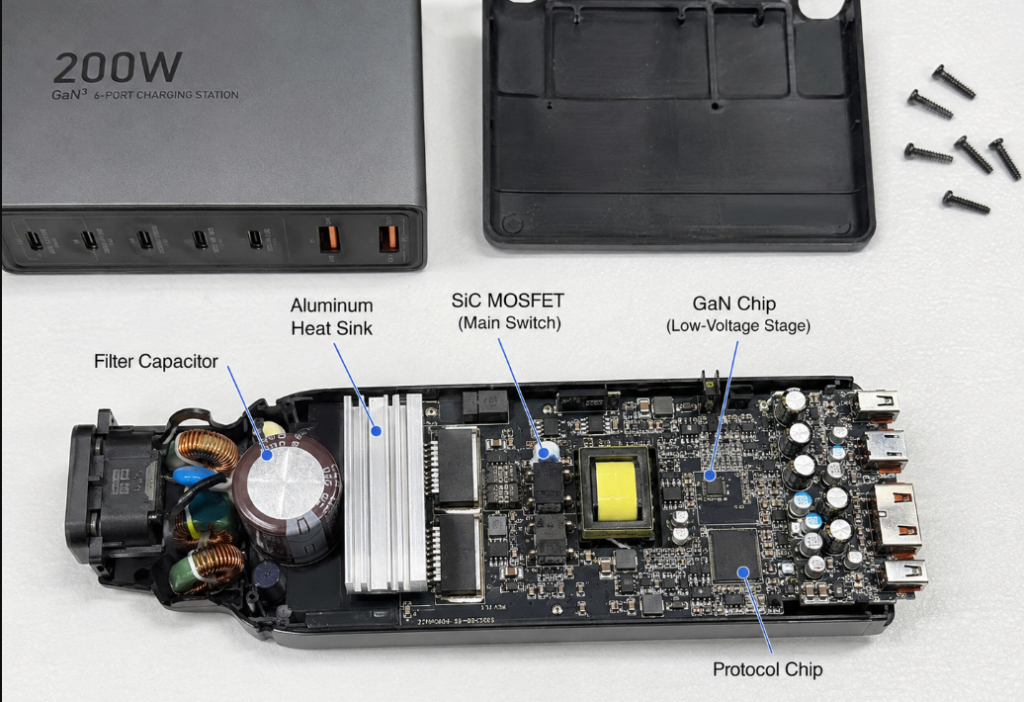
How to judge if it’s reliable? Don’t just look at promotional slogans; check if it clearly states what devices are used (for example, “main switch uses SiC MOSFET” vs “only the rectifier uses SiC diodes”), and whether there are third-party teardowns, full-load temperature rise tests, and long-term stable output test reports.
In-Car USB Chargers
Many people also struggle between gallium nitride and silicon carbide when buying car chargers, but it’s completely unnecessary.
USB car chargers for 12V/24V cigarette lighters are essentially DC-DC step-down converters (they step down the car’s 12V/24V direct current to the 5V/9V/12V required by mobile phones). The input voltage is inherently low, so the high voltage resistance advantage of silicon carbide cannot be leveraged at all. At this time, what is more important is the input voltage range, over-temperature protection, automotive-grade protection design, PD/PPS protocol support, and casing heat dissipation.
Pitfall Avoidance Reminder: Don’t believe the saying “choose GaN for 12V, choose SiC for 24V”. In low-voltage car chargers, silicon carbide is never a core selling point.
Portable Power Stations, Home Energy Storage, Solar Charging
The situation for this type of product is more complex and cannot be generalized:
- Low-power USB output ports on these devices: They may use gallium nitride or traditional silicon solutions. Focus on protocol support and output stability, don’t worry too much about the material.
- AC/DC charging modules, inverters, high-voltage power stages: Silicon carbide is more likely to appear in these parts, especially in designs with high efficiency, high temperature, and high power density, where the advantages of silicon carbide are very obvious.
When choosing this type of product, focus on charging power, heat dissipation design, BMS (Battery Management System) strategy, safety certifications, and long-term operation stability. The material is just one reference factor.
Electric Vehicle AC Charging Piles and DC Fast Charging
Many people see that electric vehicles use silicon carbide and think that home charging piles also need to be made of silicon carbide, but this is actually a misconception.
Home AC charging piles themselves are only power supply and protection devices; they are not responsible for converting alternating current to direct current—the actual AC-DC conversion is completed in the OBC (on-board charger) inside the electric vehicle. So whether your home AC charging pile uses silicon carbide is actually meaningless; what really affects efficiency is the OBC on the vehicle.
Currently, the penetration rate of silicon carbide in on-board OBCs is increasing, especially for models with 800V high-voltage platforms. Using silicon carbide can improve efficiency, reduce heat generation, and have the opportunity to reduce electric drive or charging conversion losses, thereby improving energy consumption performance; the actual range improvement depends on the overall vehicle electric drive design, working conditions, and battery management strategy. Not to mention public DC fast charging piles—in high-power, liquid-cooled ultra-fast charging scenarios, the advantages of silicon carbide modules are very obvious, but traditional silicon and IGBT solutions still exist.
Simple Conclusion: For high-voltage systems such as electric vehicles and energy storage, silicon carbide is more worthy of attention, but don’t apply the purchasing logic of mobile phone chargers to them.
Clarification of Common Misconceptions
Finally, we will collectively clarify a few of the most commonly asked misconceptions to avoid falling into pitfalls in the future.
“Silicon carbide is more advanced than gallium nitride, so it must be better”
Wrong. The two are materials with different positioning, not an upgrade-replacement relationship. Silicon carbide is suitable for high-voltage, high-power, long-term operation, while gallium nitride is suitable for high-frequency miniaturization. In scenarios such as mobile phone, tablet, and thin and light laptop chargers, gallium nitride is usually more practical and cost-effective.
“GaN can only be used for low power”
Wrong. Now consumer-grade gallium nitride has been widely used in products with 100W, 140W, 200W, and even higher power. Of course, the higher the power, the higher the requirements for heat dissipation, circuit design, cost, and power distribution. You can’t apply the size standards of low-power products to high-power products.
“Chargers using GaN or SiC won’t generate heat”
Wrong. They only have the potential to reduce losses and improve efficiency, but small-size, high-power products will definitely still generate heat at full load. To judge whether the quality is good, you should look at temperature control, stability, and protection functions, not just the temperature you feel by hand.
“SiC chargers must charge faster”
Wrong. Charging speed depends on the charging power allowed by your device, the supported fast charging protocols, battery temperature, the cable, and the output levels of the charger. The material does not directly determine the compatibility of PD, PPS, or proprietary fast charging, nor does it directly determine charging speed.
“If it says third-generation semiconductor, it must have GaN or SiC core devices”
Not necessarily. Third-generation semiconductor is a broad category term that includes many materials. Some merchants only use a tiny bit of third-generation semiconductor material in unimportant parts and use it as a selling point, while the core switch is still traditional silicon. Be sure to check what specific material is used and where it is used; it’s best to look at teardowns and official descriptions.
“Traditional silicon chargers must be outdated”
Not necessarily. In low-power, low-cost, mature design scenarios, traditional silicon solutions are still very stable and reliable, and are also cheap. For example, if you just buy a 20W charger for your iPhone, a silicon-based product from a reputable brand is completely sufficient, and there’s no need to spend extra money on gallium nitride. The advantages of gallium nitride and silicon carbide are only more obvious in high-frequency, high-power density, high-efficiency, or high-voltage scenarios.
Applicable Boundaries and Future Trends
Neither gallium nitride nor silicon carbide is omnipotent; each has its own applicable boundaries. Future development will not be one replacing the other, but each playing a role in its own field of expertise.
Boundaries of GaN
Although gallium nitride is suitable for making miniaturized chargers, it can’t handle all scenarios:
- In high-voltage, ultra-high-power scenarios, relying solely on gallium nitride may not be appropriate, after all, its voltage withstand rating is relatively not that high;
- High frequency brings the potential for miniaturization, but also brings increased electromagnetic interference, heat dissipation, and design difficulty. If the design is poor, it will instead cause problems;
- Poor-quality gallium nitride chargers may cut corners on heat dissipation and protection circuits to reduce costs, and their experience may even be worse than that of legitimate silicon-based products.
Boundaries of SiC
Silicon carbide is not suitable for all scenarios either:
- In medium and low-power small USB-C chargers, the cost and advantages of silicon carbide simply don’t match—you spend more money but get no obvious improvement in experience;
- In terms of high-frequency miniaturization, gallium nitride has more obvious advantages. Silicon carbide is more suitable for high-voltage, high-power, long-term full-load scenarios, not all fast charging scenarios.
Common Boundaries
Whether it’s gallium nitride or silicon carbide, they are only part of power devices, and cannot replace a complete power supply design. The final experience of a charger is jointly determined by circuit topology, magnetic components, capacitors, heat dissipation, protocol chips, cables, certifications, and manufacturing quality. Good materials are just the foundation; if the design is poor, no matter how good the materials are, they are useless.
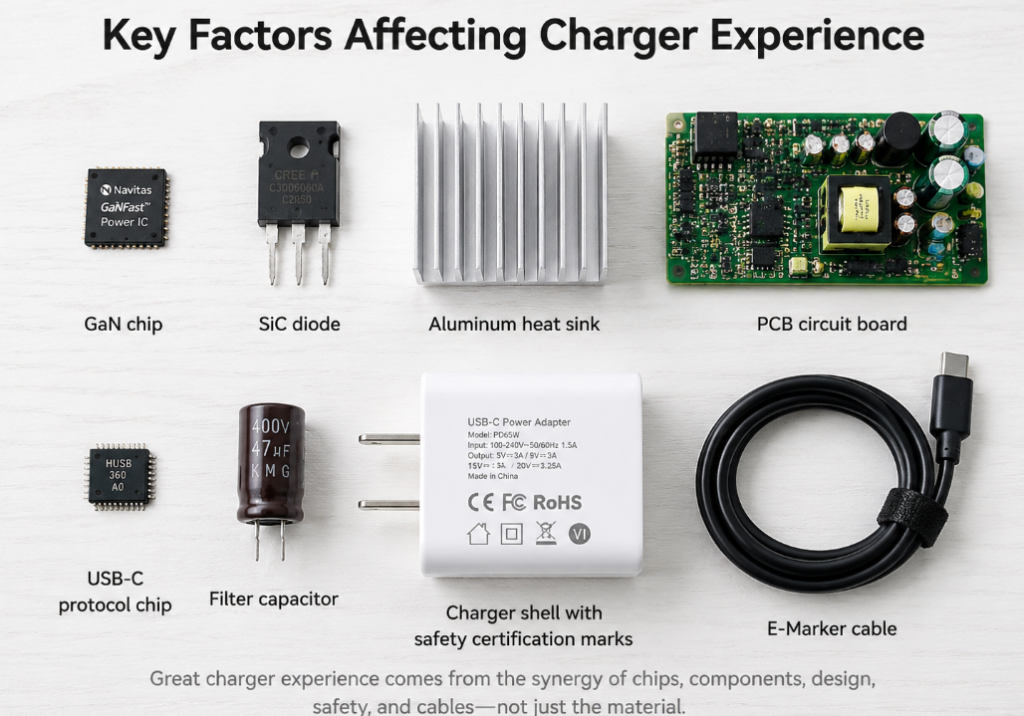
For ordinary users, when purchasing, you must treat the material as a “bonus factor”, not the only judgment standard.
Future Trends
In the future, these two materials will not replace each other, but will continue to develop in their respective fields, and even more hybrid solutions will emerge:
- Gallium nitride: It will develop in the direction of higher integration, lower cost, and higher power density, continuing to cover consumer electronics scenarios such as mobile phones, tablets, laptops, and desktop chargers. In the future, there may be smaller and cheaper gallium nitride chargers.
- Silicon carbide: It will continue to grow in fields such as electric vehicles, energy storage, photovoltaics, DC fast charging, and high-end power modules. Especially for high-voltage platform models and high-power energy storage equipment, the penetration rate of silicon carbide will become higher and higher.
- Hybrid solutions: High-power products may use gallium nitride, silicon carbide, and traditional silicon devices at the same time, using the most suitable materials in different links to balance cost, efficiency, size, and reliability. For example, using silicon carbide for high-voltage PFC and gallium nitride for low-voltage output, which can not only give play to their respective advantages but also not be too expensive.
Quick Reference Conclusions
If you can’t remember everything by the time you get here, you can just look at the quick reference conclusions below and choose according to your own needs.
Choose by Power
- 20W-65W: Prioritize gallium nitride or mature, legitimate silicon-based products; silicon carbide has very low necessity.
- 65W-140W: Prioritize gallium nitride, suitable for thin and light laptops and multi-port travel chargers, with the best balance of portability and price.
- 140W-240W: Both gallium nitride and hybrid solutions are acceptable; focus on single-port power and heat dissipation design.
- Desktop chargers above 200W: Don’t just look at the material; focus on full-load stability, power distribution, and safety certifications.
- kW-level energy storage, electric vehicles, DC fast charging modules: Focus on silicon carbide, as well as the overall efficiency and heat dissipation of the device.
Choose by Need
- For portability: Prioritize gallium nitride.
- For charging mobile phones/tablets/thin and light laptops: Prioritize gallium nitride and protocol compatibility.
- For long-term high-power full-load operation: Pay attention to silicon carbide, heat dissipation design, and derating design.
- For buying electric vehicles/energy storage/high-voltage power supplies: Silicon carbide is more worthy of attention, but also look at the overall device design.
- For fast charging: First look at protocols, single-port power, cables, and device support, don’t look at the material first.
Summary
After reading this article, you don’t need to remember all the parameters; you just need to develop these judgment abilities:
- Be able to distinguish that gallium nitride, silicon carbide, fast charging protocols, and brand promotion are not the same thing at all, and don’t be led by marketing terms;
- Be able to understand that gallium nitride leans toward high-frequency miniaturization and is suitable for making portable chargers; silicon carbide leans toward high-voltage, high-power stability and is suitable for long-term high-load scenarios;
- Be able to choose suitable products according to your own usage scenarios (mobile phones, laptops, desktop chargers, in-car use, energy storage, electric vehicles), instead of blindly pursuing “more advanced” materials;
- Be able to understand truly important parameters such as single-port power, multi-port distribution, PD/PPS/PD 3.1, E-Marker, and safety certifications;
- Be able to recognize common marketing misconceptions such as “material is everything”, “third-generation semiconductors are omnipotent”, and “silicon carbide is definitely faster and more advanced”.
When buying a charger, it’s always true that “the one that suits you is the best”. The material is just one reference factor; don’t let it be the only standard for your decision.