
If you often go out with a laptop, phone, and tablet, and your bag is stuffed with three or four bulky, messy chargers, you’ve most likely come across promotions for GaN chargers—they’re said to be small, fast-charging, and one can replace three. But some people say it’s a scam, not much different from a regular charger. What exactly is the difference between the two? Which one should you buy? We’ll put the core conclusions first, then cover the principles and details later.
First, the Conclusion: What’s the Core Difference Between the Two
First, the core advantage of GaN chargers has never been “naturally faster charging.” Instead, at the same power level and same quality, they are easier to make smaller and lighter, have higher energy conversion efficiency, and are more suitable for multi-port chargers—one charger can power multiple devices.
Second, regular chargers are not synonymous with outdated or unsafe—their core components use traditional silicon semiconductors, and the technology is very mature. As long as they are from a reputable brand, have complete certifications, and no false power labeling, they are just as stable to use, especially suitable for low-power, fixed-location use, and budget-limited scenarios.
Finally, what really determines charging speed is how much power your device supports, what fast charging protocols it supports, whether the cable you use meets specifications, how much battery is left, and the device’s temperature control strategy. It has no direct relationship with whether the charger uses silicon or GaN.
For your quick comparison, we have compiled a core difference table:
| Comparison Dimension | GaN Charger | Regular Silicon-Based Charger |
|---|---|---|
| Size and Weight | Usually smaller and lighter at the same power and quality; the gap is obvious above 65W | In medium-high power ranges like 45W/65W/100W, usually larger and heavier at the same power and quality; the gap is very small below 20W |
| Charging Speed | Basically the same as regular models with the same device, protocol, and power; speed differences come from power/protocol matching | Basically the same as GaN models with the same device, protocol, and power; low-power models are naturally slower |
| Heat and Efficiency | Usually higher conversion efficiency, relatively less heat; poor design will offset the material advantage | Slightly higher heat at the same power and volume; excellent design is also stable |
| Multi-Port Capability | Easier to make 2-4 ports in the same volume; multi-port shares total power | Can also be made with multiple ports, but size and weight will increase significantly |
| Compatibility | Depends on supported fast charging protocols and cables, has nothing to do with the material | Depends on supported fast charging protocols and cables, has nothing to do with the material |
| Safety | Compliant products have complete protection; risks come from uncertified, falsely labeled, or poorly designed products | Compliant products have complete protection; risks come from uncertified, falsely labeled, or poorly designed products |
| Price | Usually more expensive; the premium is more obvious for models above 65W or multi-port models | Usually cheaper; low-power models have very high cost-effectiveness |
| Suitable Users | Users who travel frequently, use multiple devices, or need high power above 65W | Users with a single low-power device, fixed-location use, or limited budget |
Comparison Premise: Clarify the Objects and Fair Rules First
To compare the two fairly, we must first clarify the comparison objects and rules. Otherwise, comparing the speed of a 65W GaN charger with an 18W regular charger is like comparing running shoes with leather shoes to see which is faster—it’s meaningless.
What Is a Regular Silicon-Based Charger
The core power switching components of the regular chargers we often talk about use traditional silicon semiconductor materials—this has been the mainstream solution for consumer electronics power supplies over the past few decades, and the technology is very mature.
You must have quite a few at home: the 5W chargers that came with early mobile phones, the bulky power adapters for older laptops, and many low-cost USB-A port chargers are basically silicon-based.
It must be clarified first: “regular” does not equal “inferior,” and “silicon-based” does not equal “unsafe.” As long as a regular charger is from a reputable brand, has passed the safety certification of the corresponding region, and has no false power labeling, it is completely reliable to use. Even some high-end silicon-based products have better stability than inferior GaN chargers.
What Is a Gallium Nitride (GaN) Charger
The core power switching components of GaN chargers use gallium nitride, a new type of semiconductor material, which has been particularly common in small-sized, high-power USB-C fast chargers in recent years.
Many people regard GaN as a new fast charging protocol, which is the most common misunderstanding—GaN is just an upgrade of internal materials, not a fast charging protocol. It cannot replace universal protocols such as USB-PD (universal USB fast charging standard), PPS (programmable power supply, adapted to high-speed fast charging of most Android phones), and QC (fast charging standard launched by Qualcomm), nor can it replace the private fast charging protocols of mobile phone manufacturers. Simply put, GaN helps chargers “slim down,” not “speed up.”
Most GaN chargers on the market now are medium-high power models like 65W, 100W, and 140W. Many have 2 to 4 ports, and some also have foldable plugs, focusing on one charger for shared use with mobile phones, tablets, and thin and light laptops.
Also note that the so-called “GaN charging cable” is basically a marketing gimmick—the core of a cable is its current carrying capacity, whether it has an E-Marker chip, interface type, and certification, which has nothing to do with GaN material at all.
Fair Comparison Criteria of This Article
To prevent the comparison from being a mismatch, all comparisons in this article follow four unifications:
First, unified power: we compare products with the same rated power as much as possible, for example, 65W GaN vs. 65W regular charger, instead of comparing high power with low power;
Second, unified quality: we compare products from mainstream brands, with compliant certifications, and of the same grade, excluding those cheap unbranded inferior products that cost a few dollars;
Third, unified protocol: we mainly discuss based on the universal USB-C PD fast charging, and separately explain the impact of PPS and private protocols;
Fourth, unified scenario: we only talk about USB chargers for daily use with mobile phones, tablets, earphones, watches, handheld game consoles, and thin and light laptops, and do not involve power supplies for special fields such as industry, medical care, and servers.
Key Variables That Will Change the Conclusion
Even the same charger may have very different experiences when used in different scenarios. There are four key variables that will directly affect the comparison results. If you figure them out in advance, you won’t be easily misled by marketing:
- Device side: Maximum input power, supported PD/PPS/private fast charging protocols, battery charge level, and its own temperature control strategy are the core factors affecting the charging experience.
- Charger side: Maximum single-port power, total power, multi-port power distribution rules, control chip responsible for identifying fast charging protocols, internal circuit scheme (core design affecting efficiency, heat, and stability), heat dissipation structure, and high-temperature derating strategy all affect the actual experience more than the material itself.
- Cable side: Whether the USB-C cable is 3A or 5A, whether it has an E-Marker chip (a built-in power identification chip in the cable used to inform the charger of the maximum current the cable can carry), whether it can support 100W or even higher power, and whether the Lightning cable is compliant will all limit the actual charging power.
- Environment side: Room temperature, ventilation conditions, socket input voltage (110V/220V), and whether it works at full load for a long time will also affect heat and efficiency.
Plain Language Principle: Why GaN Can Be Made Smaller and Lighter
You may be curious: it’s just a change of material, why can GaN be made so much smaller? In fact, the principle is not difficult to understand. You don’t need to memorize professional terms, just know the general logic.
Common Working Process of Chargers
Whether it’s a GaN or regular charger, the job it does is the same:
First step: convert the high-voltage alternating current from the wall socket into low-voltage direct current that the device can use, such as 5V, 9V, 12V, 20V, etc.;
Second step: “negotiate” with the device through the fast charging protocol which voltage and current gear to use, it’s not that the charger can pour as much power as it wants;
Third step: the device’s own battery management system will adjust the actual power intake in real time according to the battery level and temperature, and stop when fully charged.
Simply put, the charger is just a “power supplier,” and the one that really manages charging is your device. Therefore, a qualified high-power charger will not damage small devices, because small devices simply don’t need that much power.
Main Limitations of Regular Silicon-Based Chargers
Traditional silicon-based power devices have the advantages of being mature, cheap, and reliable, and the technology has been very stable after decades of use. But it has a shortcoming: the switching speed cannot be increased too much, and the loss will increase when working at high frequencies.
There is a key component in the charger called a transformer, whose size is directly related to the switching frequency—the lower the frequency, the larger the transformer needs to be to achieve the same power, and components such as inductors and capacitors also cannot be made small.
Therefore, if you want to make a high-power silicon-based charger smaller, you will encounter a contradiction between heat, efficiency, and size—either large size, high heat, or low efficiency. Of course, this is only the general situation. Excellent silicon-based design can still be done very well, and it cannot be said that silicon-based is necessarily inferior.
Source of GaN’s Advantages
The power devices made of GaN material have much faster switching speed than silicon-based ones, and lower loss when working at high frequencies, making them particularly suitable for working at high frequencies.
When the switching frequency is increased, components such as transformers and inductors can be made much smaller. Therefore, at the same power, GaN chargers are easier to reduce in size and weight. At the same time, with less loss, there will be relatively less heat.
But note that GaN only gives chargers the “potential for miniaturization and high efficiency,” which does not mean that all GaN products are necessarily good—if the circuit design is poor, heat dissipation is bad, and the protocol chip is junk, even with GaN, the experience may not be as good as a high-quality silicon-based charger.
Scenarios Where Material Advantages Are Not Obvious
GaN is not omnipotent. In some scenarios, its advantages are almost imperceptible:
First, low-power scenarios below 20W: regular silicon-based can already be made very small, the size advantage of GaN is almost invisible, and the price is more expensive;
Second, charging low-power devices such as earphones, watches, and e-book readers: they originally only need a few watts to more than ten watts. Chargers made of any material are the same, there is no difference in speed or heat;
Third, poorly designed GaN products may have worse stability than regular formal chargers due to poor heat dissipation and cut corners in the circuit;
Finally, scenarios that rely on private fast charging protocols: for example, the 120W and 200W fast charging of some mobile phones must use original chargers and cables to reach full speed. In this case, having the protocol is much more important than whether it is GaN.
Item-by-Item Comparison of Core Dimensions
After talking about the principle, let’s break down the several dimensions that everyone is most concerned about. For each dimension, we will first give the conclusion, then talk about the boundaries and precautions, so that you can read as needed.
Size and Weight: The Most Intuitive Advantage
Size and weight are the core selling points of GaN, and also the most obvious difference perceived by users.
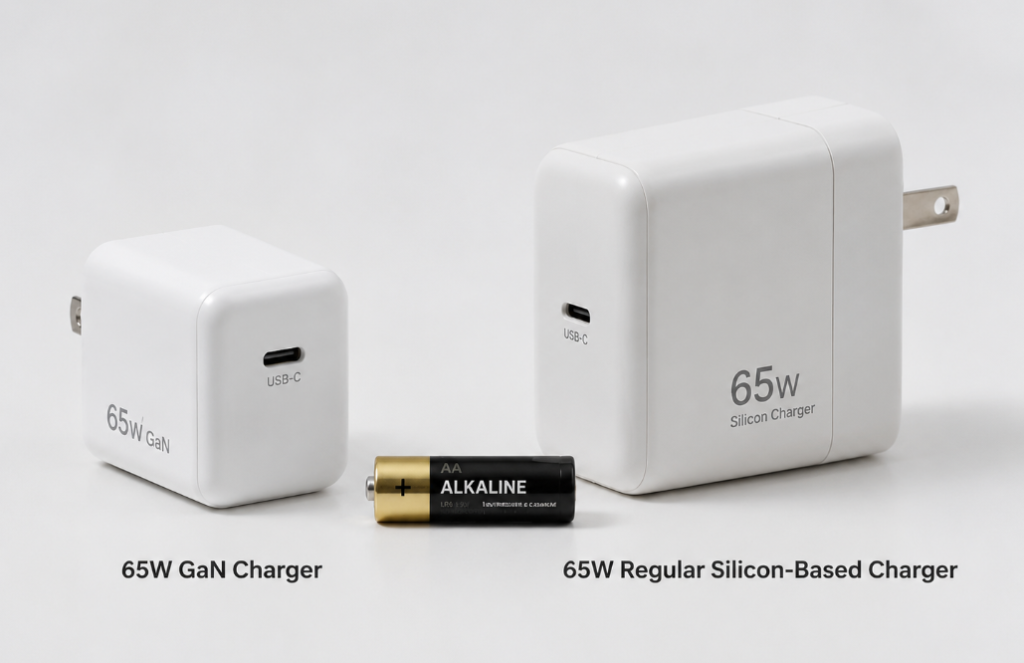
In medium-high power ranges such as 45W, 65W, and 100W, among mainstream products of the same grade, GaN chargers are usually smaller and lighter than regular silicon-based ones. Take the 65W level as an example: the size of GaN models is usually 20% to 50% smaller than traditional silicon-based models, and the weight is 10% to 40% lighter—the exact difference depends on whether the plug is foldable, how many ports there are, and the design of the shell and heat dissipation.
This advantage is particularly obvious when traveling on business: a 65W or 100W multi-port GaN charger may replace three chargers for mobile phones, tablets, and thin and light laptops, saving a lot of space and weight in your backpack.
But this advantage also has boundaries: for example, a multi-port GaN charger is not necessarily smaller than a single-port regular low-power charger; for low-power models below 20W, the size difference between the two is extremely small, almost imperceptible; in addition, models with foldable plugs are more convenient to store, which also affects the actual use experience.
Charging Speed: The Most Easily Misled by Marketing
Charging speed is the dimension where marketing most easily misleads by swapping concepts. Many merchants promote “GaN fast charging is faster,” but in fact, they bind “high power” and “GaN” together.
The core conclusion is very clear: with the same device, same cable, same fast charging protocol, and same rated power, the charging speed of GaN and regular chargers is basically the same.
Some people may say, “I do charge faster with GaN than with my previous regular charger?” That’s most likely because your previous regular charger had low power. For example, you used an 18W regular charger before, and now you’ve switched to a 65W GaN charger. The speed increase is because the power has risen from 18W to 65W, not because of the GaN material itself.
There may be slight speed differences in actual charging, such as better PPS gear matching, less temperature control derating, and smaller cable voltage drop, but these differences come from the overall design and protocol matching of the charger, not that GaN material directly makes the battery charge faster.
Take the most common example: for an iPhone that only supports up to 20W PD charging, if you charge it with a 65W GaN charger and a 65W regular PD charger, the peak power will not exceed 20W, and the charging speed is basically exactly the same.
Heat and Conversion Efficiency: There Are Differences, But Don’t Exaggerate
Many people buy GaN because they think it “doesn’t heat up,” which is actually an exaggeration.
The common conclusion is: under the same power and same size target, GaN solutions are usually easier to achieve higher conversion efficiency and lower heat. Under medium and high loads, an excellent GaN charger may be a few percentage points more efficient than traditional silicon-based solutions, and the surface temperature may be a few degrees Celsius lower. However, the design differences between different products are very large, and cannot be generalized.
Here’s a heads up: when a high-power charger is at full load, it’s normal for the shell to be warm or even hot. Generally, it’s not necessarily abnormal within the range of 40°C to 60°C—it also depends on the ambient temperature. When the room temperature is 30°C in summer, it’s common for the charger surface to reach over 50°C. It will feel hot to the touch, but it won’t cause burns.
As for power saving, since the power consumption of a single mobile phone charge is not large, the difference in electricity bills caused by a few percentage points of efficiency difference is usually very small; if it is long-term high-load power supply for a laptop, the difference is more worthy of attention. There is no need to specifically buy GaN just to save power.
You should pay attention if these situations occur: the charger is so hot that you can’t keep touching it with your hand, there’s a burnt smell, there’s a sharp whistling sound, the shell is bulging and deformed, charging is frequently interrupted, or the plug or port is blackened. In these cases, stop using it immediately to avoid danger.
Multi-Port Capability and Power Density: Key for Multi-Device Users
If you have several devices to charge, the multi-port capability of GaN will be the point you value most.
First, let’s explain a term: power density, which is the maximum power that can be output per unit volume—simply put, “the smaller the volume that can output more power, the higher the power density.” GaN has obvious advantages in power density in the medium-high power range, so under the same volume, it is easier to make chargers with 2 to 4 ports. Common combinations include USB-C+C, USB-C+C+A, USB-C+C+C+A, etc.
But there is a very important rule here that many people fall for: the “total power” marked on a multi-port charger does not mean that each port can run at full power at the same time. For example, a multi-port charger marked “100W total power” may output 100W when only the C1 port is plugged in, 65W+30W when both C1 and C2 are plugged in, and the distribution will be different when three ports are plugged in.
So when buying a multi-port charger, be sure to find the “power distribution table” on the product detail page to confirm how much power each port can get when your commonly used combination (such as laptop + phone + earphones) is plugged in at the same time. Otherwise, you may find that when you plug in both a laptop and a phone, the laptop doesn’t get enough power and charges slowly.
Of course, regular silicon-based chargers can also be made with multiple ports, but due to low power density, their size and weight will be much larger, and portability will be poor.
Compatibility: Depends on Protocol, Not Material
Many people ask “is the compatibility of GaN chargers good?” In fact, this question is wrong—compatibility has nothing to do with whether silicon or GaN is used.
Compatibility is completely determined by the fast charging protocols supported by the charger, output gears, matching cables, and the device-side strategy. For example:
For Apple’s iPhone and iPad, it mainly depends on whether there is a USB-PD protocol. Older devices with Lightning ports also need a compliant USB-C to Lightning cable;
Basic charging for Android phones is basically no problem, but to reach full high-speed fast charging, it depends on whether the charger supports PPS, QC, or the corresponding brand’s private fast charging protocol. Some models must use the original charger to reach the advertised power;
For laptops, most thin and light laptops can use 45W/65W/100W USB-C PD chargers. For higher-power gaming laptops or high-performance laptops, you may need a charger that supports PD 3.1 EPR, or just use the original adapter;
As for small devices such as earphones, watches, and fitness bands, they will not be damaged as long as the charger is compliant—the device will draw power as needed, and will not be forced to take high power.
Safety and Durability: Compliance Is More Important Than Material
Regarding safety, the core sentence is: compliant GaN and compliant regular chargers are both safe. There is no such thing as “GaN is more likely to explode” or “regular chargers are all dangerous.”
Formal chargers have basic safety functions such as overvoltage protection, overcurrent protection, over-temperature protection, and short-circuit protection, which have nothing to do with the material used. The real safety risks come from inferior products that are uncertified, have falsely labeled power, cut corners in the circuit, and have poor heat dissipation design.
Here we list common certification references for different regions, which you can check when buying: CCC for Chinese Mainland, CE for the European Union, UKCA for the United Kingdom, PSE for Japan, KC for South Korea, RCM for Australia and New Zealand. For North America, you can pay attention to safety certifications such as UL or ETL, and the FCC electromagnetic compatibility mark.
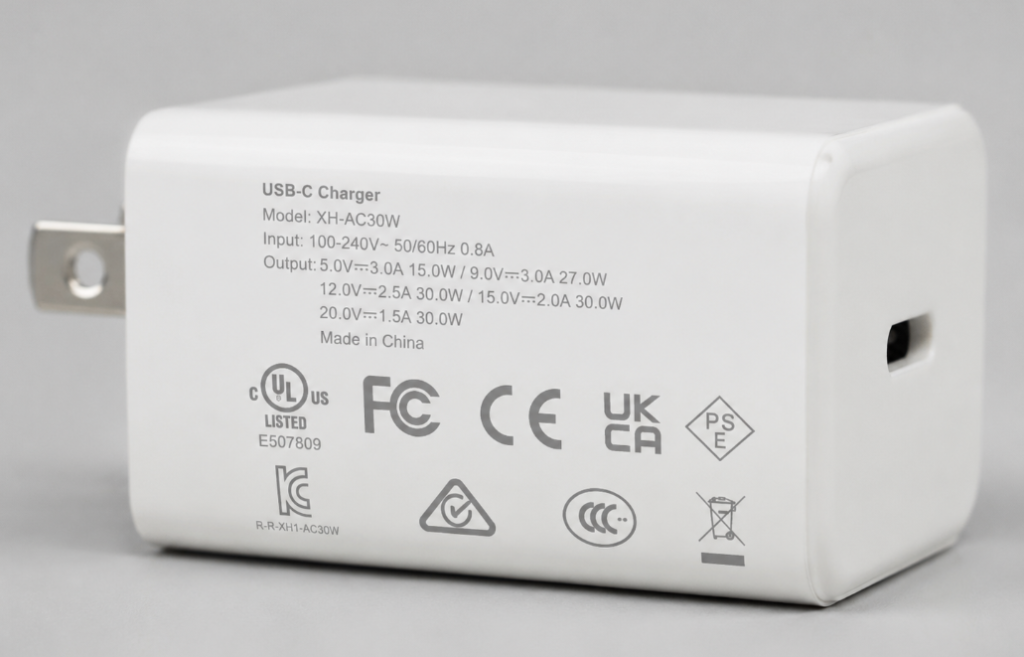
Two common misunderstandings should be particularly clarified: FCC is mainly an electromagnetic compatibility certification, not a safety certification; CE is a self-declaration of compliance in the EU, not a single third-party safety certification. Don’t think it’s absolutely safe just because you see a mark. You still have to judge based on the brand and channel.
As for durability, there are many influencing factors: long-term full-load work, placement in a high-temperature closed environment, frequent plugging and unplugging, poor cable contact, quality of internal capacitors, and good or bad heat dissipation design will all affect the life of the charger. Especially for high-power GaN products that excessively pursue extremely small size, if the heat dissipation design cannot keep up, long-term high-load use may be more prone to power reduction or aging.
Price and Cost-Effectiveness: When It’s Worth Spending More
Finally, let’s talk about the price that everyone is most concerned about. At the same power and same brand grade, GaN chargers are usually more expensive than regular chargers, and the premium is more obvious for models above 65W or multi-port models.
But cost-effectiveness cannot only look at the price of a single charger, but also whether it can replace multiple chargers. For example, if you originally needed to buy three single-port chargers for your phone, tablet, and laptop, the total cost may be more expensive than a multi-port GaN charger, and they take up more space. In this case, GaN has very high cost-effectiveness.
If you just charge a mobile phone fixed at the bedside, and the power demand is about 20W, then a regular PD charger will be more cost-effective, and there’s no need to spend extra money on GaN—after all, the experience difference between the two is extremely small, and the money saved can be used for other things.
Real Scenario Adaptation Judgment
After talking about the dimensional comparison, you may still be a bit confused: which one should I buy? In fact, you don’t need to memorize so many parameters, just choose according to your own usage scenarios.
Business Trips, Commuting, Carrying Around
In this case, GaN is preferred. It is small in size and light in weight, and multi-port models can also save you from carrying several chargers, saving a lot of space in your backpack. In terms of power selection, 45W is suitable for some tablets and thin and light laptops, 65W can cover most thin and light laptops, and 100W is suitable for higher-power laptops or charging multiple devices at the same time.
If you only take one mobile phone with you when going out, a 20W to 30W regular charger is also completely sufficient. The experience difference between the two is not big, and you can save some money.
Fixed Desktop Charging
If it’s used on a desk or bedside table, multi-port GaN is preferred. It can reduce socket occupancy, make the desktop tidier, and you don’t need to plug in a bunch of chargers. When choosing, focus on the total power, number of ports, power distribution for simultaneous output, and whether the length of the matching cable is sufficient.
If you just power fixed devices such as desk lamps, routers, and wireless charging bases, regular chargers are sufficient. They are cheap and stable, and there’s no need to spend extra money.
High-Power Devices: Thin and Light Laptops, Handheld Consoles, Gaming Phones
For these scenarios, GaN is preferred. In power ranges like 65W, 100W, and 140W, the miniaturization advantage is particularly obvious.
But pay attention to a few details: a 65W charger can normally power most thin and light laptops, but it may not cover high-performance mode. For example, when you run large software, the battery may still drain; for chargers above 100W, confirm whether your device supports the corresponding PD version, such as PD 3.1 EPR, or whether you must use the original adapter.
Special attention should be paid to gaming phones. Many high-power fast chargers rely on the brand’s own private protocols, and regular PD GaN chargers may not be able to reach the advertised power. Confirm clearly before buying.
For handheld consoles, it’s best to check the officially recommended power and PD gears, don’t just look at the total power of the charger, to avoid buying something you can’t use.
Low-Power Small Devices: Earphones, Watches, Old Phones
In this scenario, there is almost no difference in the performance of the two, and you can’t feel any difference in speed or heat.
Many people worry that high-power chargers will damage small devices, but there’s actually no need to worry—provided that the charger and cable are compliant, the device will draw power as needed and will not be forced to take too much.
So if you just charge small devices, there’s no need to spend extra money on GaN. The existing compliant regular chargers at home can continue to be used.
Overseas Travel and Cross-Region Use
No matter which charger you choose, first confirm that it supports 100-240V wide voltage input, and also confirm that the plug shape matches the local socket.
A special reminder here: travel adapters only change the shape of the plug, they do not convert between 110V and 220V. The safest way is to choose a wide-voltage charger with an input marked 100-240V~; if a device that only supports 110V is connected to 220V, it may be damaged or even pose a safety risk; when a device that only supports 220V is connected to 110V, it may also not work properly or have insufficient output power.
In this scenario, the advantages of GaN are more obvious: multi-port and small size, you can carry fewer chargers and adapters, and your luggage is lighter.
Common Misconceptions and Pitfall Avoidance Methods
After talking about how to choose, let’s talk about the pitfalls that people are most likely to fall into. Avoiding these, you basically won’t buy the wrong one.
Common Cognitive Misconceptions
The first and most common misconception: GaN must charge faster. Correct understanding: charging speed is mainly determined by the power, protocol, cable, and battery management strategy supported by the device, and has no direct relationship with the material. The feeling of being faster is usually because the new charger has higher power.
Second misconception: GaN doesn’t heat up at all. Correct understanding: any charger will heat up when at high power and full load. As long as the temperature is within the safe range, charging is stable, and there are no odors or abnormalities, it’s fine.
Third misconception: each port of a multi-port charger can run at full power at the same time. Correct understanding: the vast majority of multi-port chargers share total power. The more devices you plug in, the less power each port gets. Be sure to check the power distribution table before buying.
Fourth misconception: high-power chargers will damage small devices. Correct understanding: qualified products will negotiate the output power with the device. Small devices only take the amount they need, and will not be damaged.
Fifth misconception: having a GaN label means high quality. Correct understanding: GaN is just an internal material. Certification, circuit design, heat dissipation, and brand quality control are all more important than the word “GaN”.
Sixth misconception: regular chargers are not worth buying. Correct understanding: when power is low, scenarios are fixed, and budget is limited, compliant regular chargers are still practical, and there’s no need to blindly chase new things.
Identifying High-Risk GaN Products
Now GaN products on the market are mixed, and there are many “shell” products (products that pretend to be GaN but aren’t). How to avoid pitfalls?
First, you can’t judge whether it’s real GaN only by size, weight, and price—some products are large, maybe because the heat dissipation design is relatively conservative, or there are many ports; some products are cheap, maybe because the brand is doing promotions, not necessarily fake.
But if there are these signals, be careful: the price is obviously much lower than similar compliant products, no clear brand and model, no safety certification marks, vague parameter table, no power distribution table can be found, and user reviews have concentrated feedback on overheating, charging interruption, and false power labeling.
A more reliable verification method is: buy from formal channels, check whether the product has the safety certification of the corresponding region, refer to third-party teardowns or professional reviews, choose brands with clear after-sales service, and check whether the product detail page has publicly supported protocols and power distribution tables—the more transparent this information is, the lower the probability of falling into a pit.
Judgment and Handling of Abnormal Heat
Many people panic as soon as the charger heats up when using it. In fact, there’s no need. Let’s teach you how to judge whether it’s normal or abnormal:
Normal state: when charging at high power, the shell is warm or slightly hot, charging is stable, no odor, no frequent charging interruption. These are all normal, no need to worry.
If these situations occur, it’s abnormal: burnt smell, sharp whistling sound, bulging and deformed shell, blackened port, frequent charging interruption, temperature so high that you can’t keep touching it with your hand. In these cases, stop using it immediately.
For handling, you can first try changing the socket and cable, reduce the number of devices charging at the same time, and see if it’s still like this. If the problem persists, contact after-sales service, or just replace it directly. Don’t continue to use it to avoid danger.
Purchase Decision Checklist
If you still don’t know how to choose, you can follow the steps below step by step, it’s very simple.
Step 1: List Device Requirements First, Don’t Look at Marketing Words First
Before buying, don’t stare at marketing words like “GaN” and “140W” first. First list your own needs clearly:
First, list the devices you need to charge: mobile phone, tablet, laptop, earphones, watch, handheld console, and how much power each needs;
Second, find the device that consumes the most power, for example, whether the thin and light laptop is 45W or 65W, whether the high-performance laptop needs more than 100W;
Third, think about whether you often charge multiple devices at the same time, such as charging the computer and the phone at the same time;
Fourth, clarify the main scenario you use it in: whether it’s fixed on the desktop, often carried out, or often taken to different countries;
Fifth, determine your budget range, roughly how much you are willing to spend.
After listing these, you have already eliminated half of the unsuitable products.
Step 2: Understand Core Parameters
Next, look at a few core parameters. You don’t need to understand the principle, just know how to read them:
First is power: distinguish between maximum single-port power and total maximum power. For multi-port models, be sure to check the power distribution for simultaneous output, don’t just look at the big number on the package;
Second is protocol: for universal compatibility, prioritize USB-PD. For Android phones to have high-speed fast charging, check if there is PPS or the corresponding brand’s private protocol. For old devices, check if there is QC or USB-A port;
Third is PD version: below 65W, PD 3.0 is sufficient. Above 100W, you need a 5A cable. 140W and above usually require chargers and cables that support PD 3.1 EPR;
Fourth is cable: for most USB-C devices within 60W/65W, a 3A USB-C cable is usually sufficient to meet the demand; to reach full 100W gear, you usually need a 5A USB-C cable with E-Marker chip; for higher power scenarios such as 140W, 180W, 240W, you also need to confirm whether the charger, device, and cable all support the PD 3.1 EPR specification;
Fifth is input voltage: if you want to use it overseas, be sure to choose 100-240V wide input;
Sixth is ports: check if the number of USB-C and USB-A ports is enough for you. Don’t buy a bunch of ports you don’t use just for “multi-port”, it’s a waste of money and takes up space.
Step 3: Check the Bottom Line of Safety and Quality
Finally, be sure to check safety and quality. This is the bottom line and cannot be skipped:
First, check certifications: check the corresponding safety certification marks according to the region of use—CCC for Chinese Mainland; CE for the EU; UKCA for the UK; PSE for Japan; KC for South Korea; RCM for Australia/New Zealand; for North America, you can pay attention to safety certifications such as UL/ETL and electromagnetic compatibility marks such as FCC/ICES. Note that FCC is mainly an electromagnetic compatibility certification rather than a safety certification, and CE is a self-declaration of EU compliance rather than a single third-party safety certification, which needs to be comprehensively judged in combination with the brand and channel;
Second, check channels: prioritize mainstream brands, formal e-commerce or official channels. Don’t buy “three-no” products that have no brand, no model, and no after-sales service;
Third, check reviews: focus on whether user reviews mention problems such as overheating, charging interruption, whistling, false power labeling, loose plugs, and poor port contact. If many people mention them, don’t buy;
Fourth, check after-sales service: for high-power multi-port products, prioritize models with clear warranty and convenient after-sales service, so that if there is a problem, you have someone to contact.
Finally, let’s summarize a simple quick judgment method for everyone:
Cases to choose GaN: often carry out, charge multiple devices at the same time, need high power above 65W, want to use one charger for all devices, like a tidy desktop;
Cases to choose regular charger: limited budget, only charge one low-power device, use in fixed location, the regular charger you are using now has no problems;
Cases to buy with caution: uncertified white-label products, falsely labeled parameters, products that only promote GaN without mentioning protocols and power distribution, and products with concentrated feedback of abnormal overheating or charging interruption in reviews.
Frequently Asked Questions
Will GaN chargers damage the battery?
Qualified GaN chargers will not damage the battery just because the material is GaN. Battery life is mainly affected by temperature, number of charge-discharge cycles, device-side battery management system, and inferior chargers, and has nothing to do with whether GaN is used.
Can a 65W GaN charger charge a 20W phone?
Yes, as long as the charger and cable are compliant, there’s no problem. The phone will only draw power according to the power it supports, and will not forcefully take full power just because the charger is rated 65W.
Why does charging slow down when multiple ports are used at the same time?
Because the total power of a multi-port charger is shared. When multiple devices are plugged in at the same time, the power will be redistributed, and each device gets less power, so the speed will naturally slow down. Be sure to check the power distribution table before buying, don’t just look at the total power number on the package.
Is a 100W or 140W GaN charger better the higher the power?
Not necessarily. The power should match the device’s needs. If your phone only supports up to 20W, buying a 140W charger won’t make it charge faster. It’s just more flexible when you replace it with a higher-power device later, or charge multiple devices at the same time. High-power chargers also need to be matched with corresponding cables and protocols to work, otherwise it’s a waste.
Are regular chargers still worth buying now?
Of course they are. In low-power, fixed-use, budget-sensitive scenarios, compliant regular chargers are still a very reasonable choice, stable and cheap. If you need portability, multi-port, and high power, then the overall experience of GaN will be better.
Summary
In the final analysis, the difference between GaN and regular chargers is essentially the experience difference brought about by the upgrade of power device materials, not the opposition between “advanced” and “backward”.
The core value of GaN is to make high-power chargers smaller, lighter, and more suitable for shared use by multiple devices, suitable for users who often go out and have many devices; regular silicon-based chargers win in maturity, stability, and high cost-effectiveness, suitable for users with low power, fixed scenarios, and limited budgets.
There’s no need to blindly follow the trend to buy GaN, and there’s no need to think that regular chargers are outdated. According to your own devices, scenarios, and budget, choosing a compliant and suitable one is the best.