
Have you ever dug out a charging cable you’ve only had for a few months, only to find the rubber jacket split clean at the plug, frayed copper wires peeking through, and it cuts out the second you move your phone? The data cables, headphone cords, and power cords we use every day get bent, folded, and twisted on repeat — but how many bends can they really take before they fail?
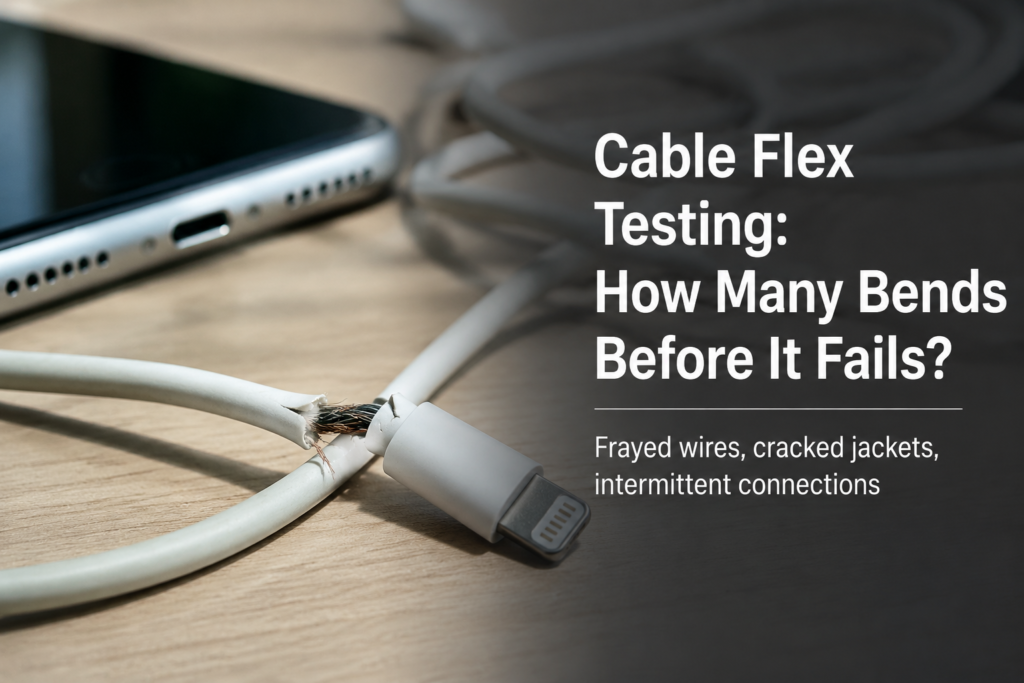
That’s the question flex testing (also called bend testing or swing testing) answers. It’s one of the most critical reliability assessments in the cable industry, used to validate durability for everything from ultra-thin earbud wires to heavy-duty power cables for industrial robots. In this guide, we’ll break down exactly how flex testing works, which standards apply, how to interpret test results, and how to see through marketing hype when shopping for cables.
Which Cables Need Flex Testing?
You might be wondering if only consumer electronics cables need flex testing. In reality, nearly all flexible cables that move or get bent repeatedly require some form of flex testing — the only difference is the focus and strictness of the test:
- Consumer electronics cables: USB cables, headphone cords, data cables, and wearable device leads are the most common test subjects, as they see high daily bend frequency.
- Power and home appliance cables: Power cords, extension cords, and internal appliance wiring don’t just need to survive bending — they need to maintain electrical safety after repeated flexing, so requirements are just as strict.
- Communication and signal cables: Ethernet, coaxial, HDMI/DisplayPort, and fiber optic cables need to retain signal integrity after bending, or performance will drop noticeably during use.
- Automotive and industrial cables: Car wiring harnesses, drag chain cables, robot cables, and moving equipment cables operate in harsher environments, so they have far higher bend lifespan requirements.
- Medical and special equipment cables: These have the most specialized requirements. Test plans are custom-built to match the device’s exact movement patterns, sterilization procedures (alcohol wipes, autoclaving), and medical regulatory rules — standard consumer cable tests don’t apply here.
Key Parameters That Define Flex Test Results
If you’ve ever shopped for cables, you’ve probably seen bold claims like “100,000 bends” or “1 million bend lifespan.” But these numbers are completely meaningless without context — flex test results depend entirely on a handful of core parameters, each of which can drastically change the final count.
Bend Radius
Bend radius is the single most critical parameter in flex testing, bar none.
It refers to the radius of the curve the cable is bent into: the smaller the radius, the sharper the bend, the more stress the cable’s internal components take, and the shorter its lifespan.
It’s also important to distinguish between minimum static bend radius (the smallest safe radius for a fixed, non-moving bend) and minimum dynamic bend radius (the smallest safe radius for repeated bending). Dynamic bend radii are almost always larger than static ones — meaning you can’t bend a cable as sharply if it’s going to be moved repeatedly.
For context: the same USB-C cable that survives 100,000 bend cycles at a 20mm radius might fail before 10,000 cycles at a 5mm radius. Talking about bend counts without mentioning bend radius is a total waste of time.
Angle, Stroke, and Motion Type
Bend style has just as big an impact on results as radius. Is the test a 90-degree side-to-side swing, or a 180-degree full fold? Is the cable bent into a gentle U-shape, or creased into a sharp kink? Which end of the cable is fixed, and which moves? Is the bend point in the middle of the cable, or right at the connector root (the weakest point in real use)?
Small differences in these details can make test results differ by multiples. For example, the same cable will have a far shorter lifespan if bent at the connector root (the most common failure point in daily use) than if bent in the middle of the cable jacket.
Frequency, Cycle Count, and Load
Frequency refers to how many bends happen per minute. If the test frequency is too high, the cable will build up heat from repeated friction and suffer from inertial shock, making results totally unrepresentative of real use — after all, no one bends their charging cable dozens of times every minute.
Load conditions also need to be clearly defined: Is a weight attached to the end of the cable? How heavy is it? Is the cable powered during testing, carrying its full rated current? Is it transmitting an active signal? All of these factors directly impact bend lifespan.
It’s also critical to distinguish between two test types:
- Pass/fail verification testing: Runs for a set number of cycles (e.g., 10,000) and stops if the sample survives, with no further testing.
- Lifecycle testing: Runs until the sample fails, recording the maximum number of cycles it can withstand.
These two test types produce completely different conclusions and can’t be compared directly.
Environment and Operating State
Cables are used in all kinds of environments, so test conditions need to match real-world use cases. Is the test run at room temperature, or in extreme cold or heat? Is the cable exposed to oil or chemicals? Does it need pre-treatment with sterilization cycles first? For example, medical cables that get wiped down with alcohol daily may need dozens of simulated cleaning cycles before flex testing even starts.
Operating state also matters: Is the cable unpowered and unloaded during testing, or carrying full rated current? Is it transmitting an active signal? Are temperature and humidity cycles running alongside the bend test? All of these conditions need to be defined upfront and fully documented in the test report.
Flex Test Plans for Different Cable Types
There’s no one-size-fits-all flex test plan. Different cables have different priorities, and testing needs to match their intended use.
Consumer Electronics Swing Testing
For phone charging cables, headphone cords, and other consumer cables, the most common test is the swing test, focused on the connector root strain relief, internal conductor flex durability, and stability of charging or data transmission.
A complete consumer swing test plan must document swing angle, bend radius, test frequency, end weight, cycle count, and failure criteria. Note that requirements vary across standards bodies and brand specs: USB-IF, Apple’s MFi (Made for iPhone), UL, and major consumer electronics brands all have their own rules. MFi bend requirements, for example, may differ from Android brand internal specs — always reference the exact certification document and product version, never mix and match rules.
Power Cord and Home Appliance Cable Testing
For power cords, safety is always the top priority. Tests focus on whether insulation stays intact, the jacket doesn’t crack, dielectric withstand performance holds, conductor resistance change stays within limits, and temperature rise under load doesn’t exceed safe levels.
Standards vary by region: China’s GB/T national standards, the International Electrotechnical Commission (IEC) standards, and U.S. UL safety standards all have different scopes and test parameters. You can’t directly apply UL test parameters to a cable designed to meet IEC standards.
Communication, Ethernet, and Fiber Optic Testing
For these cables, flex testing focuses less on mechanical breakage and more on signal performance changes. Technicians measure whether attenuation, return loss, crosstalk, and bit error rate stay within limits before and after bending; for fiber, optical loss changes are the key metric.
Many people have heard of ITU-T G.657, the core global standard for bend-insensitive fiber. While it defines performance requirements for different bend-insensitive fiber grades, actual test methods must be paired with the relevant fiber or cable product standard — you can’t make a full pass/fail call based only on G.657.
Drag Chain and Robot Cable Testing
Industrial drag chain and robot cables work in far harsher conditions than consumer cables, so their flex tests are far more complex. Key test factors include dynamic bend radius, drag chain travel speed, stroke length, cycle count, plus wear, torsion, and tension — after all, cables moving inside a drag chain don’t just bend, they get pulled and rub against other cables and the chain interior.
Standards for these tests vary widely: TÜV industry specifications, manufacturer internal standards, and custom client requirements are all common. A legitimate test report will always list the exact standard name and version number, not just a vague “meets industrial standards” claim.
Automotive Wiring Harnesses and Medical Device Cables
These two categories are specialized use cases where regular consumer bend counts are meaningless for judging performance:
- Automotive wiring harnesses operate in engine bays, door panels, and other harsh locations, so tests combine temperature cycling, vibration, oil corrosion, and terminal connection reliability, all aligned with the vehicle’s 10+ year lifespan requirement.
- Medical device cables have even stricter rules. Surgical robot cables, for example, move in complex patterns with the robot arm and require frequent sterilization (including high-pressure autoclaving). Tests are fully customized to match the device’s movement, sterilization workflow, and medical electrical safety regulations — a completely different bar than consumer cables.
How to Choose the Right Flex Test Standard
You can’t just make up test parameters and call it a flex test — results only carry weight if they follow a recognized standard. So how do you pick the right one?
Standard Selection Principles
Follow this step-by-step logic to avoid mistakes:
- Confirm basic information first: Start with the cable’s intended use, voltage rating, construction type, and target market. A USB-C charging cable sold in the U.S. and an industrial drag chain cable sold in the EU have completely different applicable standards.
- Prioritize product-specific standards: First look for the dedicated standard for that cable type — for example, USB-IF specs for USB cables, or power cord product standards for power cords. Product standards almost always define whether flex testing is required, how to run it, and pass/fail criteria. Use general test method standards and certification rules as supplements.
- Verify standard details: Always confirm the current version, scope of application, sample requirements, and pass/fail clauses of the standard. For example, some standards only apply to flexible cords rated 300V or less — using them to test a 1000V cable is fundamentally invalid.
- Use enterprise specs as a supplement: Internal company standards or custom client requirements can set stricter rules than general standards, but they can never replace mandatory local requirements. For example, cables sold in the EU must meet CE mandatory requirements — client specs can be stricter, but never looser.
Common Standard Categories
Flex testing-related standards fall into four broad groups:
- Product standards: Define construction, materials, performance requirements, and pass/fail rules for a specific cable type. These are the core basis for judging whether a product is合格.
- Test method standards: Define exact procedures for running tests — equipment requirements, parameter settings, step-by-step instructions, essentially a “test operation manual”.
- Certification or industry specifications: Set requirements for specific markets, interfaces, or brands. USB-IF certification, HDMI certification, and Apple MFi all have their own flex test rules.
- Enterprise and client specifications: Usually created by large companies or clients with special needs. They are often stricter than general standards, or add requirements for specific use cases — for example, a phone brand’s internal requirements for its first-party charging cables are stricter than the general USB standard.
Standard Citation Best Practices
Don’t just Google “10,000 bend test” and use that as a standard. Different versions and scopes of standards can have wildly different parameters.
A legitimate test report will always list the standard name, version number, specific clause referenced, test equipment ID, and any deviations from the standard — for example, if a parameter was adjusted due to equipment limitations, it must be clearly noted, or the report’s credibility is severely reduced.
How Is a Professional Flex Test Performed?
Now that you know the parameters and standards, what does a formal flex test actually look like? It follows four key stages.
Pre-Test Preparation
Preparation directly impacts test accuracy — skip it, and results will be unreliable.
First, define the test purpose: Is it for certification, incoming quality inspection, or R&D validation? Which standard applies? What is the sample batch, quantity, and sampling location (full cable with connectors, or a bare section of cable jacket)? All of these need to be confirmed and documented upfront.
Next, run initial performance testing on the samples: Check for appearance defects, confirm dimensions match requirements, verify continuity, and record baseline values for insulation resistance, conductor resistance, and signal performance (for signal cables). These baseline values are the reference for judging failures later.
Finally, complete required environmental pre-conditioning per the standard — for example, storing samples in standard temperature and humidity for 24 hours, or running pre-test thermal cycling. Pre-conditioning parameters and duration must be recorded accurately.
Equipment and Tooling
There’s no single flex test machine — different tests require different equipment: swing testers for swing tests, reciprocating bend testers for linear bend tests, dedicated drag chain test benches for drag chain tests, and combined torsion-flex machines for combined stress tests.
Supporting test equipment is also required: continuity monitors, insulation resistance testers, hipot testers, temperature rise testers, network performance analyzers, and optical power meters, to name a few, all used to monitor performance changes in real time.
The most critical rule: All test equipment must be calibrated and within its validity period. During testing, record actual measured values of parameters, not just set values. For example, if the set bend radius is 10mm but the actual tooling measures 9.8mm, record 9.8mm — that’s how you get reliable results.
Test Execution
Formal testing follows strict steps, not just “turn on the machine and go”:
- Mount the sample: Fix the cable per the standard’s requirements, and eliminate installation stress — don’t pull it too tight, and don’t leave it too loose, as both will skew results.
- Set parameters: Configure bend radius, angle, frequency, load, and operating state (powered / signal / unloaded) per standard requirements.
- Low-speed trial run: Run the test at low speed for a few minutes to check for pinching by clamps, abnormal friction, or loose connectors. Only start the formal test once everything checks out.
- Formal testing and monitoring: Run the test for the required number of cycles, monitoring continuity, signal performance, temperature rise, and other metrics in real time. Watch for abnormal issues like smoke, jacket damage, or unusual noise.
- Record failures: If a failure occurs during testing, stop immediately. Record the exact cycle count at failure, failure location, environmental conditions at the time, and specific failure type — conductor break, jacket crack, signal performance out of spec, etc.
What a Valid Test Report Includes
A legitimate flex test report is far more than a stamped “pass” note. It must include at minimum:
- Full sample information: model number, batch, quantity, sampling location, and ideally photos of the samples.
- Test basis: standard name, version number, specific clauses referenced, plus test equipment details and calibration status.
- All test parameters: bend radius, angle, frequency, load, stroke, environmental conditions, operating state, and every other relevant setting.
- Test data: initial performance values, in-process monitoring data, and final post-test values. For lifecycle testing, also include failure cycle count and failure mode.
- Judgement and notes: pass/fail conclusion with supporting basis, any deviations from the standard, test repeatability notes, and uncertainty statements where required.
How to Interpret Flex Test Results
Once testing is complete, how do you judge if a cable is合格? While exact requirements vary by standard, the general judgement framework is consistent across five core dimensions.
Universal Pass/Fail Framework
- Mechanical performance: No prohibited cracks, exposed conductors, loose or detached parts, breaks, or abnormal deformation (like jacket shrinkage or bulging). Any of these count as a mechanical failure.
- Electrical performance: Conductor continuity is maintained, resistance change stays within allowed limits, insulation resistance and hipot tests pass, temperature rise is within specs, and there is no current leakage.
- Signal performance: Signal performance changes before and after bending stay within specified limits — attenuation, return loss, crosstalk, bit error rate, etc., all meet requirements.
- Connection performance: Terminals, plugs, and solder joints stay tight, strain relief structures remain intact, and contact resistance meets specifications.
- Safety performance: No insulation breakdown, short circuits, abnormal overheating, smoke, fire, or other hazardous conditions. This is a non-negotiable baseline — any safety issue results in an immediate fail.
Failure Modes and Root Cause Troubleshooting
If a test fails, you can’t just say “it broke” — you need to match the failure mode to potential causes to guide improvements:
- Conductor break: The most common failure mode. Possible causes include individual strand diameter being too thick, poor stranding structure design, stress concentration at crimp/solder joints, or a bend radius that’s too small.
- Jacket cracking: Possible causes include poor jacket material formulation (e.g., overly brittle PVC), uneven thickness from the extrusion process, brittleness in low temperatures, or corrosion from chemical exposure.
- Shielding performance drop: Possible causes include low braid density, poor wrap structure design, poor ground contact, or stress concentration breaking braid strands at a single point.
- Connector pull-off: Almost always caused by poor strain relief design, weak overmolding adhesion to the cable jacket, or weak internal solder/crimp connections that pull apart under tension.
- Signal abnormality: First identify the root cause: Is it from a broken conductor, impedance mismatch, shielding failure, or poor connector contact? Each cause requires a completely different fix.
How Consumers Can See Through “Bend-Resistant” Marketing Hype
All that technical detail is useful, but how do regular shoppers tell if a cable’s “ultra bend-resistant” claim is actually true?
Don’t Fixate on Bend Count Alone
This is the single most important rule: Don’t be fooled by big “100,000 bends” or “1 million bend lifespan” numbers.
When you see a bend count claim, look for these critical details: What was the bend radius? What was the swing angle? Test frequency? Was a weight attached to the end? Was the cable powered during testing? How many samples were tested? What standard was used to judge failure? How old is the test report?
For example, a brand might claim “100,000 bends without failure” — but if they tested the middle of the cable at a 20mm radius, with no attached weight and no power, that’s nothing like real use, where the connector root bends repeatedly and the cable gets pulled regularly. That number is completely useless.
Quick Checks When Shopping
If you can’t get access to a test report, you can make a rough guess at bend durability with these simple checks:
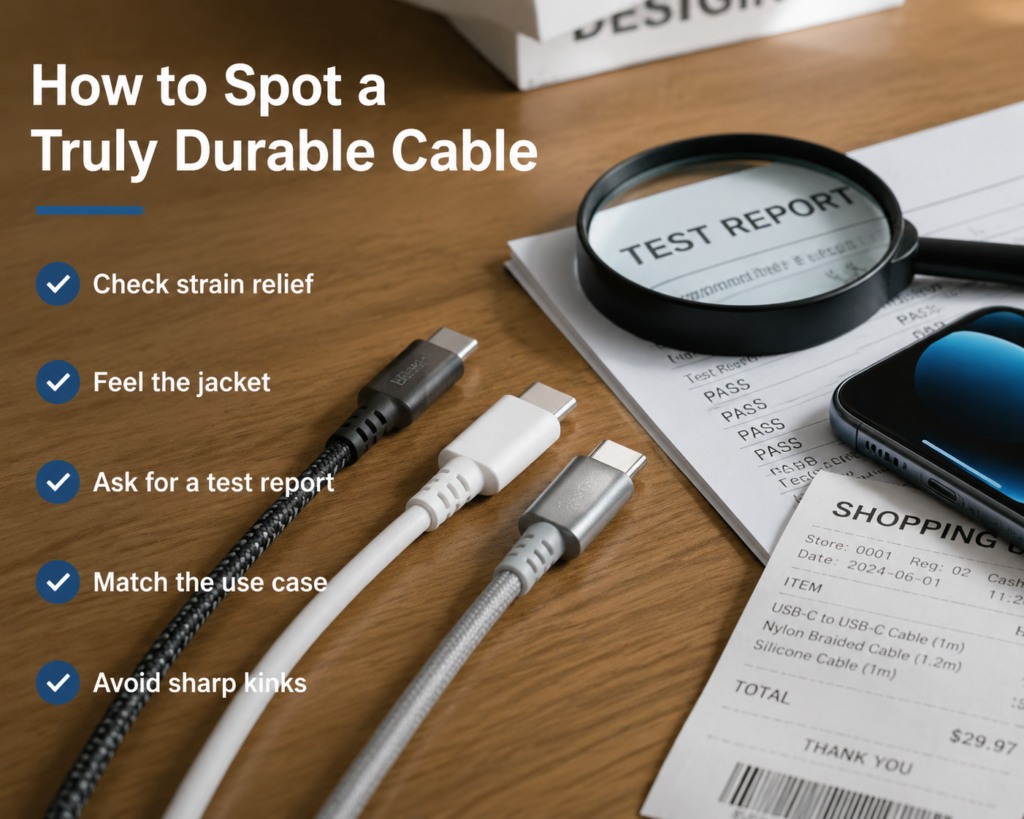
- Look at the joint between the connector and cable: Is there a smooth, flexible strain relief (the tapered rubber section) that transitions gradually? If the connector meets the cable with a hard, sharp edge and no flexible transition, it will probably break quickly.
- Feel the jacket: Is it flexible but firm, with no rough edges or visible cracks? Avoid cables that feel overly soft and squishy (they wear out fast) or stiff and rock-hard (they crack easily).
- Choose products that can provide a test report for the exact model you’re buying, not just a generic marketing flyer. Anyone can make a flyer — a model-specific formal report is credible.
- Match your priority to the cable’s use case: For power cords, prioritize safety certifications and current rating first. For data cables, prioritize transmission stability. For industrial drag chain cables, prioritize dynamic lifecycle test reports. Don’t judge the wrong metric.
Daily Use Tips to Extend Cable Life
Even the most bend-resistant cable will break fast if you misuse it. Follow these tips to make your cables last much longer:
- Avoid sharp, tight kinks. Don’t fold your charging cable into a tiny square to stuff in your bag — loop it loosely in large, gentle circles instead.
- Don’t repeatedly bend the cable right at the plug. That’s the weakest point, and it’s where most cables fail.
- Don’t let cables get crushed under chair legs, table legs, or other heavy objects. Over time, the jacket and internal conductors will get damaged.
- Unplug by grabbing the connector itself, not yanking the cord. Pulling on the cable strains internal solder joints and terminals.
- If a cable gets hot, has exposed wires, intermittent connections, or weird signal issues, replace it immediately. This is especially important for power cords, which can be a fire or shock hazard.
Common Myths & FAQ
Q: Does a higher bend count always mean a better cable?
A: Not necessarily. Bend counts are only comparable if all test parameters are identical. If bend radius, angle, and load are different, a higher number means nothing. For example: Cable A survives 10,000 cycles at a 5mm radius, with a 500g weight attached, carrying full rated current. Cable B survives 100,000 cycles at a 20mm radius, no weight, no power. Cable A has far better real-world bend performance than Cable B.
Q: Is a cable fine as long as it doesn’t break completely?
A: Definitely not. Flex testing checks mechanical, electrical, signal, connection, and safety performance. If the jacket cracks and exposes copper, it’s failed even if it still charges. If an Ethernet cable drops from 1Gbps to 100Mbps after bending, it’s failed even if it’s not physically broken.
Q: Can you test all cables on the same swing tester?
A: No. Cables of different thicknesses and use cases require different tooling, clamps, and test equipment. A thin earbud wire and a thick industrial cable have completely different bend radius requirements, so their tooling isn’t interchangeable. Drag chain and torsion tests require entirely specialized machines, too.
Q: Do UL, USB-IF, or other certification marks prove a cable is super bend-resistant?
A: No. Those certifications only mean the product meets the basic required standards for that certification, and they’re model-specific — a certification for Model A doesn’t apply to Model B. To know a specific cable’s bend performance, you need the model-specific flex test report.
Q: What are the most important things to look for on a test report?
A: Prioritize these: standard name and version number, exact test parameters, sample information (does it match the model you’re buying?), pass/fail criteria, and raw test data. If the report only has a “pass” stamp and no parameter details, it has almost no reference value.
Final Thoughts
At its core, cable flex testing isn’t about chasing flashy “1 million bend” marketing numbers. It’s about simulating real-world use cases with repeatable, quantifiable methods to fully verify a cable’s mechanical strength, electrical safety, signal performance, and connection reliability.
Whether you’re a procurement manager sourcing industrial cables, a product engineer validating a new charging cable design, or just a shopper trying to find a charging cord that won’t break in three months, understanding how flex testing works lets you cut through vague hype and choose cables that are actually durable, safe, and fit for their purpose.