
Preface
Why You Need This Fast Charging Glossary
Fast charging technology is now everywhere—phones, tablets, laptops, gaming handhelds, power banks. We use it every day. But have you ever been confused? You buy a 100W charger, but your phone charges slowly. You plug in a USB-C cable, but your device says “slow charging.” You mix chargers from different brands and wonder if it’s safe.
Fast charging is getting more complex. Different brands use different names—VOOC, SuperCharge, HyperCharge, Warp Charge—it’s overwhelming. And to make things worse, the same wattage number doesn’t mean the same charging speed. A 65W charger can charge different devices at wildly different speeds.
This glossary is for you. No complicated circuit theories, no intimidating formulas. Just plain-English explanations of common fast charging terms. Read this, and you’ll be able to pick the right charger, cable, and power bank with confidence.
Chapter 1: Basic Concepts
Fast Charging
Definition: Fast charging simply means charging faster than normal. Standard USB charging is usually 5V/1A (5W) or 5V/2A (10W). Fast charging boosts that to 18W, 65W, or even higher, dramatically cutting charging time.
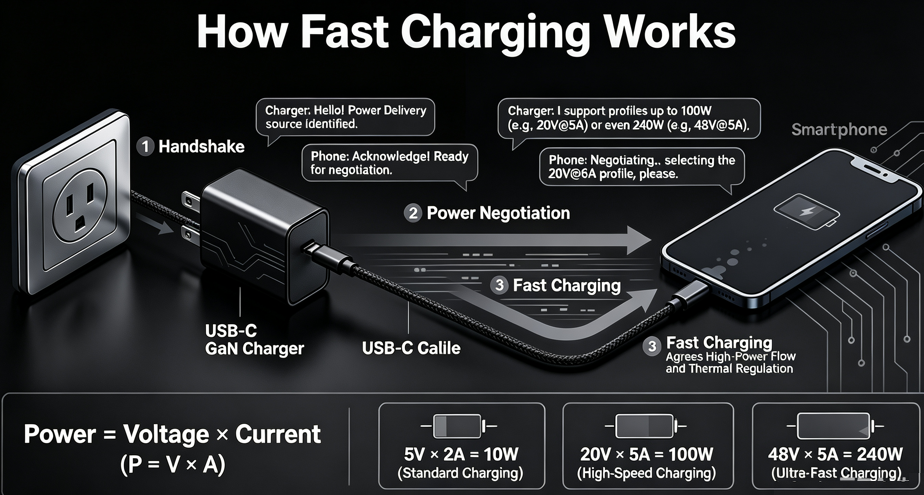
How It Works: The core idea is simple—increase charging power. Power is voltage times current (P = V × A), so to increase power you either raise voltage, raise current, or both. The charger and device “talk” to each other to agree on a voltage and current combination that both can handle, then charge at that level.
vs. Regular Charging: Regular charging is like filling a bucket with a small hose at a fixed flow rate. Fast charging is like switching to a bigger hose with higher water pressure—more water in less time.
Development History: Fast charging emerged around 2010, starting from 10W. Then Qualcomm introduced Quick Charge, pushing power to 18W, then 36W. USB PD became the industry standard, breaking through to 100W, 140W, and now USB PD 3.1 supports up to 240W.
Charging
What It Is: Charging is simply storing electrical energy in a battery. Think of the battery as a bucket, the charger as a faucet, and current as the water flow—turn on the faucet, water flows into the bucket.
The Charging Process: Charging doesn’t happen at maximum speed all the time. It usually has three phases: when the battery is very low, it charges slowly with a small current (trickle charging); when the battery is at a moderate level, it charges quickly with a large current (constant current); when it’s almost full, the current gradually decreases until fully charged (constant voltage). This staged approach protects battery life while maximizing speed.
Charging Protocol
What It Is: A charging protocol is the “language” that chargers and devices use to communicate. Just as two people need to speak the same language to understand each other, a charger and device need the same protocol to “talk”.
Why It’s Needed: Without a protocol, a charger can only output a fixed 5V, and devices can only accept it passively—no fast charging possible. Protocols let devices “tell” the charger “I can handle higher voltage and current, give me more power,” and the charger responds “OK, here’s what I can give you”.
Protocol Handshake: When you plug in your device, the charger and device immediately have a brief “conversation”—the device says “I support these protocols,” the charger says “I support these,” and they find a common one. If they find one, they “shake hands” and fast charging begins.
Power Negotiation: After the handshake, they negotiate the exact voltage and current. The device makes a request based on its battery status (charge level, temperature, etc.), and the charger evaluates whether it can meet the request.
Charging Standard
International Standards: Globally recognized standards set by international organizations. The most typical is USB PD, developed by USB-IF (USB Implementers Forum), which any manufacturer can adopt.
Industry Standards: Widely adopted technical specifications within an industry. Qualcomm’s Quick Charge isn’t mandatory, but because it’s so widely used, it’s become a de facto industry standard.
Proprietary Standards: Charging protocols developed by a single brand for its own products—like OPPO’s VOOC or Huawei’s SCP. These are usually not open to third parties, making them hard for non-brand devices to support.
Charger
How It Works: A charger converts the 220V AC from your wall outlet into the low-voltage DC that phones, tablets, and other devices need.
Output Capability: Every charger has a maximum output rating, like “65W” or “100W.” But this is a theoretical maximum—actual output depends on what the connected device needs and what the protocol negotiation determines.
Single-Port vs. Multi-Port: Single-port chargers have one output and devote full power to one device. Multi-port chargers have two or more outputs and can charge multiple devices simultaneously, but total power is fixed—each port gets less power when multiple devices are connected.
Charging Cable
Data Cable vs. Charging Cable: Data cables primarily transmit data, with charging as a secondary function. Charging cables primarily transmit power. Today, most cables do both.
Why Cables Matter for Fast Charging: The wires inside a cable have resistance. Higher current means more heat and more power loss. A poor-quality cable might not handle 5A of current, preventing fast charging from starting or causing it to slow down midway.
Receiver / Sink
The device that receives power—your phone, tablet, laptop, gaming handheld, or power bank. Different devices support different protocols and power levels, so check what your device supports before buying a charger.
Chapter 2: Electrical Fundamentals
Voltage
Definition: Voltage is like “electrical pressure”—just as higher water pressure makes water spray farther, higher voltage gives electricity more “push.”
Unit (V) : Volt.
Common Voltage Levels: 5V (standard USB), 9V, 12V, 15V, 20V (PD 3.0 max), 28V, 36V, 48V (new PD 3.1 high-voltage levels).
Current
Definition: Current is like “electrical flow rate”—the amount of electricity flowing through, like the volume of water through a pipe.
Unit (A) : Ampere, or “amp.”
1A, 2A, 3A, 5A Differences: Higher current means more electricity delivered per unit of time. A 5A cable can carry more current than a 3A cable, which is necessary for high-power fast charging.
Power
Definition: Power is the overall “charging speed”—the product of voltage and current.
Formula (P = V × A) : Power = Voltage × Current. For example, 20V × 5A = 100W—that’s where 100W fast charging comes from.
Why 65W, 100W, 140W Are Just Theoretical Maximums: The wattage on a charger is the “maximum” it can deliver, but actual charging power depends on the device’s needs and battery status—it may approach maximum when the battery is low, but gradually decreases as it nears full. So a “100W charger” doesn’t mean “always charges at 100W.”
Watt
The unit of power. 1 watt = 1 volt × 1 amp. The “65W” or “100W” you see on chargers refers to this.
Volt
The unit of voltage.
Ampere
The unit of current.
Chapter 3: Mainstream Charging Standards & Protocols
USB Battery Charging (USB BC)
The earliest charging standard for USB ports, defining how USB ports identify and provide charging capability. BC 1.2 is the most well-known version, with three port types:
- SDP (Standard Downstream Port) : Standard USB port, max 5V/0.5A
- CDP (Charging Downstream Port) : Charge-capable USB port, supports 5V/1.5A
- DCP (Dedicated Charging Port) : Charging-only port, max 5V/1.5A
USB Power Delivery (USB PD)
What It Is: USB PD is the most mainstream fast charging standard today, developed by USB-IF. It delivers high-power charging through USB-C, supporting up to 240W.
Why It’s the Industry Standard: Because it’s open and universal—any brand’s device that supports PD can fast-charge with any brand’s PD charger. Unlike proprietary protocols, there’s no incompatibility.
How It Works: The charger and device communicate through the CC pins in the USB-C port to negotiate voltage and current. Once negotiated, they output as agreed.
PD 2.0: Supports up to 100W (20V/5A) with more flexible power negotiation.
PD 3.0: Added PPS (Programmable Power Supply) for finer voltage control.
PD 3.1: Released in 2021, boosting maximum power from 100W to 240W with new 28V, 36V, and 48V voltage levels.
PPS (Programmable Power Supply)
What It Is: PPS is a PD 3.0 feature that lets chargers adjust output voltage in 20mV steps (range 3.3V-21V), rather than being limited to fixed voltage levels.
Dynamic Voltage Adjustment: PPS requires the charger and device to exchange data every 10 seconds—battery voltage, current, temperature—and adjust output accordingly. Like a car adjusting its throttle based on road conditions.
Use Cases: Mainly for smartphones, power banks, and other low-to-medium power devices.
AVS (Adjustable Voltage Supply)
New in PD 3.1: AVS is introduced in PD 3.1’s EPR (Extended Power Range), allowing voltage adjustment between 15V-48V in 100mV steps.
Difference from PPS: PPS has smaller steps (20mV) and targets low-power devices like phones, with voltage constantly changing as the battery charges. AVS uses 100mV steps and targets high-power devices like laptops, providing more stable voltage output. In short: PPS is more precise but changes frequently; AVS is more stable.
SPR (Standard Power Range)
PD 3.1 renamed the original up-to-100W power range as SPR, covering traditional voltage levels like 5V, 9V, 15V, and 20V.
EPR (Extended Power Range)
The new power range in PD 3.1, expanding maximum power from 100W to 240W with new 28V, 36V, and 48V voltage levels. EPR mode requires special EPR-certified cables.
Chapter 4: Brand-Specific Fast Charging Protocols
Qualcomm Quick Charge (QC)
Qualcomm’s fast charging protocol, widely used in Android phones.
- QC 2.0: Up to 36W (12V/3A), introduced multiple voltage levels
- QC 3.0: Up to 36W, 200mV voltage adjustment steps
- QC 4: Up to 27W, compatible with USB PD
- QC 4+: Up to 27W, added dual-path charging
- QC 5: Supports over 100W, can charge a 4500mAh battery from 0% to 50% in 5 minutes, 70% more efficient than QC 4, 10°C cooler
OPPO VOOC
OPPO’s proprietary fast charging protocol using a low-voltage, high-current approach.
- VOOC: Original version, 5V/4A (20W)
- SuperVOOC: Uses dual-series cells, up to 50W or more
- OnePlus Warp Charge: OnePlus’s customized version of VOOC
- realme Dart Charge: realme’s customized version of VOOC
Huawei FCP / SCP
- FCP (Fast Charge Protocol) : Huawei’s early protocol, 18W, high-voltage
- SCP (SuperCharge Protocol) : Huawei’s later proprietary protocol, low-voltage, high-current, evolved from 18W to 100W
HONOR SuperCharge
Honor’s super-fast charging, based on Huawei’s SCP technology.
Xiaomi HyperCharge
Xiaomi’s HyperCharge technology, reaching up to 200W wired charging using dual charge pumps and dual-cell architecture.
Samsung Adaptive Fast Charging (AFC)
Samsung’s adaptive fast charging, up to 15W (9V/1.67A), compatible with QC 2.0.
Samsung Super Fast Charging (SFC)
Samsung’s super-fast charging, based on USB PD PPS, up to 45W.
MediaTek Pump Express
MediaTek’s fast charging protocol that adjusts charger output voltage.
Apple Fast Charge
Apple has supported USB PD fast charging since iPhone 8, up to about 27W (iPhone) or 140W (MacBook).
Compatibility Between Different Brands
This is where most people get confused. Different brands’ proprietary protocols are usually incompatible—using a Huawei charger with an OPPO phone may only charge at standard speed. The good news: almost all mainstream devices support USB PD, the universal standard. So when buying a charger, prioritize PD support for the best compatibility.
Chapter 5: Charging Interfaces & Cables
USB Type-C
Why It’s the Mainstream Fast Charging Interface: USB-C is reversible (plugs in either way) and convenient. More importantly, it supports USB PD for high-power charging. Today, the vast majority of new phones, tablets, and laptops use USB-C.
USB-C Cable
Data Cable vs. Fast Charging Cable: Not all USB-C cables support fast charging. Data cables may only handle data transfer and slow charging. Fast charging cables need adequate conductivity and the right internal chip.
3A Cable: Supports up to 3A current, max 60W at 20V.
5A Cable: Supports up to 5A current, max 100W at 20V.
E-Marker Chip: A tiny chip inside the USB-C cable that stores the cable’s capabilities (how much current and voltage it can handle). The charger and device read this chip to know if the cable can safely deliver high power. Why 100W/240W requires E-Marker cables: Without an E-Marker chip, the cable can’t tell the charger “I can handle 5A,” so the charger won’t deliver high power for safety reasons.
USB-C to USB-C
USB-C on both ends—the mainstream choice for fast charging today.
USB-A to USB-C
One end is traditional USB-A, the other is USB-C. Many older chargers still use this, but USB-A ports usually don’t support high-power PD fast charging.
USB-C to Lightning
Apple’s proprietary cable—USB-C on one end, Lightning on the other (for older Apple devices). iPhone 15 series and later have fully switched to USB-C.
100W Cable / 240W Cable
Cables rated for 100W and 240W power delivery respectively. 240W cables must have an E-Marker chip and be EPR-certified.
Chapter 6: Battery & Charging Technology
Lithium-ion Battery
The most common battery type in phones, tablets, and laptops. High energy density, no memory effect, but requires sophisticated charging management.
Lithium Polymer Battery
A variant of lithium-ion using solid or gel electrolyte, can be made thinner and in various shapes.
Battery Cell
The basic unit of a battery.
- Single Cell: One battery unit, simple structure
- Dual Cell: Two cells in series, allows higher charging voltage
- Multi-Cell: Three or more cells, mainly for high-power devices
Charge Pump
A highly efficient voltage conversion technology, up to 97%+ efficient. It converts the high voltage from the charger to the low voltage the battery needs, while doubling the current. For example, a charger outputs 10V/4A, and the charge pump converts it to 5V/8A for the battery. Because it’s so efficient with minimal heat, it’s now a core technology in phone fast charging.
Battery Management System (BMS)
The battery’s “manager”. It constantly monitors voltage, current, and temperature to prevent overcharging, over-discharging, and overheating. All lithium-ion batteries need a BMS to be used safely.
State of Charge (SOC)
Simply the remaining battery percentage shown on your phone. The BMS estimates this by monitoring voltage and current.
Charging Curve
A graph showing how voltage and current change during charging. A typical lithium battery charging curve has three phases: Trickle Charge → Constant Current → Constant Voltage.
Trickle Charging
When the battery is extremely low (usually below 2.1V), it charges slowly with a tiny current—like a faucet barely dripping. This protects the battery from damage by high-current冲击.
Constant Current (CC)
After the battery recovers to a safe level, it charges with a constant high current. This is the fastest charging phase.
Constant Voltage (CV)
When the battery is nearly full (voltage reaches its limit), voltage stays constant while current gradually decreases until fully charged. This phase is slower but ensures the battery is truly full.
Cycle Life
One “cycle” = fully discharging the battery then fully recharging it. Lithium batteries typically last 300-500 cycles before capacity noticeably degrades.
Thermal Management
Batteries generate heat during charging. Excessive heat can damage the battery or even cause danger. Thermal management uses various methods (heat-dissipating materials, intelligent temperature control algorithms) to keep temperatures within safe limits.
Chapter 7: Charger Technology
GaN (Gallium Nitride)
This is the most important technological innovation in chargers in recent years. Gallium nitride is a new semiconductor material. GaN chargers have three major advantages over traditional silicon-based chargers:
- Smaller size: Same power, GaN chargers can be half the size or even smaller
- Less heat: Higher energy conversion efficiency, less power loss
- More power: Higher output in the same physical size
Today, almost all portable chargers above 65W use GaN technology.
Silicon (Silicon-Based)
Traditional charger semiconductor material. Mature technology but less efficient than GaN—bulkier and generates more heat at the same power.
Switching Frequency
How fast the charger’s internal circuits switch on and off. Higher frequency allows smaller transformers and other components. This is why GaN chargers can be so small—they switch much faster than traditional silicon-based designs.
Conversion Efficiency
How much of the AC power from the wall is actually converted to usable DC power. Higher efficiency means less wasted energy and less heat. Good GaN chargers achieve 92-95%+ efficiency.
Heat Dissipation
Heat generated during charging needs to be dissipated promptly, or it affects performance and safety. Good chargers use heat sinks, thermal pads, and proper airflow design.
Multi-Port Power Distribution
When a multi-port charger powers multiple devices simultaneously, it automatically distributes power among the ports. For example, a 100W dual-port charger might deliver 100W to one device when alone, but split to 60W+40W or 65W+35W when two are connected—the exact distribution depends on the charger’s design.
Chapter 8: Safety Protection Terms
Chargers have a full suite of protection mechanisms to keep you and your devices safe.
OVP (Over Voltage Protection) : Automatically cuts off if output voltage gets too high, preventing device damage.
OCP (Over Current Protection) : Limits or cuts off if output current gets too high, preventing overheating.
OPP (Over Power Protection) : Protects if total output power exceeds the rated limit.
SCP (Short Circuit Protection) : Cuts off if the output is shorted, preventing fire.
OTP (Over Temperature Protection) : Reduces power or stops output if the charger gets too hot.
UVP (Under Voltage Protection) : Stops working if input voltage is too low, preventing charger damage.
Surge Protection: Prevents momentary high-voltage spikes from damaging devices.
Intelligent Power Allocation: Dynamically adjusts output power based on device needs, balancing speed and safety.
Chapter 9: Certification Systems
USB-IF: The USB Implementers Forum, which develops USB and USB PD standards.
USB Certified: Products that have passed official USB-IF certification, meaning they meet USB standard specifications.
MFi (Apple) : Apple’s配件 certification program—”Made for iPhone/iPod/iPad”. MFi-certified accessories are safe to use with Apple devices.
Qi: The international standard for wireless charging, developed by the Wireless Power Consortium.
CE: Mandatory safety certification mark for the EU.
FCC: US Federal Communications Commission certification, mainly for electromagnetic compatibility.
UL: Underwriters Laboratories safety certification from the US.
RoHS: Environmental certification restricting hazardous substances.
Chapter 10: Common Misconceptions
Does higher wattage mean faster charging?
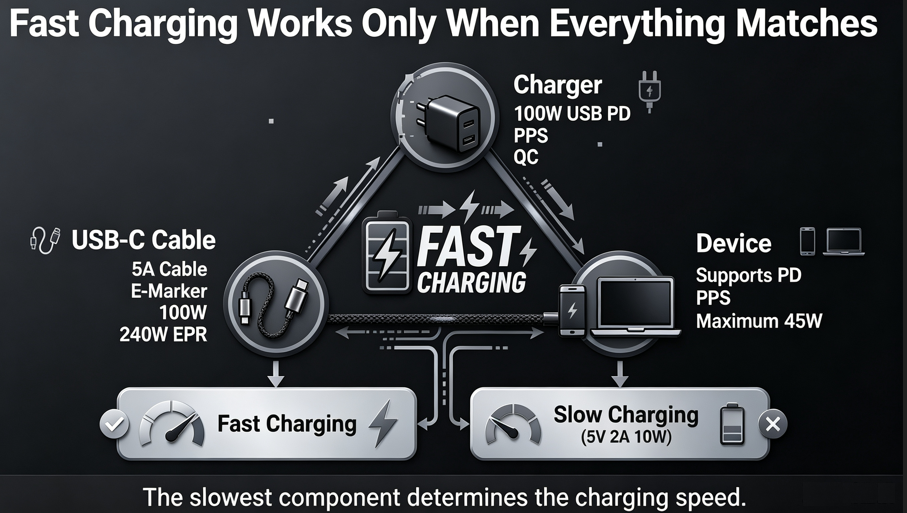
Not necessarily. Charging speed depends on the combination of charger, cable, and device. The device itself has a maximum接受的 power. Beyond that, a bigger charger won’t help—if your phone only supports 27W fast charging, a 100W charger will still only deliver 27W.
Can a 240W charger always deliver 240W?
No. 240W is the charger’s maximum capability. Actual output depends on what the device needs and whether the cable supports it. A 240W charger charging a phone might only deliver 20-30W.
Does USB-C always mean fast charging?
No. USB-C is just a connector shape—it doesn’t guarantee any fast charging protocol support. Some USB-C ports only support standard 5V charging.
Do all USB-C cables support 100W?
No. Only 5A cables with E-Marker chips support 100W. Regular USB-C cables might only support 3A (60W) or even less.
Does a 5A cable always support 240W?
Not necessarily. 5A is just the current rating. 240W also requires 28V+ voltage and EPR certification. A 5A cable without EPR support maxes out at 100W (20V × 5A).
Does fast charging seriously damage batteries?
No. Modern phones have BMS (Battery Management Systems) that precisely control charging to keep batteries within safe limits. Fast charging does generate more heat, but as long as you use genuine chargers and cables, the impact on battery life is minimal. Battery capacity naturally degrades after 2-3 years of normal use—that’s normal, not fast charging’s “fault.”
Are different brand fast charging protocols compatible?
Mostly no. Proprietary protocols (like VOOC, SCP) usually only work with same-brand devices. The good news: almost all devices support USB PD, the universal protocol—so a PD charger will fast-charge most devices (though maybe not at the proprietary protocol’s maximum speed).
Are third-party chargers safe?
Brand-name third-party chargers are safe. As long as they have safety certifications like CE, FCC, or UL, quality is assured. But never buy no-name chargers from street vendors—they lack over-voltage and over-current protection, which can damage devices or even cause fires.
Chapter 11: Buying Guide
How to Choose a Charger
For Phones: First, check what fast charging protocol your phone supports. For iPhones, choose USB PD. For Android, besides PD, try to get one that also supports your phone brand’s proprietary protocol. For wattage, phones range from 27W to 120W—buy slightly above your phone’s supported wattage, no need to max out.
For Tablets: iPads typically support 20W-30W PD fast charging; Android tablets are similar. A 30W-45W PD charger is sufficient.
For Laptops: Laptops need more power, typically 45W-140W. Check your laptop’s original charger wattage and buy a PD charger with the same or higher rating. Note: not all USB-C ports support laptop charging—check that it supports PD output.
For Gaming Handhelds: Devices like Steam Deck, ROG Ally typically support 45W-65W PD fast charging—a 65W PD charger works.
For Power Banks: Charging a power bank (input) and discharging it (output) are different. When buying, check what protocol and wattage the input supports—PD input charges power banks fastest.
How to Choose a Cable
By Wattage: Under 60W → 3A cable; 60W-100W → 5A cable (with E-Marker); over 100W → EPR-certified cable.
By Protocol: Most fast charging works with USB-C to USB-C. Apple’s older devices (Lightning) need MFi-certified USB-C to Lightning cables.
By Length: Longer cables have more resistance and more power loss. Under 1 meter is best; over 1.5 meters, choose thicker cables.
By Certification: Prioritize USB-IF certified cables, and MFi for Apple devices.
How to Check What Protocols Your Device Supports
- Check the device manual or official specs online
- Use a USB power meter (like POWER-Z)
- Search online for “device model + fast charging protocol”
How to Match Charger, Cable, and Device
The simplest rule:
- Charger wattage ≥ device’s required wattage
- Cable capability ≥ charger’s output (e.g., 100W charger needs 5A cable)
- Charger supports the protocol your device needs (prioritize PD support)
Chapter 12: Glossary Index
| Term | Full Name | Plain Explanation |
|---|---|---|
| AFC | Adaptive Fast Charging | Samsung’s adaptive fast charging |
| AVS | Adjustable Voltage Supply | PD 3.1’s precision voltage adjustment |
| BMS | Battery Management System | The battery’s “manager” |
| Cable | – | Charging/data cable |
| Charge Pump | – | High-efficiency voltage converter |
| Charging Protocol | – | The “language” chargers and devices use |
| Constant Current | – | Fast charging phase with constant high current |
| Constant Voltage | – | Final charging phase with tapering current |
| Current | – | Electrical “flow rate” |
| E-Marker | – | The cable’s ID chip |
| EPR | Extended Power Range | PD 3.1’s 240W mode |
| Fast Charging | – | Charging faster than standard USB |
| FCP | Fast Charge Protocol | Huawei’s early fast charging |
| GaN | Gallium Nitride | The material making chargers smaller and cooler |
| HyperCharge | – | Xiaomi’s fast charging |
| MFi | Made for iPhone/iPod/iPad | Apple配件 certification |
| OCP | Over Current Protection | Prevents excessive current |
| OPP | Over Power Protection | Prevents excessive power |
| OTP | Over Temperature Protection | Prevents overheating |
| OVP | Over Voltage Protection | Prevents excessive voltage |
| PD | Power Delivery | The universal fast charging standard |
| PPS | Programmable Power Supply | PD’s precision voltage adjustment |
| Power | – | Overall charging speed |
| QC | Quick Charge | Qualcomm’s fast charging |
| Qi | – | Wireless charging standard |
| SCP | SuperCharge Protocol | Huawei’s super-fast charging |
| SOC | State of Charge | Battery percentage |
| SPR | Standard Power Range | PD’s up-to-100W mode |
| SuperCharge | – | Huawei/HONOR super-fast charging |
| SuperVOOC | – | OPPO’s super flash charging |
| Thermal Management | – | Temperature control |
| Trickle Charging | – | Slow charging when battery is extremely low |
| USB BC | USB Battery Charging | Early USB charging standard |
| USB PD | USB Power Delivery | The universal fast charging standard |
| USB Type-C | – | The reversible universal connector |
| Voltage | – | Electrical “pressure” |
| VOOC | – | OPPO’s flash charging |
| Watt | – | Unit of power |
| Warp Charge | – | OnePlus’s fast charging |