
Introduction: Why Everyday Users Need to Understand Fast Charging Compatibility
Most people have run into these frustrating charging issues: you buy an expensive high-power charger, plug it in, and only get slow charging speeds. You upgrade to a new phone, but your old charger won’t trigger fast charging at all. You pick a charging cable just by its port shape, only to find it never reaches the advertised speed. In the end, you waste money on accessories that don’t deliver the experience you expected.
The core misunderstanding behind these problems is the common belief that “higher wattage = faster charging”. In reality, whether fast charging works at full speed depends not on the wattage number, but on whether the fast charging “protocol” of the charger matches your device. Without a matching protocol, even a 200W charger may only deliver basic 5V slow charging.
This article explains fast charging fundamentals in plain language, and includes a complete protocol compatibility reference. It will help you understand how fast charging standards work together, so you can shop for chargers and cables without making costly mistakes.
Fast Charging Basics: 3 Key Concepts Everyone Should Know
Before diving into the compatibility chart, grasp these 3 basic concepts to understand the core logic of fast charging compatibility.
1. What Is a Fast Charging Protocol?
Think of a fast charging protocol as a shared language between your charger and your device.
Before charging starts, the charger and phone perform a “handshake”: the phone tells the charger what voltage and current it can accept, and the charger adjusts its output to match. Only when both sides “speak the same language” (support the same protocol) will fast charging activate. If they don’t share a protocol, charging falls back to the slowest basic mode.
The main purpose of charging protocols is to ensure safety, match the correct power level, and prevent overload damage to your phone’s battery.
2. Core Charging Parameters: Voltage, Current, and Power
There is a simple formula for calculating charging power:
Power (W) = Voltage (V) × Current (A)
To achieve fast charging, manufacturers increase total charging power using two main technical approaches:
- High voltage, low current: Raises the charging voltage while keeping current relatively low. This approach works with standard cables but produces slightly more heat during charging.
- Low voltage, high current: Keeps voltage low while greatly increasing current. This runs cooler and more stably, but requires thicker, higher-quality charging cables.
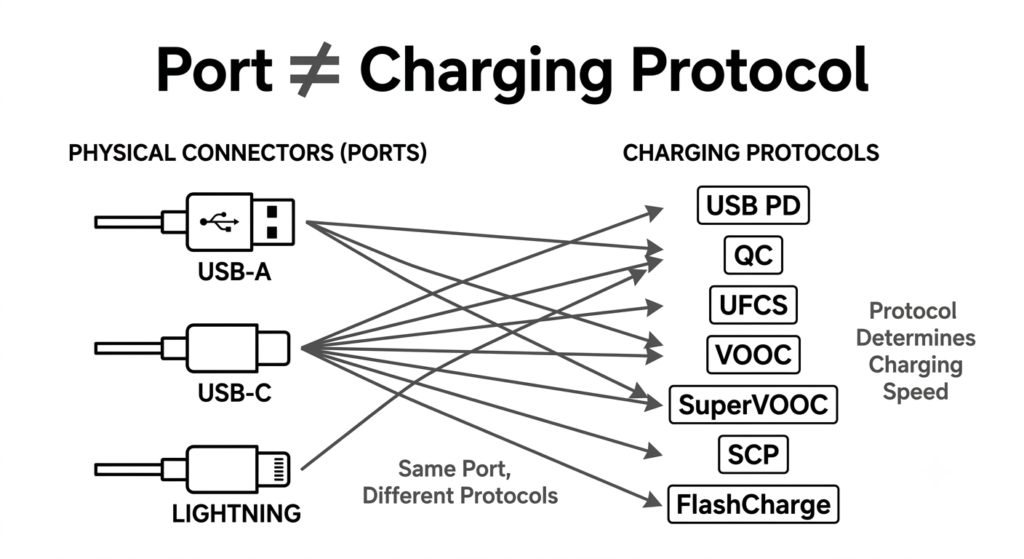
3. Port ≠ Protocol: The Difference Between Physical Ports and Charging Standards
Many people assume “a Type-C port means fast charging support” — this is one of the most common misconceptions.
A port is just the physical shape of the charging socket. A protocol is the set of charging rules that runs behind the port. Today there are three common charging ports: USB-A (the older rectangular port), Type-C (the oval, reversible port), and Lightning (Apple’s proprietary port).
The same port shape can support multiple protocols, or only basic slow charging. For example, three Type-C ports might look identical, but one could only support 5V slow charging, another could support PD fast charging, and a third could support a brand’s proprietary super fast charging. Port shape does not determine fast charging capability. Supported protocols are what matter.
Complete Guide to Mainstream Fast Charging Protocols: Public vs. Proprietary
Fast charging protocols fall into two main categories: public protocols that work across all brands, and proprietary protocols exclusive to specific manufacturers. Think of them as universal languages vs. regional dialects.
Public Protocols: The “Universal Language” of Fast Charging
Public protocols are industry-wide standards. Any charger and device that support the same public protocol will work for fast charging across brands — they offer the broadest compatibility.
USB PD Protocol
- Developed by: USB-IF (Universal Serial Bus Implementers Forum)
- Common versions: PD 2.0, PD 3.0, PD 3.1
- Power range: 18W to 240W
- Supported devices: Smartphones, tablets, laptops, Nintendo Switch, and almost all modern digital devices.
USB PD is the most widely compatible fast charging standard in the world. It is the baseline fast charging option for almost all devices with a Type-C port.
QC (Quick Charge) Protocol
- Developed by: Qualcomm
- Common versions: QC 3.0, QC 4+, QC 5
- Power range: 18W to over 100W
- Relationship to PD: Starting with QC 4+, Quick Charge is fully compatible with USB PD.
QC was very widely adopted in early Android phones. Today most new phones with Qualcomm chips support both PD and QC public protocols.
Brand Proprietary Protocols: Each Brand’s “Dialect”
Proprietary protocols are fast charging standards developed in-house by phone brands. They usually only work with that brand’s own devices and accessories. To reach your phone’s maximum charging speed, you must use a charger and cable that support the corresponding proprietary protocol. Third-party universal chargers will usually only trigger basic public-protocol fast charging.
| Brand | Proprietary Protocol | Typical Full-Speed Power Levels |
|---|---|---|
| Huawei / Honor | FCP / SCP SuperCharge | 22.5W, 40W, 66W, 88W, 100W |
| Xiaomi / Redmi | Surge Fast Charging (formerly MDY) | 33W, 67W, 120W, 210W |
| OPPO / OnePlus / realme | VOOC / SuperVOOC Flash Charge | 30W, 65W, 80W, 100W, 240W |
| vivo / iQOO | FlashCharge Dual-Cell Fast Charging | 44W, 80W, 120W, 200W |
| Apple | No standalone proprietary protocol | Customized based on PD: 20W–27W for iPhone, 20W–35W for iPad |
| Samsung | AFC Fast Charging | 25W, 45W; compatible with PD/QC |
Unified Chinese Standard: UFCS Universal Fast Charging
To solve the problem of incompatible proprietary protocols and slow cross-brand charging, China has developed the UFCS (Universal Fast Charging Specification) unified standard.
- Purpose: Break down barriers between proprietary protocols and enable cross-brand fast charging across Chinese smartphone brands.
- Participating brands: Huawei, Xiaomi, OPPO, vivo, and other major domestic manufacturers have all joined.
- Current status: Today it mainly supports mid-to-low power levels, with higher power capabilities in development. In the future, it will enable truly universal cross-brand fast charging.
The Core Reference: Fast Charging Protocol Compatibility Chart
This is the central section of the article. First, learn the 4 ground rules of compatibility, then use the reference charts to quickly tell if any charger will work with any phone.
4 Core Rules of Charging Compatibility
Memorize these 4 rules, and you can judge most compatibility cases without a chart:
- Public protocols work everywhere: PD is the universal baseline. All compliant charging devices support basic 5V charging — you will never have a charger that simply won’t charge a phone at all.
- Proprietary protocols for full speed: To reach your phone’s maximum fast charging speed, you must match the brand’s own proprietary protocol.
- Downward compatibility: Within the same protocol, a higher-wattage charger works with a lower-power device. It automatically adjusts to the highest level the device can accept, and will not cause damage.
- Fallback safety: If the charger and phone don’t share a fast protocol, charging automatically drops to basic 5V mode. It will still charge, and will not damage the device.
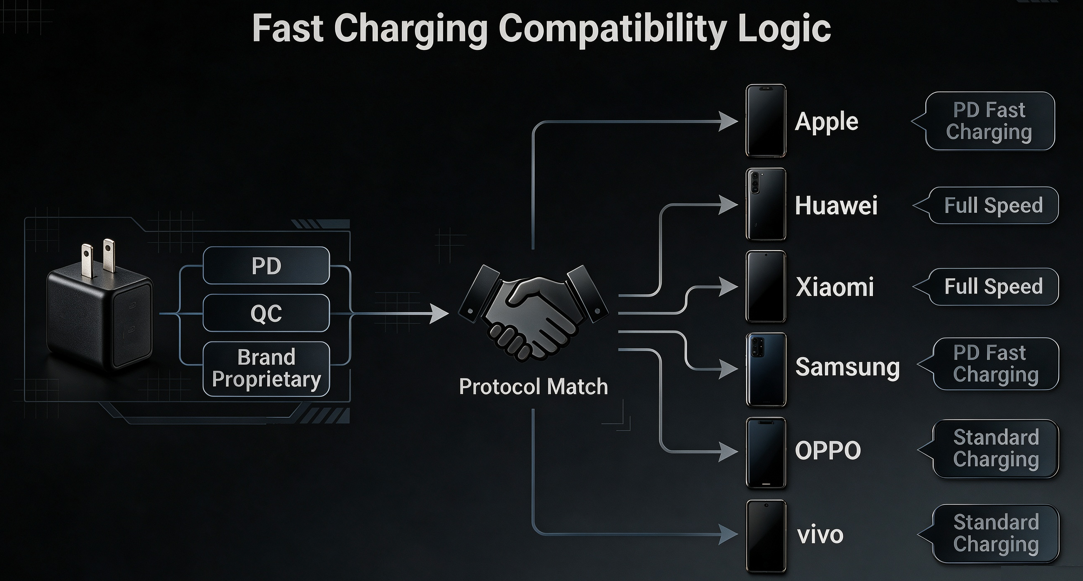
Mainstream Phone Brand Protocol Support Chart
| Phone Brand | Supported Public Protocols | Proprietary Protocol | Typical Full-Speed Power |
|---|---|---|---|
| Apple iPhone / iPad | USB PD 3.0 | None (PD-based custom) | 20W – 27W |
| Huawei / Honor | USB PD, FCP | SCP SuperCharge | 40W – 100W |
| Xiaomi / Redmi | USB PD, QC | Surge Fast Charging | 67W – 210W |
| OPPO / OnePlus / realme | USB PD | SuperVOOC Flash Charge | 65W – 240W |
| vivo / iQOO | USB PD | FlashCharge | 80W – 200W |
| Samsung | USB PD, QC | AFC Fast Charging | 25W – 45W |
Common Charger × Phone Compatibility Quick Reference
1. PD Chargers with Different Phone Brands
PD chargers offer the broadest compatibility. Here is how they perform with different brands:
- Apple iPhones/iPads: Triggers PD fast charging normally, reaching the device’s maximum PD speed (20W–27W).
- Huawei / Honor: Triggers basic PD fast charging (usually around 18W). Cannot activate SCP SuperCharge.
- Xiaomi / Redmi: Triggers PD fast charging (usually around 27W). Cannot reach full Surge Fast Charging speed.
- OPPO / vivo series: Triggers basic PD fast charging (around 18W). Cannot reach proprietary protocol full speed.
- Samsung phones: Triggers PD fast charging normally, reaching the phone’s full rated speed.
2. QC Chargers with Different Phone Brands
- Xiaomi / Redmi, Samsung: Triggers QC fast charging normally, reaching corresponding power levels.
- Apple, Huawei, OPPO, vivo: Most will only run basic charging or low-power PD fast charging. They cannot reach full QC speeds.
3. Brand Original Chargers with Other Brand Phones
- Huawei original charger with other brands: Only supports basic PD/QC public fast charging. Other brands cannot trigger SCP SuperCharge.
- Xiaomi original charger with other brands: Supports basic PD/QC fast charging. Other brands cannot reach full Surge Fast Charging speed.
- Bottom line: When you use a brand’s original charger on a different brand phone, you will only get public-protocol fast charging at most — never the full original speed.
Compatibility Limits by Port Type
- USB-A chargers: Most only support QC and their own brand’s proprietary protocol. Almost none support PD fast charging, so they have limited cross-brand compatibility.
- Type-C chargers: Almost all support USB PD public protocol. Many also add QC and proprietary protocol support. This is the most universally compatible port type today.
- Lightning port: Used only by Apple devices. It only supports PD fast charging and basic 5V charging — it does not work with other proprietary fast charging protocols.
8 Common Compatibility Mistakes Almost Everyone Makes
Myth 1: A higher-wattage charger always charges faster
Fact: Charging speed is limited by your phone’s supported protocols and maximum power. If the protocol doesn’t match, even a 120W charger will only deliver slow 5V speeds. Even if the protocol matches, if your phone maxes out at 67W, a 120W charger will still only charge at 67W — no faster.
Myth 2: Any Type-C port supports fast charging
Fact: The port is just a physical shape. Whether fast charging works, and which kind, depends on the protocol chip inside. Many cheap Type-C cables and chargers have the Type-C shape but only support 5V slow charging internally — they will never trigger fast charging.
Myth 3: Third-party fast chargers will damage your battery
Fact: Any compliant charger that follows official protocols will perform a safety handshake with your phone and automatically match the correct voltage and current. It will not damage your battery. The real risk comes from cheap, no-brand chargers with no proper protocol support — their unstable voltage and current can cause harm.
Myth 4: Wireless and wired fast charging use the same protocols
Fact: Wireless charging has its own independent standards like Qi. It is not identical to wired fast charging protocols. A phone that supports wired proprietary super fast charging may not support the same power level wirelessly. Wireless and wired charger protocols are not interchangeable.
Myth 5: Any same-brand charger will charge at full speed
Fact: Older model chargers may not support the higher-power proprietary protocols of newer phones. For example, an older Huawei 22.5W charger will only charge a new 100W Huawei phone at 22.5W maximum — not full speed. Even within the same brand, you need matching protocol versions and power levels.
Myth 6: PD protocol only works for laptop charging
Fact: PD is a universal fast charging standard for all types of devices: phones, tablets, earbuds, game consoles, and laptops all use it. Almost all new smartphones today support PD fast charging, making PD chargers the best choice for people with multiple devices.
Myth 7: Any charging cable works for fast charging
Fact: High-power fast charging has strict requirements for cables. Cables are rated for different maximum current levels: a 3A cable supports up to ~60W PD fast charging. 5A and 6A cables are required for higher power levels. For PD charging over 100W, cables must include an E-Marker smart identification chip — otherwise high-power mode will not activate.
Myth 8: UFCS support means all brands charge at full speed together
Fact: Right now, UFCS mainly provides basic cross-brand compatibility. It solves the problem of “can it fast charge across brands?” but does not yet support each brand’s maximum proprietary power level. To reach your phone’s factory maximum speed, you still need accessories for that brand’s proprietary protocol.
Practical Guide: How to Shop for Fast Charging Accessories
3 Steps to Find What Fast Charging Your Device Supports
Before you buy anything, confirm what protocols your phone supports to avoid mistakes:
- Check the official website / manual: Look for the “battery and charging” section of your phone’s specs. It will clearly list supported protocols and maximum power.
- Check your original charger: The parameter label on your original charger lists supported protocols and voltage/current levels. This matches what your phone supports.
- Quick rule of thumb: If you only charge one flagship phone, prioritize official or certified same-brand accessories for full speed. If you have multiple devices from different brands, prioritize a universal PD charger for the best compatibility.
Key Tips for Buying Chargers
- Single-device users: If you only charge one phone, pick a charger that supports your brand’s proprietary protocol. It will deliver the fastest, full-speed charging.
- Multi-device users: If you charge a phone, tablet, and laptop, choose a GaN (Gallium Nitride) PD charger. It’s compact, powerful, and works with almost all digital devices — one charger for everything.
- Multi-port charger note: When buying a multi-port charger, always check both “total power” and “maximum power per port”. Many 65W or 100W chargers only reach that number as total power. When you use multiple ports at once, per-port power drops and you won’t get full speed.
Key Tips for Buying Charging Cables
- Match the ports first: Confirm the connector types on both ends (Type-C to Type-C, Type-C to Lightning, etc.). If the ports don’t fit, nothing else matters.
- Check the current rating: A 3A cable works for regular fast charging. For 65W+ high power, choose a 5A cable. For proprietary super fast charging (like 120W or 200W), buy the brand’s dedicated 6A/10A cable.
- E-Marker chip for high-power PD: For 100W+ PD fast charging, you must buy a cable with an E-Marker chip. Without it, the charger will not deliver high power.
Special Scenario Buying Tips
- Car chargers: Prioritize car chargers that support PD protocol — they work with both Apple and Android. If you want full speed, pick a car charger that supports your phone’s proprietary protocol.
- Power banks: Choose a power bank with PD bidirectional fast charging. It will charge your phone fast and recharge itself fast too. If you need proprietary protocol speeds, pick a power bank designed for your brand.
- Wireless chargers: Choose a Qi-standard wireless charger for the broadest compatibility. For full wireless speed, you will need your brand’s official wireless charger with its proprietary wireless protocol.
Conclusion
Key Takeaways
- USB PD is the universal foundation of all fast charging — it works across every brand. Proprietary protocols determine whether you reach your phone’s maximum speed.
- A port is not a protocol. Type-C does not guarantee fast charging. Matching protocols are what matter.
- Compliant fast charging will not damage your battery. Mismatched protocols just charge slower — they won’t break your device.
Industry Trends
The fast charging industry is moving toward standardization. On one hand, the PD 3.1 standard raises the power ceiling to 240W, covering more high-power devices. On the other hand, the domestic UFCS universal fast charging standard is growing in adoption, making cross-brand charging on Chinese phones more and more convenient.
Final Advice for Everyday Users
You don’t need to chase the highest wattage when buying charging accessories. Choose what fits your needs: single-device users who want speed should pick same-brand proprietary accessories. Multi-device users who want versatility should pick a PD GaN charger. Pair them with properly rated, compliant cables, and you’ll get great fast charging performance without overspending.
FAQ
How do I check what fast charging protocols my phone supports?
The most accurate way is to check the official product spec page on the brand’s website. The “Battery & Charging” section will clearly list supported protocols and maximum power. You can also check the parameter label on your original phone charger — the protocols and power levels printed there match what your phone supports.
Will using an iPad charger damage my iPhone’s battery?
No. iPad chargers and iPhones both support USB PD protocol. During charging, they automatically handshake and match the power level the iPhone can accept — there is no overload risk. Any compliant PD charger is safe to use with Apple devices and will not damage the battery.
Why does my 65W charger charge my phone so slowly?
Most likely, the protocols don’t match. 65W is just the charger’s maximum power. If it only supports PD protocol, but your phone needs a proprietary protocol to reach full speed, then charging will only trigger basic PD fast charging (usually 18W–27W) — never 65W. That’s why it feels slow.
How do I choose a car charger that actually delivers fast charging?
First, confirm what fast charging protocol your phone supports, then pick a car charger with that same protocol. If you use multiple phone brands, a PD-supported car charger will guarantee basic fast charging for all of them. If you want full speed for one specific brand, choose a dedicated car charger that supports its proprietary protocol.
Does long-term fast charging shorten battery life?
Proper, compliant fast charging has very little impact on battery lifespan. Modern phones have sophisticated battery management systems that intelligently adjust current and control temperature during fast charging. Normal fast charging causes barely more battery wear than slow charging. The things that really damage batteries are charging in high heat, using cheap low-quality chargers, and fully draining or overcharging the battery.